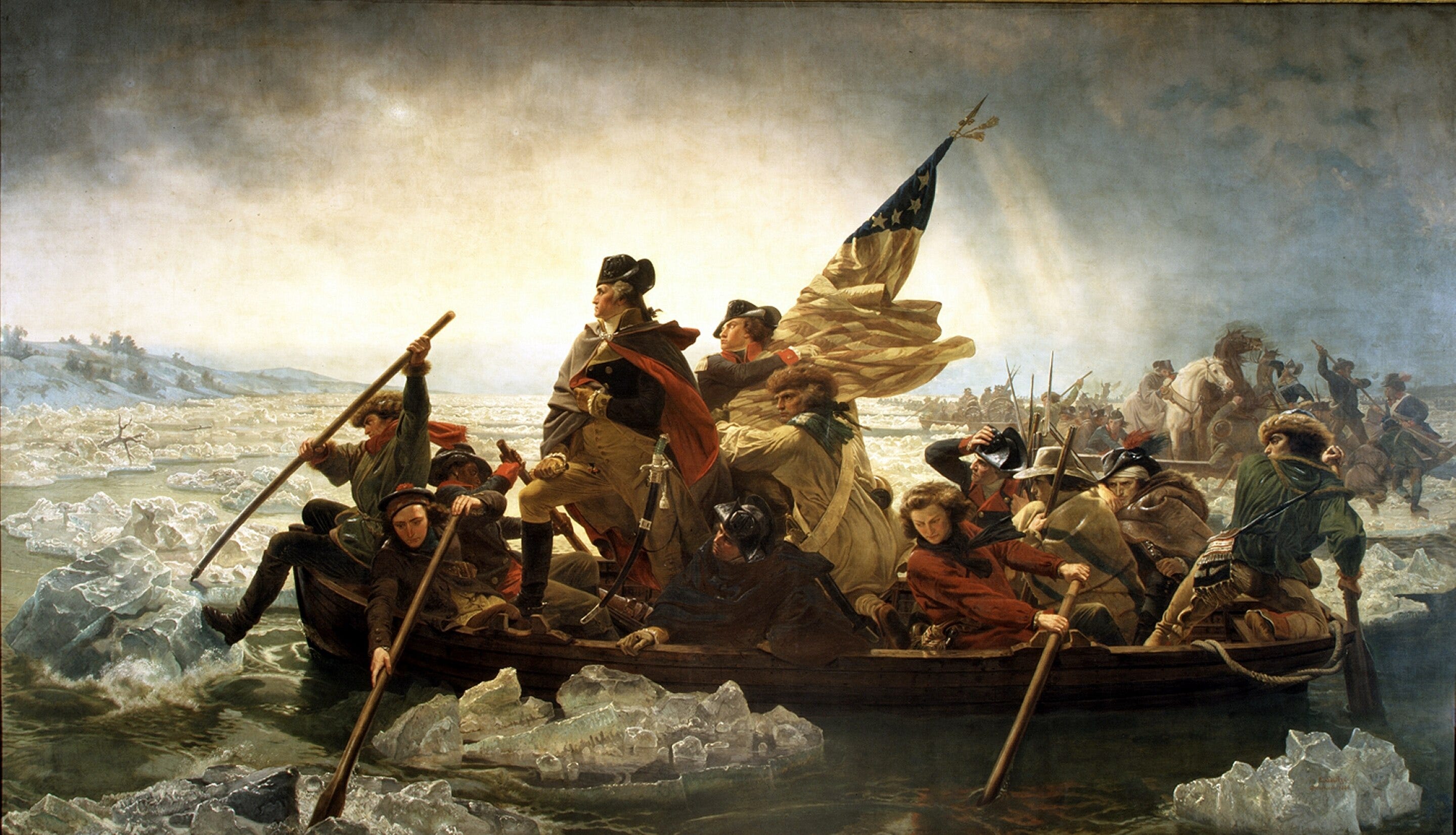
Emanuel Leutze's Washington Crossing the Delaware shows George Washington standing upright in a small boat as troops row through ice choked water on Christmas night, 1776, at the start of the American War of Independence. Leutze painted it in Germany in 1851, seventy five years later, and got the details wrong on purpose.
The real crossing happened in freezing sleet, in the dark, with soldiers who had not eaten properly in days. The painting looks nothing like that.
Date: Painted in 1851, depicting the night of December 25 to 26, 1776
Medium: Oil on canvas, about 378 by 647 centimeters
Location: Metropolitan Museum of Art, New York
More Paintings Built on a Legend
Leutze was not the only artist willing to bend the facts for a stronger picture. These three did it too.
A Desperate Gamble on Christmas Night
By late December 1776, Washington's army was near collapse. Most enlistments expired on December 31, morale had cratered after repeated defeats, and a surprise strike on the Hessian garrison at Trenton was the only real option left. The crossing had to work, or the war might end that winter.
Washington planned a surprise attack on the Hessian garrison at Trenton, New Jersey, crossing the ice clogged Delaware River at night in flat bottomed Durham boats.
The following Battle of Trenton was a decisive American win at a moment the war badly needed one.
Painted in Germany, Not America
Leutze painted the scene in Düsseldorf, not America, using American expatriates and art students as his models. He meant it partly as encouragement for European reformers after the failed uprisings of 1848, holding up the American War of Independence as proof that a hard fight could still be won.
An earlier version of the painting was damaged by a studio fire in 1850 and later destroyed in an Allied bombing raid on Bremen in 1942. The famous version that survives today is technically his second attempt, finished in 1851 and shipped to New York.
What strikes me is that the surviving version is a redo, not the original. The picture everyone knows almost did not survive its own studio.
The Historical Errors, Mostly on Purpose
The flag shown is the stars and stripes design, which did not exist in December 1776. Washington stands upright in an overloaded boat crossing ice choked water at night, a pose no general would actually risk. Historians read it as theater, not documentation of what happened that night.
The flag was not adopted until June 1777, six months after the actual crossing.
Most historians read the standing pose as a deliberate, almost statue like choice rather than an attempt at accuracy, matched by boats that look more European than the actual American Durham boats used that night.
To me the standing pose is the giveaway. No commander crosses a frozen river standing up. Leutze wanted a statue, not a memory.
Why It Still Works
Despite every inaccuracy, the painting remains the single most recognized image of the American War of Independence, endlessly reproduced and parodied. Leutze built it as pure theater, using a strong diagonal composition, dramatic light breaking through cloud, and a pose built like a monument rather than a man in a rowboat.
It was never trying to be a photograph. It was trying to be a monument, and monuments do not need to be accurate to be remembered.
A Third Canvas Nobody Talks About
Most accounts mention two versions of the painting: the one destroyed in Germany and the one at the Met. A third, smaller Leutze replica also exists. It hung in the White House from 1979 to 2014, then sold at Christie's in 2022 for 45 million dollars.
That smaller canvas, about 40 by 68 inches, stayed in private hands for over a century before it ever went on public view.
It now hangs at the Minnesota Marine Art Museum in Winona, Minnesota, after the 2022 sale closed at more than double its high estimate.
I think that quiet third canvas says more about the painting's staying power than the famous one does. People kept paying for the same image for two centuries.
Not the First Depiction of That Night
Thomas Sully had already painted the same crossing in 1819, more than three decades before Leutze's version. His calmer, more anatomically accurate scene hangs today at the Museum of Fine Arts, Boston. Sully's picture never became a household image, largely a matter of scale and staging rather than accuracy.
Sully's canvas is barely six feet wide. Leutze's is over twelve feet across, built to dominate a gallery wall, not just document a night.
An Immigrant Who Painted Two Countries
Leutze was born in Germany in 1816 and emigrated to Philadelphia as a child. He crossed back to Düsseldorf to study painting, which is why an artist raised American ended up making the country's most famous War of Independence image from a German studio.
He became a United States citizen and eventually returned for good, spending his final years painting in Washington, D.C., a short walk from the Capitol dome where his largest American mural now hangs.
Leutze's Other Famous Wall
Leutze went on to paint an even larger work a decade later, Westward the Course of Empire Takes Its Way, a mural for the United States Capitol completed in 1861, the year the Civil War began. Both paintings share the same instinct: oversized American history staged as inspiration rather than as a record of what happened.
The Password Was Victory or Death
Washington gave his men a countersign for that Christmas night: Victory or Death. Compared to that whispered password in the freezing dark, Leutze's sunlit, flag draped boat looks like a different event entirely, staged decades later by a painter who never crossed that river himself.
That whispered password does not appear anywhere in Leutze's sunlit, flag draped composition.
More Stories Worth Reading
A few more paintings that reward a second, closer look.
Frequently Asked Questions
Did Washington really stand up in the boat?
Almost certainly not. Standing in a small, overloaded boat crossing an ice choked river at night would have been extremely dangerous. Most historians read the pose as a symbolic, almost statue like choice rather than an attempt at accuracy.
Is the flag in the painting historically accurate?
No. The stars and stripes design shown was not adopted until June 1777, about six months after the actual crossing took place on Christmas night in 1776.
Why did a German artist paint an American War of Independence scene?
Emanuel Leutze lived and worked in Düsseldorf when he painted it in 1851. He partly intended the image as encouragement for European reformers after the failed uprisings of 1848, using the American War of Independence as an example.
What happened to the first version of the painting?
An early version was damaged by fire in Leutze's studio and later destroyed during an Allied bombing raid on Bremen, Germany, in 1942. The famous version that survives today is technically the second one, finished in 1851.
Where can I see the painting today?
In the Metropolitan Museum of Art in New York, which has owned it since 1897.