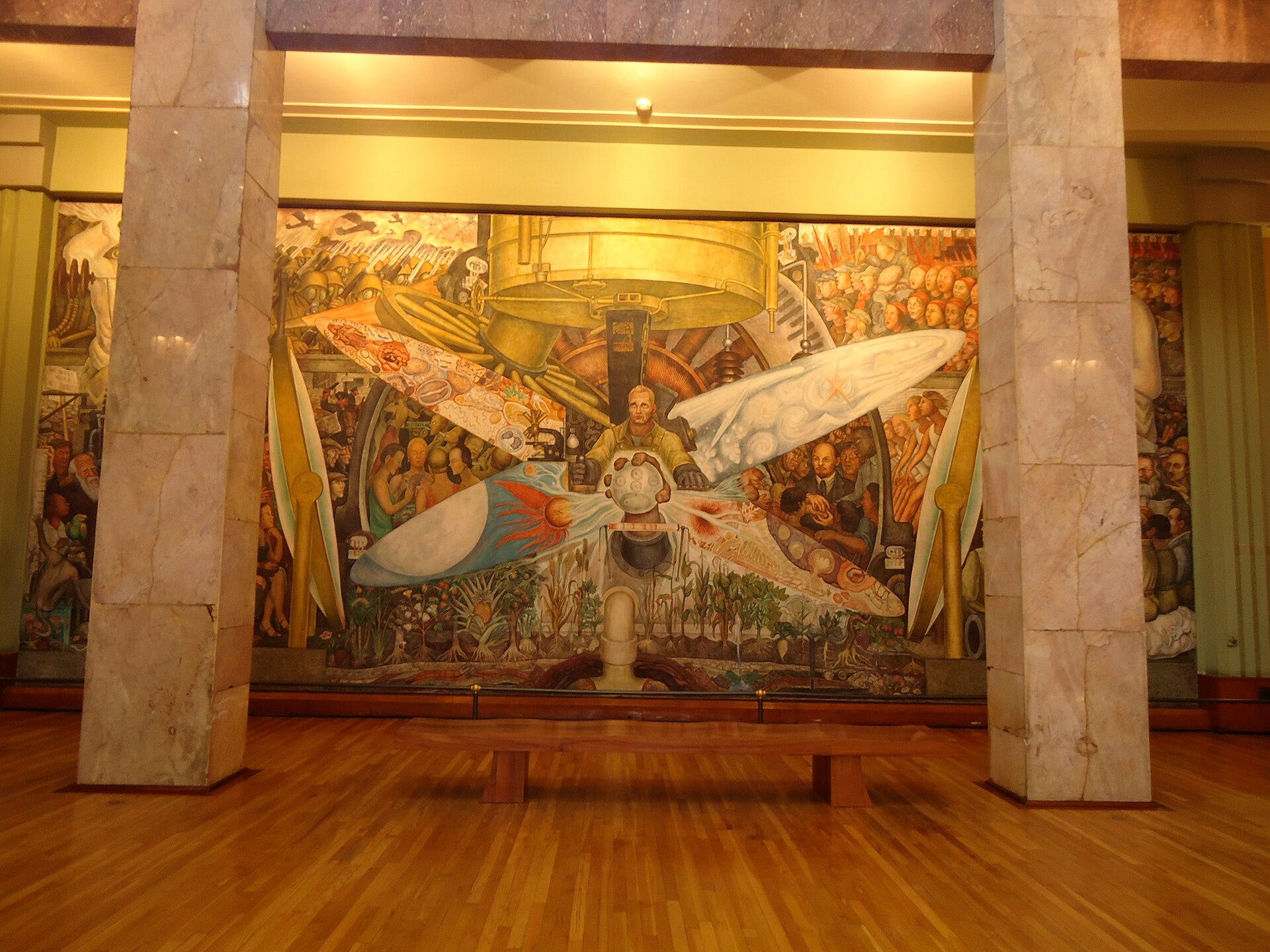
Diego Rivera's mural Man at the Crossroads was destroyed in February 1934, less than a year after he started it, because he refused to remove a portrait of Vladimir Lenin that John D. Rockefeller Jr. had ordered him to paint out.
Rivera had already been paid in full, more than 21,000 dollars. He lost the mural anyway. Workmen plastered it over, then chiseled it off the wall in a single night, and the only record we have of the original is a set of black and white photographs a young assistant smuggled out under her coat.
Artist: Diego Rivera, 1886 to 1957
Original mural: Man at the Crossroads, 1933, Rockefeller Center, New York
Destroyed: February 1934, less than a year after it was started
Where Power And Paint Collided Elsewhere
Rivera was not the only painter to clash with the people paying for the work. A few more stories from the archive go looking at what happens when politics ends up on the wall.
A Radical Hired to Decorate a Temple of Capitalism
I keep coming back to this story because it turns on a question bigger than one painting: who gets to decide what a wall says once someone else has paid for the wall. Rivera knew the answer before he picked up the brush, and he painted the face anyway.
In 1932, Nelson Rockefeller was building the largest private real estate project in the world, Rockefeller Center in midtown Manhattan. He wanted a mural for the lobby of the RCA Building, and he wanted a name that would make people talk.
He had seen Rivera's Detroit Industry murals and admired them. So the family that had built its fortune on Standard Oil hired the most famous Communist painter alive to decorate the entrance of their skyscraper.
The theme Rivera was given sounded harmless on paper. A man at a crossroads, looking with hope toward a new and better future, caught between two paths. Nobody in the room seemed to ask which two paths he had in mind.
He answered with a fresco split down the middle. On one side, machines, workers, and science serving humanity. On the other, soldiers, gas masks, and the wealthy drinking in a nightclub while the world burned around them. He was never subtle about which side he preferred.
The Face Nobody Asked For
On April 24, 1933, the New York World Telegram ran a story with the headline Rivera Paints Scenes of Communist Activity and Rockefeller Foots the Bill. The piece described the mural as anti capitalist propaganda paid for by one of the richest families in America.
Rivera's response to the bad press was to make the mural more pointed, not less. A few days later he added a portrait of Lenin, unmistakable, front and center, leading a crowd of workers under a red banner.
Nelson Rockefeller wrote to Rivera and asked him, politely at first, to swap the face for an anonymous figure. Rivera refused. He offered a strange compromise instead, adding a portrait of Abraham Lincoln to balance the composition. It satisfied nobody.
Stopped Mid Brushstroke
On May 9, 1933, guards arrived at the lobby with a check for the full commission, more than 21,000 dollars, and asked Rivera to stop painting immediately. He was escorted out with his brushes still wet.
The unfinished fresco was covered first with a canvas, then with builder's paper, as if the building itself were embarrassed by what was underneath. Rivera never touched it again.
Outside, the story had already become a fight about free expression against private property. Artists picketed Rockefeller Center for weeks, and some called for a boycott of the entire complex before it had even opened.
A Photographer With a Camera Under Her Coat
Rivera suspected from the start that the mural would not survive. So he arranged for a young assistant, the photographer and muralist Lucienne Bloch, to document it before anyone could stop her.
Cameras were banned from the site. Bloch hid a small camera under her coat and returned several times to shoot the fresco panel by panel in black and white, working fast and quietly.
Those photographs are the only visual record of Man at the Crossroads that exists today. Every reproduction, every book illustration, every image online traces back to what Bloch managed to smuggle out.
The Night of the Hammers
The building sat half finished and covered for months while lawyers argued. Then, on a Saturday night in February 1934, with almost no warning, Rockefeller Center sent in a crew of workmen.
They worked through the night with hammers and chisels, breaking the wet fresco off the wall in chunks small enough to haul away in wheelbarrows. By morning there was nothing left but bare plaster.
The timing was not an accident. A weekend demolition, done fast, left almost no window for protesters or reporters to step in before the job was finished.
Painted Twice, Defiantly
Rivera did not let the story end there. Using Bloch's photographs as his only reference, he repainted the entire composition from memory the following year, this time on a wall at the Palacio de Bellas Artes in Mexico City.
He renamed it Man, Controller of the Universe, and he used the second chance to settle scores. He added Leon Trotsky standing beside Marx and Engels, and in a nightclub scene he painted John D. Rockefeller Jr. himself holding a cocktail under a cloud of syphilis bacteria.
That mural still hangs in the Palacio de Bellas Artes today, free for anyone to walk in and see. The New York lobby moved on to other art. Jose Maria Sert, then Frank Brangwyn, eventually painted the walls the Rockefellers had actually wanted.
What It Still Says About Who Owns a Wall
This story usually gets told as a fight between a rich family and a stubborn painter. Underneath that, it is a fight about what a commission actually buys.
Rockefeller believed he had purchased a decoration. Rivera believed he had been asked to make a painting, and a painting says what the painter means or it says nothing. Both of them were partly right, which is why nobody walked away from this clean.
It also says something that Rivera won in the long run. The destroyed mural is more famous today than almost anything that replaced it.
More Secrets to Unlock
A few more stories, if this one pulled you in.
FAQ
What was Man at the Crossroads about?
It showed a worker standing between two paths, one leading toward industry, science and organized labor, the other toward war, wealth and decadence. Rivera used it to argue that socialism, not capitalism, was the future worth choosing.
Why did Rockefeller destroy the mural?
Rivera refused to remove a portrait of Lenin after Nelson Rockefeller asked him to replace it with an anonymous face. Rather than negotiate further, the family paid Rivera in full, covered the fresco, and had it chiseled off the wall in 1934.
Was Rivera paid for the destroyed mural?
Yes. He received the full commission of more than 21,000 dollars in May 1933, months before the mural was actually destroyed.
Do any photographs of the original mural survive?
Yes. The photographer Lucienne Bloch smuggled a camera into the site and secretly photographed the fresco in black and white. Those images are the only visual record that remains.
What is Man, Controller of the Universe?
It is Rivera's 1934 repainting of the same composition, done from memory using Bloch's photographs, on a wall at the Palacio de Bellas Artes in Mexico City. It survives and can still be visited today.
Did Rivera add anything new in the Mexico City version?
Yes. He added a portrait of Leon Trotsky and a scene mocking John D. Rockefeller Jr., showing him drinking in a nightclub under a cloud of syphilis bacteria.