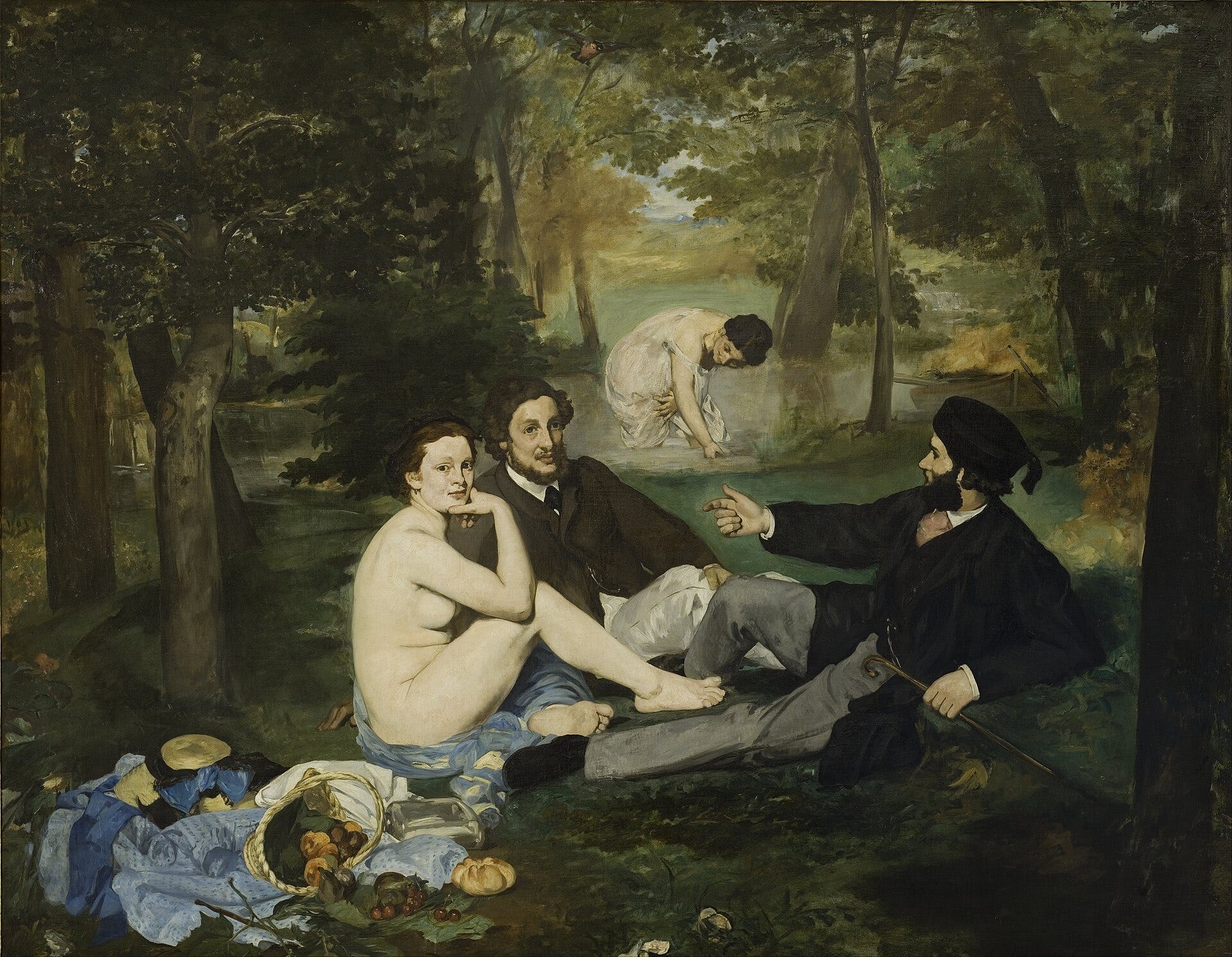
Manet's Luncheon on the Grass shows a nude woman picnicking with two dressed men, rejected by the Paris Salon of 1863. The nudity was not the real problem. And the model, Victorine Meurent, later out ranked Manet at the very Salon that once rejected him.
Nude women had filled Salon walls for decades, always wrapped inside a myth or a distant century. Manet's woman sits in a Paris park, in the company of two men dressed for the year the painting was made. Nothing about the setting asks the viewer to look away.
Date. Painted in 1863, rejected by the official Salon that same year.
Medium. Oil on canvas, about 208 by 264.5 centimeters.
Location. Musee d'Orsay, Paris.
More scandals, more painters
Manet spent his career testing what a modern painting could get away with. These pick up the thread.
Rejected, then famous anyway
So many paintings were turned away by the 1863 jury that public complaints reached Napoleon III, who ordered a second exhibition for the rejects. Manet's picture became its main attraction, mocked in the press and crowded by visitors who came only to be scandalized.
Around 3,000 works were refused that year, a record the jury itself had not anticipated. Napoleon III visited the Salon des Refuses in person and reportedly called Manet's painting an offense against modesty, a comment that only fed the crowds.
Newspapers turned the exhibition into front page news for weeks, less for the quality of the rejected work than for the spectacle of watching Parisians line up to laugh at it. Caricaturists reprinted the painting in satirical drawings within days, spreading the scandal well beyond anyone who actually walked through the exhibition halls.
A nude that refuses the myth
Academic nudes came wrapped in a story: a goddess, a nymph, a biblical figure kept at a safe distance from the viewer. Manet's woman has no myth to hide behind. She looks straight out of the canvas, fully aware of being watched, in a scene set in the viewer's own century.
That directness, more than the bare skin itself, is what critics could not forgive. A nude Venus was acceptable. A naked Parisian woman staring back at a well dressed audience was not. To me, that gaze is the actual scandal. A myth can be naked. A real woman looking back at you is a different kind of exposure.
Manet painted the same defiant gaze into Olympia a few months later, using the same model, and provoked an even louder scandal in 1865.
Borrowed from Raphael, filtered through an engraving
The pose of the three central figures was not invented from scratch. Manet adapted it from a sixteenth century engraving by Marcantonio Raimondi, itself based on a lost design by Raphael showing the Judgment of Paris, a subject academic painters had reused respectfully for three centuries before Manet touched it.
Manet kept the arrangement of bodies almost exactly, then transplanted it from myth into a Paris park, a switch contemporary viewers were quick to notice and slow to forgive. What strikes me is how small the change looks on paper and how much it mattered in the room. Same bodies, same arrangement, wrong century.
Borrowing a composition from an old master was common practice at the time. Doing it to house a scene of modern undress was the part that read as an insult to the tradition.
The bather who breaks the rules
In the background, a second woman bathes in a stream, drawn at a scale too large for how far away she stands. Academic critics read the mismatch as carelessness. Manet treated it as a choice, one consistent with how he built the whole canvas out of flat, deliberate shapes rather than a single measured perspective.
He was less interested in optical accuracy than in the flat, direct arrangement of shapes on canvas, an idea that would matter more to painters a generation later than it did to his own critics. I think that flatness is the detail later painters actually learned from, more than the nudity everyone argued about at the time.
More Manet, more nerve
The exhibition invented just for rejects
In 1863, the Salon jury turned away an unusually large share of submitted work. Napoleon III allowed a separate exhibition of the refused paintings that same year, the Salon des Refuses, so the public could judge for itself, a rare instance of an emperor overruling his own art establishment.
Luncheon on the Grass hung there, not in the main Salon, alongside hundreds of other rejected canvases most visitors ignored entirely.
The gamble backfired for the jury. The Salon des Refuses drew larger crowds than the official Salon that same season, and Manet's painting is the one people still remember from it. Most of the roughly 3,000 rejected works from 1863 are footnotes today. This one is not.
The people in the painting were real
The nude woman is Victorine Meurent, Manet's regular model that year, who sat for him again months later for Olympia. The two dressed men are modeled on people close to Manet: his brother Gustave and Ferdinand Leenhoff, a sculptor who would soon become his brother in law.
Putting recognizable, ordinary Parisians into a scene borrowed from classical art was part of what made critics uneasy. This was not a myth. It read as a picnic among people the audience might actually know.
The model who out ranked Manet at his own Salon
Victorine Meurent did not stay a model. She trained as a painter, took evening classes at the Academie Julian starting in 1875, and had her own self portrait accepted into the 1876 Salon, the same year the jury rejected Manet's submissions entirely.
She went on to show work at the Salon again in 1879, 1885 and 1904, earning a living from painting for years afterward, according to a letter she later wrote to Manet's widow.
The woman most viewers see only as a scandalous nude spent decades on the other side of the easel, judged by the same institution that once judged the painting she posed for.
It was not always called this
Manet's own title for the painting was Le Bain, The Bath, referring to the second woman bathing in the background stream. The now standard French title was attached later by journalists covering the Salon des Refuses, and it stuck permanently within a few years of the scandal.
Journalists covering the Salon des Refuses started calling it Dejeuner sur l'herbe, and the nickname outlived Manet's own choice within a few years.
English language references mostly use the literal translation, Luncheon on the Grass, a title Manet himself never actually wrote down.
From a private collection to the Musee d'Orsay
The painting stayed in private hands for decades after the scandal. Collector Etienne Moreau Nelaton bequeathed his collection, including this painting, to the French state in 1906, and it entered the Louvre the following year, decades after the same picture had been mocked as an insult to painting.
It later moved to the Jeu de Paume, then to the Musee d'Orsay when that museum opened in 1986, where it hangs today alongside Olympia.
Frequently asked questions
Why was Luncheon on the Grass rejected by the Salon?
The Salon jury of 1863 rejected it along with thousands of other works. It was shown instead at the Salon des Refuses, a separate exhibition ordered by Napoleon III after public complaints about the rejections.
Why did Luncheon on the Grass cause a scandal?
Not because of the nudity itself, common in Salon painting, but because the woman is clearly a contemporary figure looking directly at the viewer, with no mythological story to justify the scene.
Who are the men in the painting?
Manet's brother Gustave and his future brother in law Ferdinand Leenhoff posed for the two dressed men.
What inspired the composition of Luncheon on the Grass?
Manet adapted the pose of the three central figures from a sixteenth century engraving by Marcantonio Raimondi, based on a lost design by Raphael.
What happened to Victorine Meurent after she modeled for Manet?
She became a painter herself, exhibited a self portrait at the 1876 Salon the year Manet's own work was rejected, and continued showing paintings there until 1904.
Where can I see Luncheon on the Grass today?
At the Musee d'Orsay in Paris.