Wifredo Lam: The Complete Story

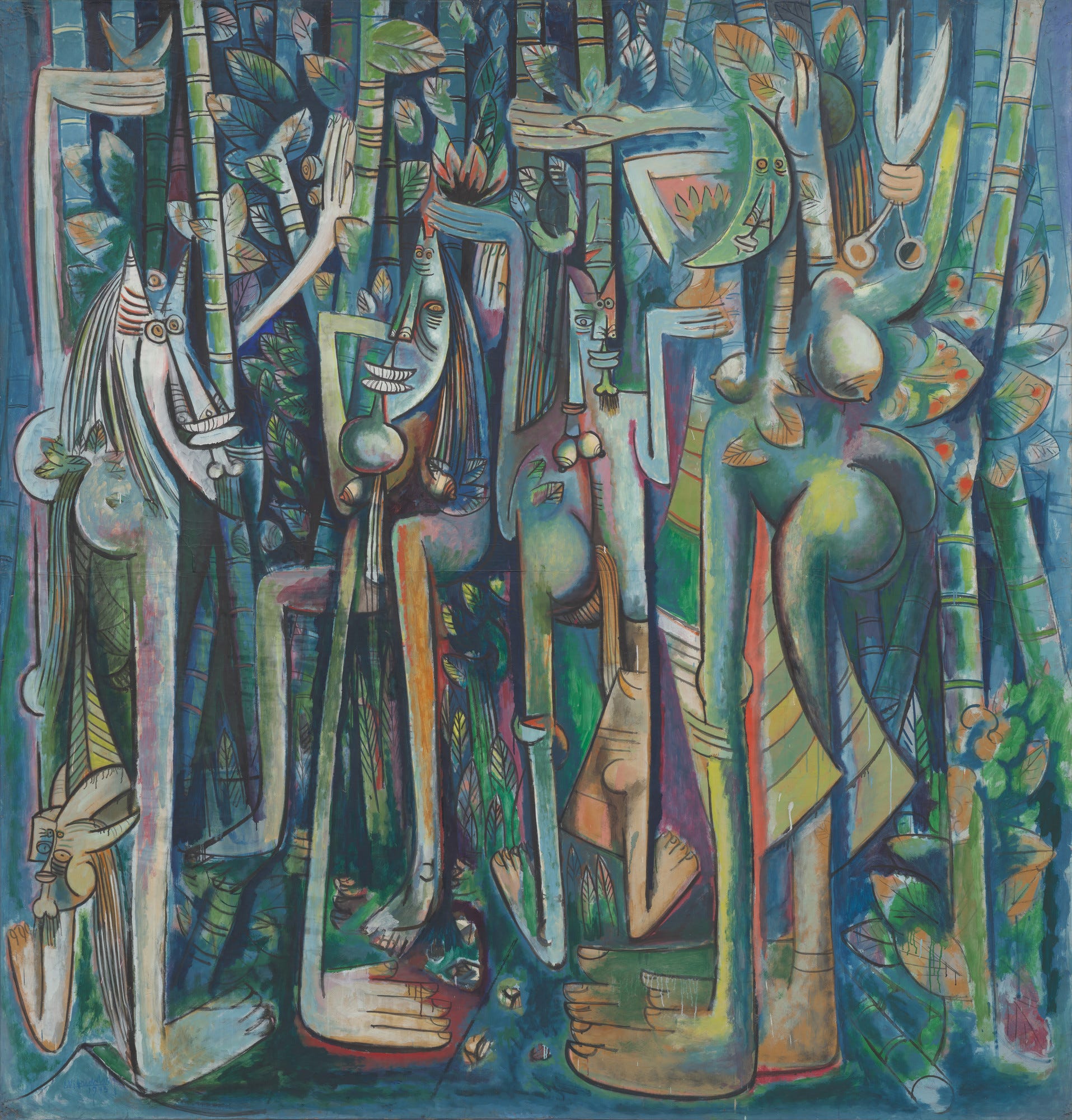
A painting where human limbs, sugarcane stalks and the masks of African gods grow into one another, half plant, half spirit, half person.

Pencil signatures of Cuban artist Wifredo Lam

The Jungle by Wifredo Lam stopped visitors cold when it hung near the entrance of the Museum of Modern Art, and it announced a new kind of art that belonged to no single continent.

He was a Cuban artist who fused modern European painting with the African and Caribbean spirit world, creating a vision entirely his own.


More than 100,000 readers, one great art story at a time. Join free.


For readers who want the whole picture

These go past the caption and into what actually happened:


A mixed inheritance

Lam was born in Cuba to a Chinese father and a mother of African and Spanish descent, and that mixed heritage runs through everything he made.

He drew on the Afro Cuban religion of Santeria, its gods and rituals, blending it with the modern art he absorbed in Europe.

The lessons of Europe

Lost Garden of Error and Decay at Wifredo Lam Havana by Rich
Lost Garden of Error and Decay at Wifredo Lam Havana by Richter and Bielicky 03

In Spain and then Paris, Lam met Picasso, who championed him, and joined the circle of the Surrealists around the poet Andre Breton.

From Picasso he took the broken forms of Cubism, and from the Surrealists a freedom of imagination, but he turned both toward his own Caribbean world.

The Jungle

His masterpiece, The Jungle, painted in 1943 after he returned to Cuba, shows figures merging with sugarcane and masks in a dense, dreamlike thicket.

It reads as a vision of the Caribbean itself, its slavery, its spirits and its lush land, and remains one of the touchstones of Surrealism made outside Europe.

The return home

Fleeing the Nazi occupation of France, Lam sailed back to Cuba in 1941 on a ship that also carried Breton and other exiles.

Shocked by the poverty and racism he found at home, he poured that anger and pride into his art, giving the African roots of Cuban culture a dignity that colonial society had denied them.

A few questions about Wifredo Lam

What is he known for?

Fusing modern European art with Afro Cuban spirit imagery, above all in The Jungle.

Who championed him?

Picasso, who promoted his work in Paris.

Where was he from?

Cuba, born in 1902 to a mixed family.

When did he die?

In 1982, in Paris.

Why his hybrid world matters

Lam proved that modern art did not have to speak only with a European voice, and he gave the African heritage of the Caribbean a place on the world stage.

The Jungle still hangs in New York as one of the great paintings of the twentieth century, made by an artist who belonged to three continents at once.


More than 100,000 readers, one great art story at a time. Join free.


He travelled widely in his later years, working in Italy and across Europe, and his prints and paintings now sell for large sums as collectors catch up with his importance.

A foundation in his name and growing museum interest have steadily moved him from the edge of the story of modern art to its centre, where his fusion of worlds finally reads as ahead of its time rather than outside it.

His later sculptures and ceramics extended the same hybrid vision into three dimensions, and major retrospectives in Paris, London and New York have steadily confirmed his place among the most original artists of his century.

Born in a small Cuban town to a family that crossed China, Africa and Spain, he carried that meeting of worlds into every canvas, and a foundation now guards his legacy and lends his work to shows around the globe.

His prints, posters and paintings continue to climb in value as the wider world finally recognises how early he opened modern art to voices from beyond Europe.


One good art story at a time. Join free, no catch.