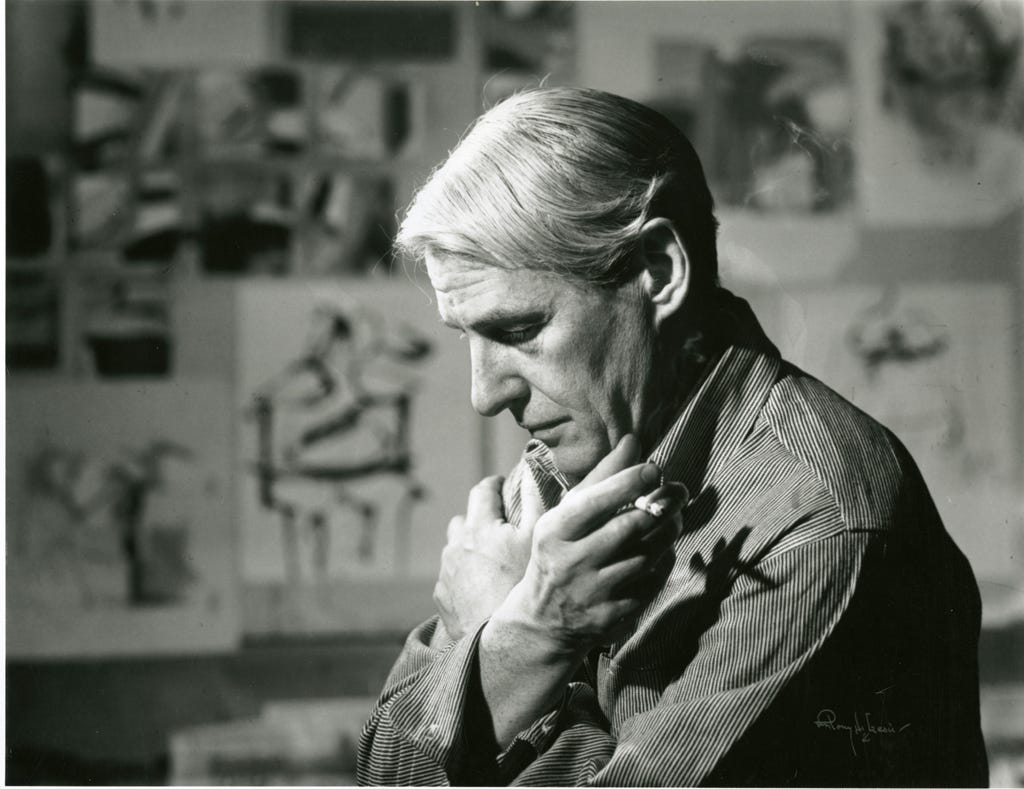
Willem de Kooning: The Complete Story
Willem de Kooning was the Dutch born American who painted like a brawler and a poet at once. A leader of Abstract Expressionism, he attacked the canvas with slashing strokes and smeared colour, yet he refused to give up the human figure when everyone else went fully abstract.
His ferocious Woman paintings split the art world in two.
One of his pictures later sold for around 300 million dollars, among the highest prices ever paid for any painting.
Born: Rotterdam, Netherlands, 1904
Known for: Abstract Expressionism, action painting, the Woman series
Died: East Hampton, New York, 1997
The next stop
These go past the caption and into what actually happened:
Luncheon of the Boating Party, detail by detail, who everybody at that table actually was
Ten women artists you need to know, the names the textbooks skipped
Was Monet really the first Impressionist, the painting that may have got there first
The figure that would not die
By the early 1950s pure abstraction was the rule in New York. De Kooning broke it. His Woman I shows a wild, grinning female figure, all teeth and eyes, built from violent strokes. See what is abstract art.
Critics were stunned that a leading abstractionist had smuggled the human body back in. He shrugged that flesh was the reason oil paint was invented. The Woman series remains his most argued over work.
Painting as an attack
De Kooning is a king of action painting, where the act of making is part of the picture. He scraped, repainted and reworked a canvas for months, leaving the struggle visible in every drag of the brush. See what is expressionism.
He stowed away from the Netherlands to the United States in 1926 as a young house painter, then clawed his way into the New York avant garde. The toughness never left the work.
The drawing that got erased
In 1953 a young Robert Rauschenberg asked de Kooning for a drawing so he could rub it out and call the blank sheet his own art. De Kooning, half amused, handed over a good one, hard to erase on purpose.
The result, Erased de Kooning Drawing, became a landmark of conceptual art. Even de Kooning's leftovers helped launch the next movement.
The long, fading finale
In his last years de Kooning developed dementia, yet kept painting, producing spare, ribbon like canvases. Whether those late works are triumphs or the output of a failing mind is still debated.
The market had no doubts about the rest. His painting Interchange sold privately for about 300 million dollars in 2015, briefly the most expensive painting in the world.
A few things people ask about de Kooning
What is Willem de Kooning famous for?
Abstract Expressionism and his fierce Woman paintings that kept the figure alive in abstraction.
Why were the Woman paintings shocking?
He brought the human figure back when the art world demanded pure abstraction.
What was Erased de Kooning Drawing?
A drawing he gave Rauschenberg, who rubbed it out and exhibited the blank page as his own work.
When did he die?
In 1997, on Long Island, after living with dementia in his final years.
Why the brawler still lands
De Kooning proved you could be wild and disciplined at once, an abstract painter who never stopped wrestling with the body. The fight he left visible on every canvas is exactly why his pictures still feel alive and unfinished, in the best way.
One last detail. He kept reworking some paintings for years, scraping a day's work off each night to start again. The man who sold for hundreds of millions sometimes could not bear to call a single picture finished.