Witches in Art: 12 Paintings of the Dark Craft

Witches have haunted European painting for five hundred years, from Durer's goat riding hag to Goya's great goat, Salvator Rosa's cauldrons and Waterhouse's beautiful sorceress.

The image swings from ugly menace to alluring power, tracking what each age feared in women.

Old witch riding backward on a goat, Durer engraving
Albrecht Durer, The Witch, about 1500, engraving.

The witch is one of art's most telling inventions. She barely appears in medieval painting, then explodes across print and canvas exactly when the witch hunts begin, which tells you these pictures were never only entertainment.

I have followed her from the German engravers who built the stereotype to the Victorians who made her gorgeous, and the shift says a lot about us.

Four things to watch for in a witch picture:

  • The age. For centuries she is old, ugly and nude, a warning. Later she turns young and lovely, which is its own kind of fear.

  • The kit. Cauldron, goat, broom, black cat, skulls and grimoires are a whole visual language of the forbidden.

  • The night. Most of these unfold in darkness, the painter using deep shadow to hide and reveal.

  • The real fear. Behind the fantasy sits an actual body count of women tried and killed across Europe and America.


Learn art the fun way. Free stories every week, no boring lectures.


For readers who want the full story

The ones I would send you to next:


1. Albrecht Durer, The Witch (about 1500)

A withered old woman rides backward on a goat through a storm, her hair streaming against the wind, while frightened cherubs tumble around her.

Durer engraved this small, strange scene around 1500, and it helped fix the look of the witch for centuries.

Every detail is a sign. Riding backward marks her as a creature of inversion, the goat is the Devil's animal, and the swirling weather points to the old belief that witches could conjure hail and ruin a harvest.

Durer was working at the exact moment the panic caught fire. Printed pictures like this one spread the new stereotype faster than any sermon could.

2. Hans Baldung Grien, Witches (1510)

Nude witches around a cauldron, Baldung woodcut
Hans Baldung Grien, Witches, 1510, woodcut.

Naked witches crouch around a steaming pot in the woods, one riding a goat through the sky above, smoke and bones everywhere. Baldung Grien, a pupil of Durer, turned the witch into a whole artistic subject, grim and hard to look away from.

He printed his first witches in 1510 using a new color woodcut technique that made the night glow. The mix of horror and open eroticism was deliberate, and it sold.

This is where the template hardens. The cauldron, the goat, the flying hag and the nude coven all come together in Baldung, and painters copied him for two hundred years.

3. Frans Francken the Younger, Witches' Sabbath (1606)

Room full of witches with potions and demons
Frans Francken the Younger, Witches' Sabbath, 1606.

A candlelit room swarms with witches reading spells, mixing brews and flying up the chimney, painted in tiny, obsessive detail. Francken made a small collector's picture you could pore over for an hour and keep finding new horrors.

It is almost a catalogue of magic. Skulls, candles, black books, potions and demons are laid out like specimens, feeding a rich Flemish taste for the occult as parlor entertainment.

Pictures like this were luxury goods. Wealthy collectors hung them in cabinets of curiosities, a safe thrill of the forbidden behind a locked door. One version of Francken's sabbath survives in the Victoria and Albert Museum in London.

4. David Teniers the Younger, Departure for the Sabbath (17th century)

Witches in a smoky room preparing to fly
David Teniers the Younger, Witchcraft Scene, 1633, Musee de la Chartreuse, Douai.

An old witch smears flying ointment on a young one while imps scuttle underfoot and a body drifts up toward the chimney. Teniers painted the witches' kitchen again and again, half comic, half sinister.

He leaned on a real belief. People genuinely thought witches rubbed on a grease to fly, and modern historians suspect the recipes held plants that cause hallucinations, which may be where the flying came from.

His witches are grubby and domestic. The Devil is in the housework here, magic mixed up with pots, brooms and cats in a smoky Flemish kitchen.


Join 130,000 readers who get the secrets behind the paintings. Free.


5. Salvator Rosa, Witches at their Incantations (about 1646)

Coven around a fire at night, a hanged man above
Salvator Rosa, Witches at their Incantations, about 1646, National Gallery, London.

In near total darkness a coven works around a fire, a hanged man swinging above, a baby held out for sacrifice, skeletons and monsters closing in. Salvator Rosa built the whole nightmare out of chiaroscuro, light clawing tiny holes in the black.

Rosa liked to seem dangerous. He cultivated a wild, rebel image, and his witches were part of a taste for the macabre that thrilled his patrons in Florence and Rome.

The scene is a dark mirror of the Mass. Every element inverts a Christian rite, which is exactly how the church of the day described what witches supposedly did.

6. Henry Fuseli, The Three Witches (1783)

Three hags in profile pointing, from Macbeth
Henry Fuseli, The Three Witches, 1783.

Three hags lean out of the dark in a single sharp line, their profiles stacked, three arms shooting out to point at once. Fuseli painted the weird sisters from Macbeth as a chilling, almost modern piece of theater.

He cared about the shudder, not the plot. Fuseli stripped the scene down to gesture and shadow, the pointing hands and locked profiles doing all the menace.

Theater was booming, and Shakespeare with it. Painters like Fuseli fed a public hungry for the eerie, and his witches still turn up in stagings of the play today.


Learn art the fun way. Free stories every week, no boring lectures.


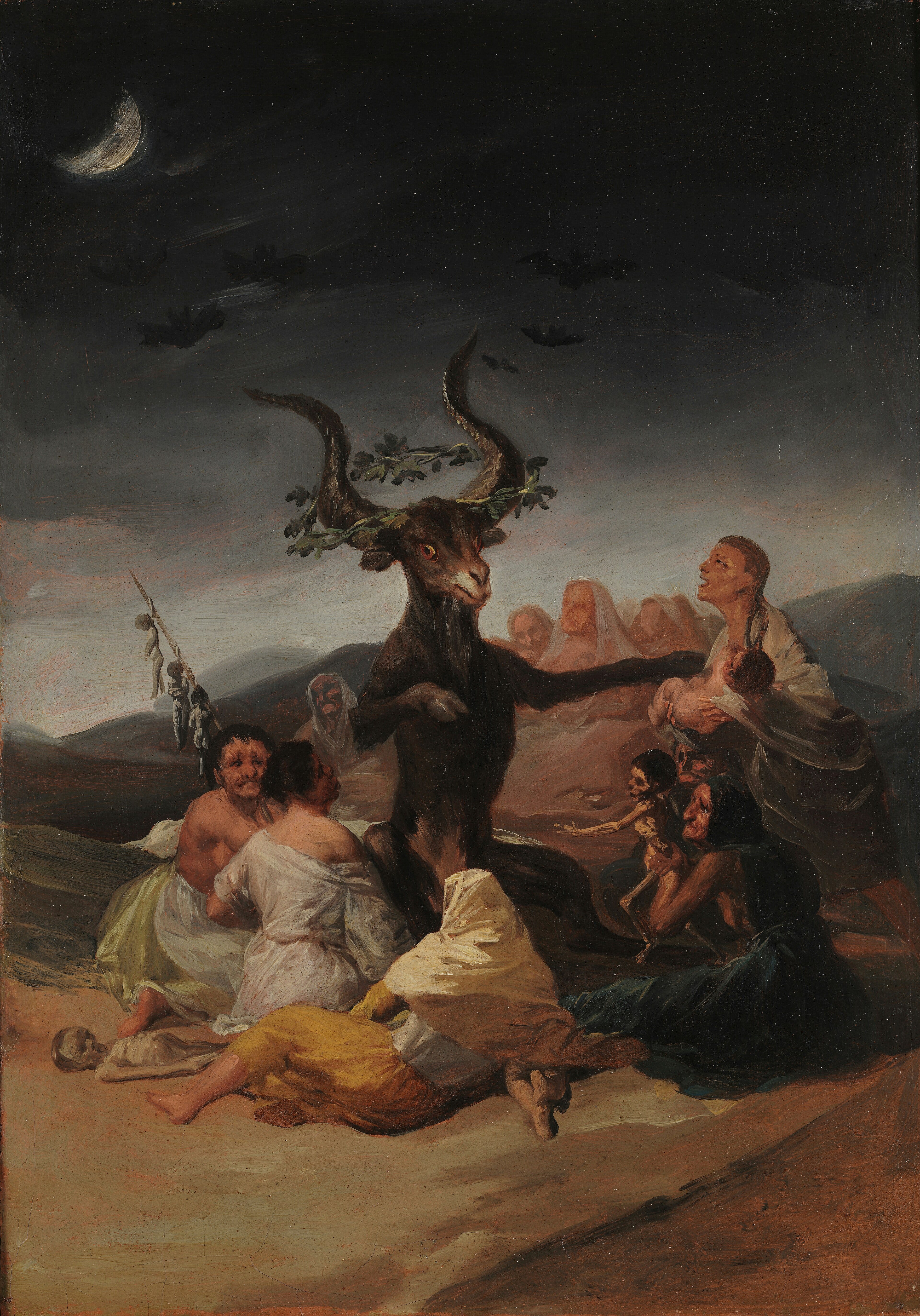
7. Francisco Goya, Witches' Sabbath (1798)

A great black goat before a ring of witches, Goya
Francisco Goya, Witches' Sabbath, 1798, Museo Lazaro Galdiano, Madrid.

A huge black goat, the Devil in animal form, presides over a ring of witches who offer him children in the moonlight. Goya painted this for the Duke and Duchess of Osuna, and it is one of the sharpest witch pictures ever made by perhaps the greatest painter of his age.

Here is the twist. Goya did not believe a word of it, and the picture reads as a jab at the superstition and church power still gripping Spain, the coven half terrifying and half absurd.

His witches are the hinge of this whole story. After Goya the subject slowly stops being a warning and starts becoming a comment on fear itself.

8. Tompkins Matteson, Examination of a Witch (1853)

Puritans examining a woman for a witch's mark
Tompkins Matteson, Examination of a Witch, 1853, Peabody Essex Museum.

A half undressed woman is held before a grim crowd of Puritans while a man points to a mark on her back, taken as proof she serves the Devil.

This is not myth. Matteson painted a real colonial witch examination in Puritan New England, the kind of scene that played out across the American colonies.

The mark was the whole case. Any mole or scar could be read as the Devil's brand, and there was no way to disprove it, the same logic that sent twenty people to their deaths at Salem in 1692.

Painted in 1853, it looks back with a shudder. By then Americans saw Salem as a national shame, and the picture is a warning about crowds, not covens.

9. Luis Ricardo Falero, Witches Going to Their Sabbath (1878)

Nude young witches flying through the night sky
Luis Ricardo Falero, Witches Going to Their Sabbath, 1878.

A rush of nude young women streams through the night sky on the way to the sabbath, trailed by bats and imps, all sensual motion and moonlight. Falero turned the old horror into a frankly erotic fantasy for the Paris Salon.

Something has flipped. The hag is gone, and the witch is now young, naked and desirable, which says more about male fantasy in 1878 than about any belief in magic.

Falero sold this glamour by the yard. He built a whole career on nude witches, nymphs and star maidens, respectable eroticism dressed up as myth.


Two new stories a week, 130+ secrets unlocked. Start free.


10. John William Waterhouse, The Magic Circle (1886)

A witch drawing a glowing circle with a wand
John William Waterhouse, The Magic Circle, 1886, Tate.

A dark haired woman in a long robe draws a glowing circle in the dirt with a wand, a cauldron smoking at her side, ravens and frogs around her feet.

Waterhouse painted a witch as calm, focused and completely in control, closer to a priestess than a monster, at the Symbolist edge of Victorian art.

The circle is protection, not attack. She is walling herself off from the spirits she has raised, an image of concentration rather than evil.

It was bought for the nation in 1886, the year it was painted, through the Chantrey Bequest, and it now hangs at Tate Britain. Audiences were ready to see the witch as a figure of mystery and power, not just a thing to burn.

11. Evelyn De Morgan, The Love Potion (1903)
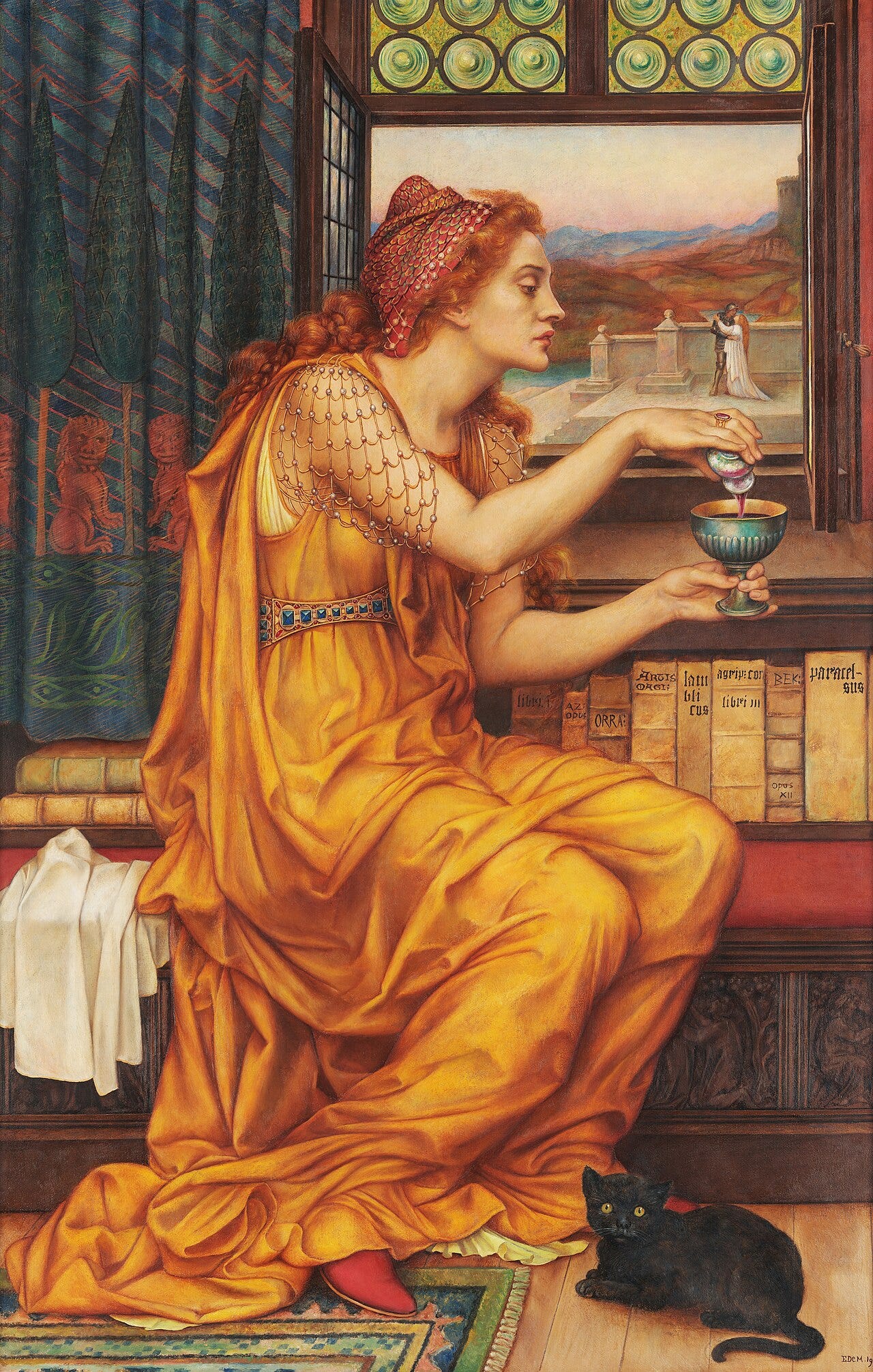
A sorceress in gold mixing a potion, a black cat
Evelyn De Morgan, The Love Potion, 1903.

A woman in a golden gown stands mixing a potion, a black cat at her feet and shelves of old books behind her, serene and learned. Evelyn De Morgan, one of the finest women painters of her day, made her sorceress a scholar.

She reclaims the figure. De Morgan gives the witch knowledge and dignity instead of ugliness, turning centuries of fear into a portrait of a woman with genuine power.

The details are chosen with care. The books and instruments frame magic as a kind of learning, and the picture quietly argues that a wise woman is not a wicked one.

12. John William Waterhouse, Circe Offering the Cup to Ulysses (1891)
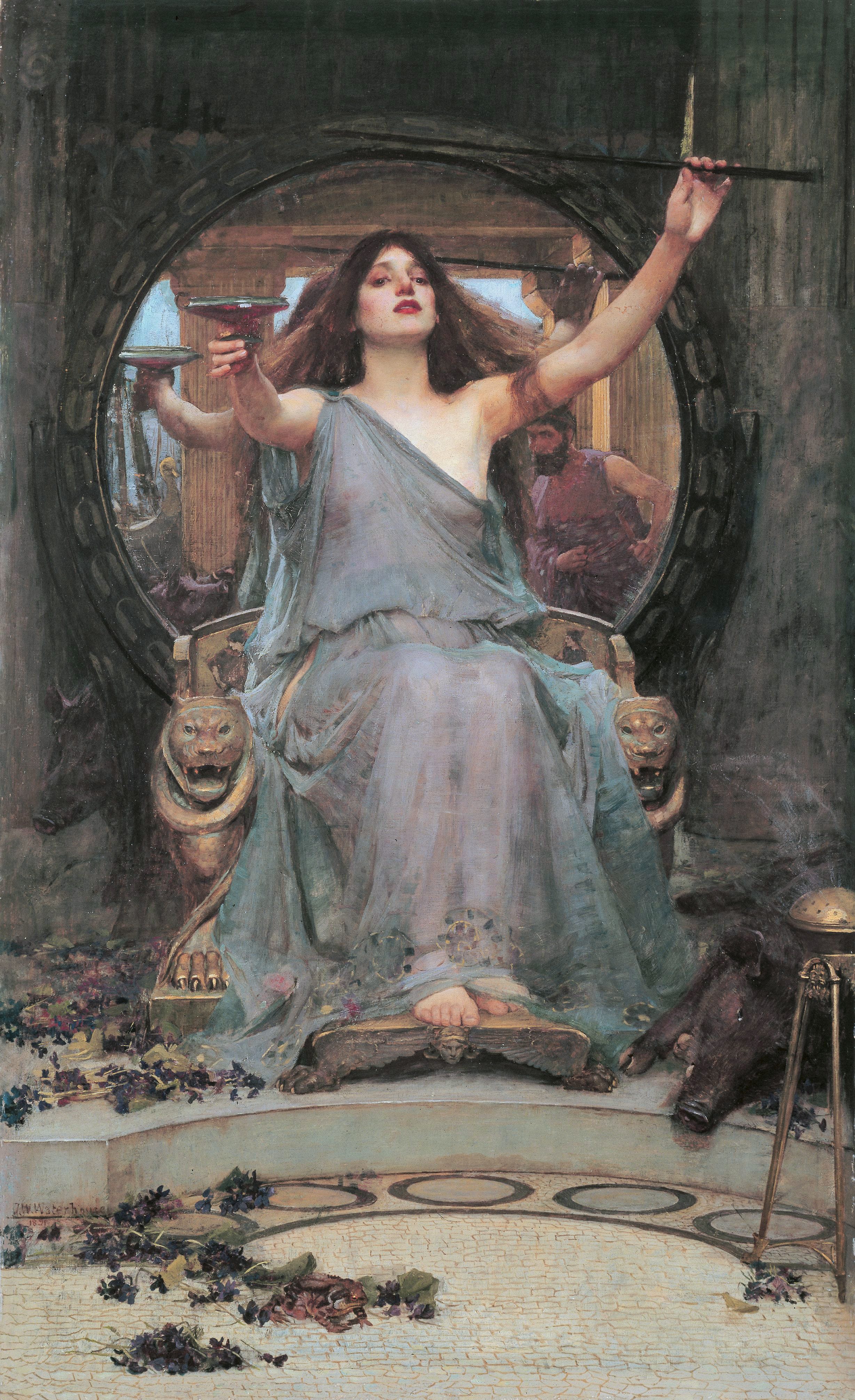
Circe enthroned holding out a cup, victims below
John William Waterhouse, Circe Offering the Cup to Ulysses, 1891.

The enchantress Circe sits enthroned, holding out a poisoned cup, her victims already turned to swine at her feet while the hero is reflected in the mirror behind. Waterhouse ends the story where witch and goddess blur into one.

Circe is the oldest witch of all. She comes straight from Homer, a sorceress who drugs men and changes them into animals, and painters loved her as a beautiful, dangerous woman with real power.

That is where five centuries lead. The witch begins as a warty hag on a goat and ends as a queen on a throne, and the fear underneath was always the same, a woman who cannot be controlled.

Where to see the coven

  • Salvator Rosa, Witches at their Incantations: the National Gallery, London.

  • Goya, Witches' Sabbath: the Museo Lazaro Galdiano, Madrid.

  • Waterhouse, The Magic Circle: Tate Britain, London.

  • Matteson, Examination of a Witch: the Peabody Essex Museum, Salem.

  • Baldung Grien, Weather Witches: the Stadel Museum, Frankfurt.

Read on into the dark

The witch is really a story about how art has looked at women and fear. Keep going with these:


Questions people ask about witches in art

  • Who painted the most famous witch pictures? Francisco Goya, Salvator Rosa, Hans Baldung Grien and John William Waterhouse are the names that come up most, across five centuries.

  • Why are old witches always ugly and naked? Early prints used the ugly nude hag as a warning, linking female bodies, old age and sin. The young, lovely witch is a much later idea.

  • What is a witches' sabbath in art? A nighttime gathering where witches were said to worship the Devil, often shown as a goat, in a dark inversion of a church service.

  • Is Goya's Witches' Sabbath serious? No. Goya used it to mock the superstition and church power of his day, not to endorse a belief in witches.

  • Which witch painting shows a real witch hunt? Matteson's Examination of a Witch, a colonial Puritan examination for the Devil's mark, echoing the hysteria that killed twenty people at Salem in 1692.

The woman who could not be controlled

Line them up and the witch keeps changing her looks and her status, but never loses her charge. Baldung drew a nude hag to frighten, Goya used a goat to mock the church, Matteson painted a Puritan courtroom, and Waterhouse handed the same woman a wand and a throne.

Behind all of it sits a real toll. Some twenty people were hanged or pressed to death at Salem in 1692, and many thousands more across Europe, which is the grim history these lovely and horrible pictures actually decorate.