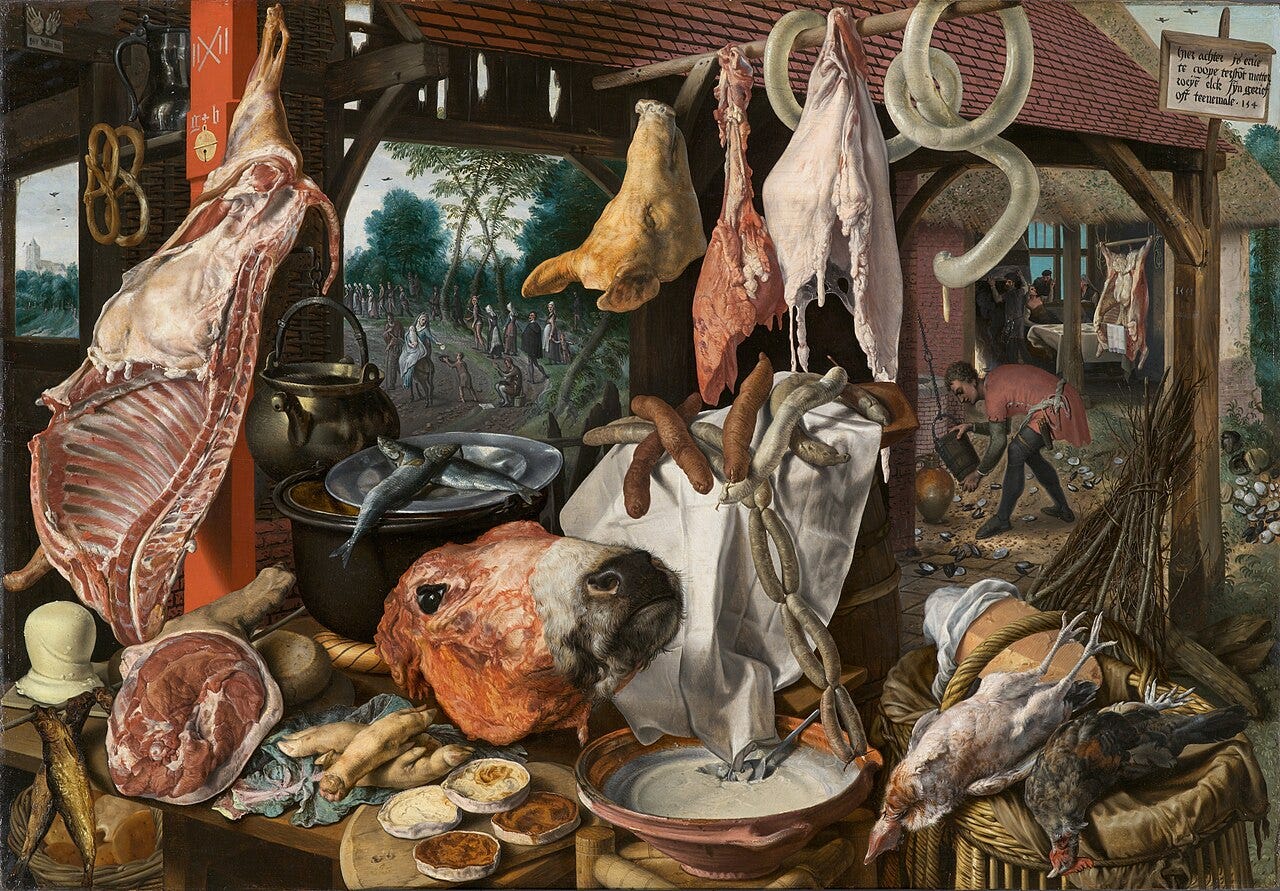
Painters spent five centuries arguing that a blacksmith, a fishwife, a beggar and a boy frying eggs deserved the same weight of canvas as a king. Kitchens, markets, forges, boats and sickrooms became a rival subject to history painting.
For most of European art history, a painter's reputation depended on gods, saints and battles. Ordinary work sat at the bottom of an official ranking of subjects.
That ranking had a name and a date. In 1667, the French Academy's historian Andre Felibien wrote a preface ranking history painting above portraiture, and portraiture above scenes of everyday life. The hierarchy stood, more or less, for two hundred years.
Painters ignored it anyway. A blacksmith's forge, a fish stall, a kitchen table and a sickroom kept pulling serious artists back, century after century, until the everyday scene became its own tradition. This page maps that tradition across six corners of it already covered on this site: the market, the trades, the water, the kitchen, poverty, and medicine.
The market stall that started an argument

Around 1550, two Antwerp painters filled an entire canvas with food for the first time and pushed the sacred story into the far background. Pieter Aertsen's 1551 Meat Stall buries a tiny scene of the holy family giving alms under a slaughtered ox, sausages and a pig's head.
His nephew Joachim Beuckelaer took the idea further, building whole series out of market women and their produce. A century later Camille Pissarro was still painting the same subject, a pork seller at a French market stall, dissolved into Impressionist light.
Iron, stone and the trades
Work with the hands got its own separate tradition, and it argued a harder case than the market did. Diego Velazquez painted the gods of Olympus using real blacksmiths as models in The Forge of Vulcan. Gustave Courbet went further in 1849, painting two anonymous men breaking stones at the scale usually reserved for a coronation.
The Salon punished painters who pushed too far. Gustave Caillebotte's Floor Scrapers, three shirtless men stripping his own Paris apartment floor, was rejected in 1875 for showing labor without heroism or pity attached to it.
Forges, floors and one famous Parisian bar are gathered in blacksmiths and workers in painting.
Boats, nets and the water
Fishing gave religious painters a five hundred year excuse to paint boats, since Christ recruited his first apostles from among fishermen on the Sea of Galilee. Painters kept the trade going long after the excuse stopped being necessary.
Winslow Homer built his career on it, spending years on the Maine coast painting men who worked the water for a living, then changed the ending of The Gulf Stream after readers wrote in horrified about the sailor's fate. Ilya Repin lived two summers among Volga barge haulers before he painted them straining against their harnesses.
Homer, Repin and the rest of the catch are in fishermen in painting.
The kitchen and its servants
Painters used the kitchen the same way Aertsen used the market stall, as a place to hide something bigger in the background. Diego Velazquez painted a servant grinding garlic in the foreground of Christ in the House of Martha and Mary while the biblical scene plays out through a hatch behind her.
Johannes Vermeer took the opposite approach and gave a milkmaid, alone with her jug and her bread, the stillness normally reserved for a saint. X rays later showed he painted over a wall hanging and a basket so nothing would compete with the stream of milk.
Beggars, gleaners and the poor
Poverty was the subject painters kept returning to and buyers kept softening. Bartolome Esteban Murillo's barefoot beggar boys, painted in a Seville recovering from a plague that had killed nearly half the city, were bought almost entirely by wealthy collectors abroad who found poverty charming at a distance.
Rembrandt drew himself in rags on no one's commission in 1630, simply to see what it looked like. Jean Francois Millet painted three women bent over a field picking up the grain the harvest had left behind, an ancient legal right of the very poor, and Paris read it as a threat.
Murillo, Rembrandt, Millet and the rest are in beggars and the poor in painting.
The doctor's visit
Medicine gave painters a subject with real stakes attached: a body that might not survive the picture. Rembrandt's Anatomy Lesson of Dr Tulp shows Amsterdam's surgeons around a corpse with a name, a man named Aris Kindt, hanged for robbery the same morning the dissection took place.
Two centuries later, Thomas Eakins painted the same profession twice, fourteen years apart. The Gross Clinic of 1875 was judged too bloody for the art section of a world's fair and hung with the medical exhibits instead. The Agnew Clinic of 1889 shows the same operating theater in white coats instead of black frock coats, antiseptic protocol in place. Medical schools still teach the two paintings side by side as a before and after of modern surgery.
Tulp, the two Eakins clinics and Van Gogh's own doctor are in doctors and medicine in painting.
Three painters who kept coming back
Millet, Bruegel and Courbet show up more than once across this cluster, because each of them treated everyday labor as a subject worth a career rather than a single canvas.
Jean Francois Millet had the standing to paint peasants because he was raised among them, born to a farming family in the Norman village of Gruchy before he ever picked up a brush professionally. Pieter Bruegel the Elder painted beggars, peasant weddings and village fairs at a moment when almost no one else in the Netherlands treated ordinary rural life as a finished subject rather than a joke in the margin. Gustave Courbet went so far as to build his own pavilion outside the gates of the 1855 Paris World's Fair, after the official jury rejected his largest paintings of workers and peasants, and called the show inside it Le Realisme.
Their work is the connective tissue between the market, the forge and the poorhouse. A blacksmith, a gleaner and a beggar are all standing in the same argument these three painters were making: that a life spent working is not a lesser subject than a life spent ruling.
Frequently asked questions
Why did the same handful of trades keep coming back across centuries of painting? Markets, forges, kitchens, boats and sickrooms were the places painters could watch real bodies doing real work, which gave them problems history painting could not offer: awkward poses, real light, real tools. The subject supplied its own realism.
Was everyday life always looked down on by serious painters? Officially, yes. Andre Felibien's 1667 preface to the French Academy ranked history painting first and scenes of common life last, and the ranking shaped Salon juries for two centuries. Painters kept working the subject anyway, and by the time of Courbet and Millet the ranking was being challenged in public.
Which painter appears in the most categories on this site? Diego Velazquez shows up in the trades, the kitchen and the poor, since the same bodegon technique he learned frying eggs and grinding garlic as a teenager in Seville carried straight through to his court portraits. Millet and Courbet run a close second across labor and poverty.
Did any of these paintings get in real trouble for showing work without dressing it up? Several did. Caillebotte's Floor Scrapers was rejected by the Salon of 1875 for showing shirtless laborers with no moral framing attached, and Eakins' Gross Clinic was refused a place in the fine art section of the 1876 Centennial Exhibition and shown with the medical displays instead.
Where can I see the largest concentration of these paintings in one place? The Musee d'Orsay in Paris holds Millet's Gleaners and Angelus, Caillebotte's Floor Scrapers, and Courbet material from the same decade, making it the single best stop for this whole cluster. The Prado, the Rijksmuseum and the Met each cover one or two corners of it in depth.
The clearest number in this whole cluster belongs to Denis Diderot, who reviewed the Paris Salons for two decades and ranked Jean Simeon Chardin's kitchen scenes above the history paintings hanging in the same rooms, a verdict the Academy's own rulebook said should have been impossible.