
During the war, governments sent painters to the front with orders to record it, and soldiers who had never trained as artists came home and taught themselves to paint. Witnesses from America, Germany, Australia, Canada, France and Britain each gave their own answer to a hard question: what can a picture show of a war like this one?
Cool Stories About Art is a newsletter to learn art the fun way.
Join 200,000+ readers and get:
10 new art stories / month
The entire archive of content (140+ articles)
Comment, ask questions, and chat with other readers
What This War Asked of Painters
This war was hard to paint. The enemy stayed out of sight, shells came from guns miles away, gas drifted in on the wind, and whole stretches of the front turned to mud with nothing left standing. The old battle picture, a general on horseback above a charge, had nothing to say about it.
Every artist on this list saw that war at close range, as a soldier, an ambulance driver, an official artist sent to the lines, or, in one case, a mother at her son's grave. They come from both sides of the trenches and from both sides of the Atlantic.
Back home, most of them faced the same problem: how to make people who had not been there understand. Their answers range from careful description to pictures with no soldier in them at all.
12. Horace Pippin, The End of the War: Starting Home (1930 to 1933)
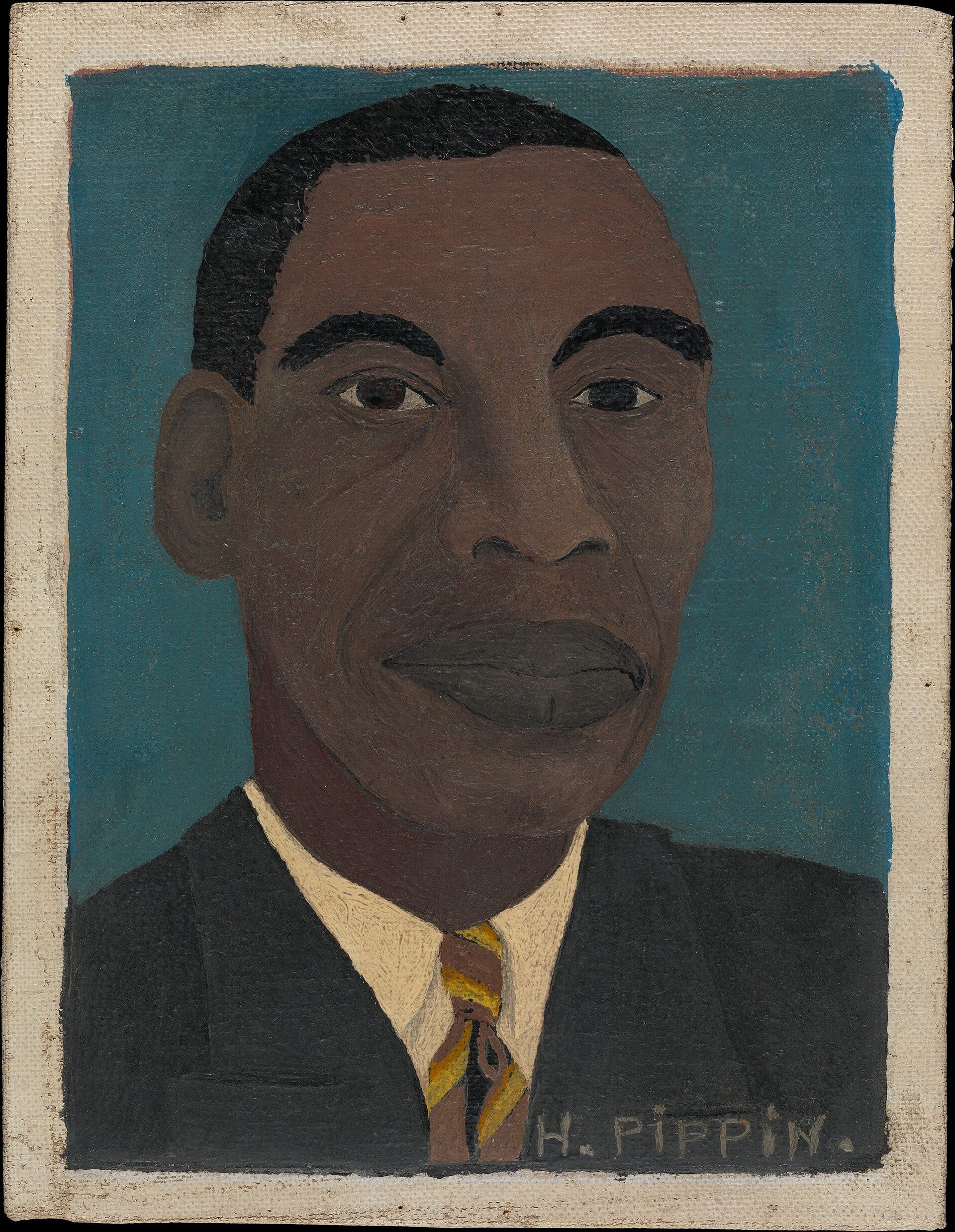
Small carved tanks, rifles, grenades and gas masks are fixed around the frame of this painting, the equipment of the war its maker had fought in. On the canvas, Black soldiers in brown uniforms push forward while German soldiers in gray raise their hands or run, and a biplane falls in flames above them.
Horace Pippin knew that war from the inside. In 1917 he joined the 15th New York National Guard infantry, which became the 369th U.S. Infantry, an all-Black regiment sent to France. White American units refused to fight beside it, so it served under the French army, and the Germans called its men the Harlem Hellfighters.
That is where he was hurt. On September 30, 1918, during the advance on the village of Séchault, a bullet went through his right shoulder and arm. He came home to West Chester, Pennsylvania, with an arm that barely obeyed him.
Art was partly a way to bring that arm back to life. He began by drawing in pencil on wooden panels, burning the lines in with a heated poker and adding a few colors. In 1930 he bought oil paint to start what his memoir calls "the picture that was in my mind," and he steadied the brush by guiding his right arm with his left.
That picture is this one. It took him three years and around a hundred layers of paint, and it carries the title Pippin gave it, The Ending of the War, Starting Home.
Out of everything he had lived through in France, the first scene he chose to paint, one arm holding up the other, was the moment the fighting stopped and the road home opened.
At a Glance
Artist: Horace Pippin (1888 to 1946)
Painted: 1930 to 1933
Medium: Oil on canvas
Size: 66 × 76.4 cm (26 × 30 1/16 in)
Where to see it: Philadelphia Museum of Art, Philadelphia
11. Ernst Ludwig Kirchner, Self-Portrait as a Soldier (1915)
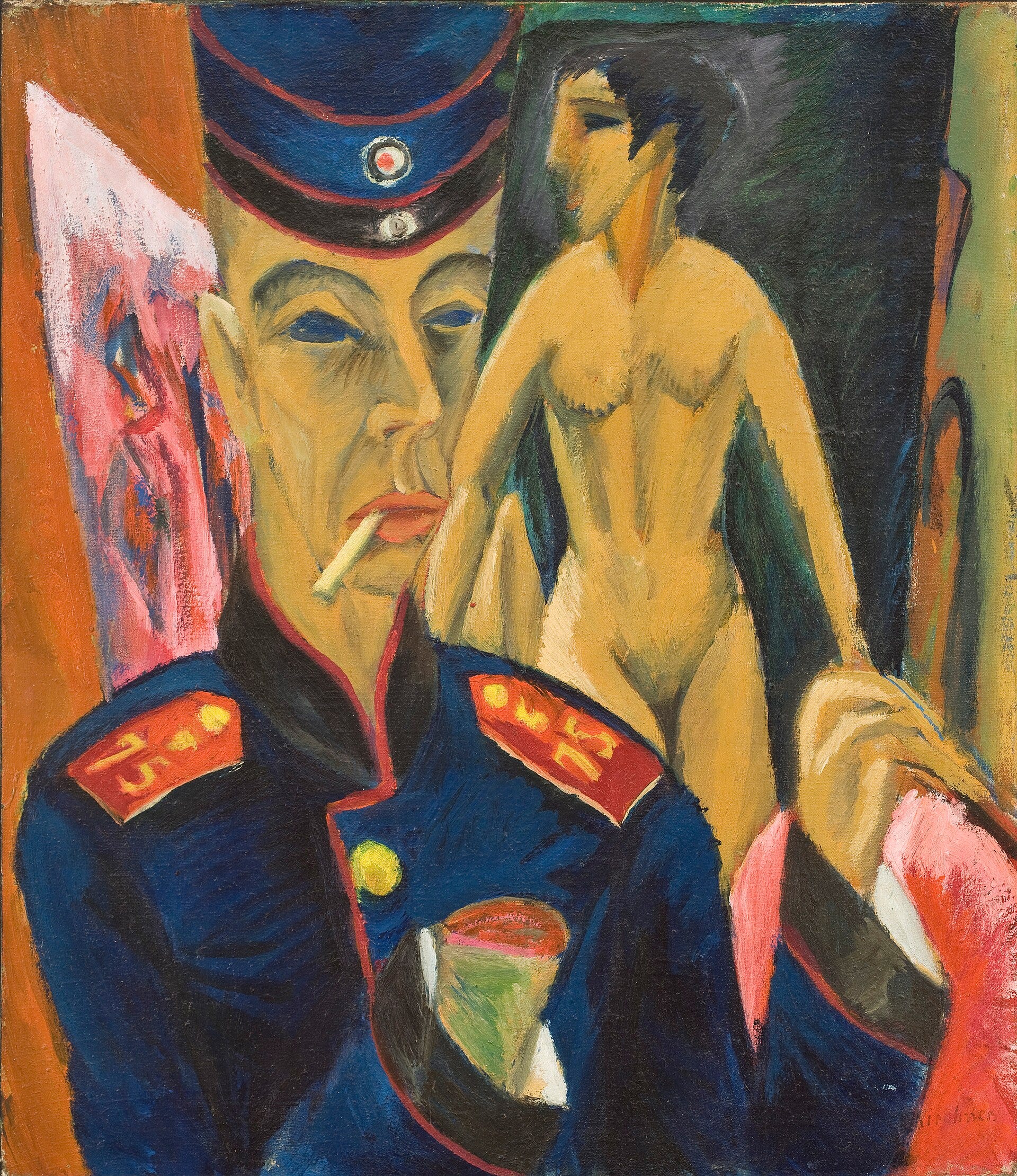
A soldier in a blue army uniform raises his right arm, and the arm ends in a red stump. The missing hand is the one he paints with. Ernst Ludwig Kirchner pictured himself this way in 1915, yet he never lost a hand.