
In medieval Kyoto, the stories said, an old cooking pot thrown out with the trash could come back one night with a grudge. Japan gave its monsters names, faces and even jobs. Its artists kept drawing them for five centuries, from temple scrolls to children's comics, and in 2020 one of these creatures went to work for the government against an epidemic.
Cool Stories About Art is a newsletter to learn art the fun way.
Join 200,000+ readers and get:
10 new art stories / month
The entire archive of content (140+ articles)
Comment, ask questions, and chat with other readers
Why Japan Kept Drawing Its Monsters
Yōkai is the Japanese word for the strange creatures of folklore: demons, animals that change shape, old objects that come to life. Yōkai art is simply the name for their pictures. Beside them walk the yūrei, the ghosts of the dead, who were once people. Japanese artists drew both kinds side by side, so both share this page.
A monster sets a painter a particular problem, because there is no model to copy from life. Each creature had to be invented, or borrowed from an older picture. In Japan the borrowing never stopped, and it carried the same faces from painted scrolls kept in temples to prints sold for small change in the street.
That chain of borrowing guided the selection, together with a second rule: each work had to carry a story through to its end. Along the way come a funeral, a ban, a play and an epidemic.
12. Utagawa Kuniyoshi, The Earth Spider Conjures Up Demons at the Mansion of Minamoto no Raikō (1843)
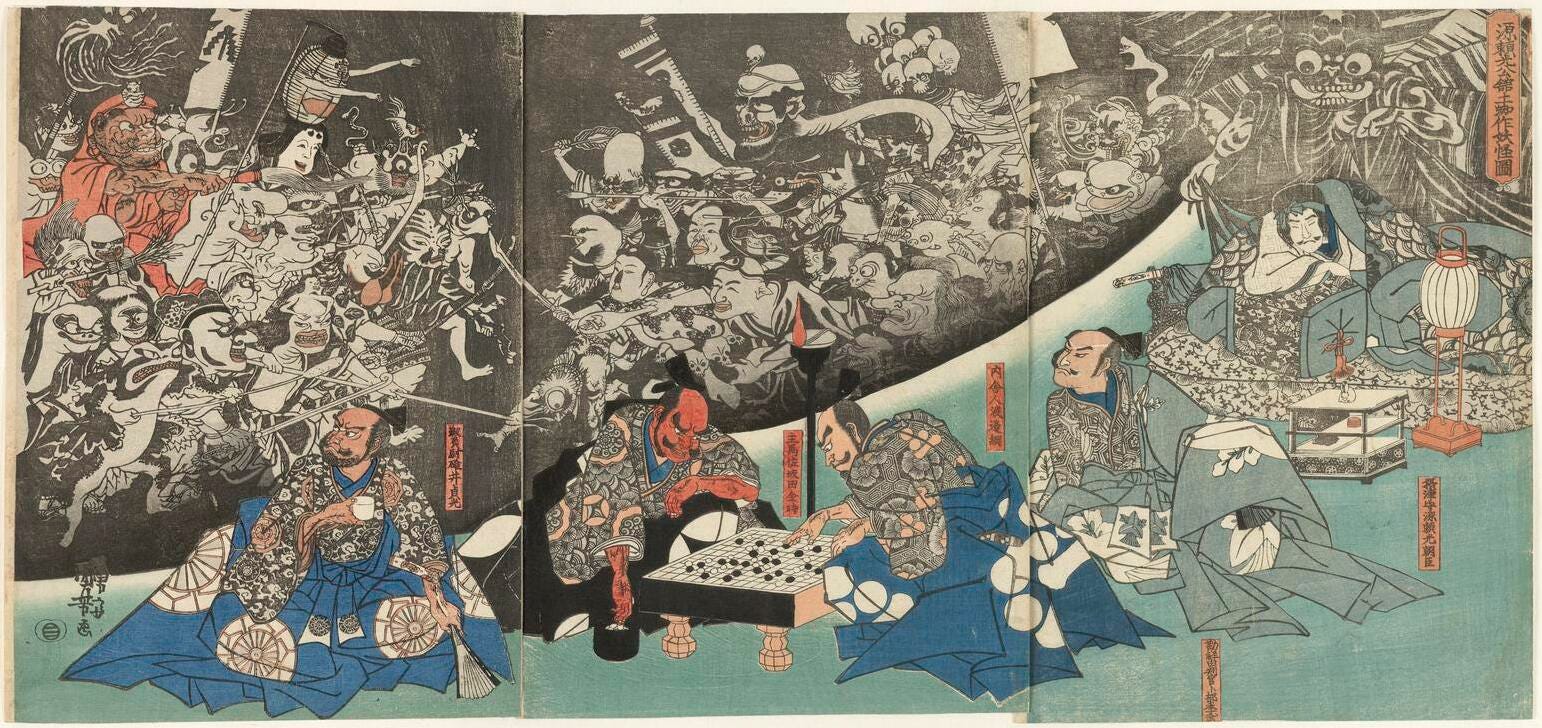
Four guards sit bent over a game of go, a board game played with black and white stones. Beside them, a sick man lies stretched out under a mosquito net. Across the rest of the three sheets, a giant spider and a crowd of demons, ghosts and walking household objects pour into the room, and none of the guards looks up.
The scene comes from a play of nō, the old masked theater of Japan, called Tsuchigumo, The Earth Spider. The sick man is the warrior Minamoto no Raikō, pinned to his bed by a fever. While his four famous retainers play on, the spider sends its army against him. Utagawa Kuniyoshi designed the print in Edo, today's Tokyo, in 1843.
To buyers in Edo that year, the image looked like a riddle about their own city. Since 1841, the government of the shogun, the military ruler who governed Japan in the emperor's name, had been waging a campaign against luxury, theater and pleasure. It was known as the Tenpō Reforms, and it ran until 1843.
The buyers soon found everyone in the picture. The feverish warrior was the shogun Tokugawa Ieyoshi, the guards who paid no attention were the ministers who enforced the reforms, and the monsters were all the people the reforms had hurt. Read that way, the print counts among the earliest political cartoons in Japan.
Whether Kuniyoshi meant any of this is not known. The scholar Iwakiri Yuriko thinks he drew the design late in 1842 as a New Year print, before anyone saw a satire in it.
His publisher, Ibaya, did not wait for an answer. Frightened by how well the image sold, he recalled the sheets in the eighth month of 1843 and destroyed the woodblocks, the carved boards from which the colors were printed. Pirated editions were circulating almost at once.
At a Glance
Artist: Utagawa Kuniyoshi (1797 to 1861)
Made: 1843
Medium: Color woodblock print, triptych
Size: 35.5 × 76 cm (14 × 29.9 in)
Where to see it: British Museum, London (impressions also in the Seattle Art Museum and other collections)
About This Work
What kind of subjects did Kuniyoshi choose?
Above all warriors and heroes of old legends, often in battle with the ghosts and monsters of those stories. He was also popular in Edo for his prints of cats.
11. Maruyama Ōkyo, The Incense of Returning Souls (before 1784)
A woman with her hair undone leans out of a curl of smoke. Her face and shoulders are painted with care, and below the waist the silk is simply left bare. The temple in northern Japan that keeps her lets her out of her box for one hour a year. She has no feet, and Japanese tradition says that ghosts have gone without them ever since she was painted.