

170 000+ readers. Learn art the fun way.
This is a preview. Paid subscribers get the full story.
You’ll also get:
10 new stories every month
The full archive (120+ Art stories)
Your personal art guide. Comment, ask questions, DM me anytime
iPhone user? Subscribe at coolstoriesabout.art, not via the app. Apple adds 30% to the price.
Paris, boulevard de Clichy, a night in the winter of 1889. On the seventh floor of a Montmartre building, a studio lit by gas.
A man of 30 stands before a canvas a meter tall. He has taken off his top hat and laid his long dark frock coat over a chair.
On a table, a half eaten croissant and a piece of chocolate. What he eats almost every day, standing up, so as not to lose time.
In front of him, on the canvas, a woman powders her face.
He does not mix his colors. On the palette, the tones of the spectrum sit in small separate heaps, pure, like the colors in a brand new box of school paints.
The brush is fine. It taps the canvas. One dot, then another.
An orange dot beside a blue one. A pink dot against a green.
From ten centimeters away, you see the dots. From three meters, the eye blends them on its own, and the woman's skin takes on its volume.
The Impressionists, before him, had broken light into quick strokes. Seurat goes further. He breaks it into dots, each one calculated.
Two pure colors set against each other shine brighter than a dull mix on the palette. The mixing, he leaves to the eye of whoever looks.
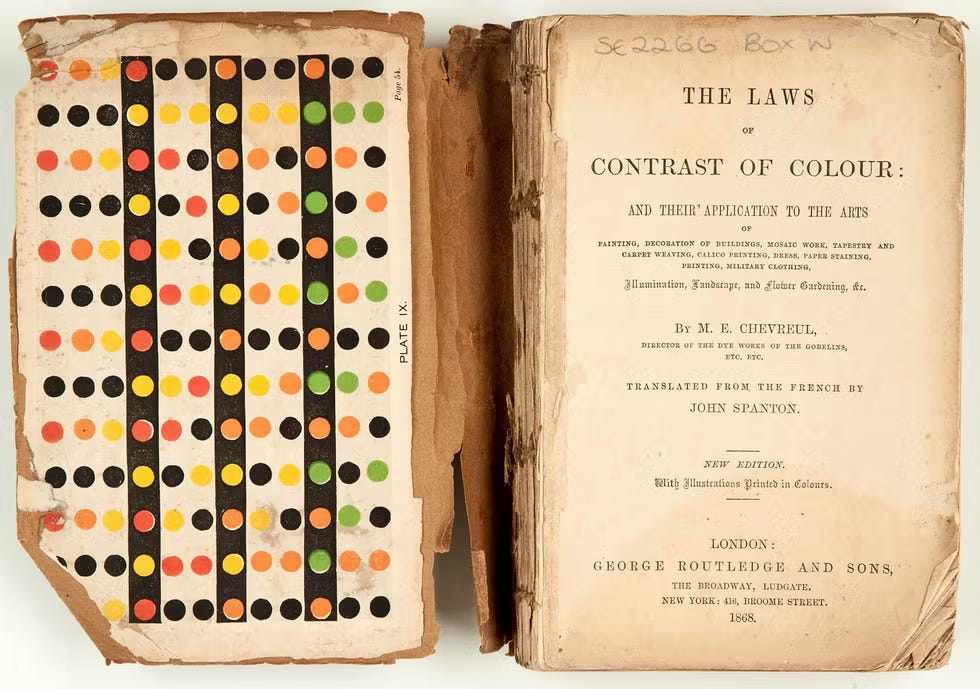
He read it in the work of scientists who spent their lives on color, the chemist Chevreul, the physicist Rood.
Nowhere any black. The shadows on the back wall are not gray. They are made of opposite colors set side by side.
The yellow gas flame throws off every shade. In his head, he corrects each dot, works out what the color will become in daylight, in the hall where the canvas will hang in the spring.
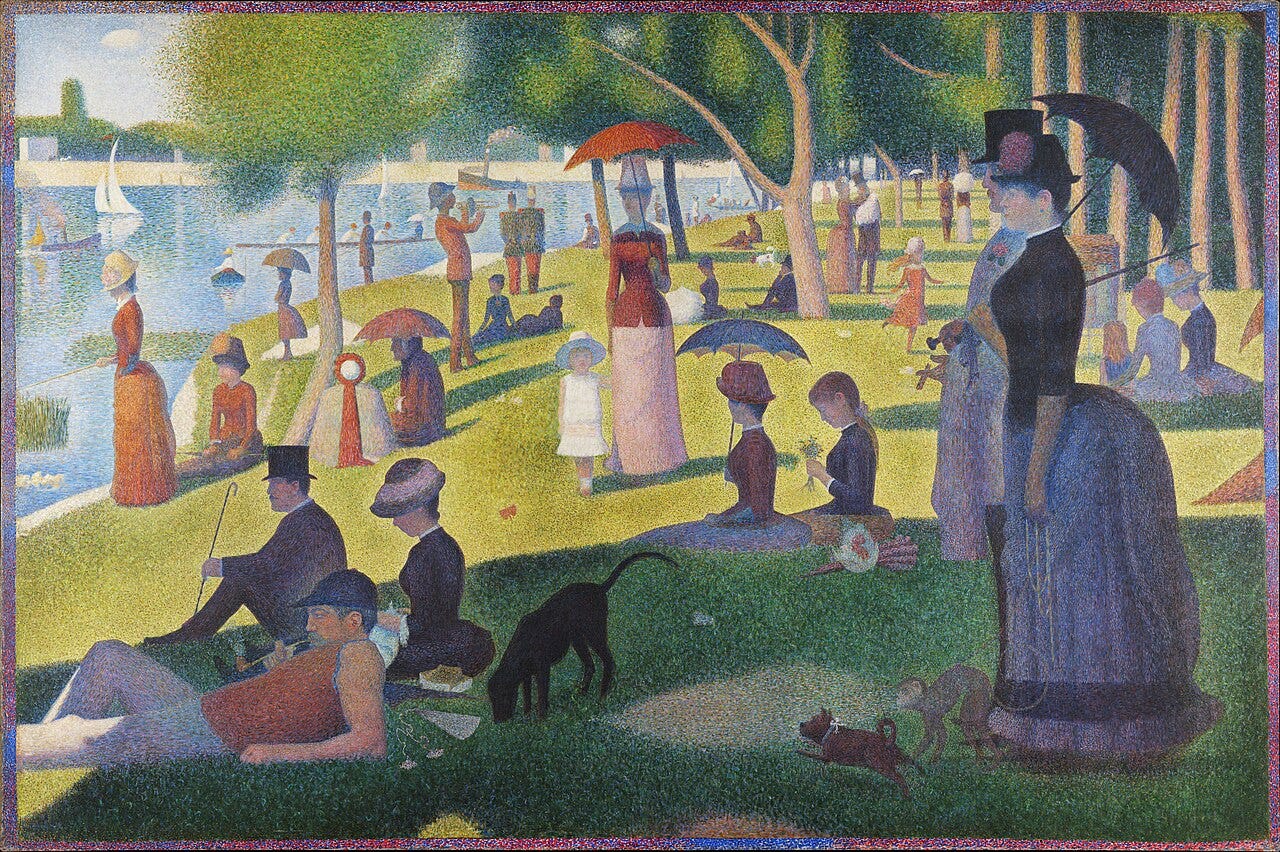
This kind of painting is slow. His great canvas of the Grande Jatte took him two years.
Discover my new newsletter !

Keep learning art the fun way


The Notary
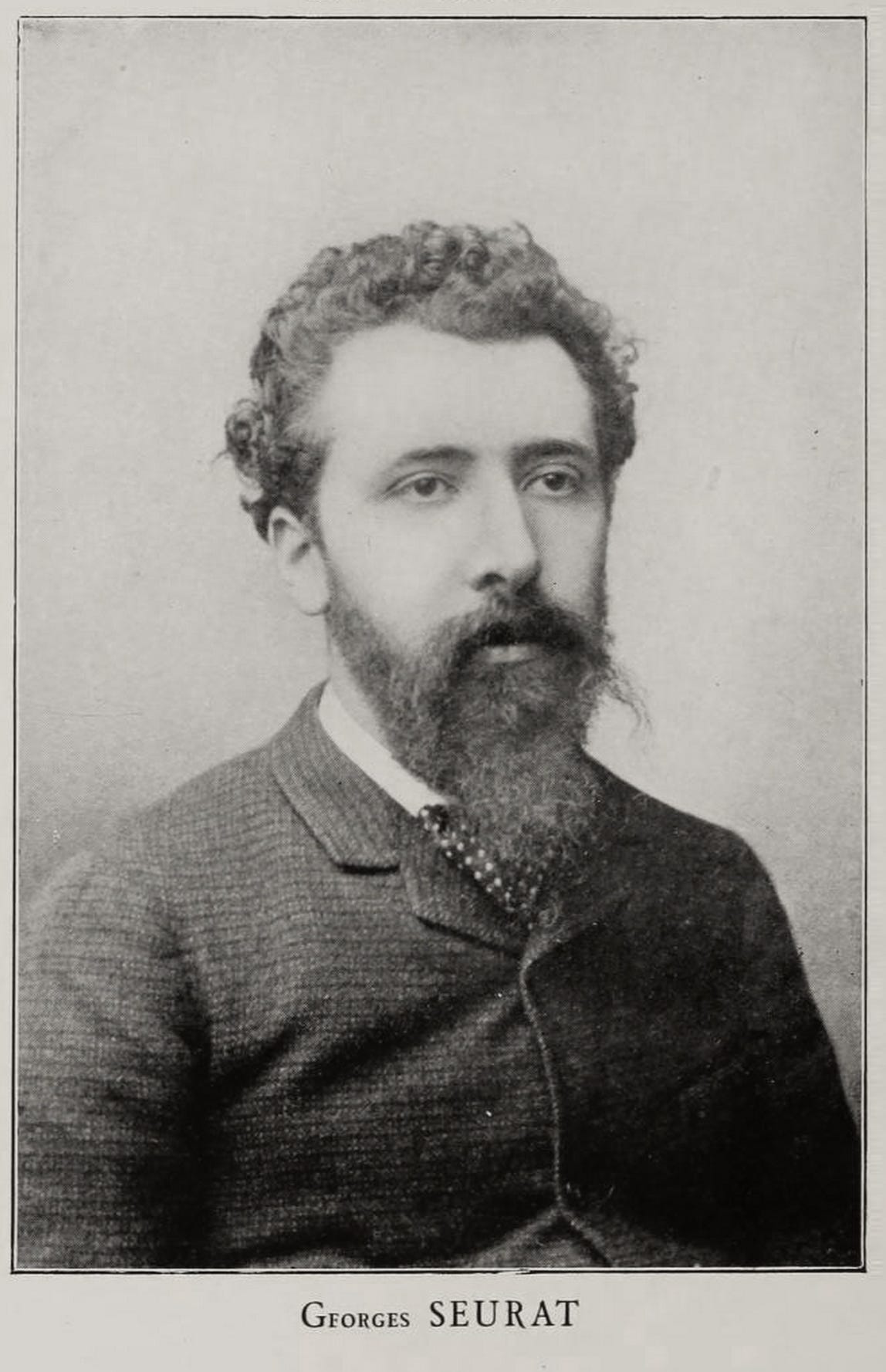
In the cafes where the painters gather, they call him the notary. The frock coat, the stiff collar, the hat, the look of an office clerk with no business in a studio.
Everything about him is in order. The colors lined up, the hours counted, every gesture measured.
Of his life, he says nothing. Signac, who thinks he is his friend, knows almost nothing about him. When someone asks, he answers beside the point, or he stays silent.
Almost every evening, he comes down from Montmartre, crosses Paris, and goes to dine at his mother's, 110 boulevard de Magenta. He sits down, he eats little, he leaves.
He has never had to sell a canvas. His father's money, made in real estate, is what he lives on.
The Woman
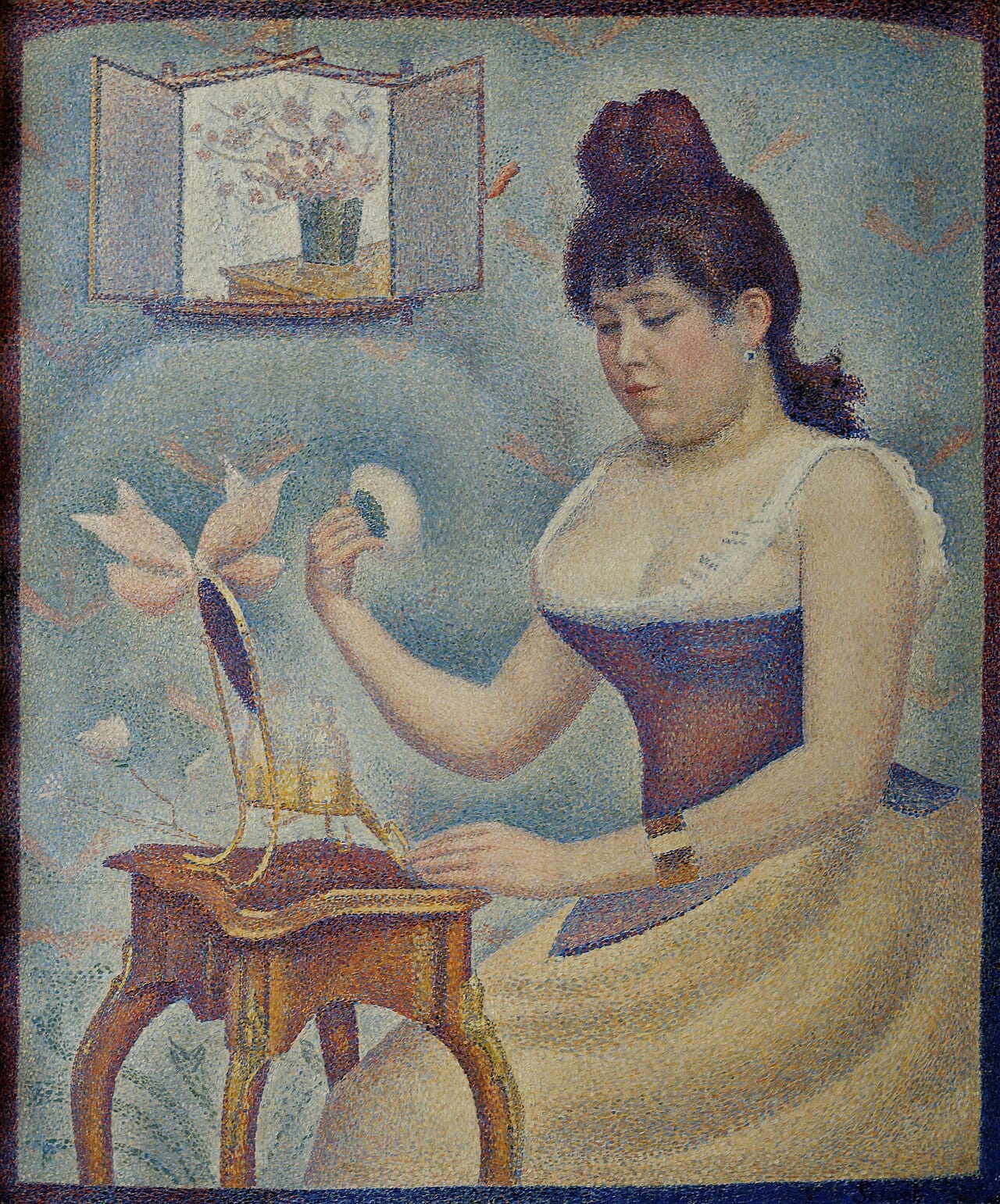
On the canvas, the woman fills almost all the space. Heavy, facing forward, laced into a corset, seated at a small dressing table on slender legs.
He does not make her prettier. He paints her as she is, heavy, the belly just barely rounded under the corset.
She holds a powder puff. She lays it on her skin in small touches.
The same motion as his, a few centimeters away, as he sets down his dots of color.
Her name is Madeleine Knobloch. Born in the 19th arrondissement, to a father the records do not name, to a mother of 18. A seamstress.
When a visitor climbs up to the studio, she leaves the room. None of his friends guesses her real place.
The Reflection
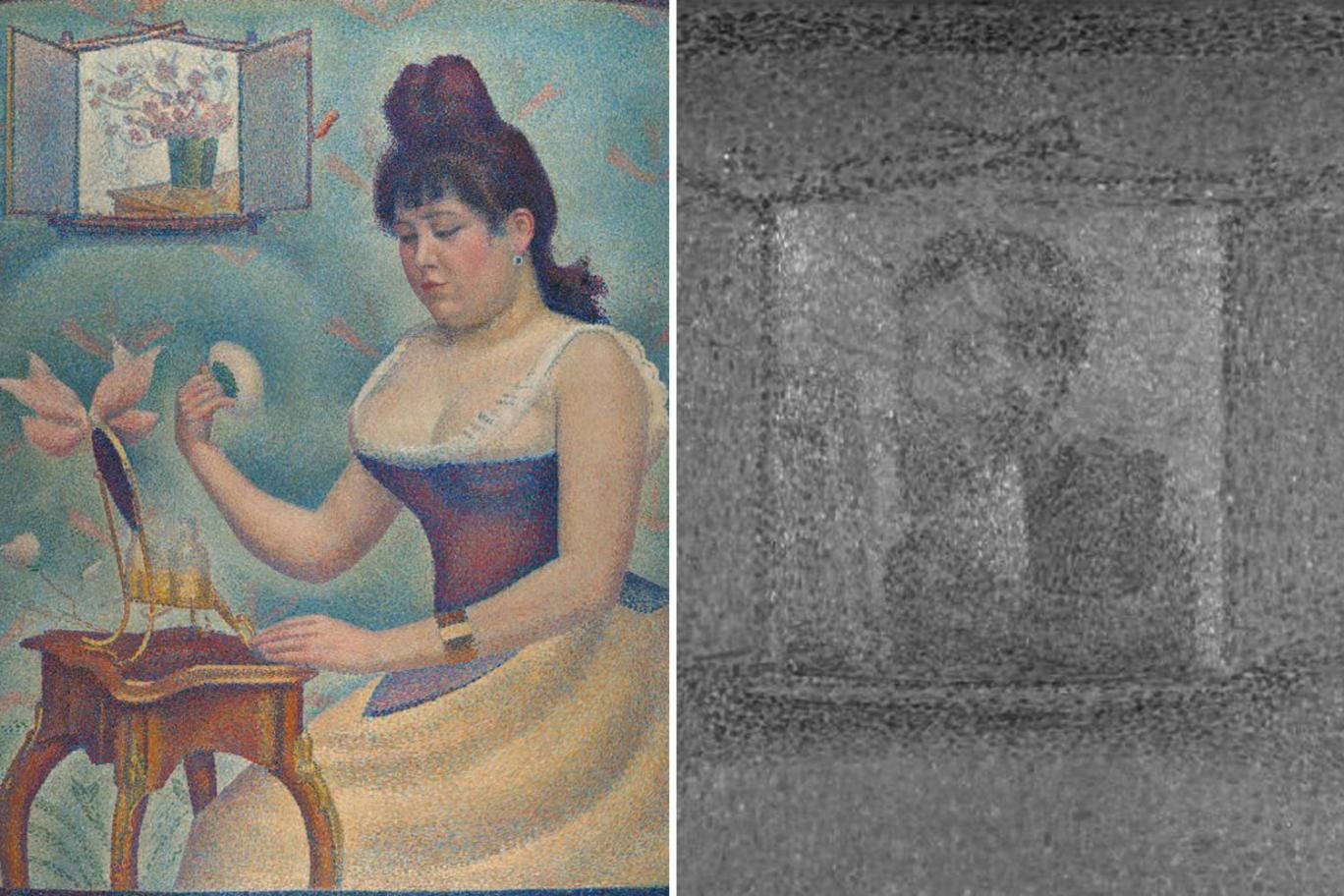
He turns back to the canvas. One corner is left to finish, at the top left.
There, against the back wall, he has painted a small bamboo frame. And inside the frame, a mirror.
In the mirror, a reflection. A man with a long face and a pointed beard, seated at his easel, a brush in his hand.
Himself.
Of all the canvases he has painted, this is the only time he puts himself inside one.
A man who says nothing about his life has set his own face beside hers.
The Visit
One evening, a knock. A painter has climbed the seven flights, a familiar face, one of the few he lets in.
Madeleine gets up and steps into the next room.
The friend moves toward the canvas. The woman, the table, the two little bottles. Then his eyes travel up to the corner, to the little bamboo mirror.
He points a finger at the reflection. He sneers.
Seurat does not move. He lets the other man finish.
The friend leaves without knowing what he has just set off.
Seurat waits for the sound of the footsteps to die away far below.
A bit of mockery has brushed against what he has been hiding for months.
By morning, the little mirror will be gone…