Yves Klein: The Complete Story

A canvas of a single, intense blue, so deep it seems to pull you in. No image, no story, just colour. Yves Klein patented his own shade of blue and built a whole career on it, becoming one of the most provocative artists of the twentieth century in a life that lasted barely thirty four years.

Square Yves Klein @ Lycée Hôtelier Guillaume Tirel @ Paris (
Square Yves Klein @ Lycée Hôtelier Guillaume Tirel @ Paris (32963597993)

He was a French artist, a leading figure of the movement called New Realism, famous for his pure blue monochromes and for turning art into performance.


110,000 readers get the story behind the art every week. Join free.


If this pulled you in, keep going

If you like knowing what is actually going on inside a picture, start with these three:


International Klein Blue

Klein became obsessed with one ultramarine so rich he developed and registered it as International Klein Blue, then covered canvases, sculptures and sponges in it.

These pure blue fields are some of the purest works of abstract art ever made, an attempt to paint pure feeling and infinity with nothing but colour.

Painting with bodies

In his Anthropometries, Klein directed nude models to coat themselves in blue paint and press their bodies onto paper, while an orchestra played a single sustained note.

The result turned the human figure into a living brush, a startling rethink of the nude in art staged as a public performance before an audience.

The void and the leap

Klein staged an exhibition of an empty gallery, which he called the Void, and crowds came to see nothing at all.

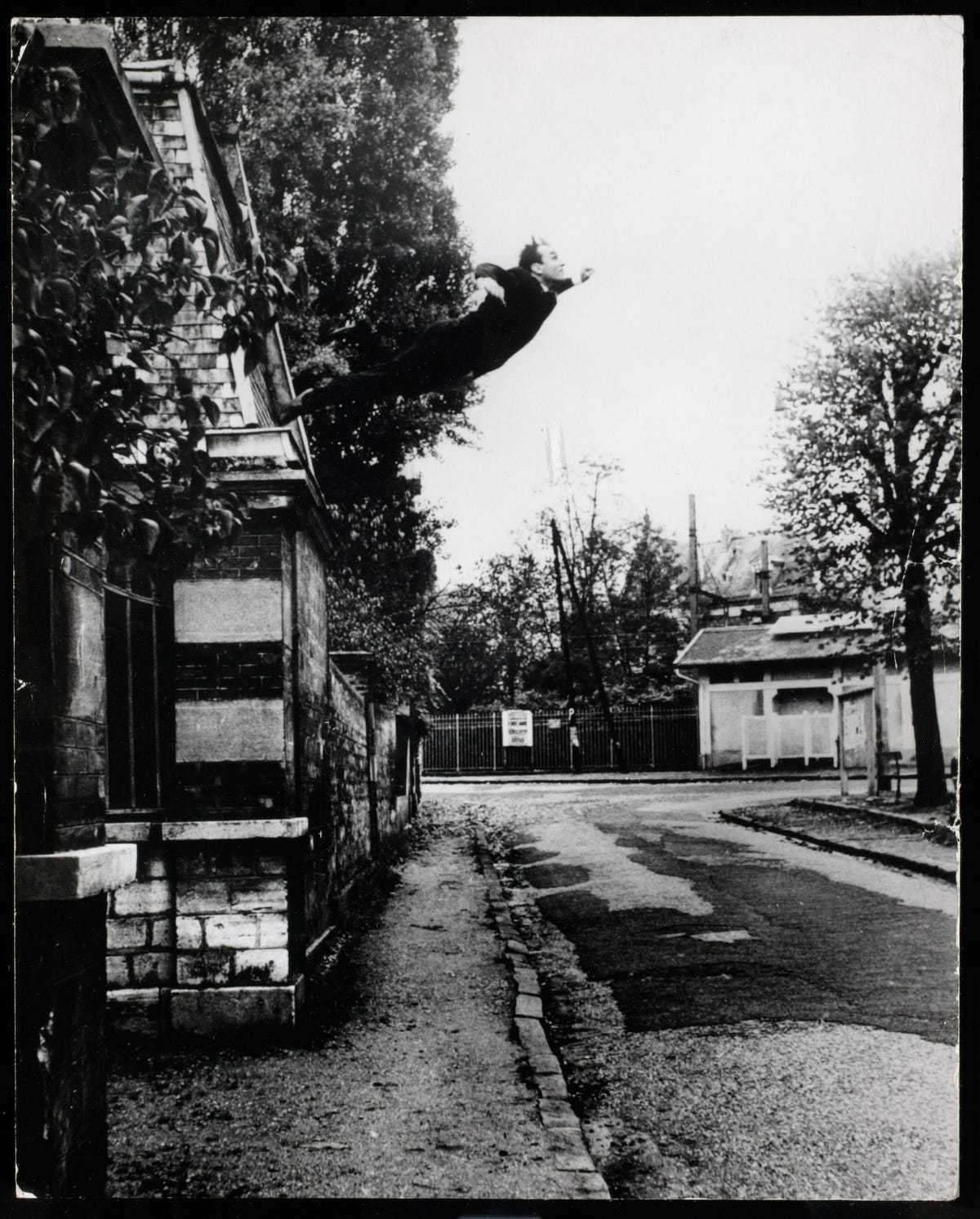
He also produced a famous photograph, Leap into the Void, that seems to show him diving from a wall into empty air, an early masterpiece of staged, faked imagery.

Fire, gold and judo

Klein worked with fire, scorching canvases with a flamethrower, and with gold leaf, and he was also a serious judo master who wrote a book on the sport.

He treated his whole life as art, blending mysticism, showmanship and ritual into everything he did in his short, intense career.

What people ask about Yves Klein

What is he known for?

His pure blue monochromes and his body print performances.

What is IKB?

International Klein Blue, the ultramarine he developed and registered.

Did he really leap into the void?

The famous photo was staged and montaged, not a real fall.

When did he die?

In 1962, of a heart attack, at the age of thirty four.

Why the blue still pulls us in

Klein crammed a lifetime of provocation into a handful of years, and proved that a single colour could carry as much weight as any picture.

His blue is now so identified with him that the shade itself bears his name, a rare case of an artist owning a colour outright.


110,000 readers get the story behind the art every week. Join free.


He sold an invisible work, a zone of immaterial sensitivity, in exchange for gold, then threw half the gold into the Seine as part of the ritual, with photographs to prove it.

His sudden death at thirty four, just months before his child was born, sealed his legend as an artist who lived and worked at a furious, almost reckless pace.

His influence on later art was enormous, feeding directly into minimalism, performance art and conceptual art, all of which built on ideas he had tested first.

For an artist who worked for barely eight years, the reach is astonishing, and museums around the world now treat his blue panels as touchstones of postwar art.

His blue sponges, mounted on panels, turned a humble studio material into precious objects, and his fire paintings, scorched with a flamethrower, pushed the very idea of how a picture could be made.

Each new stunt or invention seemed designed to test the limits of what art could be, and most of those limits never quite recovered.


One good art story at a time. Join free, no catch.