Zao Wou-Ki: The Complete Story

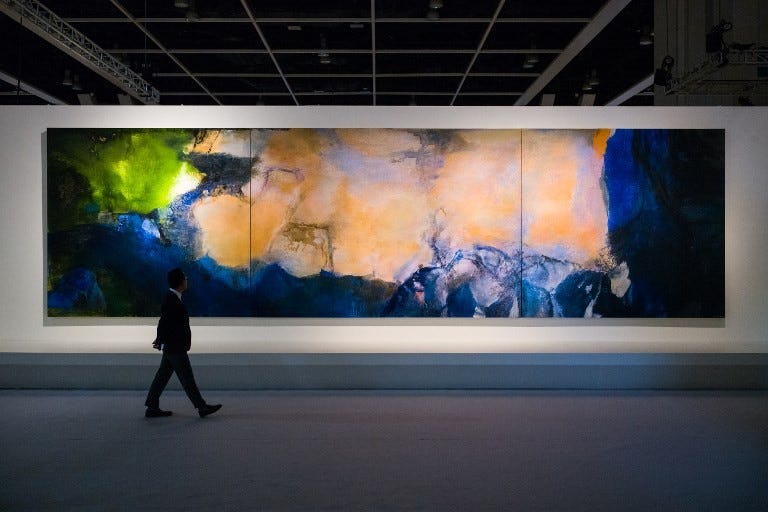
Vast canvases of swirling colour and light that seem to be landscapes, or storms, or the moment before a world takes shape. Zao Wou Ki brought together the brush traditions of China and the abstraction of postwar Paris, and became one of the most celebrated painters to bridge East and West.

He was a Chinese French artist whose lyrical abstract paintings fused Chinese ink traditions with European modern art, and now sell for record sums.


110,000 readers get the story behind the art every week. Join free.


The next thing to read

Three worth opening next:


Between two traditions

Zao trained in Chinese painting and calligraphy before moving to Paris in 1948, where he fell in with the leading abstract painters of the day.

His work joined the deep space and brushwork of Chinese art to Western abstract art, creating something that belonged fully to neither and to both.

Painting light and space

His large oil paintings are built from layers of luminous colour, with forms that hover between pure abstraction and hints of mountains, water and sky.

He often titled them simply with dates, inviting the viewer to feel the painting as an event of light rather than a picture of anything.

The return to ink

Late in his career Zao returned to the Chinese ink of his youth, making washes of grey and black that breathe with empty space.

This homecoming closed a circle, the master of Western oils rediscovering the brush traditions he had left behind decades earlier.

A global success

Zao became hugely successful, honoured in France, where he was elected to its academy of fine arts, and celebrated across Asia.

His paintings now break auction records, among the most valuable works by any Asian artist of the modern era.

Questions readers ask about Zao Wou-Ki

What is he known for?

Lyrical abstract paintings fusing Chinese and Western traditions.

Where did he work?

Mostly in Paris, after leaving China in 1948.

Did he return to ink?

Yes, he came back to Chinese ink late in his life.

When did he die?

In 2013.

Why his bridge between worlds matters

Zao showed that the great traditions of East and West did not have to compete, and could meet in a single luminous canvas. His paintings now hang in the world leading museums and command record prices, proof that the meeting of two cultures can produce something entirely new.


110,000 readers get the story behind the art every week. Join free.


He was close friends with poets and composers, and his work was admired by figures across the arts who saw in it the same search for the infinite.

One of his large triptychs sold in Hong Kong for a sum that set a record for the artist, confirming the global hunger for an art that speaks in two languages at once.

His paintings hang in the leading museums of Europe, Asia and the Americas, and retrospectives of his work draw crowds on several continents.

He stands as one of the clearest proofs that the deep traditions of Chinese art could enter the heart of Western modernism and emerge stronger, not diluted, a quiet revolution carried out one luminous canvas at a time.

He was elected to the prestigious Academy of Fine Arts in France, a rare honour for an artist born abroad, sealing his place at the very centre of postwar French culture.

His large triptychs and luminous abstractions remain among the most prized works by any artist of Asian origin, sought by collectors and museums across the world.

His friendships reached across the arts, and his calm, searching surfaces continue to influence painters who want to make abstraction feel like a place rather than a pattern.


Get more art secrets and stories in your inbox, free.