Andy Warhol: The Complete Story
Andy Warhol went to church nearly every week of his life, kept 610 sealed cardboard boxes of his daily mail, and survived being shot in 1968. The man who said he wanted to be a machine was the most complicated soul in the room, disguised as the emptiest.
From a Pittsburgh sickbed to a 195 million dollar Marilyn, the record deserves better than the wig and the one-liners.
Andy Warhol at a glance:
1928: born Andrew Warhola in Pittsburgh to Carpatho-Rusyn immigrants; a childhood nerve illness keeps him home with comics and movie magazines.
1949: arrives in New York and becomes the city's best-paid shoe illustrator before the fifties are half over.
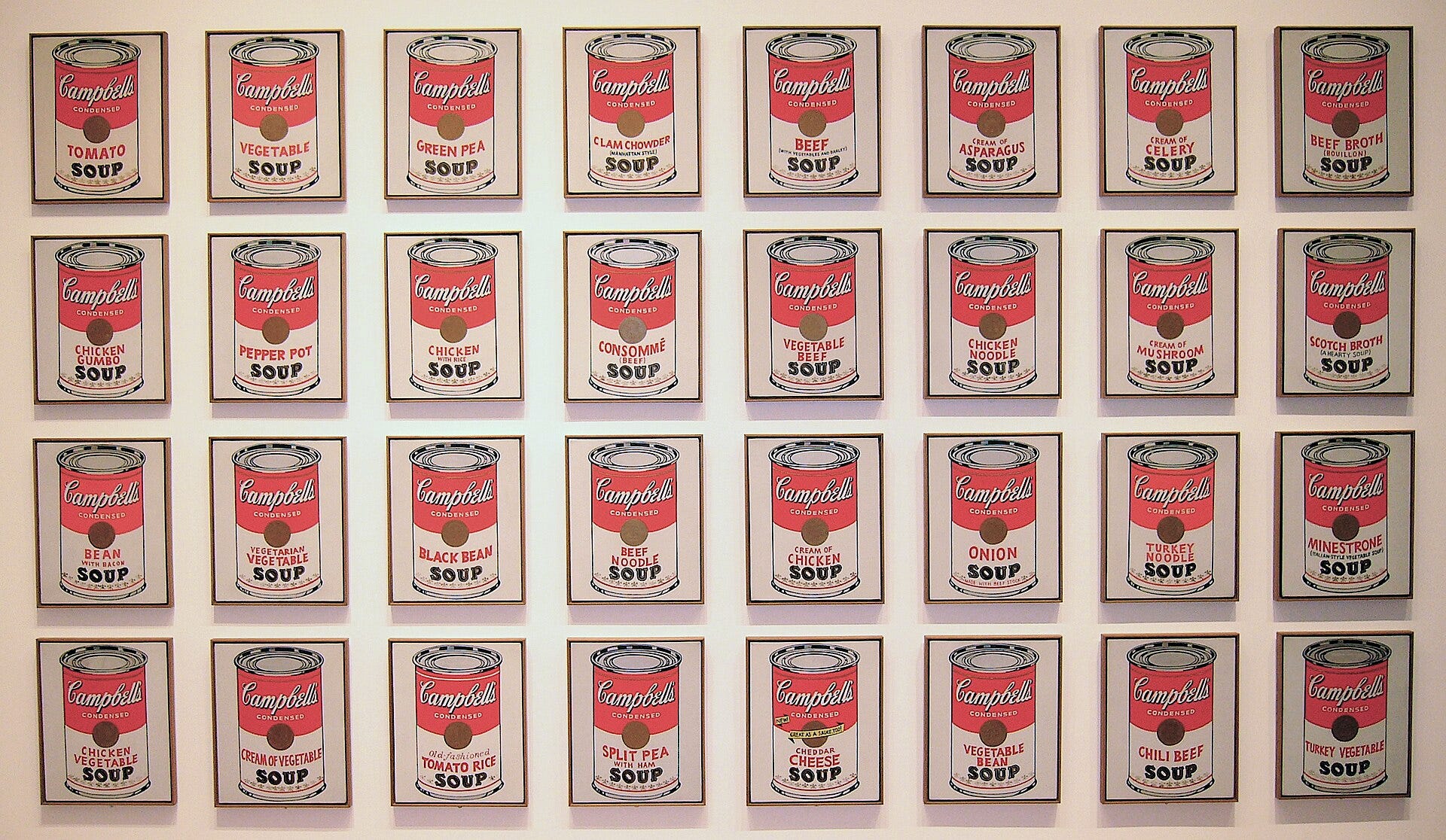
1962: the Campbell's cans show in Los Angeles; the Factory's silkscreen assembly line follows within two years.
1968: survives being shot by Valerie Solanas; the wounds and the corset stay with him for life.
1987: dies at 58 after routine gallbladder surgery; the memorial fills St Patrick's Cathedral.

Pittsburgh, sickness, and shoes
Andrej Warhola was born in Pittsburgh on August 6, 1928, to Carpatho-Rusyn immigrants who worshipped in the Byzantine Catholic rite.
A childhood attack of Sydenham's chorea kept him bedridden with movie magazines, and the fan worship never left.
In 1950s New York he became the highest paid shoe illustrator in advertising, a detail his fine-art rivals never let him forget.
1962: soup, Marilyn, and the assembly line
In July 1962 the Ferus Gallery in Los Angeles showed his 32 Campbell's Soup Cans at 100 dollars each; dealer Irving Blum bought the set back and kept it together, and it now lives at MoMA. When Marilyn Monroe died that August, Warhol began silkscreening her face on an industrial scale, and by 1964 the silver-foiled Factory was producing paintings, films, and Screen Tests with the Velvet Underground rehearsing in the corner.
More incredible painter stories
If Andy Warhol pulled you in, you will love these too:
June 3, 1968: the shooting
Valerie Solanas, a writer on the Factory's fringe, shot Warhol in the chest at close range.
Surgeons opened his heart to save him; he was pronounced clinically dead before being revived, and wore a surgical corset for the rest of his life.
The Factory got a doorman, the sixties ended early at 33 Union Square, and Warhol turned to commissioned portraits, Interview magazine, and the Mao series of 1972.
The myth of the cynical machine
Warhol built the blank persona himself, so the correction has to be documentary.
He attended mass at St Vincent Ferrer with his mother for decades, volunteered at church soup kitchens at Thanksgiving and Christmas, financed his nephew's seminary studies, and filled his last years with a Last Supper series of more than a hundred works.
The diaries published after his death read less like a machine than like the loneliest careful observer in New York.
The end, the boxes, and where to see him
Warhol died on February 22, 1987, at 58, after routine gallbladder surgery.
Sorting his estate, archivists found the Time Capsules: 610 sealed boxes into which he had swept mail, photographs, pizza dough, and taxi receipts since 1974, still being catalogued at the Andy Warhol Museum in Pittsburgh, the largest museum devoted to a single artist in North America.
In May 2022 Shot Sage Blue Marilyn sold for 195 million dollars, the record for any American artwork at auction.
The films nobody watched all of
Between 1963 and 1968 the Factory produced hundreds of films: a man sleeping for five hours, the Empire State Building for eight, screen tests of anyone who sat still.
The point was duration itself, attention stretched until it snapped or became something else. Cinema took decades to catch up with the dare.
He financed the Velvet Underground out of the same instinct: put the machine near interesting people and record everything.
The commissions machine
After the shooting, portraits became the business model: 25,000 dollars a face in the seventies, Polaroid session included, dictators and collectors processed with identical courtesy.
Interview magazine, the TV shows, the modeling contract: he franchised himself across media before anyone had the word for it.
Critics called the late Warhol a sellout for exactly the practices that now look like the prophecy: the artist as brand, the brand as work.
The church on 89th Street
Almost no one at the Factory knew that Warhol went to mass, quietly and often, at St Vincent Ferrer, and volunteered at church suppers for the homeless.
The last paintings are sixty Last Suppers after Leonardo, made for a show across the street from Milan's original.
The wigs and the piety were not a contradiction he felt any need to resolve. Both were ways of disappearing in plain sight.
The Andy Warhol questions that keep coming up
What is Andy Warhol famous for? Turning mass production into fine art: silkscreened soup cans, Marilyns, and Maos, plus films, the Factory, and the idea that fame itself is a medium.
How much is a Warhol worth? Shot Sage Blue Marilyn brought 195 million dollars in 2022. Strong canvases regularly clear eight figures, and even prints reach six.
Was Warhol religious? Quietly and seriously. Raised Byzantine Catholic, he attended mass most of his life, did volunteer work, and ended his career on a massive Last Supper cycle.
What happened when Warhol was shot? Valerie Solanas shot him on June 3, 1968. He was declared clinically dead, revived after open-chest surgery, and lived in pain, and a corset, for his remaining 19 years.
What are the Time Capsules? 610 cardboard boxes he filled, taped shut and dated for 13 years: mail, invoices, pizza dough, a mummified foot. The Warhol Museum in Pittsburgh is still cataloguing them.
Did Warhol actually make his own work? He designed, cropped, chose color and supervised; assistants pulled screens. The delegation was the statement, and he never hid it: he named the studio the Factory.
More secrets to unlock
Later came
Warhol taped a box shut nearly every two weeks for 13 years and called it art for later. The museum cataloguing the 610 Time Capsules has found lawsuits, love letters, a mummified foot, and Concorde cutlery. He was right: later came.