The most famous birth in art history contains no birth at all.
By the time Botticelli's goddess stands on her shell, the event named in the title is already over. What we watch is a landing.
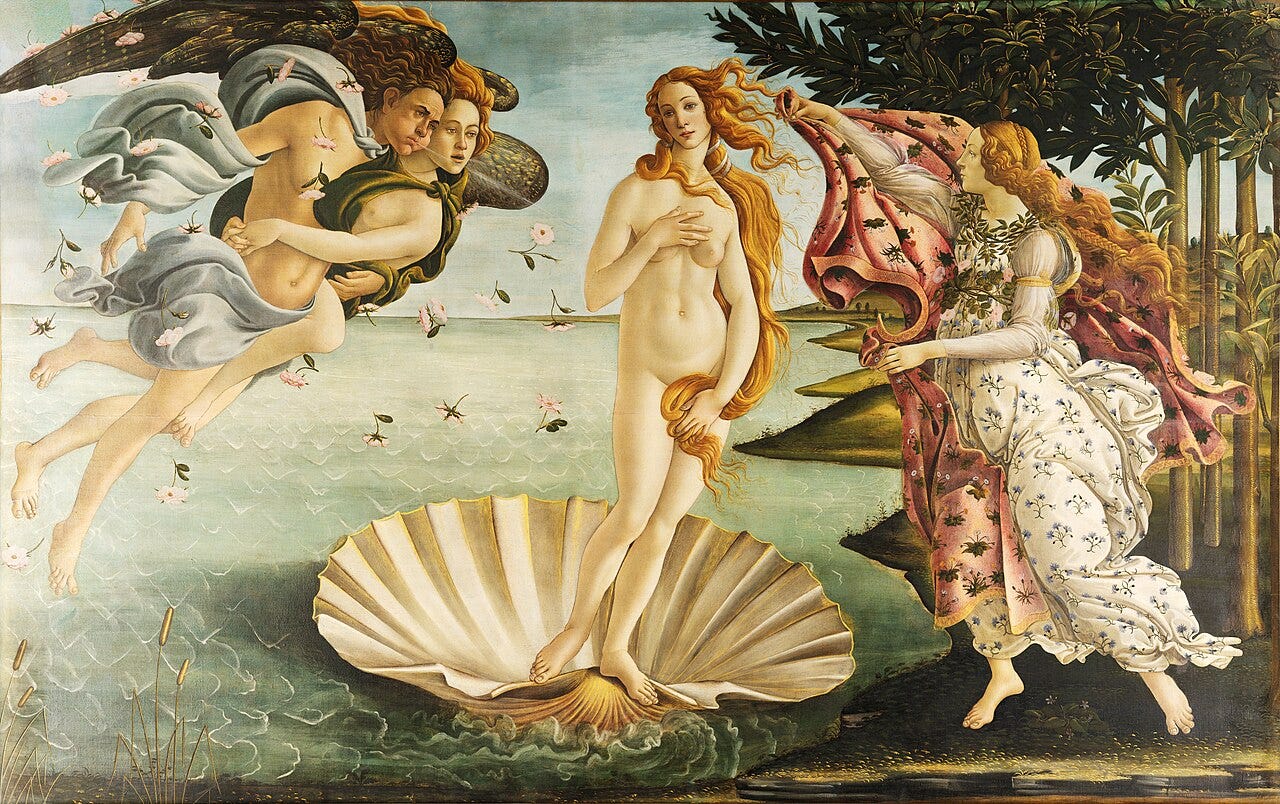
Sandro Botticelli painted The Birth of Venus around 1485; it hangs in the Uffizi Gallery in Florence. Despite its title, the canvas shows the goddess arriving on the shore of Cyprus, carried in by winds, some time after her birth from sea foam.
Wind gods on the left, Zephyr among them, blow her across the water. On the right, one of the Horae, the goddesses of the seasons, waits with a floral cloak to cover her.
So the picture is really a welcome. The birth happened out at sea, off screen, and it was far stranger than the painting lets on.
What Botticelli Actually Painted
The canvas measures 172.5 by 278.5 centimeters, unusually large for a mythological subject in the 1480s. Sacred scenes got that kind of square footage. Pagan goddesses usually did not.
The support is unusual too. Botticelli worked in tempera on canvas rather than the wood panel most Florentine painters preferred, likely because canvas was cheaper and lighter for a countryside villa. The painting is first recorded in 1499 in an inventory of the Medici villa of Castello, alongside his Primavera.
Venus herself holds a pose with a long pedigree. She covers her breast with one hand and her groin with her hair, the gesture known as Venus Pudica, a type that runs back through ancient Greek and Roman sculpture.
The closest ancestor is the Venus de' Medici, an ancient marble Botticelli could have known through Florentine collections. He essentially took a statue a thousand years old and set it afloat.
The Myth Nobody Tells in Full
Ask most people how Aphrodite was born and you get something soft. Sea foam, a shell, a goddess rising like a swimmer at dawn.
Hesiod's Theogony tells it differently. Cronus castrates his father Uranus and throws the severed genitals into the sea. Foam gathers around them, and from that foam the goddess takes shape.
Her name records it. Aphros is Greek for foam, so Aphrodite is, roughly, the foam born one. The prettiest name in the pantheon comes out of a mutilation.
She drifts first to the island of Cythera, then comes ashore on Cyprus. That Cyprus landing is the moment Botticelli chose, which is why the Hora stands ready with a cloak, greeting a goddess who has just crossed open water.
Popular explainers tend to skip the castration entirely. It is worth restoring, because it changes how the painting reads: all that calm on the surface of the Uffizi canvas sits on top of the most violent origin story in Greek myth.
Venus After the Shell: Titian and Velazquez
Painters did not stop at the shoreline. Once Venus was ashore, European art gave her a long second life, mostly horizontal.
Titian's Venus of Urbino, painted in 1538 and also in the Uffizi, is the template. A nude modeled on Venus reclines on a bed, yet the room around her is a contemporary Venetian bedroom, with servants and a sleeping dog. The mythology has thinned to a name.
A century later, Diego Velazquez painted the Rokeby Venus, around 1647 to 1651, now in the National Gallery in London. She lies with her back to us, studying her own face in a mirror held by Cupid.
That canvas is one of very few female nudes by a Spanish painter of the era, since the Spanish Inquisition kept tight restrictions on nude art. Velazquez needed the cover of mythology to paint her at all.
These reclining figures belong to a different iconography from Botticelli's. His Venus is arriving, upright, in motion between sea and land. Theirs are settled, indoors, at rest. Same goddess, different chapter of her story.
How to Recognize a Birth of Venus Scene
If you want to sort one Venus from another in a museum, the birth and arrival type carries fixed props.
Look for the shell, her vehicle across the water. Look for wind figures blowing her toward land. Look for a receiving figure holding out a cloak or garment.
A reclining Venus on a bed or couch, the Titian and Velazquez type, is a later life image. No shell, no wind, no shore.
Questions People Ask
Where is The Birth of Venus today? In the Uffizi Gallery in Florence, where it shares the collection with Botticelli's Primavera. Both paintings were recorded together at the Medici villa of Castello in 1499.
Does the painting actually show a birth? No. It shows Venus arriving on Cyprus after her birth at sea, blown ashore by wind gods and met by one of the Horae holding a cloak.
Why is Aphrodite associated with sea foam? In Hesiod's Theogony she forms from the foam, aphros in Greek, that gathers around the severed genitals of Uranus after Cronus castrates him. Her name comes from that word.
What is the difference between The Birth of Venus and the Venus of Urbino? Botticelli paints an arrival scene with shell, winds, and shore. Titian paints a reclining nude in a contemporary bedroom, a separate iconographic type that borrows the goddess's name without her myth.
The earliest record of the painting is that 1499 inventory of the Medici villa of Castello, where Botticelli's canvas, all 172.5 by 278.5 centimeters of it, was listed among the villa's furnishings.