Clouds in Painting: 12 Skies That Steal the Show

Clouds are the only subject in art history with no edges.

Mantegna's painted oculus opening the ceiling onto a ring of sky and figures
Andrea Mantegna, oculus ceiling, Camera degli Sposi, 1474, fresco, Palazzo Ducale, Mantua

A face holds still. A mountain holds still. A cloud dissolves while you mix the white, and the one you finally paint never existed in the sky at all.

For five centuries, painters answered that problem in wildly different ways. Some froze clouds into furniture solid enough to seat a god. One Englishman chased them with a pocket watch and a wind gauge. One American waited until she was in her seventies and saw them from above.

Quick answer: Painters treated clouds three ways: as illusion, from Mantegna's 1474 painted oculus to Tiepolo's Wurzburg ceiling; as science, in Constable's dated cloud studies after Luke Howard's 1802 classification; and as pure subject, in O'Keeffe's 24 foot Sky Above Clouds IV.

1. Andrea Mantegna opens a hole in the ceiling, Mantua, 1474

In the Camera degli Sposi of the Palazzo Ducale in Mantua, Mantegna painted a round opening in the ceiling, a fake oculus giving onto blue sky, with winged babies and smirking court ladies peering down at whoever stands below.

The room was finished in 1474. It is usually counted as the first fully worked out painted sky meant to fool the eye from directly underneath, the trick later named di sotto in su, seen from below.

The clouds here are small and polite. But the door was open. Once a ceiling could become sky, every ceiling in Europe was a candidate.

2. Correggio turns a cathedral dome into weather, Parma, 1526 to 1530

Correggio's dome fresco of a spiraling vortex of clouds and bodies in Parma Cathedral
Correggio, Assumption of the Virgin, 1526 to 1530, fresco, dome of Parma Cathedral

A generation later, Correggio filled the dome of Parma Cathedral with his Assumption of the Virgin, a vortex of bodies and cloud spiraling up toward a burst of light.

Seen from the nave floor, the architecture disappears. You are looking up through rings of figures who seem to tumble in actual air.

Not everyone was grateful. A local churchman famously dismissed the dome as a stew of frog legs, all those foreshortened limbs dangling overhead. The frog legs won. Correggio's dome became the template for two centuries of ceiling painting.

New here? Learn art the fun way. Free stories every week, no boring lectures.

3. Andrea Pozzo builds scaffolding out of vapor, Rome, 1690s

On the nave ceiling of Sant'Ignazio in Rome, Andrea Pozzo painted the Apotheosis of Saint Ignatius, completed in the 1690s, where painted architecture continues the real church upward into open sky.

Look at what actually holds everyone up. Saints, angels, and allegories of four continents all ride on clouds, which by now had become the standard load bearing material of Baroque heaven.

Pozzo even marked a disc on the church floor showing the one spot where the illusion locks perfectly into place. Step away from it and the painted columns start to lean.

4. Tiepolo paints the biggest sky ever attempted, Wurzburg, 1752 to 1753

Above the grand staircase of the Wurzburg Residence in Germany, Giovanni Battista Tiepolo frescoed Apollo and the Continents, a single ceiling of more than 600 square meters, often cited as the largest ceiling fresco in the world.

Europe, Asia, Africa, and America sit around the edges while gods circulate overhead, and clouds do all the logistics. They carry figures, separate zones, and bridge the gap between painted sky and real cornice.

Tiepolo was summoned from Venice specifically for this job. Rococo cloud painting never went higher, in either sense.

5. Japan makes clouds do the editing

In Japanese narrative handscrolls and folding screens, bands of stylized gold cloud drift across the picture. The convention is often called suyari gasumi, and it has nothing to do with weather.

The clouds are editing tools. They separate scenes, hide what the story does not need, and cover jumps in time and place inside one continuous image.

Illustrated versions of The Tale of Genji use the device constantly. A pair of Genji screens in the Suntory Museum of Art in Tokyo, Suma and Hashihime, splits two separate episodes with gold clouds so the eye reads them as different moments, centuries before film invented the cut.

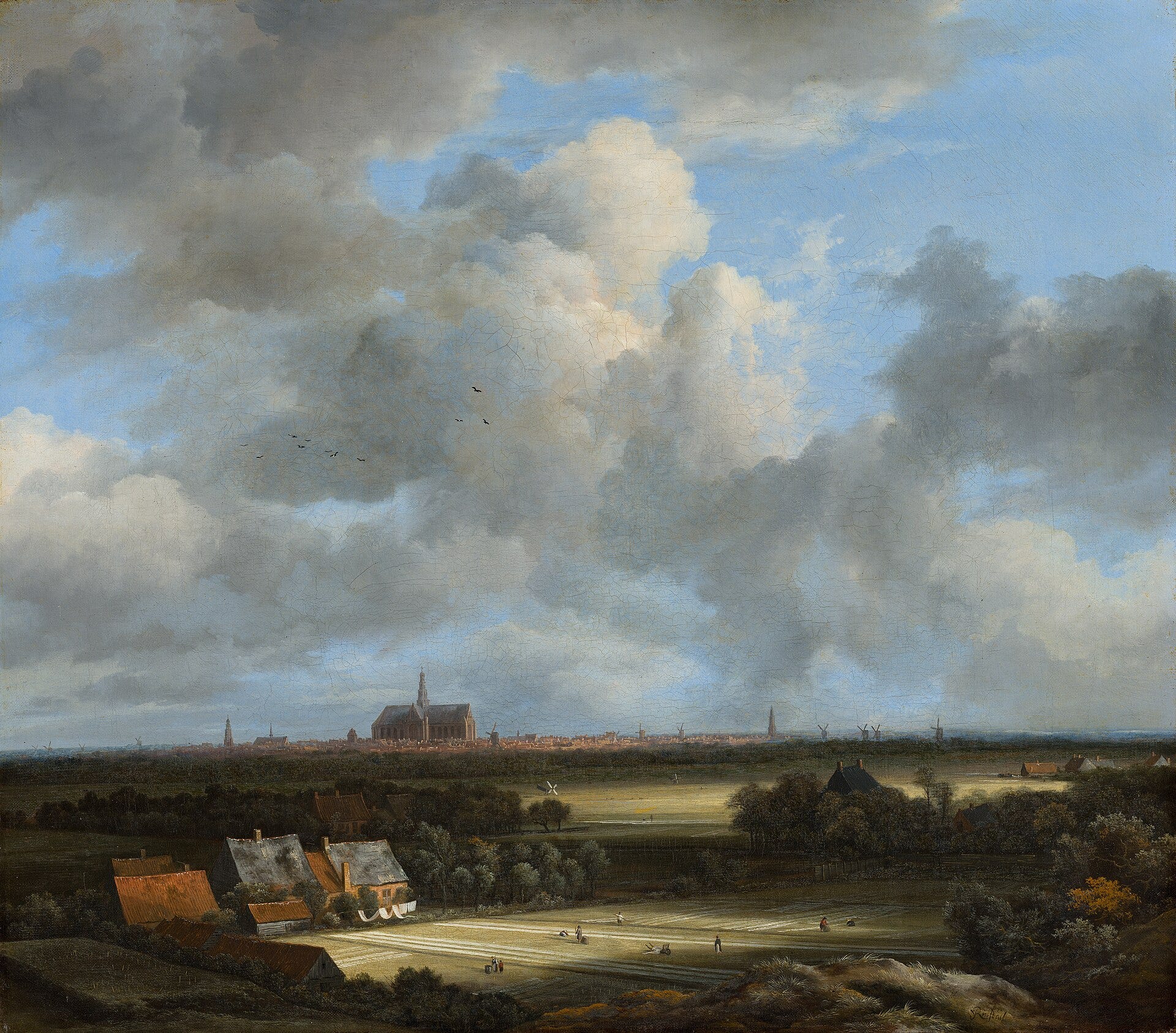
6. Jacob van Ruisdael gives the sky two thirds of the canvas, Haarlem, 1670s

The Dutch had no mountains, so they painted altitude with vapor. In Ruisdael's views of Haarlem from the 1670s, so popular they earned their own nickname, Haarlempjes, the horizon sits low and cumulus towers claim roughly two thirds of the picture.

In the version at the Mauritshuis in The Hague, sunlight falls through gaps in the clouds onto linen bleaching fields outside the city.

The clouds are not backdrop. They run the lighting for the entire painting, deciding which strip of Holland gets the sun.

7. Luke Howard names the clouds, and Constable goes skying, Hampstead, 1821 to 1822

Constable's Hay Wain under a broad cloudy English sky over the river
John Constable, The Hay Wain, 1821, National Gallery, London

In 1802, a London pharmacist and amateur meteorologist named Luke Howard proposed a classification of clouds into types, cumulus, cirrus, stratus, nimbus, that meteorologists still use today.

A generation later, John Constable took that science outdoors. In 1821 and 1822, mostly on Hampstead Heath, he made around 50 surviving oil studies of nothing except sky, a practice he called skying in a letter to his friend John Fisher.

He treated each one like a lab record, inscribing the back with date, time, wind, and weather. One study now at the Royal Academy in London carries the date 11 September 1821, painted between 10 and 11 in the morning under sultry light and a southwest wind.

8. Constable writes cirrus on the back, about 1822

One small oil on paper at the Victoria and Albert Museum shows only wisps of high white cloud on blue. On the reverse, Constable wrote a single word: cirrus.

That word is Howard's, from the new scientific vocabulary. Constable owned and annotated a copy of Thomas Forster's Researches About Atmospheric Phaenomena, the book that spread Howard's classification.

It is one of the rare moments in art history where you can watch a science land inside a painting, in the artist's own handwriting.

9. Turner's colour beginnings, sky with nothing under it

Among the works Turner left to the British nation, Tate holds hundreds of unfinished watercolor studies now known as colour beginnings, many of them washes of sky and atmosphere with no subject, no shore, no ship.

They were private working material, never exhibited in his lifetime.

To modern eyes they look like abstraction arriving a century early, which is exactly why curators keep hanging them. Turner was not making pictures of things in the sky. He was testing what a sky is made of.

10. Georgia O'Keeffe paints the view from the airplane window, 1965

O'Keeffe began flying commercially in her seventies and became obsessed with the unbroken field of flat white clouds seen from above, stretching to a curved horizon.

In 1965, at 77, she painted Sky Above Clouds IV, a canvas roughly 8 feet tall and 24 feet wide, one of the largest paintings of her career. It hangs at the Art Institute of Chicago.

There was a family precedent for treating sky as a complete subject. Her husband Alfred Stieglitz had photographed his Equivalents in the 1920s, small prints of clouds alone, offered as pictures of pure feeling.

11. Gerhard Richter paints clouds from photographs, around 1970

In the late 1960s and 1970s, Gerhard Richter made a group of cloud paintings based on photographs, including Wolke, Cloud, of 1971, now at the Museum of Modern Art in New York.

The subject that once carried saints into Baroque heaven now arrives secondhand, through a camera, rendered with deadpan precision.

Richter kept the source snapshots in his Atlas, his archive of working photographs. The cloud had completed its journey from divine vehicle to found image.

12. Magritte hangs a sky where it should not be

Magritte's Son of Man, a man in a bowler hat with a green apple, under a cloudy sky
Rene Magritte, The Son of Man, 1964, private collection

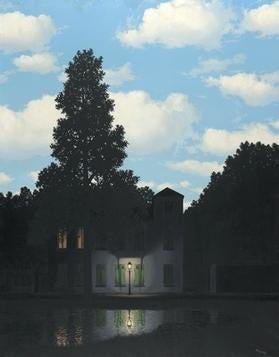
Rene Magritte used the same crisp cumulus cloud his whole career, floating it through doorways, mirrors, and eyes. The Curse, from 1931, is reported to show nothing except blue sky and clouds, a painting of weather with the world removed.

He also put clouds back on a ceiling. In 1951 he painted a blue sky with clouds across the ceiling of the Theatre Royal des Galeries in Brussels, a Surrealist handshake with Tiepolo across two centuries.

Where to see them

Italy. Mantegna's oculus in the Palazzo Ducale, Mantua. Correggio's dome in Parma Cathedral. Pozzo's nave ceiling in Sant'Ignazio, Rome.

Germany. Tiepolo's staircase ceiling at the Wurzburg Residence, a UNESCO World Heritage Site.

London. Constable cloud studies at the Victoria and Albert Museum and the Royal Academy of Arts. Turner's colour beginnings at Tate Britain, shown in rotation.

The Hague. Ruisdael's View of Haarlem with Bleaching Grounds at the Mauritshuis.

United States. O'Keeffe's Sky Above Clouds IV at the Art Institute of Chicago. Richter's Wolke at the Museum of Modern Art, New York. The Yale Center for British Art also holds Constable sky studies.

Tokyo. Genji screens with gold cloud conventions at the Suntory Museum of Art.

Related skies

If it is the sea rearing up and ships going under that you want, that drama lives on our page about Storm Paintings; this page is about clouds as shape and structure, not danger.

If it is haze swallowing the world, that is Fog in Art; clouds here have edges to study, fog exists to erase them.

For the whole overhead subject in one place, from dawn to stars, start with The Sky in Art.

FAQ: clouds in painting

  • Who first gave clouds their scientific names? Luke Howard, a London pharmacist, proposed cumulus, cirrus, stratus, and nimbus in 1802. Meteorologists still use his terms, and Constable absorbed them through Thomas Forster's book.

  • What does di sotto in su mean? Seen from below. It is the technique of painting ceilings so figures and clouds appear correctly foreshortened to a viewer looking straight up, pioneered in Mantegna's Camera degli Sposi.

  • Why are the clouds gold in Japanese screens? They are a narrative convention, often called suyari gasumi, used to separate scenes and hide jumps in time within one image, not to describe weather.

  • What is the largest cloud ceiling ever painted? Tiepolo's fresco over the Wurzburg Residence staircase, more than 600 square meters, is often cited as the largest ceiling fresco in the world.

  • How many cloud studies did Constable make? Around 50 oil sky studies survive from his 1821 and 1822 Hampstead campaigns, and scholars estimate he painted as many as 100.

  • Which cloud painting is the biggest on canvas? O'Keeffe's Sky Above Clouds IV of 1965, roughly 8 by 24 feet, among the largest works she ever made.

Enjoyed this? Join the readers who learn art the fun way, free every week.

Constable's cloud studies stayed in the family for half a century after his death in 1837. His daughter Isabel gave them to the Victoria and Albert Museum in 1888, where the little Study of Cirrus Clouds is still catalogued under its accession number from that gift, 784 1888.

Related reading