Famous Autumn Paintings: 12 That Turn to Gold

Autumn is the painter's favorite season, a few short weeks when the whole world turns to gold, rust and fire before it lets go.

Four girls at dusk raking a heap of leaves to burn
John Everett Millais, Autumn Leaves, 1856

No season has drawn painters like autumn, with its blazing color, its harvest and its quiet promise of death. It is beauty and loss in the same picture, which is exactly why it has drawn so many great painters.

Here are twelve of the most famous autumn paintings, all now in the public domain. I have chosen the ones that still smell of woodsmoke and fallen leaves.


Learn art the fun way. Free stories every week, no boring lectures.


If you want to keep going

Three that changed how I look at a picture:


1. John Everett Millais, Autumn Leaves (1856)

Four girls stand in the blue dusk raking a great heap of leaves to burn, their faces solemn, a thin thread of smoke rising into the darkening sky.

Millais, one of the founders of the Pre Raphaelite brotherhood, wanted a picture with no real story at all, just a mood of pure, aching melancholy.

The burning leaves are a quiet symbol of the passing of youth and time, beauty going up in smoke. He had his young models rake real leaves at dusk, evening after evening, to catch the exact dying light.

The critic John Ruskin called it the first perfectly painted twilight ever made.

2. Jasper Francis Cropsey, Autumn on the Hudson River (1860)

A scarlet and orange forest rolling toward blue mountains
Jasper Francis Cropsey, Autumn on the Hudson River, 1860

A blaze of scarlet and orange forest rolls back toward distant blue mountains, hunters resting in the golden foreground under a vast American sky.

Cropsey painted the fiery autumn of the Hudson valley, a jewel of American landscape, so vividly that Londoners refused to believe leaves could really turn such colors.

To convince them, so the story goes, he had real American autumn leaves sent across to prove such colors were true. It was a piece of homesick patriotism, made from memory while he was living in London.

He became so known for fall foliage that admirers nicknamed him the painter of autumn.

3. Isaac Levitan, Golden Autumn (1895)

A river between golden birch trees under a soft blue sky
Isaac Levitan, Golden Autumn, 1895

A slow river winds between banks of birch trees blazing pure yellow gold under a soft blue sky, one of the most beloved images in all of Russian art.

Levitan was the great painter of the Russian mood landscape, able to fill an empty field or a quiet river with deep feeling. A close friend of the writer Chekhov, he shared that writer's gift for finding sadness and beauty in ordinary places.

He suffered from deep depression and poor health, yet this picture is pure, warm joy. He died at only thirty nine, having painted around a thousand works in a short, driven life.

4. Van Gogh, The Mulberry Tree (1889)

A mulberry tree ablaze with orange autumn leaves against a cliff
Van Gogh, The Mulberry Tree, 1889

Van Gogh painted a single mulberry tree exploding into a mass of blazing orange and yellow autumn leaves against a chalk white cliff and a pale blue sky.

He made it in the grounds of the asylum at Saint Remy, where he had committed himself the year after cutting off his ear in Arles.

The wild twisting branches and thick, clotted paint are all electric energy, a Post Impressionist tree that seems to writhe with a life of its own.

He wrote to his brother that it was one of his best works. His whole legacy was later rescued by his sister in law Johanna, whose story I tell in the piece on the woman who made Van Gogh, and the painting now hangs at the Norton Simon Museum in California.


Join 130,000 readers who get the secrets behind the paintings. Free.


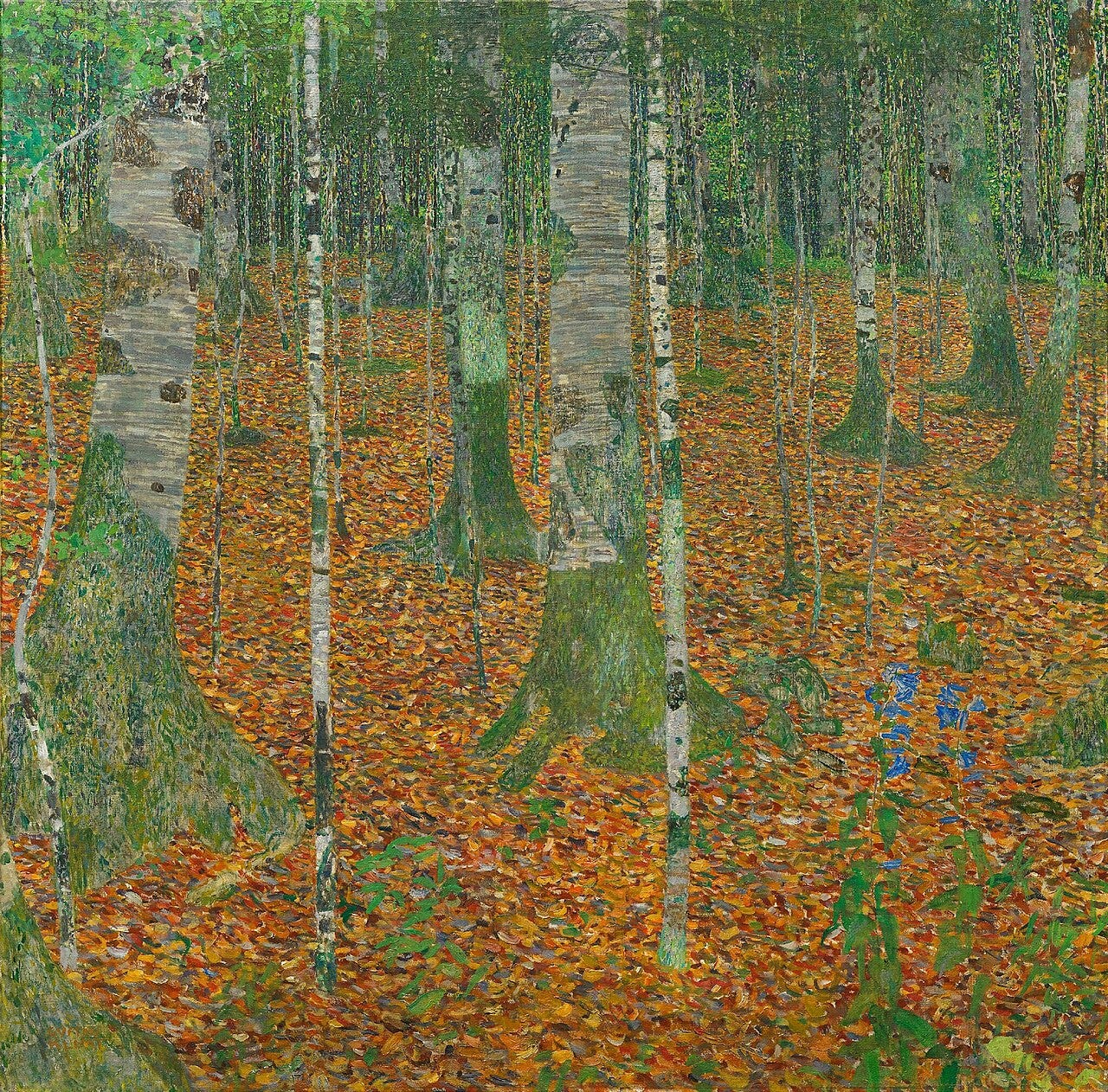
5. Gustav Klimt, Birch Forest (1903)

Birch trunks and a carpet of fallen leaves filling the canvas
Gustav Klimt, Birch Forest, 1903

Klimt fills the whole canvas edge to edge with slim birch trunks and a deep carpet of fallen autumn leaves, with no sky and no horizon at all.

He painted these dense forest views on his summer holidays by an Austrian lake, working in a near square format like a window into the woods.

The eye has nowhere to escape, held inside a haze of gold, russet and green. It is a mosaic of a forest floor, as decorative and flat as his famous golden portraits.

One of these birch woods sold at auction in 2022 for over one hundred million dollars.

6. Pieter Bruegel the Elder, The Return of the Herd (1565)

Herdsmen driving cattle downhill under a bruised autumn sky
Pieter Bruegel the Elder, The Return of the Herd, 1565

Herdsmen drive a train of cattle down a hillside toward a valley under a heavy, bruised autumn sky, the trees already stripped to brown and bare.

Bruegel painted it as part of a great series marking the seasons of the year, this one standing for the darkening months of autumn.

There are no golden leaves here, just the raw, cold truth of the year turning toward winter. Bare branches claw at a sky the color of tin, and everyone is hurrying home.

It is one of the first landscapes to make plain country weather its true subject, and it hangs today in Vienna among the surviving panels of the series.


Join 130,000 readers who get the secrets behind the paintings. Free.


7. John Atkinson Grimshaw, A Moonlit Lane (about 1880)

A wet lane under a hazy moon scattered with fallen leaves
John Atkinson Grimshaw, A Moonlit Lane, about 1880

A wet lane glows under a hazy autumn moon, the road scattered with fallen leaves and shining with soft reflected light, a dark house looming at its edge.

Grimshaw was a self taught Englishman who made the damp, misty English autumn night entirely his own. He worked with photographic precision, and it is thought he sometimes traced projected images, to catch every reflection on the wet road.

His moonlit lanes of dripping trees and lamplight are among the most atmospheric pictures in British art. He signed many with the date but no address, and much of his life remains as shadowy as his paintings.

8. George Inness, Autumn Oaks (about 1878)

Coppery oaks in a hazy meadow with a grazing cow
George Inness, Autumn Oaks, about 1878

A group of oaks holds its coppery autumn leaves in a soft, hazy meadow, a lone cow grazing, the whole scene dissolving in warm afternoon light.

Inness was the leading American painter of mood over fact, chasing not a photograph of a place but a feeling.

Deeply religious and drawn to mysticism, he believed a landscape should carry a spiritual charge. He worked and reworked his hazy surfaces until the trees seemed to breathe and glow from within.

He collapsed and died in Scotland in 1894, reportedly throwing up his hands at a sunset and crying out at its beauty.

9. Egon Schiele, Four Trees (1917)

Four chestnut trees against a banded orange sunset, one bare
Egon Schiele, Four Trees, 1917

Four chestnut trees stand in a row against a banded orange sunset, three still holding their autumn leaves while one has gone completely bare and dead.

Schiele, the intense young Austrian Expressionist, turned a simple row of trees into a picture about life, decline and death. Each tree is a stage, from full leaf to skeleton, the seasons and a human life read across a single field.

The low autumn sun sinks behind them in flat, glowing stripes of orange and pink. Schiele died the very next year at twenty eight in the great flu pandemic, days after his pregnant wife.

10. Tom Thomson, Autumn's Garland (1915 to 1916)

A screen of scarlet and gold maple over a cold blue lake
Tom Thomson, Autumn's Garland (oil sketch), 1915

A screen of maple branches blazes scarlet and gold across the whole canvas, half hiding a cold blue northern lake and low hills behind.

Thomson was a Canadian painter who fell in love with the wild lakes of Ontario, capturing their intense autumn color with thick, quick strokes.

He worked as a fire ranger and fishing guide, painting small oil sketches outdoors on the spot, straight from the canoe. His raw, brilliant north woods inspired the Group of Seven, Canada's most famous painters.

He drowned mysteriously on a lake he loved in 1917, at only thirty nine, his death never fully explained.


Two new stories a week, 130+ secrets unlocked. Start free.


11. Alfred Sisley, Autumn: Banks of the Seine near Bougival (1873)
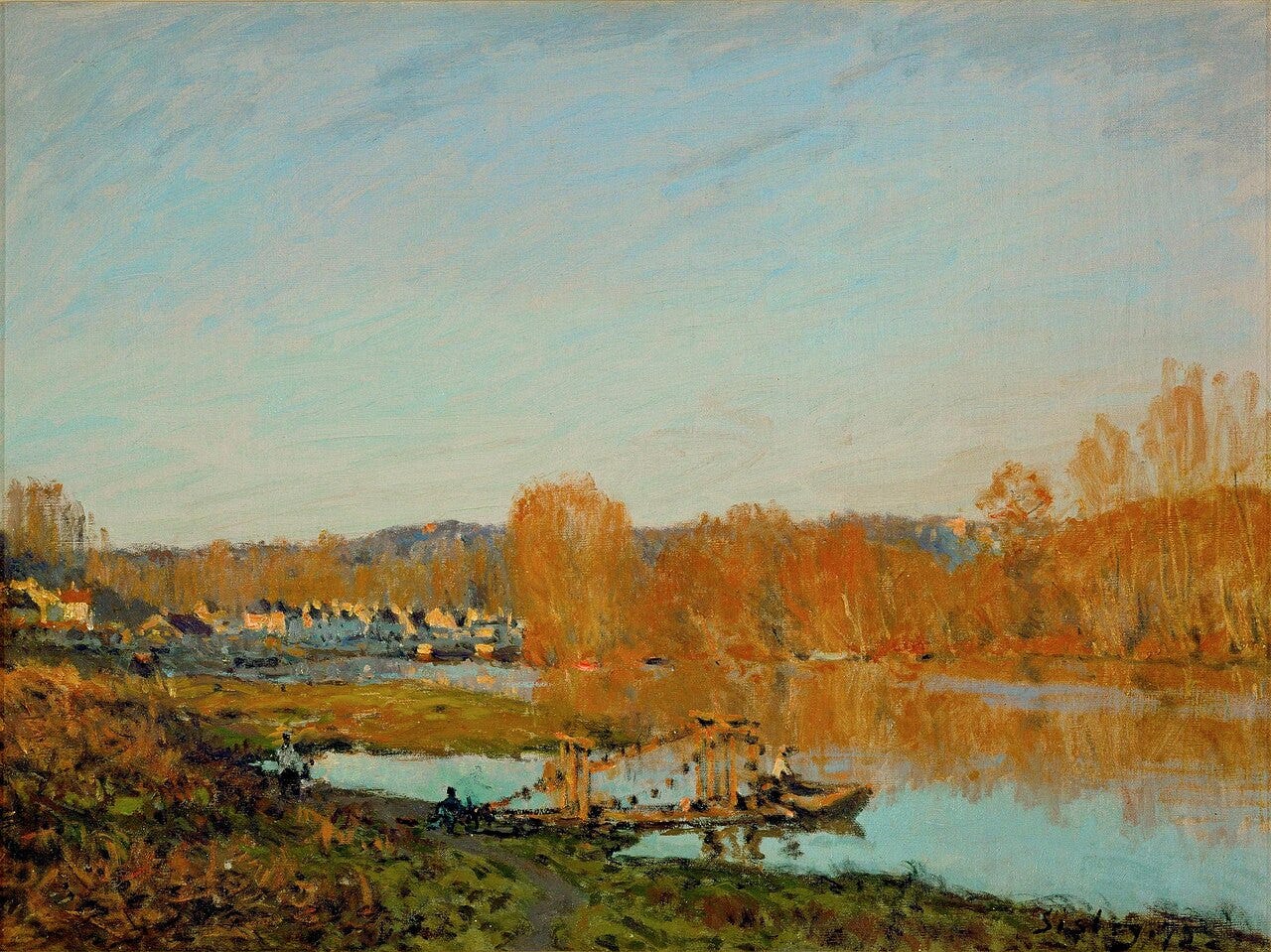
Golden autumn trees along the Seine reflected in still water
Alfred Sisley, Autumn: Banks of the Seine near Bougival, 1873

Golden autumn trees line the far bank of the Seine, their color doubled in the still water under a wide, soft sky full of drifting cloud.

Sisley was among the most devoted of the Impressionists, painting the same French rivers and skies over and over in every season.

He chased the exact feeling of a mild, hazy autumn day, all reflection and gentle light. Born in France to English parents, he stayed loyal to pure landscape while the others chased fame.

He died poor and almost unknown, just before his paintings began to sell for large sums.

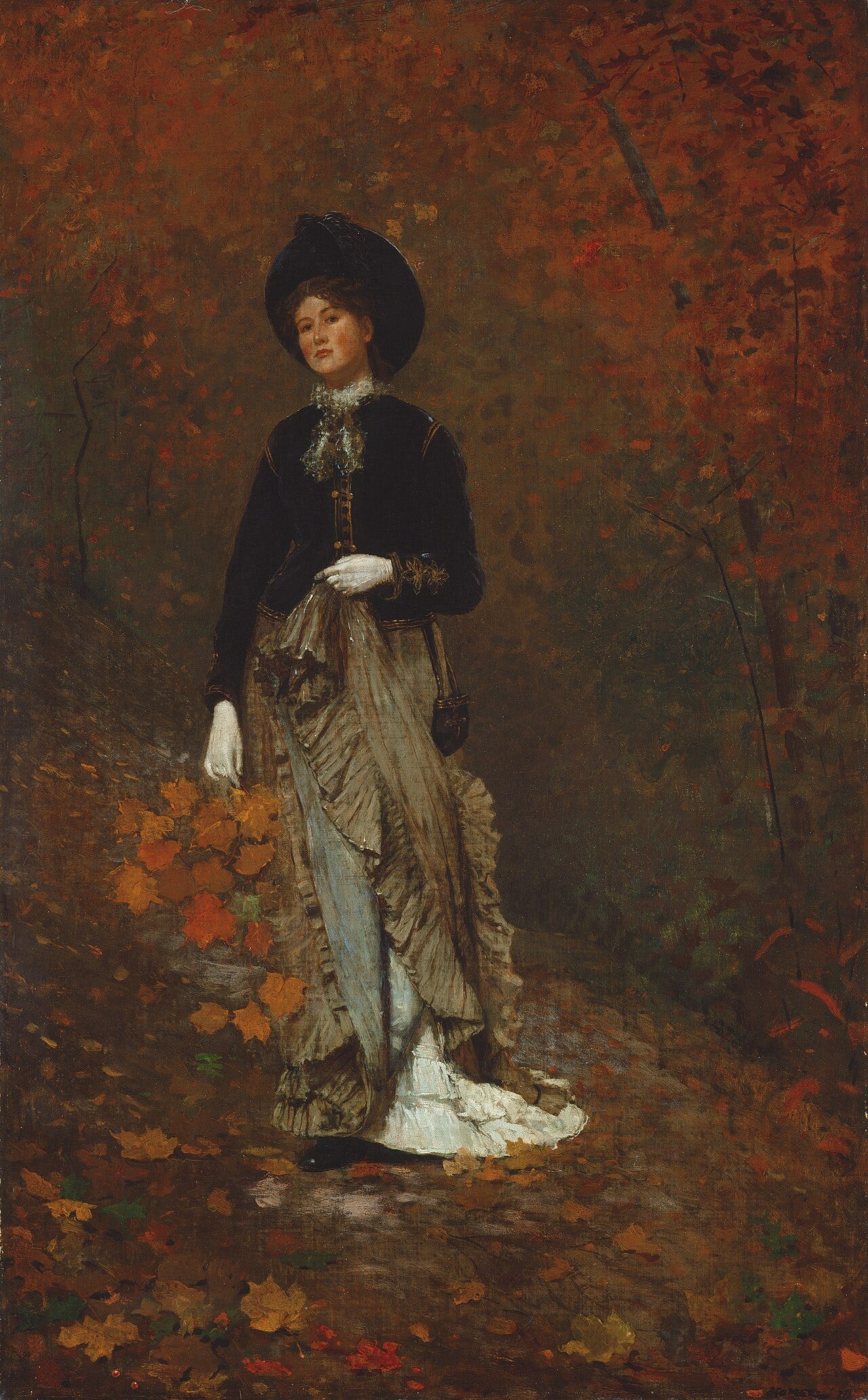
12. Winslow Homer, Autumn (1877)

A woman in a wood holding a bunch of bright autumn leaves
Winslow Homer, Autumn, 1877

A young woman in a fine dress stands alone in a wood, holding a bright bunch of autumn leaves, the trees behind her a wall of gold and brown. Homer, the tough, plain spoken giant of American painting, gave a simple stroll a strange, still dignity.

Painted just after the Civil War, it belongs to a run of quiet pictures of women alone in nature. Her fashionable clothes and the wild woods set up a gentle tension between town and the turning year.

Homer soon abandoned scenes like this for the sea, which would obsess him for the rest of his life.


The autumn questions readers ask me

  • What is the most famous autumn painting? Millais's Autumn Leaves and Levitan's Golden Autumn are among the best loved, along with the fiery American views of Cropsey.

  • Why do painters love autumn? Its blazing color and its link to harvest, decay and the passing of time make it beauty and sadness in one season.

  • What does autumn symbolize in art? Ripeness and plenty, but also aging, loss and the approach of death, the year in its final act.

  • Which artists painted autumn best? Isaac Levitan in Russia, Jasper Cropsey in America and John Atkinson Grimshaw in England all made the season their specialty.

  • Why are autumn leaves red and gold in paintings? As the days shorten, leaves lose their green and the hidden yellows, oranges and reds beneath finally show, which painters raced to catch.


If these golden woods pulled you in, you will love these too:


The season that lets go

Autumn gives a painter everything at once, color at its loudest and the sadness of knowing it cannot last. That double feeling, joy shot through with loss, is what makes these pictures ache.

Every one of them catches a world a few days from bare branches and first frost. Look at them and you can almost feel the year breathing out.