
Winslow Homer was the American painter of the sea at its most dangerous and the country at its most raw. From Civil War battlefields to a lone fisherman adrift among sharks, he painted struggle, weather and survival with a plainness that feels utterly American, the same unsparing eye Thomas Eakins brought to the rowers and surgeons of Philadelphia.
Many consider him the greatest painter the United States produced in the 19th century.
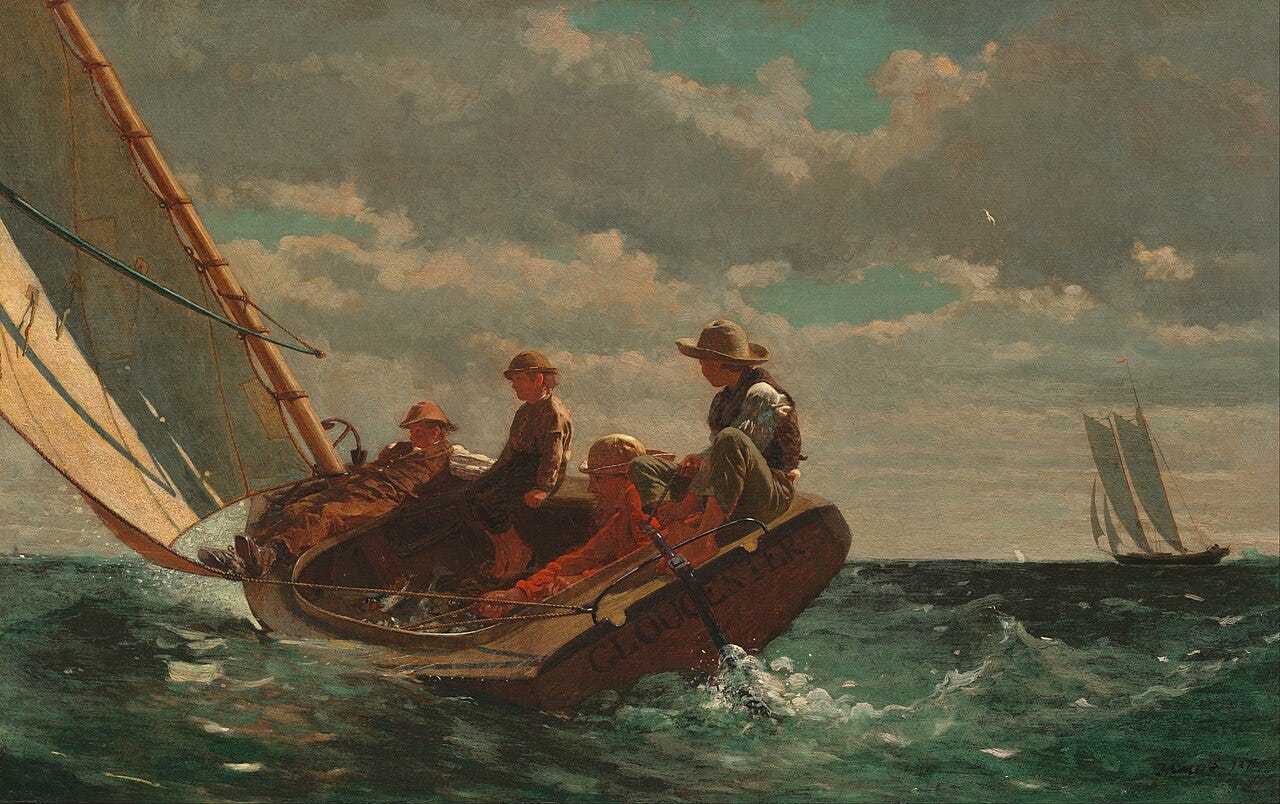
He was self taught, fiercely private, and happiest alone on a rocky coast with the Atlantic crashing below. The drama is never decoration. It is the real, indifferent power of nature.
Born: Boston, 1836
Known for: the sea, the Civil War, expert watercolors
Died: Prouts Neck, Maine, 1910
More incredible painter stories
If Winslow Homer pulled you in, you will love these too:


Winslow Homer at a glance
1836. Born in Boston, and largely self taught.
1861. Sent to the Civil War front as an illustrator for Harper’s Weekly.
1881. Began two years in Cullercoats, England, where the sea took over his art.
1883. Settled at Prouts Neck, Maine, in a studio on the rocks.
1910. Died at Prouts Neck at 74.
From the front line to fine art
Homer started as a magazine illustrator and was sent to cover the American Civil War. Instead of grand battle scenes he drew the boredom, the waiting and the small human moments of the camps. Those sharp, honest images launched him. How do those quiet camp scenes compare to the war’s grand battle paintings? This collection of famous Civil War paintings sets Homer beside Eastman Johnson and the great Gettysburg canvases.
He taught himself oil painting and never lost that reporter's eye for the real and unposed.
Boyhood, then the sea
His early oils caught a young nation at play and at work, in the fields, at the seaside, outside the one room schoolhouse.
Then the sea took over. After time in an English fishing village he moved to the Maine coast and painted the ocean for the rest of his life, waves, rescues, fishermen, and the thin line between people and drowning.
The Gulf Stream and the watercolors
His most famous oil, The Gulf Stream, shows a black sailor adrift on a dismasted boat, surrounded by sharks and a distant waterspout, a far off ship offering faint hope. It is grim, ambiguous and unforgettable.
He was also one of the greatest watercolorists who ever lived. His bright, fluid scenes of the Caribbean and the Adirondacks show total command of the medium. See what is watercolor.
You can explore works by Winslow Homer in the collection of the Metropolitan Museum of Art.
The lithography shop he could not wait to leave
Homer was born in Boston in 1836 and grew up partly in the countryside of Cambridge, where his mother, a talented amateur watercolourist, gave him his first lessons. He had almost no formal art training after that.
At nineteen he was apprenticed to a Boston commercial lithographer named John Bufford, drawing sheet music covers and portraits to order. He hated the routine of it.
He walked out the day he turned twenty one and never took a salaried job again. From then on he made his living as a freelance illustrator, answering to no employer, a habit of independence that shaped the rest of his life.
The pictures that came out of the Civil War
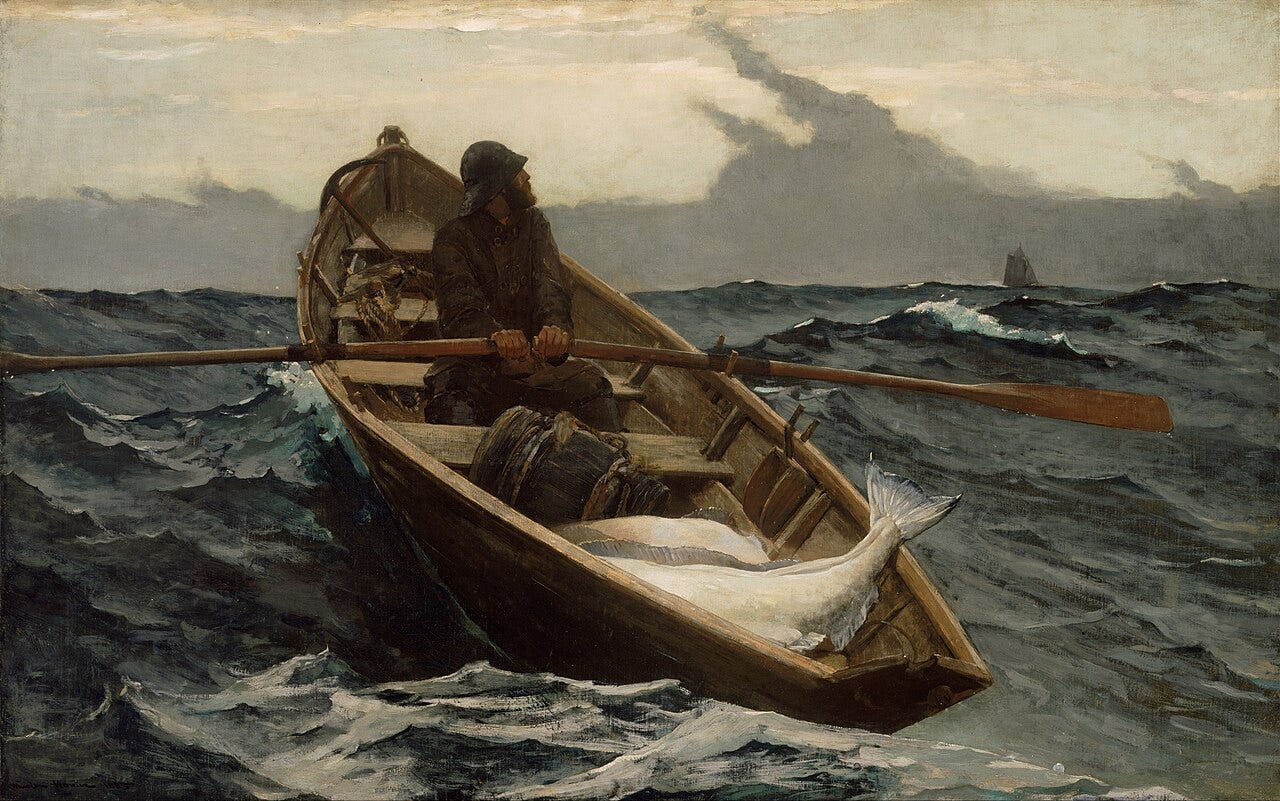
In 1859 Homer moved to New York and began drawing for Harper's Weekly, the most widely read illustrated magazine in the country. When the Civil War broke out he went to the front as an artist correspondent.
He was less interested in battles than in the waiting: soldiers in camp, a sharpshooter up a tree, the boredom and dread between the fighting. Out of that came his first important oil paintings.
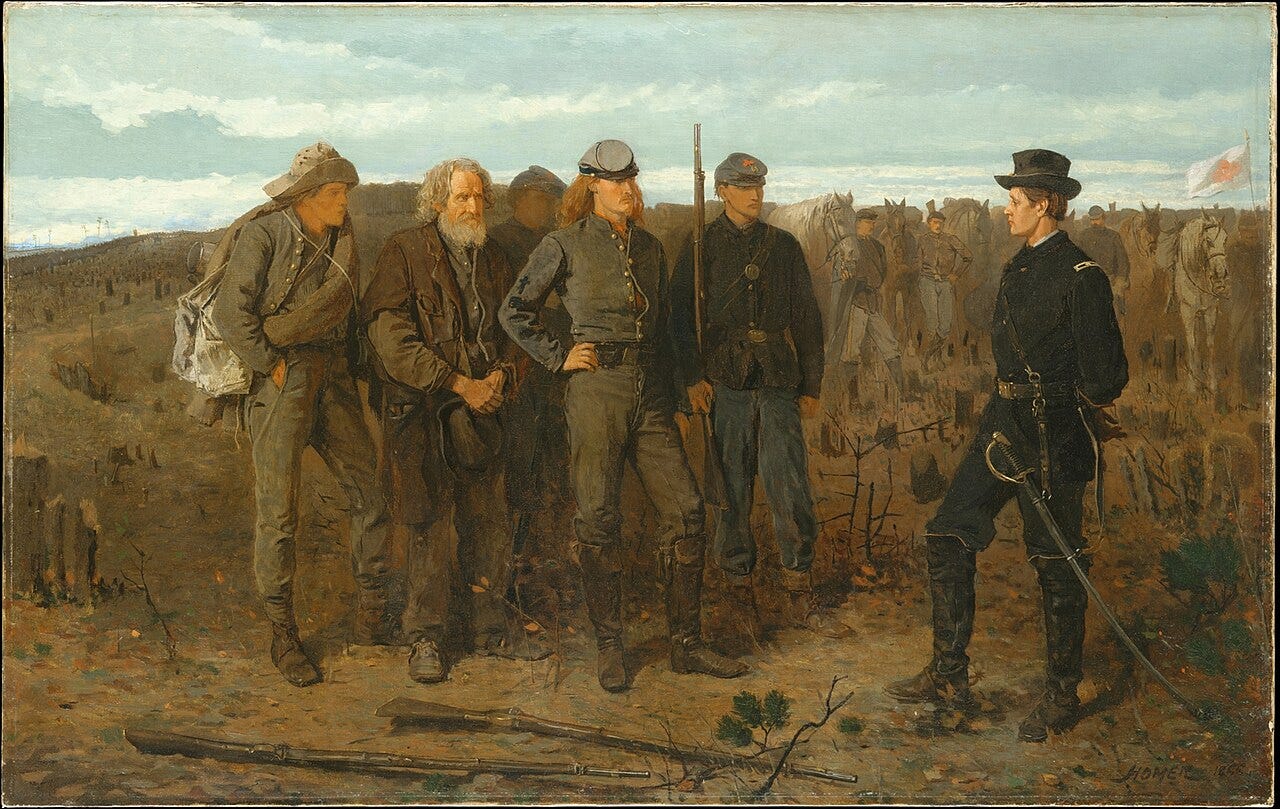
Prisoners from the Front, shown in 1866, made his reputation almost overnight. The Veteran in a New Field, now at the Metropolitan Museum, shows a demobbed soldier harvesting wheat with a single blade, a quiet image of a country trying to return to peace.
Ten months in France
Late in 1866 Homer sailed to France and stayed for about ten months, partly to see two of his war paintings hung at the Exposition Universelle in Paris.
He arrived at the very moment French landscape painting was changing. He would have seen the plain air pictures of the Barbizon painters, and the first stirrings of Impressionism were in the air, though he never claimed any of it as an influence.
He came home with a lighter palette and a surer sense of outdoor light, and turned it on American subjects the French had never seen.
Barefoot boys and the Reconstruction South
The years after the war produced some of his most loved pictures of ordinary life. Snap the Whip shows a line of barefoot schoolboys tumbling across a field, a nostalgic image of a rural America already slipping away.
He also travelled to Virginia and painted the Black population of the defeated South during Reconstruction. A Visit from the Old Mistress and The Cotton Pickers treat their subjects with a seriousness rare for the moment.
These are not sentimental. Homer painted freed people as dignified, wary and watchful, and left the tension in the scene unresolved.
How he made watercolour a serious medium
In 1873, on a summer trip to Gloucester, Homer took up watercolour in earnest. At the time it was thought of as a medium for amateurs and lady hobbyists.
He treated it as a professional tool, quick, portable and brilliant, and produced hundreds of sheets over the rest of his life. His watercolours of the Adirondacks, and later of the Bahamas, Cuba and Florida, are now held to be among the finest ever made by an American.
Collectors who found his oils forbidding bought the watercolours happily, and they helped keep him afloat between the big canvases.
Cullercoats, where the sea took over
In 1881 Homer left for England and settled for nearly two years in Cullercoats, a fishing village on the North Sea coast near Newcastle. It changed his art for good.
He watched the fisherwomen haul lines and wait for boats in bad weather, and he began to paint the sea as a force that ruled human lives. The figures grew sturdier, the mood graver, the water more dangerous.
He went to England a painter of pleasant American scenes and came back gripped by a single great subject: people at the mercy of the ocean.
The studio on the rocks at Prouts Neck
Back in the United States, Homer moved in 1883 to Prouts Neck, a rocky headland on the coast of Maine, and built a studio a stone's throw from the surf. He lived there, largely alone, for the rest of his life.
From that perch he painted the Atlantic in every mood, breaking on the rocks below his windows. The isolation suited him. Visitors were not encouraged.
The studio still stands and is now cared for as a museum, kept close to how he left it.
The rescues and the open sea
The Maine years produced his greatest sea pictures. The Life Line of 1884 shows a coastguard carrying an unconscious woman across a rope above churning water, the faces hidden by spray.
Northeaster and other storm canvases reduced the human figure to almost nothing against the waves. He was painting survival, and often its odds.
The most famous of all, The Gulf Stream, sits inside its own section below, but it belongs to this same late reckoning with the ocean as a thing indifferent to people.
The wood engravings that paid the bills
For roughly twenty years, from the late 1850s into the 1870s, Homer earned his keep drawing on wood blocks that were cut and printed in magazines, above all Harper's Weekly. His designs reached a huge national audience long before his oils did.
He drew skating parties in Central Park, fashionable crowds at the seaside, farm children and war camps, all in crisp black and white. It taught him to compose fast and to strip a scene to its essentials.
By the mid 1870s he felt he had outgrown the trade and gave it up to paint full time. The habit of clear, uncluttered design never left him.
Right and Left, a duck's eye view
One of Homer's last oils, painted in 1909, is Right and Left, now in the National Gallery of Art in Washington. It shows two ducks at the instant a hunter's shot hits them.
The point of view is startling. We see the scene from the birds' side, with the tiny gunman and his puff of smoke far off across the water, so that the viewer is placed almost among the targets.
It is a summing up of a lifetime spent watching living things meet sudden danger, made with the plainest possible means. He died the following year.
A private man to the end
Homer never married and left almost no record of his inner life. He guarded his privacy fiercely, destroyed letters, and let his paintings do the talking.
He kept working into old age, hunting and fishing in the Adirondacks and the tropics, and painting the sea outside his door. He died at Prouts Neck in 1910.
By then he was widely regarded as the greatest American painter of his century, a reputation that has only hardened since. He got there without a school, a manifesto or a single word of self promotion.
Where Homer stands next to Eakins and Sargent
Homer, Thomas Eakins and John Singer Sargent worked through the same decades of American art, born within twenty years of each other. Eakins spent his career in Philadelphia, painting the rowers of the Schuylkill in Max Schmitt in a Single Scull and the surgeons of The Gross Clinic. Sargent built his reputation in London and Paris on the portraits of the wealthy, most famously Madame X, also held today at the Metropolitan Museum of Art.
Of the three, Homer aimed his eye lowest and got the most out of it. He painted fishermen, sailors and soldiers instead of society patrons, and the ocean became a subject in its own right rather than scenery behind a sitter. The Gulf Stream carries more weight than Madame X for that reason: one shows an anonymous man fighting for his life at sea, the other a scandal over a fallen dress strap.
Inside Homer's own catalogue, The Gulf Stream ranks above Snap the Whip. Snap the Whip is a fond memory of boyhood, well made but slight next to a man adrift among sharks with no clear rescue in sight. The Adirondacks and Bahamas watercolors carry the same weight as the late oils, a genuine second body of major work.
Eakins was forced to resign from the Pennsylvania Academy of the Fine Arts in 1886 after removing a loincloth from a male model in front of female students. Sargent stopped taking portrait commissions after 1907 and spent his final decades on murals and travel watercolors instead. Homer answered to no academy and painted alone at Prouts Neck until his death in 1910.
The Winslow Homer questions that keep coming up
What is Winslow Homer famous for?
Powerful paintings of the sea, the Civil War, and brilliant watercolors. See what is landscape painting.
Was he trained?
Largely self taught, starting as an illustrator.
Where did he work?
Famously at Prouts Neck on the Maine coast, facing the Atlantic.
What is Winslow Homer best known for? His powerful scenes of the sea. After early work as a Civil War illustrator, he turned to watercolors and oils of fishermen, storms and the raw force of the Atlantic.
More secrets to unlock


America’s own painter, at last
Homer gave America a serious art of its own, rooted not in myth or court but in weather, labour and the sea. Stand in front of The Gulf Stream and the ocean still feels like it could take you.
A final detail. Asked for years what finally happens to the man in The Gulf Stream, Homer grew so irritated that he wrote a sarcastic note insisting the exhausted sailor would be rescued, so collectors would stop worrying about him.