Famous Cubist Paintings: 12 That Broke Perspective

The most famous Cubist paintings include Picasso's Les Demoiselles d'Avignon, Braque's Houses at l'Estaque and Picasso's Three Musicians. Here are twelve, in the order they were painted, with the year and the museum that holds each one today.

Two painters built Cubism in a handful of rooms in Paris and the south of France, then a wider circle carried it into the 1920s. If you want the movement explained from the ground up, start with what Cubism is.

Five things worth knowing before you scroll

  • Cubism takes its name from an insult. A critic mocked one of Braque's landscapes as being built from little cubes in 1908, and the label outlived the joke.

  • For a few years Picasso and Braque painted in such a similar style that some of their unsigned canvases are still debated today.

  • One of Picasso's Cubist inspirations came from ancient sculptures that turned out to be stolen from the Louvre.

  • In 1912 Picasso glued real oilcloth onto a canvas instead of painting it, in what is usually called the first Cubist collage.

  • One of the paintings on this list was turned down by the Cubists themselves before it went on to shock New York.


Two phases, one very close partnership

Cubism ran through two phases. Analytic Cubism, from about 1908 to 1912, broke objects into fragments of grey, brown and green, seen from several angles at once. Synthetic Cubism, after 1912, rebuilt the picture instead, adding flat color, stenciled letters and pasted paper.

Georges Braque later described the partnership as being roped together like two mountaineers. Between 1908 and 1911 the two of them painted in nearly the same palette, and a handful of canvases from those years carry no clear signature at all. Picasso gets most of the public credit today, but the full account of who invented Cubism is more complicated than that.


1. Pablo Picasso, Les Demoiselles d'Avignon (1907)

Picasso Les Demoiselles d'Avignon 1907 five figures
Pablo Picasso, Les Demoiselles d'Avignon, 1907, Museum of Modern Art, New York

Five women in a Barcelona brothel, their faces borrowed from Iberian sculpture and the African masks Picasso had just seen at the ethnographic museum in the Trocadéro. Two of the faces show a nose in profile set on a head turned forward, at the same time.

Some of Picasso's Iberian pieces turned out to be stolen from the Louvre. When the Mona Lisa disappeared in 1911 the theft came to light, and Picasso's friend Apollinaire was arrested and jailed. Picasso, questioned by a magistrate, claimed he had never seen him before, even though the two men were close friends.

2. Georges Braque, Houses at l'Estaque (1908)

Braque Houses at l'Estaque 1908 cubist landscape
Georges Braque, Houses at l'Estaque, 1908, Kunstmuseum Bern

Braque painted red roofs and green trees near Marseille, working from lessons Paul Cézanne had left behind in the same village a few years earlier.

The Salon d'Automne jury, which included Matisse, turned the painting down. Braque showed it instead at Kahnweiler's gallery that November, and the critic Louis Vauxcelles reviewed the show in the paper Gil Blas, writing that Braque reduced everything to geometric cubes. The word stuck to the whole movement.

3. Pablo Picasso, Girl with a Mandolin (1910)

Picasso Girl with a Mandolin 1910 Fanny Tellier
Pablo Picasso, Girl with a Mandolin, 1910, Museum of Modern Art, New York

Picasso painted the model Fanny Tellier holding a mandolin, breaking her body into shaded planes while leaving just enough of her face and hands intact to read as a person.

Tellier stopped sitting for him before the portrait was finished, tired of how long it was taking. Picasso left the canvas exactly as it stood that day and never went back to it.

4. Pablo Picasso, Portrait of Ambroise Vollard (1910)

Picasso portrait Ambroise Vollard 1910 cubist
Pablo Picasso, Portrait of Ambroise Vollard, 1910, Pushkin Museum, Moscow

Vollard was the dealer who had given Picasso his first solo show in Paris in 1901, when Picasso was nineteen. Nine years later Picasso painted him back, in one of the hardest portraits to read in the whole movement.

Underneath the fractured surface sits a real likeness. Vollard's heavy features, his watch chain and his folded arms all survive the analysis, once your eyes adjust.

5. Georges Braque, Violin and Candlestick (1910)

Braque Violin and Candlestick 1910 analytic cubism
Georges Braque, Violin and Candlestick, 1910, San Francisco Museum of Modern Art

A violin, a candlestick and a sheet of music dissolve into a grid of grey and brown planes, painted while Braque worked alongside Picasso in Paris and in the Pyrenees town of Céret.

The museum that owns it lists the French title as Violon et Compotier, meaning Violin and Fruit Dish. The candlestick in the common English title is a mistranslation that has stuck for decades.

6. Georges Braque, Man with a Guitar (1911 to 1912)

Braque Man with a Guitar cubist figure
Georges Braque, Man with a Guitar, 1911 to 1912, Museum of Modern Art, New York

Braque painted this figure in Céret, working in nearly the same grey and ochre palette Picasso used a few streets away that same summer.

During the First World War the French state seized the painting as enemy property, because its owner at the time, Wilhelm Uhde, was German. It was auctioned off in Paris in 1921 before eventually reaching the Museum of Modern Art in New York.

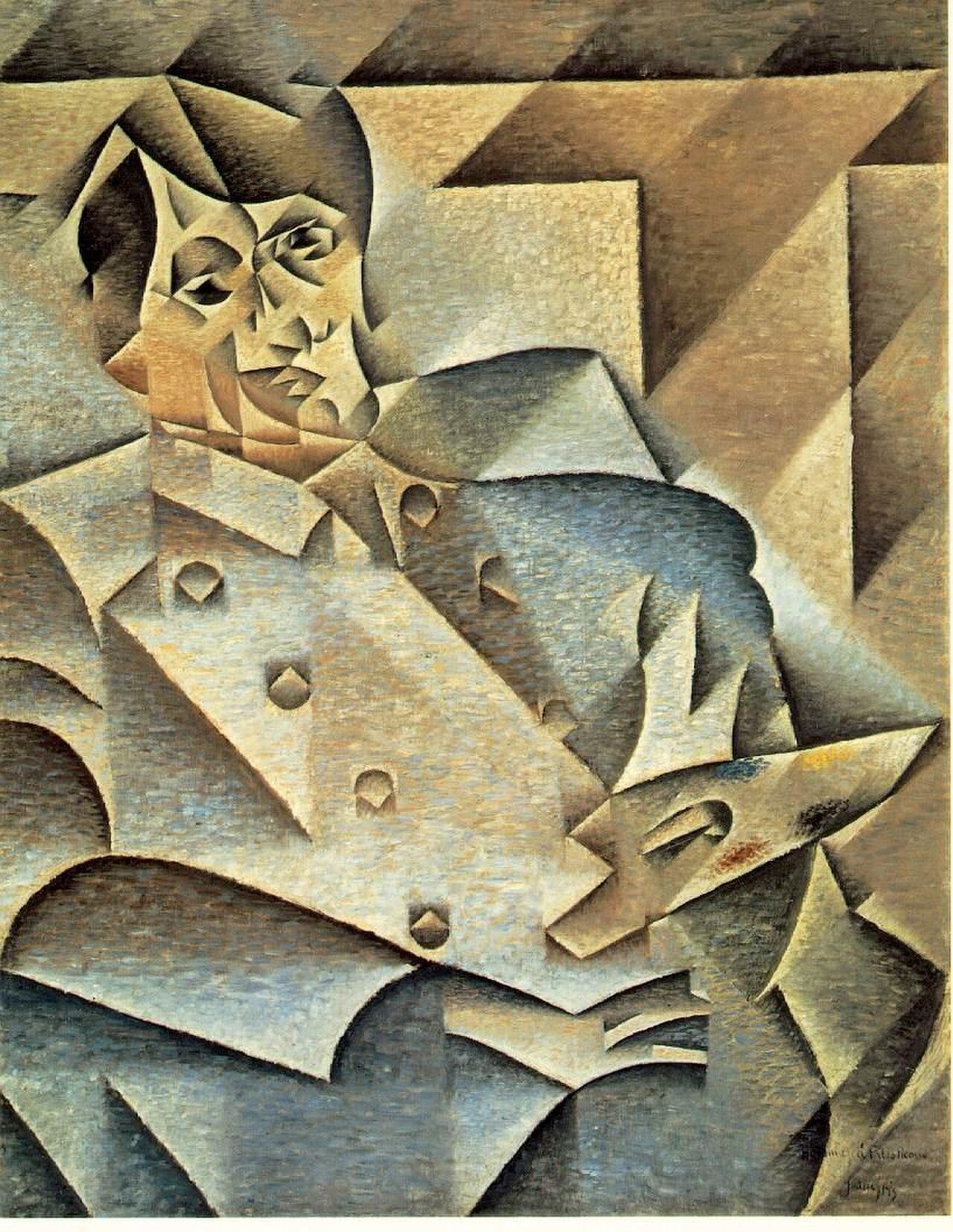
7. Juan Gris, Portrait of Pablo Picasso (1912)

Juan Gris portrait of Pablo Picasso 1912
Juan Gris, Portrait of Pablo Picasso, 1912, Art Institute of Chicago

Gris painted Picasso holding a palette, in cool blues, browns and greys, and signed the canvas Hommage à Pablo Picasso in the corner.

It is one of the first major Cubist paintings made by someone other than Picasso or Braque, proof the style could work in other hands than the two who invented it.

8. Pablo Picasso, Still Life with Chair Caning (1912)

An oval canvas edged in real rope, with a strip of printed oilcloth standing in for a chair's woven caning. Picasso glued the oilcloth on rather than painting it.

Historians usually call it the first Cubist collage. Picasso had just shown that a painting could include a piece of the actual world, not just a description of it.

9. Marcel Duchamp, Nude Descending a Staircase No. 2 (1912)

Duchamp Nude Descending a Staircase No 2 1912
Marcel Duchamp, Nude Descending a Staircase No. 2, 1912, Philadelphia Museum of Art

A figure breaks into overlapping planes as it moves down a staircase, painted by Duchamp in browns close to the Cubist palette of the same years.

The Cubists themselves rejected it before the 1912 Salon des Indépendants, judging it too close to Futurism. A year later, at the Armory Show in New York, it became the painting Americans loved to mock, and one of the works that introduced Cubism to the country.

10. Juan Gris, Breakfast (1914)

Juan Gris Breakfast 1914 papier colle collage
Juan Gris, Breakfast, 1914, Museum of Modern Art, New York

A collage of wood grain paper, real wallpaper and painted canvas, arranged into a coffee cup, an eggcup and a coffee pot, each seen from a different angle.

Gris built the picture entirely from pasted paper and paint, with no drawing underneath holding it together. It pushes Cubism's collage technique further than almost any other work from the period.

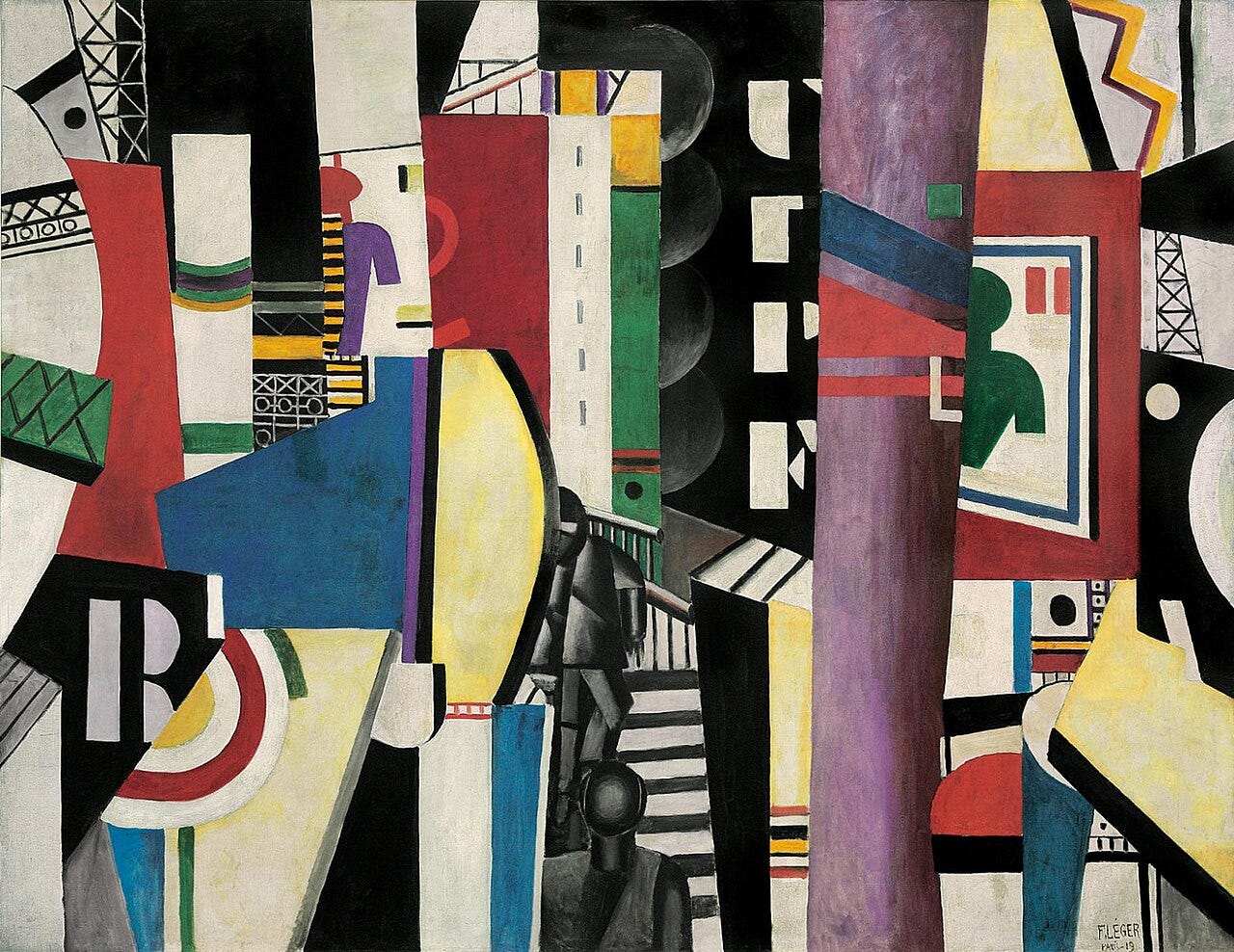
11. Fernand Léger, The City (1919)

Fernand Leger The City 1919 cubist urban scene
Fernand Léger, The City, 1919, Philadelphia Museum of Art

Stenciled letters, a metal railing and blocks of flat color fill a canvas nearly ten feet wide, Léger's answer to Paris rebuilding after the First World War.

Léger had spent years at the front as a military engineer and was gassed at Verdun in 1916. He came back convinced that machines, not the countryside, were the real subject for a modern painter.

12. Pablo Picasso, Three Musicians (1921)
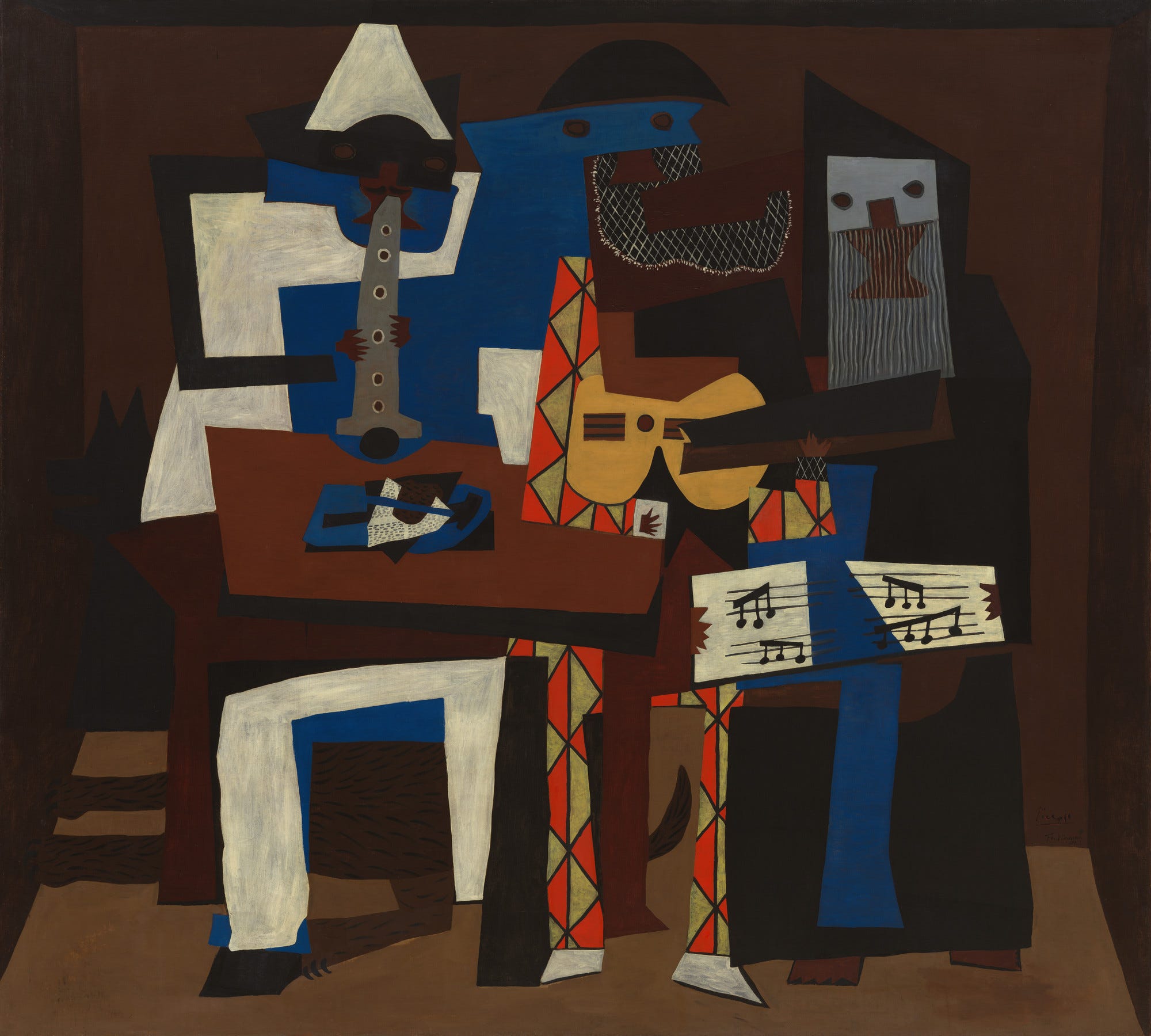
Picasso Three Musicians 1921 synthetic cubism
Pablo Picasso, Three Musicians, 1921, Museum of Modern Art, New York

A Pierrot, a harlequin and a monk play music in flat shapes of color that recall paper cutouts more than paint, made a decade after Picasso's first Cubist experiments.

The three figures stand for Picasso's own circle. The harlequin is usually read as Picasso himself, the Pierrot as the poet Guillaume Apollinaire, who had died three years earlier, and the monk as the writer Max Jacob.

1. Pablo Picasso, Les Demoiselles d'Avignon (1907)

Five women in a Barcelona brothel, their faces borrowed from Iberian sculpture and the African masks Picasso had just seen at the ethnographic museum in the Trocadéro. Two of the faces show a nose in profile set on a head turned forward, at the same time.

Some of Picasso's Iberian pieces turned out to be stolen from the Louvre. When the Mona Lisa disappeared in 1911 the theft came to light, and Picasso's friend Apollinaire was arrested and jailed. Picasso, questioned by a magistrate, claimed he had never seen him before, even though the two men were close friends.

2. Georges Braque, Houses at l'Estaque (1908)

Braque painted red roofs and green trees near Marseille, working from lessons Paul Cézanne had left behind in the same village a few years earlier.

The Salon d'Automne jury, which included Matisse, turned the painting down. Braque showed it instead at Kahnweiler's gallery that November, and the critic Louis Vauxcelles reviewed the show in the paper Gil Blas, writing that Braque reduced everything to geometric cubes. The word stuck to the whole movement.

3. Pablo Picasso, Girl with a Mandolin (1910)

Picasso painted the model Fanny Tellier holding a mandolin, breaking her body into shaded planes while leaving just enough of her face and hands intact to read as a person.

Tellier stopped sitting for him before the portrait was finished, tired of how long it was taking. Picasso left the canvas exactly as it stood that day and never went back to it.

4. Pablo Picasso, Portrait of Ambroise Vollard (1910)

Vollard was the dealer who had given Picasso his first solo show in Paris in 1901, when Picasso was nineteen. Nine years later Picasso painted him back, in one of the hardest portraits to read in the whole movement.

Underneath the fractured surface sits a real likeness. Vollard's heavy features, his watch chain and his folded arms all survive the analysis, once your eyes adjust.

5. Georges Braque, Violin and Candlestick (1910)

A violin, a candlestick and a sheet of music dissolve into a grid of grey and brown planes, painted while Braque worked alongside Picasso in Paris and in the Pyrenees town of Céret.

The museum that owns it lists the French title as Violon et Compotier, meaning Violin and Fruit Dish. The candlestick in the common English title is a mistranslation that has stuck for decades.

6. Georges Braque, Man with a Guitar (1911 to 1912)

Braque painted this figure in Céret, working in nearly the same grey and ochre palette Picasso used a few streets away that same summer.

During the First World War the French state seized the painting as enemy property, because its owner at the time, Wilhelm Uhde, was German. It was auctioned off in Paris in 1921 before eventually reaching the Museum of Modern Art in New York.

7. Juan Gris, Portrait of Pablo Picasso (1912)

Gris painted Picasso holding a palette, in cool blues, browns and greys, and signed the canvas Hommage à Pablo Picasso in the corner.

It is one of the first major Cubist paintings made by someone other than Picasso or Braque, proof the style could work in other hands than the two who invented it.

8. Pablo Picasso, Still Life with Chair Caning (1912)

An oval canvas edged in real rope, with a strip of printed oilcloth standing in for a chair's woven caning. Picasso glued the oilcloth on rather than painting it.

Historians usually call it the first Cubist collage. Picasso had just shown that a painting could include a piece of the actual world, not just a description of it.

9. Marcel Duchamp, Nude Descending a Staircase No. 2 (1912)

A figure breaks into overlapping planes as it moves down a staircase, painted by Duchamp in browns close to the Cubist palette of the same years.

The Cubists themselves rejected it before the 1912 Salon des Indépendants, judging it too close to Futurism. A year later, at the Armory Show in New York, it became the painting Americans loved to mock, and one of the works that introduced Cubism to the country.

10. Juan Gris, Breakfast (1914)

A collage of wood grain paper, real wallpaper and painted canvas, arranged into a coffee cup, an eggcup and a coffee pot, each seen from a different angle.

Gris built the picture entirely from pasted paper and paint, with no drawing underneath holding it together. It pushes Cubism's collage technique further than almost any other work from the period.

11. Fernand Léger, The City (1919)

Stenciled letters, a metal railing and blocks of flat color fill a canvas nearly ten feet wide, Léger's answer to Paris rebuilding after the First World War.

Léger had spent years at the front as a military engineer and was gassed at Verdun in 1916. He came back convinced that machines, not the countryside, were the real subject for a modern painter.

12. Pablo Picasso, Three Musicians (1921)

A Pierrot, a harlequin and a monk play music in flat shapes of color that recall paper cutouts more than paint, made a decade after Picasso's first Cubist experiments.

The three figures stand for Picasso's own circle. The harlequin is usually read as Picasso himself, the Pierrot as the poet Guillaume Apollinaire, who had died three years earlier, and the monk as the writer Max Jacob.


Where to see the twelve

  • Museum of Modern Art, New York: Les Demoiselles d'Avignon, Girl with a Mandolin, Braque's Man with a Guitar, Juan Gris's Breakfast, and Three Musicians.

  • Philadelphia Museum of Art: Duchamp's Nude Descending a Staircase No. 2, Léger's The City, and Picasso's second version of Three Musicians.

  • Pushkin Museum, Moscow: Picasso's Portrait of Ambroise Vollard.

  • Art Institute of Chicago: Juan Gris's Portrait of Pablo Picasso.

  • Kunstmuseum Bern, Switzerland: Braque's Houses at l'Estaque.

  • San Francisco Museum of Modern Art: Braque's Violin and Candlestick.

  • Musée Picasso, Paris: Still Life with Chair Caning.


Cubist paintings, what readers ask

  • What is the most famous Cubist painting? Les Demoiselles d'Avignon and Three Musicians, both by Picasso, are the two most reproduced.

  • Who invented Cubism? Pablo Picasso and Georges Braque developed it together in Paris between 1908 and 1914.

  • What is the difference between Analytic and Synthetic Cubism? Analytic Cubism, before 1912, broke objects into fragments seen from several angles. Synthetic Cubism, after 1912, rebuilt the picture with flat color and pasted paper.

  • Why is it called Cubism? A critic used the word cubes to mock one of Braque's paintings in a review published in 1908, and the name stuck to the whole movement.

  • Who were the main Cubist painters besides Picasso and Braque? Juan Gris, Fernand Léger, Albert Gleizes and Jean Metzinger carried the style through the 1910s.


The joke that became the introduction

The critic Julian Street looked at Duchamp's Nude Descending a Staircase at the Armory Show in New York in 1913 and called it an explosion in a shingle factory. Tens of thousands of visitors came to see it anyway, many of them meeting Cubism for the first time.

Picasso painted a second, nearly identical version of Three Musicians that same summer. It hangs at the Philadelphia Museum of Art, a few rooms from Duchamp's Nude Descending a Staircase and Léger's The City, three Cubist paintings that ended up in the same building by coincidence.

Cubism is the seventeenth of twenty stops in Art Movements in Painting.