
Pablo Picasso (1881 to 1973) was the Spanish artist who broke painting open and rebuilt it, the most famous and most prolific artist of the twentieth century, and one of its most troubling men.
Over a seventy year career he moved through the Blue and Rose periods, invented Cubism with Georges Braque, painted Guernica, and produced roughly fifty thousand works, dying one of the wealthiest artists in history.
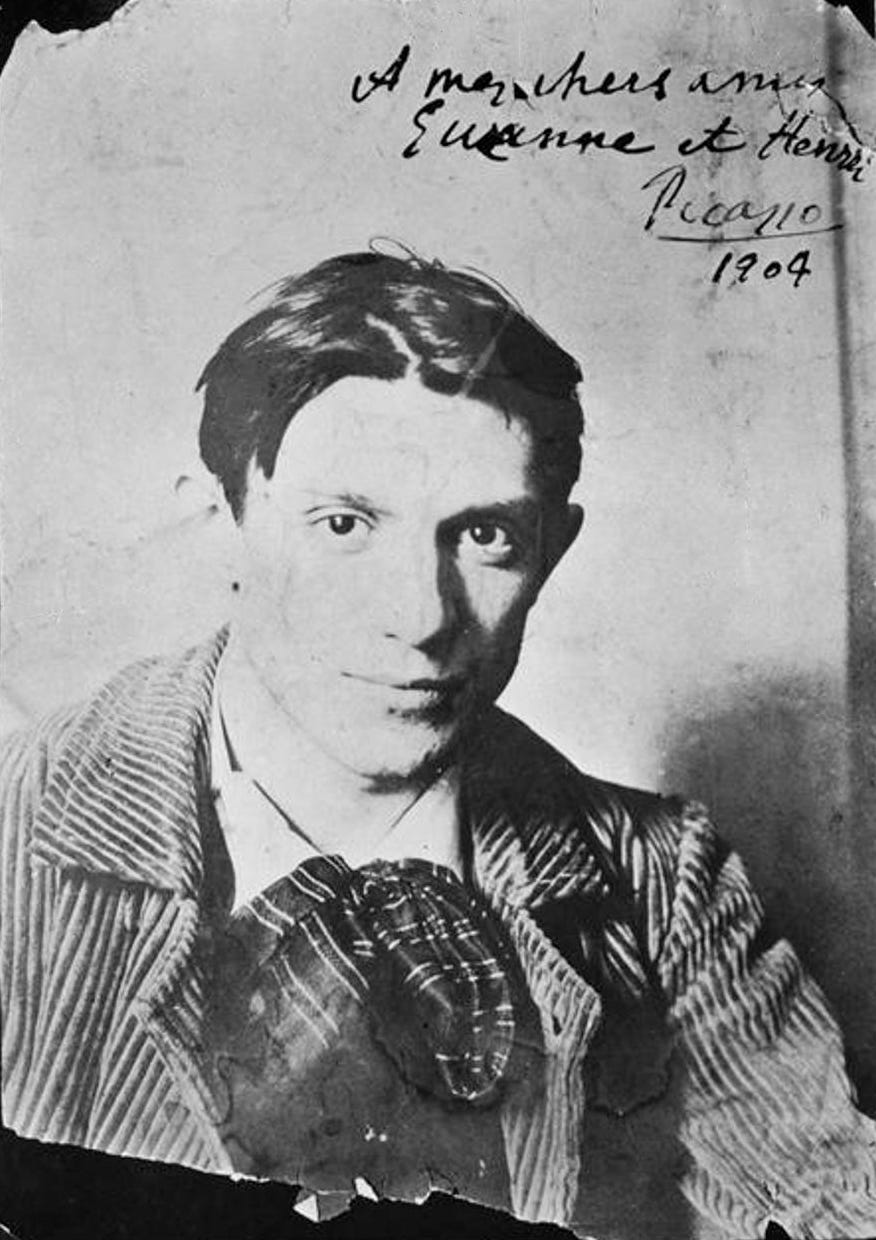
He invented Cubism, painted the century's greatest protest against war, made some fifty thousand works, died a multimillionaire at 91, and left behind a trail of broken women and a family at war over his fortune.
Genius and monster live in the same story. Here is the whole of it.
For the paintings themselves, start with his twelve greatest works.
Picasso in sixty seconds
Lived: 1881 to 1973, from Malaga to the South of France, dead at 91.
Invented: Cubism, with Georges Braque.
Greatest work: Guernica, his scream against war.
Output: around fifty thousand works, a world record.
The shadow: his cruelty toward the women in his life.
More incredible painter stories
If Pablo Picasso pulled you in, you will love these too:


Two ended their own lives. He once said women were either goddesses or doormats. The full reckoning is here: how Picasso destroyed the six women who loved him.
The prodigy from Malaga
Picasso was born in Malaga, in southern Spain, in 1881. His father was a painter and drawing teacher who spotted the boy's gift early.
The talent was almost unfair. He could draw like a master as a teenager. He later said it took him a few years to paint like Raphael, but a lifetime to paint like a child.
Where he came from is here: where Pablo Picasso was born. His odd habits and his 23 word full name are among the surprising facts about Picasso. He was endlessly quotable too: his famous quotes.
The Blue Period and a friend's death
In 1901 a close friend, Carlos Casagemas, shot himself over a failed love affair. It shattered the young Picasso.
Out of that grief came his Blue Period, years of paintings drowned in cold blue: beggars, the blind, the poor and the lonely. His art has always run on his life, and it started with a death.
He blew up how we see
In 1907 Picasso painted Les Demoiselles d'Avignon, five angular women with faces like African masks. It was so jarring even his friends recoiled.
With Georges Braque he pushed it into Cubism, shattering objects into facets and showing several viewpoints at once. It was the biggest rupture in Western art since the Renaissance, and it grew partly out of his charged rivalry with Matisse.
The name that barely fit on a certificate
When he was baptized in Malaga in 1881, the baby was given a chain of names most people never finish reading.
The full version runs: Pablo Diego Jose Francisco de Paula Juan Nepomuceno Maria de los Remedios Cipriano de la Santisima Trinidad Ruiz y Picasso.
Spanish tradition strung together saints and relatives, so a long name was not unusual. His was just longer than most.
Notice the ending. In Spain a child carries the father's surname first, Ruiz, then the mother's, Picasso. As a young man he dropped Ruiz almost entirely and signed only with his mother's name.
Picasso was rarer, and it stood out. By his twenties, one word was enough, and it became one of the most recognized signatures in art.
The father who put down his brushes
Picasso's father, Jose Ruiz Blasco, was himself a painter and a drawing teacher. He worked at a school of fine arts and later at a museum, and he specialized in careful studies of birds and other quiet subjects.
He gave his son the first lessons, drilling him in figure drawing from plaster casts and live models. The famous story goes that one day the father handed the boy his own palette and brushes and never painted seriously again, convinced the child had already passed him.
Treat that as a family legend, retold and probably polished over time. What is solid is the training. By his early teens Pablo drew with a skill that startled his teachers. The academic grounding came straight from home.
The Rose Period and the circus
After the cold sadness of his Blue Period, Picasso's palette warmed around 1904. Blues gave way to soft pinks, ochres and terracotta. Critics call this the Rose Period.
His subjects changed too. He became fascinated by traveling circus people: acrobats, jugglers and above all the harlequin in his diamond patterned costume.
These performers lived on the edge of society, admired one night and hungry the next. Picasso, still poor himself, clearly saw something of his own life in them.
The shift also lines up with a new relationship. Around this time he met Fernande Olivier, a young woman living in his Montmartre building, who became his companion and a frequent model.
The pink canvases of these years are gentler than almost anything he made later.
The Bateau Lavoir and a banquet for Rousseau
When Picasso arrived in Paris, he settled in a run down wooden building in Montmartre. Artists nicknamed it the Bateau Lavoir, the washing boat, because it creaked and swayed and had one shared tap.
Rooms were freezing in winter and stifling in summer.
Inside those cramped studios, some of the most radical ideas of the century took shape, including the early moves toward Cubism.
In 1908 Picasso threw a now legendary party there for Henri Rousseau, a self taught painter who had spent his career being mocked by the art establishment.
Picasso and his friends admired Rousseau's directness. They hung a banner in his honor and toasted him through the night. The banquet became a symbol of a new generation crowning outsiders the official Salons had refused.
Vollard and Kahnweiler, the men who sold him
No artist becomes Picasso without dealers, and two mattered most in the early years.
Ambroise Vollard was an adventurous Paris dealer who bought and showed Picasso's Blue and Rose Period work when almost no one else would. Vollard also published prints, which spread the young Spaniard's name.
The second was Daniel Henry Kahnweiler, a German dealer who arrived in Paris and gambled on the newest, strangest art in town. From around 1908 Kahnweiler signed exclusive contracts with the Cubists, buying their output and defending it in print.
That backing gave Picasso something rare for an experimental artist: a steady income while he was busy dismantling how pictures were made.
Both men also sat for portraits, so their faces survive in his work.
Questioned over the stolen Mona Lisa
In August 1911 the Mona Lisa vanished from the Louvre, and all of France went looking for it.
The scandal brushed close to Picasso. A friend, the poet Guillaume Apollinaire, had a secretary who had earlier stolen small ancient Iberian stone figures from the museum. Some of those figures had ended up with Picasso.
When police widened their net, both men were pulled in. Apollinaire was arrested and briefly jailed. Picasso was questioned. By later accounts Picasso, frightened, hesitated to admit he even knew Apollinaire.
He was released, and neither had anything to do with the actual theft. The painting turned up two years later. A former Louvre worker, Vincenzo Peruggia, had simply walked out with it under his coat.
Cutting and pasting, with Braque roped alongside
Around 1912 Picasso did something simple that changed art: he glued real material onto a picture. A scrap of printed oilcloth, a piece of newspaper, a length of rope.
The technique of pasting paper became known as papier colle, and it opened the door to modern collage.
He did not do it alone. He worked in near constant dialogue with the French painter Georges Braque, the co inventor of Cubism. The two saw each other almost daily for years, trading ideas so freely that their canvases from this stretch can be hard to tell apart.
Braque later described the closeness with a mountaineering image. He said they were roped together like climbers on a peak, each depending on the other not to fall.
A ballet, a dancer, and a calmer style
In 1917 Picasso took an unexpected job. He designed the sets, costumes and a huge stage curtain for a ballet called Parade.
It was staged by the famous Ballets Russes, with music by Erik Satie and a story by Jean Cocteau. The premiere in Paris on 18 May 1917 baffled audiences, who expected a normal ballet, not cardboard skyscraper costumes.
To prepare, Picasso traveled to Rome with the company. Among the dancers he met Olga Khokhlova, a Russian ballerina, and they married the following year.
Olga pulled him toward a more formal, upper class life, and his art shifted with it. Through the 1920s he painted calm, heavy, classical figures that look carved from stone, a period historians call his Neoclassical years.
Bending iron, then shaping clay
Picasso was never only a painter. He kept reaching into three dimensions.
Around 1928 he wanted to build sculptures out of welded metal but did not know how to weld. So he turned to an old acquaintance from Barcelona, the sculptor Julio Gonzalez, who was skilled with a torch.
Gonzalez taught him to cut and join iron, and together they made spiky, open constructions that treated empty space as part of the sculpture.
Years later, after the war, Picasso found another material. From 1947 he worked at the Madoura pottery in Vallauris, a small town in the south of France.
There he produced thousands of ceramic plates, jugs and figures, painting bulls, owls and faces onto everyday clay.
A peace dove, Velazquez redone, and a gift to Chicago
In 1949 Picasso drew a simple white dove for a poster for the World Peace Congress in Paris. The image spread worldwide and became a lasting symbol of peace. That same year he named his newborn daughter Paloma, Spanish for dove.
His late years stayed busy. Between August and December 1957 he painted 58 pictures reworking Las Meninas by the Spanish painter Velazquez, later giving the whole series to the Museu Picasso in Barcelona.
In 1967 Chicago unveiled a 50 foot steel sculpture he designed. He refused the fee of 100,000 dollars and made it a gift to the city, where it still stands in Daley Plaza. He kept working furiously into his nineties, until his death in 1973.
Iberian statues, African masks, and Cezanne
Picasso built Cubism from real sources. He studied ancient Iberian sculpture from his own Spain and the African and Oceanic masks he saw in Paris, and he took the faceted, structural logic of Cezanne.
Guernica
In 1937, during the Spanish Civil War, German planes flew for Franco and bombed the Basque town of Guernica, killing civilians in an afternoon.
Picasso answered with a vast black and grey mural of screaming horses, a dead child and a broken figure. Guernica became the most powerful antiwar painting ever made.
He refused to let it go to Spain while Franco lived. It only arrived in Madrid in 1981, after both men were dead.
The women he consumed
Picasso's private life is the hardest part of his story.
Across his life there were two wives and a string of mistresses, many far younger than him, and he treated most of them with appalling cruelty.
A communist and a millionaire
In 1944 Picasso joined the French Communist Party and stayed a member until he died.
He drew the famous Dove of Peace and gave money to the cause, even as he lived in villas and grew enormously rich from his own work. He was one of many artists who tied their art to the radical left, told in 13 famous left wing artists.
Fifty thousand works
Picasso almost never stopped. Paintings, sculptures, ceramics, prints, drawings: the total runs to roughly fifty thousand pieces.
It made him the most prolific artist on record and, by the end, fabulously wealthy. Just how much he made is here: how many paintings Picasso made.
Death and the war over his fortune
Picasso died in 1973 at his home in the South of France, aged 91.
He left no will and a colossal estate, and the fight over it tore the family apart, trailed by more tragedy among those he left behind. The full story of his end is here: how Pablo Picasso died.
Barcelona, Paris, and New York, above all
Les Demoiselles d'Avignon is at MoMA in New York, and the Museo Picasso in Barcelona covers his early years. The Metropolitan Museum of Art holds major Picassos too.
Picasso bought Balthus's painting The Street in 1937 and hung it in his own apartment, an early vote of confidence for a young painter whose unsettling scenes of adolescence would later draw far more controversy than admiration.
The Pablo Picasso questions that keep coming up
What is Picasso famous for? Inventing Cubism and painting Guernica.
Where was he born? Malaga, in southern Spain, in 1881.
How did he die? Heart failure in 1973, at 91, in the South of France.
How many works did he make? Around fifty thousand.
Was he a good man? A genius, but cruel to the women in his life.
Was Picasso a communist? Yes. He joined the French Communist Party in 1944 and stayed a member for the rest of his life.
How many wives and children did he have? Two wives, and four children by three different women.
How tall was Picasso? Short, around 1.63 meters, about five foot four.
Did Picasso win any awards? Yes, including the Soviet Lenin Peace Prize, which he received twice.
Did Picasso have pets? Yes, famously a dachshund named Lump, plus an owl and a goat.
Where is Picasso buried? At his chateau of Vauvenargues, in the South of France.
More secrets to unlock


The genius and the monster
Picasso is the hardest kind of artist to love, because the same restless force that remade painting also wrecked the people closest to him.
For me you do not get to keep one without the other.
He changed how the whole world sees, and he hurt almost everyone who loved him, and both are true at once. In 2015 his Les Femmes d’Alger sold for 179.4 million dollars, briefly a record for any painting at auction.
Go deeper: