
Fauvism is named after fauve, French for wild beast. A Paris critic used the word in 1905 to mock Henri Matisse, André Derain and their friends for their pure color. Most had moved on by 1908.
The first thing I check is the shadows. A Fauve painter gives each shadow its own color instead of darkening the color beside it. Elsewhere the paint often comes straight from the tube, and no color has to match the real object.
Cool Stories About Art is a newsletter to learn art the fun way.
Join 200,000+ readers and get:
10 new art stories / month
The entire archive of content (1,000+ articles)
Comment, ask questions, and chat with other readers
How These Were Chosen
Three tests decided the list, and every painting meets at least one. Someone ordered it, showed it or bought it while the movement lasted.
Another Fauve was painting beside the artist, in the same place and the same weeks. Or an older master had already painted the same place or scene, so you can see what the new color changed.
12. Raoul Dufy, Street Decked with Flags (1906)
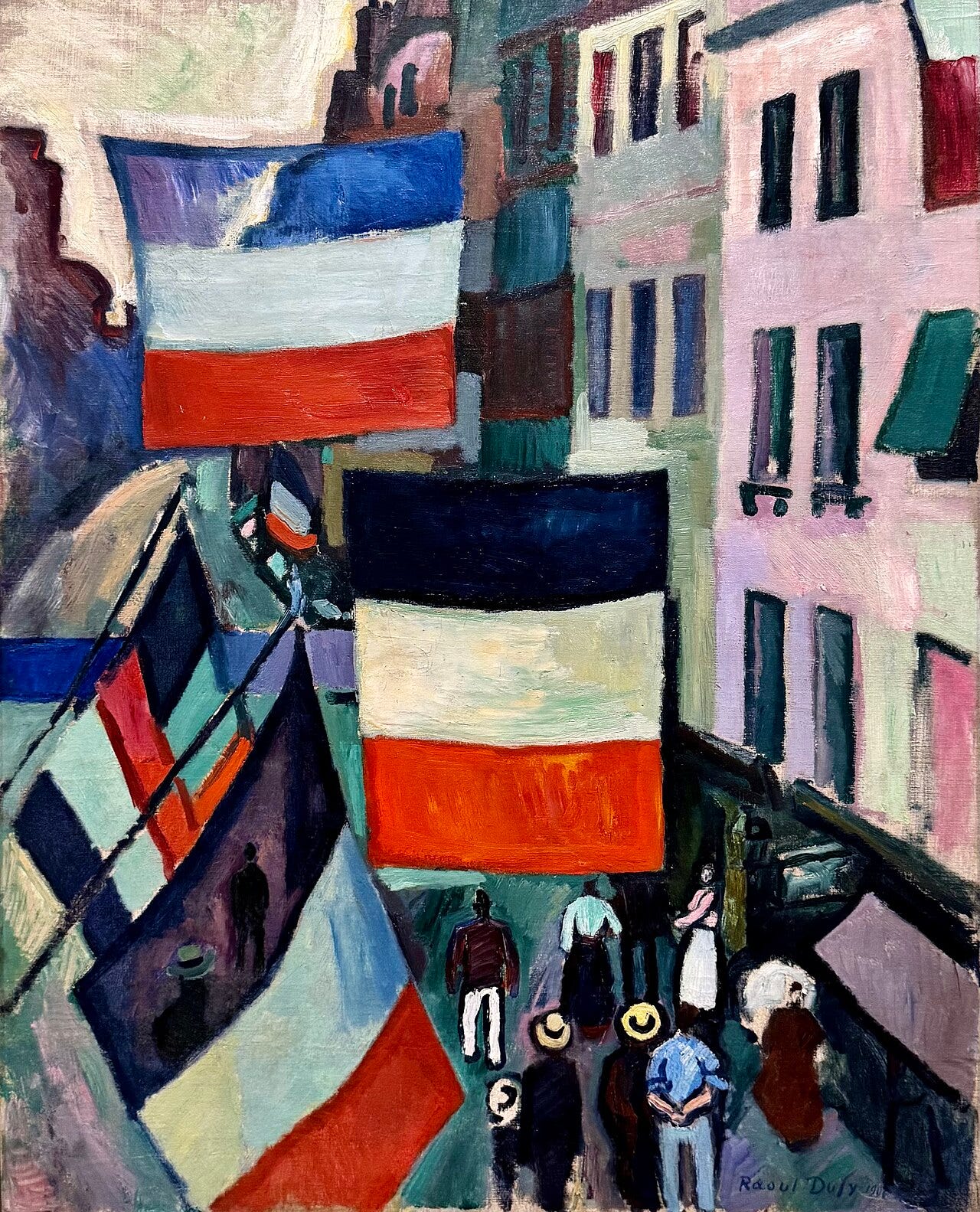
Two French flags hang across a narrow street, one near the top of the canvas and one square in its center. Smaller flags slant in from the left. Below them, men in straw boaters walk between pink and green houses.
Raoul Dufy painted this street in 1906. According to the Centre Pompidou, it is the rue des Drapiers in Le Havre, the Normandy port where he was born. The town had put out its flags for July 14, the French national holiday.
Each flag is three flat bands of blue, white and red, with almost no shading. The rows of windows behind them shrink toward the far end of the street. The flags cut straight across that perspective.
Dufy had come to this way of painting only the year before. Until then, he painted Normandy landscapes in the manner of the Impressionists. In March 1905, he saw Henri Matisse's Luxe, calme et volupté hanging in the Paris Salon des Indépendants.
Its bathers on a shore are painted in little points of unmixed color. Dufy later wrote that, in front of that canvas, impressionist realism lost its charm for him. What he found instead was imagination at work in drawing and color.
That summer, Dufy's friend Albert Marquet joined him in Le Havre. Marquet had shown beside Matisse at the Salon d'Automne the year before. Both painted the flag hung streets of the holiday, with the same model in mind.
In 1878, Claude Monet had painted the rue Montorgueil in Paris, packed with flags. Dufy kept Monet's layout, the same narrow street seen from above. Monet painted his flags and the crowd beneath them with the same quick dabs.
Dufy turned the flags into heavy blocks of flat color. In a few places, he let the cloth turn transparent.
Dufy kept this canvas in his studio for the rest of his life. In 1950, the museum says, he painted a copy of it at exactly the same size. As far as we know, it is one of the rare times Dufy repainted one of his Fauve pictures decades later.
A woman in a pink blouse stands on her doorstep. In the copy, Dufy painted her naked.
He also crowded the street with more straw boaters, sailor suits and soldiers in red trousers. The flags in the copy are even more transparent than in 1906.
At a Glance
Artist: Raoul Dufy (1877 to 1953)
Painted: July 1906
Medium: Oil on canvas
Size: 81 by 65 centimeters, about 32 by 26 inches
Where to see it: Centre Pompidou, Musée national d'art moderne, Paris. The building is closed for renovation, with reopening announced for 2030, and works from the collection travel on loan.
About This Painting
How did it reach the museum?
The Pompidou's records say Dufy's widow left Street Decked with Flags to the Musée national d'art moderne in 1963.
Is there a second version from 1906?
Yes. A second 1906 canvas of the same street is recorded in the collection of the Fondation Fridart.
Was it exhibited at the time?
According to the museum, both 1906 canvases went on show at the Salon d'Automne that fall, under the title Rue pavoisée (Le Havre).
Did Dufy keep painting flags?
Yes. About twenty years later, he came back to them in his series of regattas and water festivals.
11. Maurice de Vlaminck, View of Chatou (around 1907)
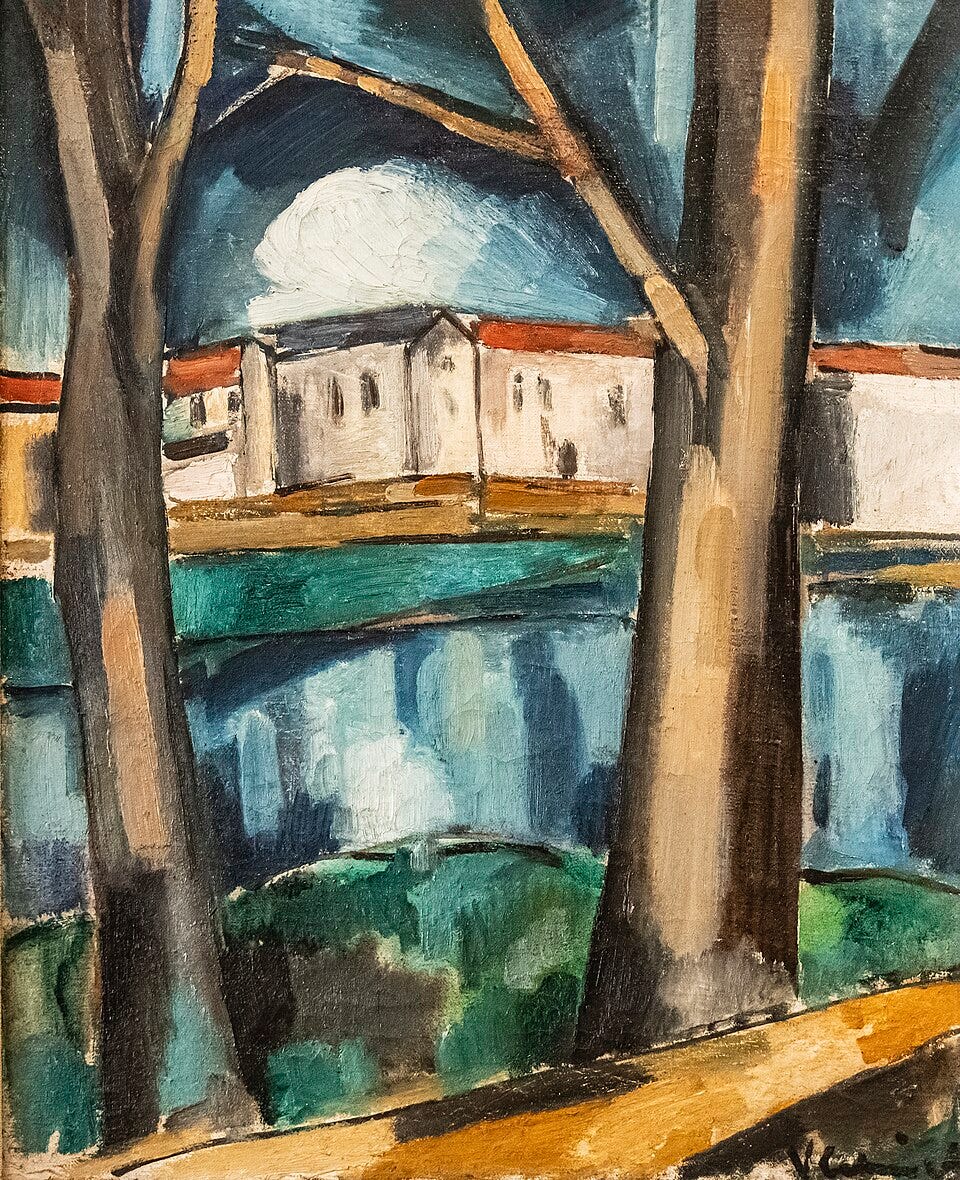
Two tree trunks rise the full height of the canvas, like the posts of a window frame. Between them, a row of white houses with red roofs stands on the far side of the water. Maurice de Vlaminck painted this view of Chatou around 1907.
Chatou is a small town on the Seine, west of Paris. Vlaminck grew up in and around it. The water fills the middle of the picture in bands of blue green and pale blue.