Fire in Art: 12 Famous Paintings of Blazes and Ruin
Fire has drawn painters for centuries, from erupting volcanoes and burning cities to furnaces glowing at night. These 12 famous fire paintings span Renaissance panels, a Japanese battle scroll, Romantic apocalypses and a Surrealist dream, each turning flame into one of art history most gripping subjects.
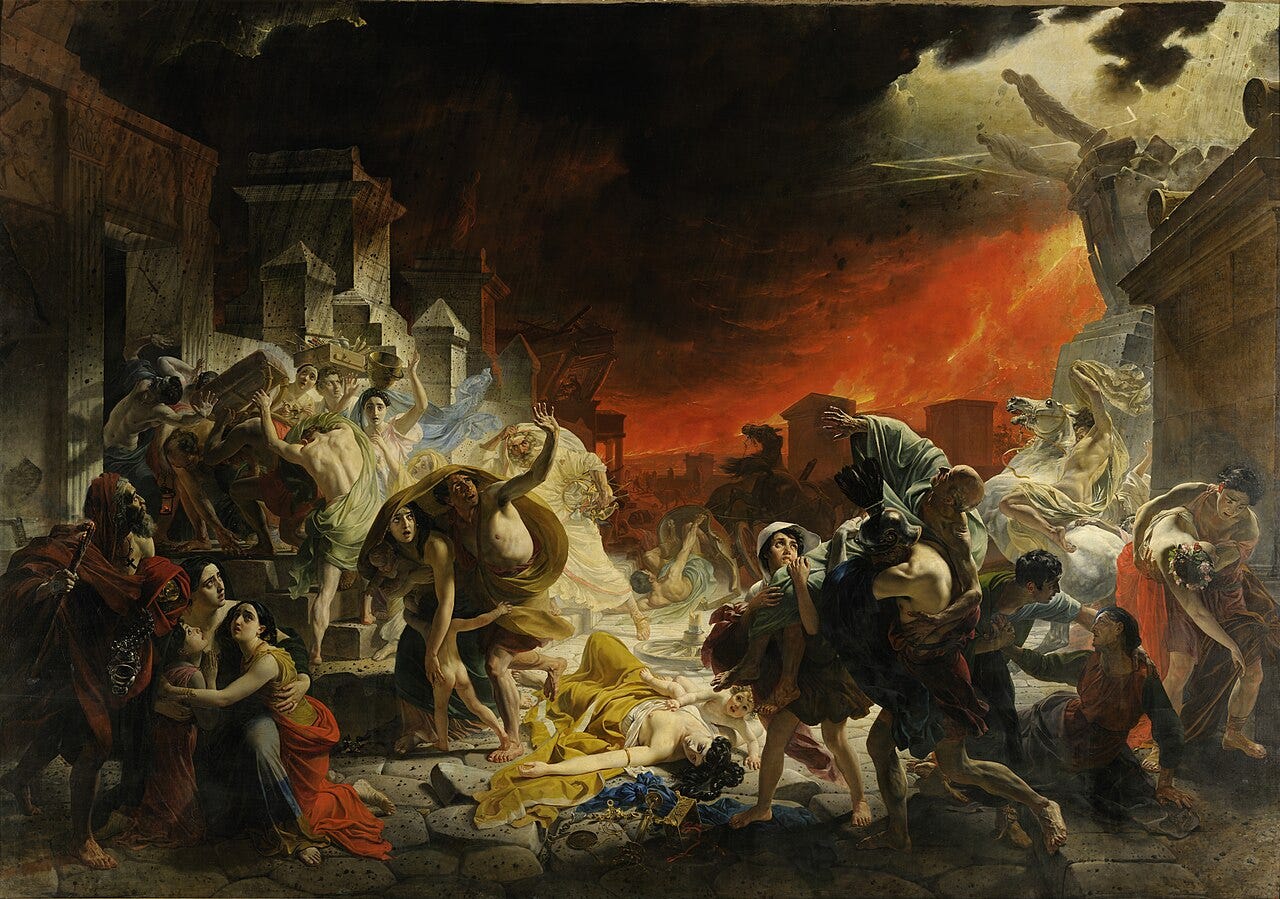
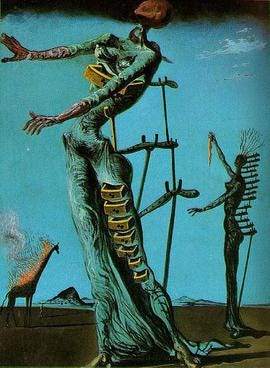
Turner rowed onto the Thames to sketch Parliament as it burned, then made not one painting but two. Karl Bryullov buried Pompeii in ash and hid his own face in the crowd, while Salvador Dali set a giraffe quietly alight as a warning of war.
Real events: many of these fires actually happened, from Pompeii in AD 79 to London in 1666 and Parliament in 1834.
Light from within: flame lets a painter light a scene from inside it, throwing faces and smoke into deep contrast.
Nature versus man: fire often stands for forces people cannot control, a favorite theme of Romantic painters.
Industry and dream: later artists turned to furnaces, fireworks and even a burning giraffe to push the subject somewhere new.
If these grip you, you will also love 7 secrets hidden in famous paintings, the painting that obsessed Hitler, and the untold story behind the Raft of the Medusa.
1. J.M.W. Turner, The Burning of the Houses of Lords and Commons

On the night of 16 October 1834, the old Palace of Westminster caught fire. Turner rowed onto the Thames and filled a sketchbook as London seat of power went up in flames.
He worked those sketches into two oil paintings, not one. This version looks across Westminster Bridge, while a second view, now in Cleveland, faces downriver. He kept adjusting the flames right up to the exhibition.
The fire wiped out centuries of English government in a single night. The building we call Parliament today was built to replace what burned.
2. Karl Bryullov, The Last Day of Pompeii
Between 1830 and 1833, Bryullov painted the eruption of Vesuvius that buried Pompeii in AD 79, crowds fleeing under a sky of ash and lightning.
He built the scene from real research, the letters of Pliny the Younger and the ruins being dug up nearby. Look for the man carrying a box of paints on his head. That is Bryullov himself.
The picture made him the first Russian painter with a European name. Pushkin wrote a poem about it and Walter Scott sat before it for hours.
3. Piero di Cosimo, The Forest Fire
Around 1505, Piero di Cosimo painted animals bolting from a blaze at the edge of a wood, one of the earliest true landscapes of the Renaissance.
The idea came from the Roman poet Lucretius, who described fire as the spark that pushed early humans toward civilization. Look closely and a few animals have human faces, added at the last minute.
The panel was furniture, not a wall picture. It was set high on a bench or chest and meant to be seen from below.
4. Frederic Edwin Church, Cotopaxi
In 1862 Church painted the Ecuadorian volcano Cotopaxi hurling smoke across a blood red sunrise, the sun straining to shine through the ash.
He had traveled to see the volcano in 1853 and 1857, then combined places and invented details to show the raw forces shaping the earth.
Americans read it as a parable of the Civil War then raging at home. A volcano stood in for a country tearing itself apart.
5. Joseph Wright of Derby, Vesuvius in Eruption
After touring Italy from 1773 to 1775, Wright painted Vesuvius throwing fire over the Bay of Naples, the mountain glowing against a cold night sea.
He was fascinated by every kind of light and painted the volcano more than thirty times. He likely never saw a major eruption in person and reconstructed the drama from smaller signs.
For Wright, fire was a science experiment as much as a spectacle. He was the painter of the age of factories and furnaces.
6. Philip James de Loutherbourg, Coalbrookdale by Night
In 1801 Loutherbourg painted the Bedlam ironworks in Shropshire at night, flames and smoke pouring from the furnaces beside the River Severn.
Cool moonlight touches the hills on either side while the center burns orange. It is one of the first paintings to treat heavy industry as a subject worthy of art.
The picture became the image of the Industrial Revolution birth, the moment fire left the volcano and moved into the factory.
7. John Martin, The Great Day of His Wrath
Between 1851 and 1853, Martin painted the end of the world from the Book of Revelation, whole cities torn loose and falling into a sea of fire.
His son said the vision came from a night journey through the Black Country, England smoking industrial heartland. The apocalypse was modeled on real ironworks.
It is one panel of three. The other two, heaven and judgement, hang beside it, but the burning world is the one people remember.
8. James McNeill Whistler, Nocturne in Black and Gold: The Falling Rocket

In 1875 Whistler painted fireworks bursting over the Thames at Cremorne Gardens, gold sparks falling through a dark blue night.
The critic John Ruskin said Whistler was flinging a pot of paint in the public face. Whistler sued for libel and won, but the court awarded him a single farthing.
The trial and its costs helped bankrupt him. A picture of falling sparks nearly ended his career.
9. Hubert Robert, The Fire of Rome
In 1785 Robert staged the Great Fire of Rome of AD 64, a huge bridge framing an inferno as tiny figures scatter in panic.
Robert was nicknamed the painter of ruins and loved grand architecture in trouble. The old story that Nero fiddled while Rome burned is a later legend, since the emperor was out of the city when it started.
For Robert the disaster was a stage set. He used a real catastrophe to indulge his love of columns, arches and collapse.
10. Dutch School, The Great Fire of London
Painted in 1666 by an unknown Dutch artist, this view shows London burning behind Old London Bridge, with Old Saint Paul alight in the distance.
Unusually, the painter filled the quayside with panic, crowds dragging belongings onto boats. It is one of the closest things we have to an eyewitness record of the fire.
The cathedral you see in flames did not survive. Christopher Wren domed Saint Paul rose in its place.
11. Kamakura period artist, Night Attack on the Sanjo Palace

This Japanese handscroll, painted in the late 1200s, shows the burning of the Sanjo Palace during a night raid in December 1159, when rebels seized a retired emperor.
The fire is done in gold and ink, sweeping across the paper as you unroll it right to left. It is often called one of the finest depictions of the chaos of war ever painted.
The scroll runs more than 20 feet. Read it like a film and the flames, arrows and fleeing figures move past you scene by scene.
12. Salvador Dali, The Burning Giraffe
Dali painted this small canvas in 1937, as the Spanish Civil War tore his country apart, with a giraffe quietly ablaze on the horizon.
He called the burning giraffe a masculine cosmic apocalyptic monster, a sign of coming war. The propped up woman in front has drawers opening from her body, his image of hidden fears.
The fire is almost easy to miss. The giraffe burns in the background while the figures stand frozen, and that quiet is the point.
Where to see them
Tate, London: Joseph Wright of Derby Vesuvius in Eruption and John Martin The Great Day of His Wrath.
Detroit Institute of Arts: Frederic Edwin Church Cotopaxi and Whistler The Falling Rocket.
Philadelphia Museum of Art: Turner The Burning of the Houses of Lords and Commons.
Ashmolean Museum, Oxford: Piero di Cosimo The Forest Fire.
Science Museum, London: Loutherbourg Coalbrookdale by Night.
How painters turned flame into meaning
Many of these are history paintings, built to make a real disaster feel like a moral event, from Pompeii to the fall of Rome.
Others belong to Romanticism, where fire stood for nature raw power, and to landscape painting, where a volcano or a furnace lit the whole horizon.
Fire in art, questions people ask
What is the most famous fire painting? Turner The Burning of the Houses of Lords and Commons is among the best known, painted after he watched Parliament burn in 1834.
Did the artists witness these fires? Some did. Turner sketched the Parliament fire from a boat, while others, like Bryullov, reconstructed events from history and archaeology.
Why did Romantic painters love fire? Fire showed nature power and human helplessness, a central idea in Romantic art.
Is there a famous modern fire painting? Yes. Salvador Dali The Burning Giraffe from 1937 uses a flaming giraffe as a warning of war.
Where can I see fire paintings in person? The Tate in London, the Detroit Institute of Arts and the Ashmolean in Oxford all hold important examples.
What rose from the ashes of 1834
The Parliament fire Turner painted was not the end of the story. The old Palace of Westminster burned down on that October night in 1834, and in its place Charles Barry and Augustus Pugin built the Houses of Parliament we know now, clock tower and all, finished around 1870. Turner two canvases are the closest thing we have to a live report from the river. One hangs in Philadelphia, the other in Cleveland, both still glowing.