Famous Flower Paintings: 12 in Full Bloom

The most famous flower paintings are never only about flowers. They are about wealth, love, faith and above all time, since the bloom the painter chased would be dead within days. Here are twelve of the greatest, all now in the public domain.

Vincent van Gogh, Sunflowers, 1888

From impossible Dutch bouquets to Van Gogh's blazing sunflowers, painters have used flowers to stop the clock for four hundred years. I have gathered the pictures that still make people lean in and breathe deeper.

What blooms in them:

  • The wealth. Rare tulips and roses that cost more than a house.

  • The warning. Fallen petals and insects that whisper how short life is.

  • The skill. Every dewdrop and beetle painted under an invisible lens.

  • The feeling. Gratitude, grief and joy poured into a single vase.


Learn art the fun way. Free stories every week, no boring lectures.


The stories behind the stories

If you like knowing what is actually going on inside a picture, start with these three:


1. Vincent van Gogh, Sunflowers (1888)

No artist has ever been tied to one flower more tightly than Van Gogh and the sunflower. In Arles in 1888 he painted a whole series of them to brighten the yellow house he was readying for his friend Gauguin.

To him the flower stood for gratitude and light.

He used a brand new chrome yellow so intense that some of it has since faded toward brown, and museums now shield the pictures from strong light.

Several versions survive, scattered from London to Tokyo. One sold in 1987 for a record price that shook the art world.

2. Ambrosius Bosschaert the Elder, Bouquet of Flowers in a Niche (1620)

Ambrosius Bosschaert the Elder, Bouquet of Flowers in a Niche, 1620

Look closely at this perfect bouquet and you realize it could never have existed. Bosschaert crammed tulips, roses and lilies into one vase though they bloom in different months, an arrangement impossible in real life.

He built it from studies made across a whole year.

This was the dawn of Dutch flower painting, at the very moment tulip fever was gripping Holland. A single rare tulip bulb could cost more than a canal house. His jewel bright bouquet was as much a display of wealth as of beauty.

3. Jan van Huysum, Flowers in a Vase (about 1720)

Jan van Huysum, Flowers in a Vase, about 1720

A riot of blooms tumbles from a stone urn, every petal, dewdrop and crawling insect rendered with microscopic precision. Van Huysum was the most celebrated flower painter of his age, and the most secretive.

He locked his studio and refused to let anyone watch him work.

He often took two years to finish a single picture, waiting for each flower to bloom in its season before adding it. His clients paid the highest prices in Europe and waited patiently for their turn.

He guarded his recipe for a clear varnish so jealously that it died with him.

4. Rachel Ruysch, Flowers in a Vase (about 1700)

Rachel Ruysch, Flowers in a Vase, about 1700

The finest flower painter of the Dutch golden age was a woman who out earned Rembrandt. Rachel Ruysch built a sixty year career on lavish bouquets alive with lizards, butterflies and beetles, a queen of still life painting. She kept going past the age of eighty.

Trained beside her father, a professor of anatomy, she hid tiny creatures in every arrangement like a naturalist. She raised ten children and once won a state lottery.

In 1708 the Elector Palatine hired her as his court painter, a rare honor for any artist, let alone a woman.

5. Jan Brueghel the Elder, Bouquet of Flowers (about 1606)

Jan Brueghel the Elder, Bouquet of Flowers, about 1606

Dozens of species crowd a wooden tub, from grand tulips down to a single fallen petal on the ledge. Jan Brueghel, nicknamed Velvet for his soft touch, treated each flower as a precise specimen. Together they form a catalog of everything that blooms.

The dropped petals and the insects are quiet reminders that all this beauty will rot within days. He worked for archdukes and emperors, who prized his flowers like jewels. It is among the earliest great flower pictures in Western art.

6. Pierre Joseph Redoute, Roses (about 1820)

Pierre Joseph Redoute, Rosa gallica, about 1820

Some called him the Raphael of flowers, and empresses competed to employ him. Redoute painted the roses in the garden of Josephine, Napoleon's wife, at her country house of Malmaison.

His prints of them remain among the most reproduced botanical images ever made.

He worked in delicate watercolor on vellum, exact enough for a botanist yet lovely enough for a palace wall. His great books of roses and lilies sold across Europe. Two centuries on, his roses still hang in kitchens and tearooms everywhere.

7. Claude Monet, Water Lilies (about 1916)

Claude Monet, Water Lilies, about 1916

In his last decades Monet painted almost nothing but the lily pond in his garden at Giverny. He dug the pond himself, planted it, and returned to it hundreds of times as the light shifted. The water became his whole world.

By the end his eyes were clouded with cataracts, and he painted partly from memory of colors he could barely see. The largest canvases now wrap two oval rooms of the Orangerie in Paris, a pond you can stand inside.

He gave them to France the day after the First World War ended.


130,000 readers already get these. Add your email, it is free.


8. Henri Fantin Latour, Roses (1885)

Henri Fantin Latour, Roses in a Bowl, 1885

A handful of roses sits in a plain glass on a bare table, quiet and almost breathing. Fantin Latour painted flowers like portraits, giving each bloom its own character and mood. He sold most of them to English collectors who could not get enough.

While his friends chased the new Impressionism, he stayed loyal to careful, tender realism. A popular old rose still carries his name today. His still lifes paid the bills that let him paint the group portraits he cared about most.

9. Odilon Redon, Vase of Flowers (about 1910)

Odilon Redon, Vase of Flowers, about 1910

After decades of drawing nothing but nightmares in black, Redon broke into color late in life, and flowers led the way. His bouquets float on dreamy backgrounds, half real and half imagined, glowing like stained glass.

They feel less observed than dreamed.

He worked in soft pastel and thin oil, letting colors bleed into strange, tender clouds. The Symbolists and later the Surrealists claimed him as a forefather. His flowers hang today from Paris to New York, still hard to place in any one time.

10. Edouard Manet, Flowers in a Crystal Vase (about 1882)

Edouard Manet, Carnations and Clematis in a Crystal Vase, about 1882

In his final year, dying and often unable to leave his bed, Manet painted small bouquets of the flowers friends brought him. These last little pictures, a few blooms in a glass, are among the most tender things he ever made. He was only fifty one.

A painful illness was slowly taking his legs, and flowers were a subject he could still manage from a chair. Each one is fresh, loose and full of life, the opposite of a sickroom. Several now hang in the National Gallery of Art in Washington.

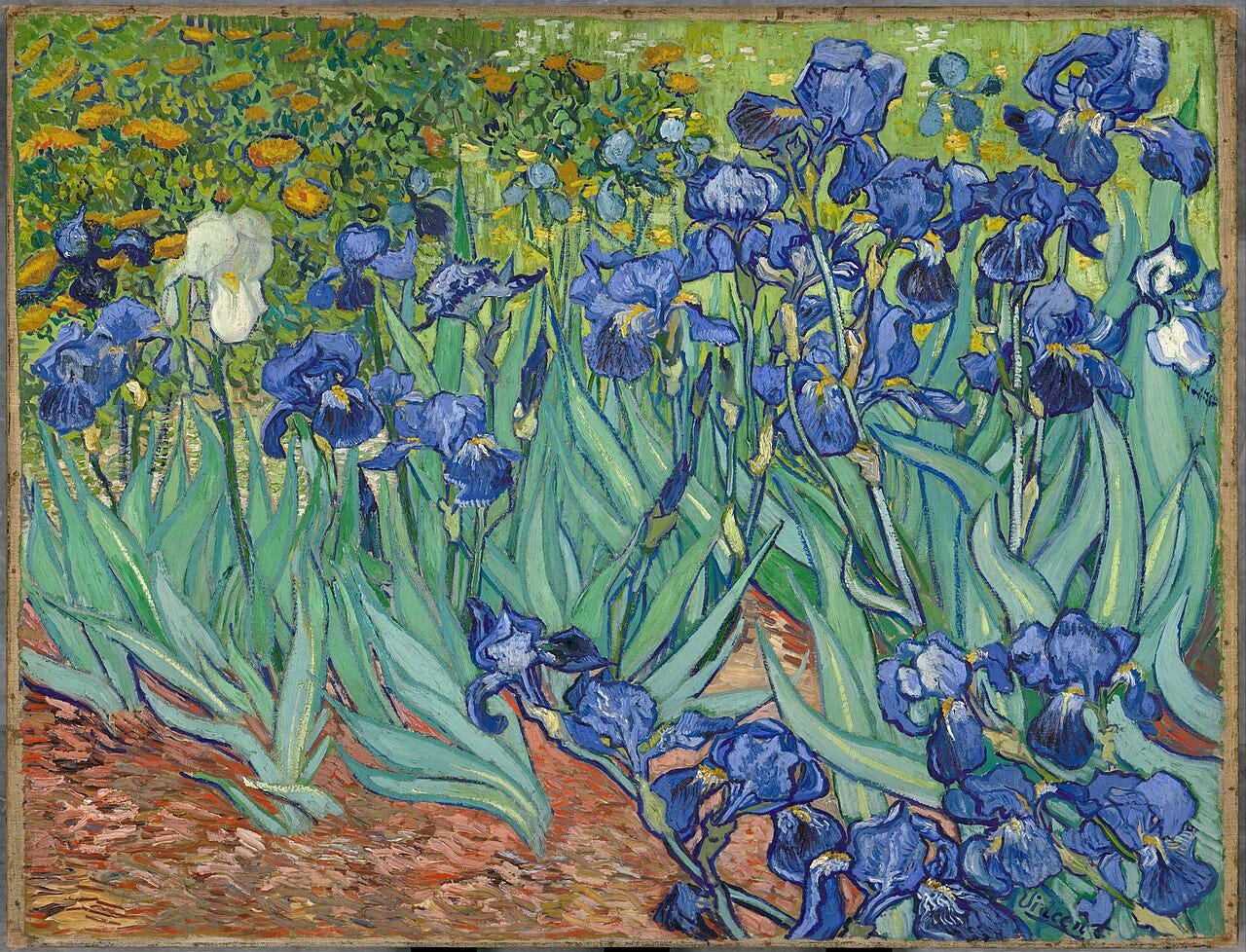
11. Vincent van Gogh, Irises (1889)

Vincent van Gogh, Irises, 1889

Van Gogh painted this dense bed of blue irises in the garden of the asylum where he had voluntarily shut himself away. He called painting the lightning rod for his illness, and worked at it feverishly to stay steady.

There is barely a straight line in the picture.

One white iris stands apart from all the blue, a lone outsider in the crowd, as many viewers have noticed. He made it in the same burst of work as The Starry Night. In 1987 it briefly became the most expensive painting ever sold.

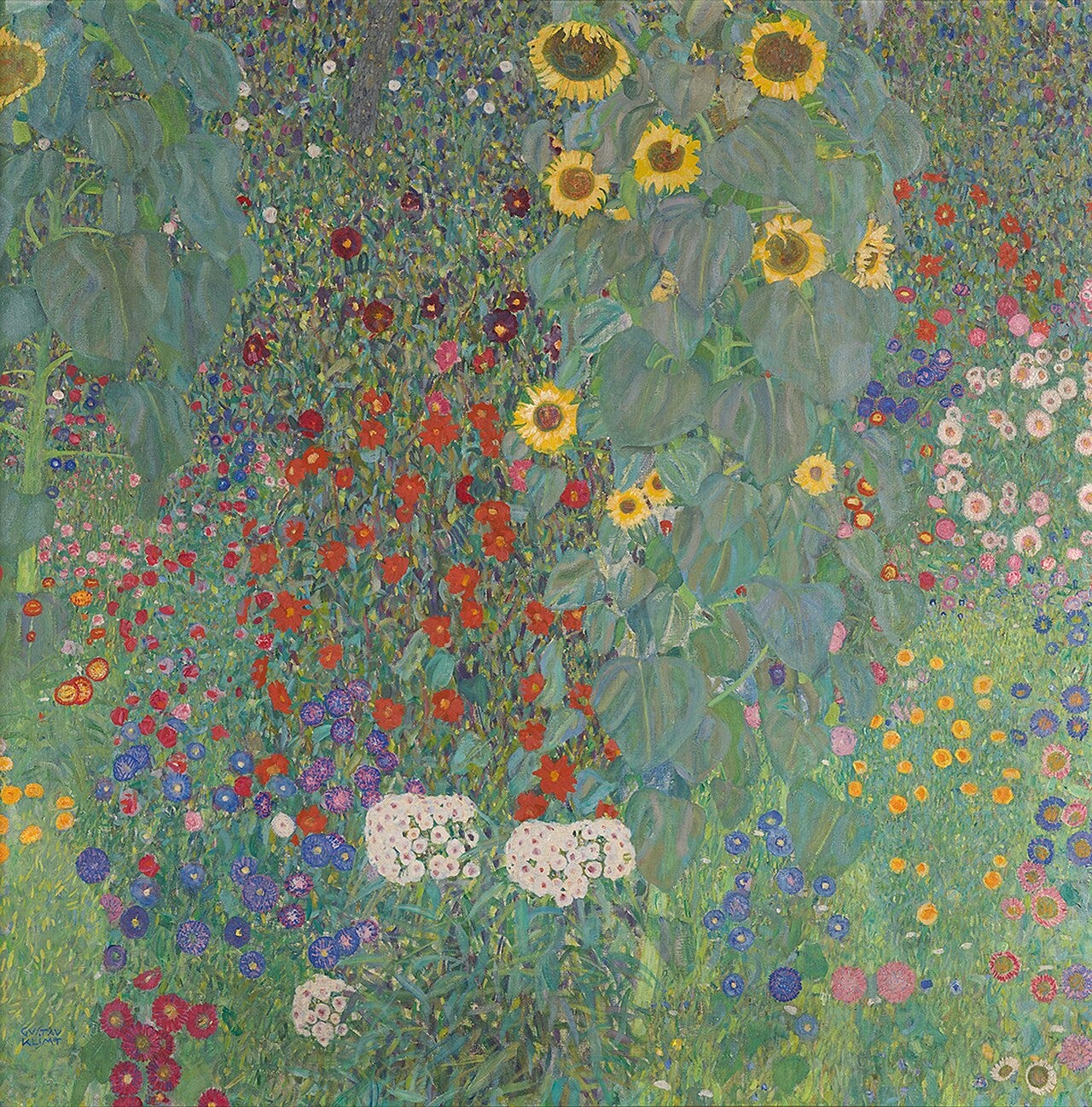
12. Gustav Klimt, Farm Garden with Sunflowers (1907)

Gustav Klimt, Farm Garden with Sunflowers, 1907

A wall of flowers fills the whole square canvas, so dense you can barely find the sky. Klimt painted the summer gardens of the Austrian countryside where he spent his holidays, packing every inch with blossom.

The sunflowers stand among them like quiet figures.

He made these garden pictures in the same golden years as his famous portraits, often framing the view through a small cardboard viewfinder to flatten it.

There is no horizon and no story, only pure pattern and color. Klimt made these gardens on holiday at the Attersee, where he swam and painted every summer for years.


Join 130,000 readers who get the secrets behind the paintings. Free.


Where these bouquets survive

  • Vincent van Gogh, Sunflowers: the National Gallery, London, and the Van Gogh Museum, Amsterdam.

  • Vincent van Gogh, Irises: the Getty Museum, Los Angeles.

  • Claude Monet, Water Lilies: the Orangerie, Paris.

  • Rachel Ruysch and Jan van Huysum: the Rijksmuseum, Amsterdam.

  • Edouard Manet, flower pieces: the National Gallery of Art, Washington.

  • Gustav Klimt, Farm Garden with Sunflowers: the Belvedere, Vienna.


If these blooms pulled you in, keep going:


Two new stories a week, 130+ secrets unlocked. Start free.


Flower paintings, a few quick questions

  • What is the most famous flower painting? Vincent van Gogh's Sunflowers, painted in Arles in 1888, is the best known of all.

  • Why did the Dutch paint so many flowers? In the 1600s flowers, especially rare tulips, were symbols of wealth, and their quick decay let painters hint at how fleeting life is.

  • What about Georgia O'Keeffe? Her giant close up flowers are icons of the twentieth century, but her work is still under copyright, so it is not shown here.

  • Are flower paintings just decoration? Rarely. Most carry a quiet message about wealth, love or the shortness of life, tucked into a fallen petal or a wilting bloom.

  • Where can I see famous flower paintings? The Rijksmuseum, the Van Gogh Museum, the National Gallery in London and the Orangerie in Paris hold the greatest examples.

Beauty on a deadline

Every flower painting is a small act of defiance against time. The bloom in front of the painter would be dead within days, so catching it in paint was a way of stopping the clock.

The Dutch knew this and turned it into a whole language of petals and insects, and Van Gogh felt it too as he raced his sunflowers toward their gold.

The Water Lily rooms of the Orangerie opened to the public in 1927, months after Monet died, and their flowers have not wilted since.