
The most famous Impressionist paintings caught ordinary life in motion, a station full of steam, a Sunday dance, a barmaid staring past you. Between 1872 and 1897 a group the critics laughed at rebuilt what a painting was allowed to look like.
Here are twelve of them, in the order they were painted, with what is actually going on inside each one. If you want the movement itself first, start with what Impressionism is. The movement that followed took the same bright color somewhere darker and more personal, a shift covered in Impressionism vs Post Impressionism.
In 30 seconds:
Twelve paintings, from Berthe Morisot's The Cradle in 1872 to Camille Pissarro's Boulevard Montmartre at Night in 1897.
The name of the movement started as an insult, thrown at Monet's title Impression, Sunrise by a critic in 1874.
The first Impressionist show opened in April 1874 in the old studio of the photographer Nadar, on the boulevard des Capucines.
Berthe Morisot showed in seven of the eight Impressionist exhibitions. Monet showed in five.
Six of the twelve hang in the Musée d'Orsay in Paris, three at the Art Institute of Chicago.
What made a painting Impressionist:
The light. They painted the same scene at different hours and treated the changing light as the real subject.
The speed. Brushstrokes left visible where they landed, instead of a smooth finish that hides the hand.
The subject. No gods and no battles. Trains, dance halls, a flooded street, a child in a basin.
The exit. They stopped waiting for the official Salon and put on their own shows, eight of them between 1874 and 1886.
Learn art the fun way


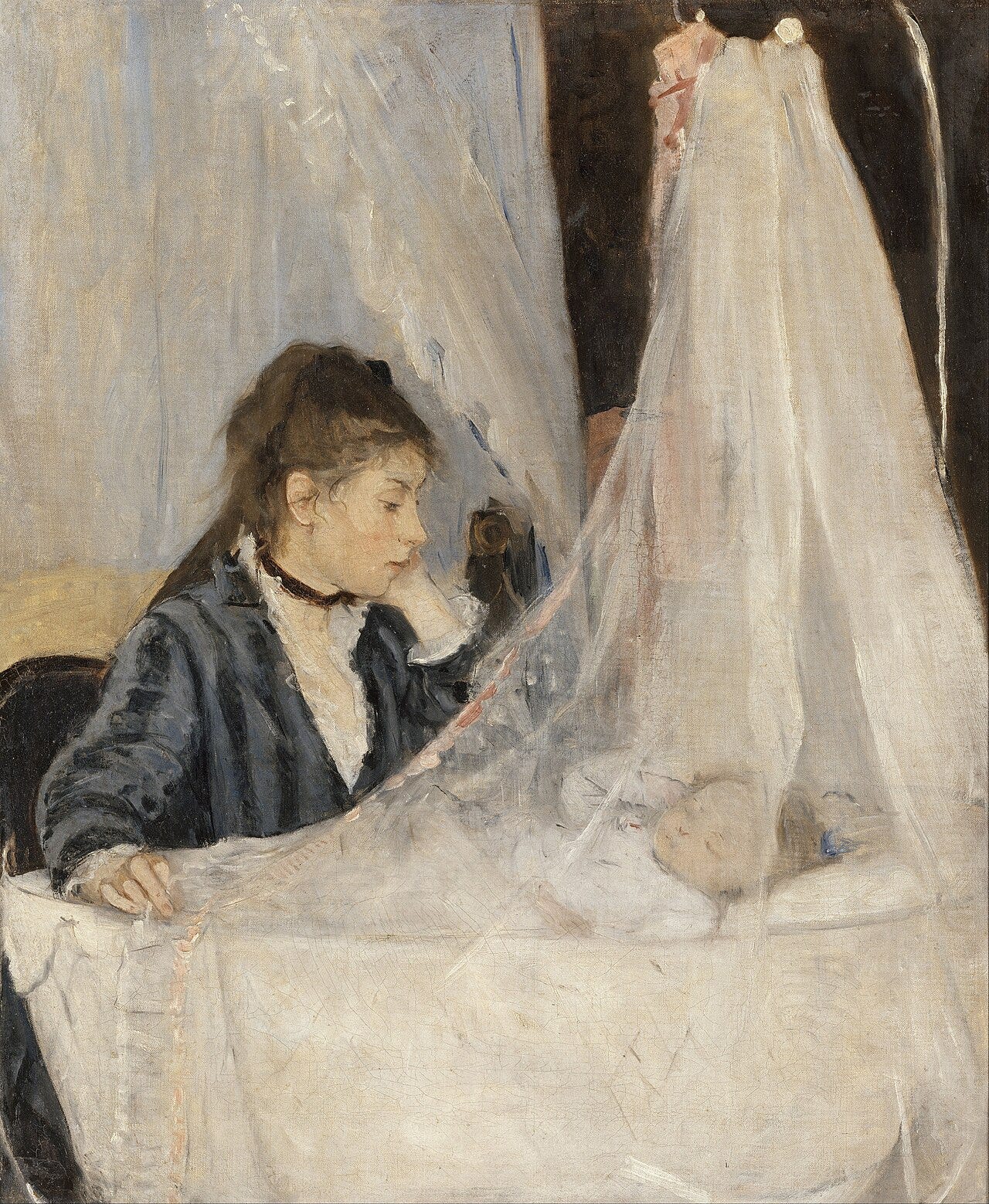
1. Berthe Morisot, The Cradle (1872)
Morisot painted her older sister Edma watching her newborn daughter Blanche sleep. The gauze over the cradle is laid on so thinly that you read the baby straight through it.
It hung in the first Impressionist exhibition in April 1874 and found no buyer. The painting stayed inside the family for the rest of her life, and the French state acquired it only in 1930. Morisot took part in seven of the eight group shows, two more than Monet.
2. Edgar Degas, The Dance Class (1874)
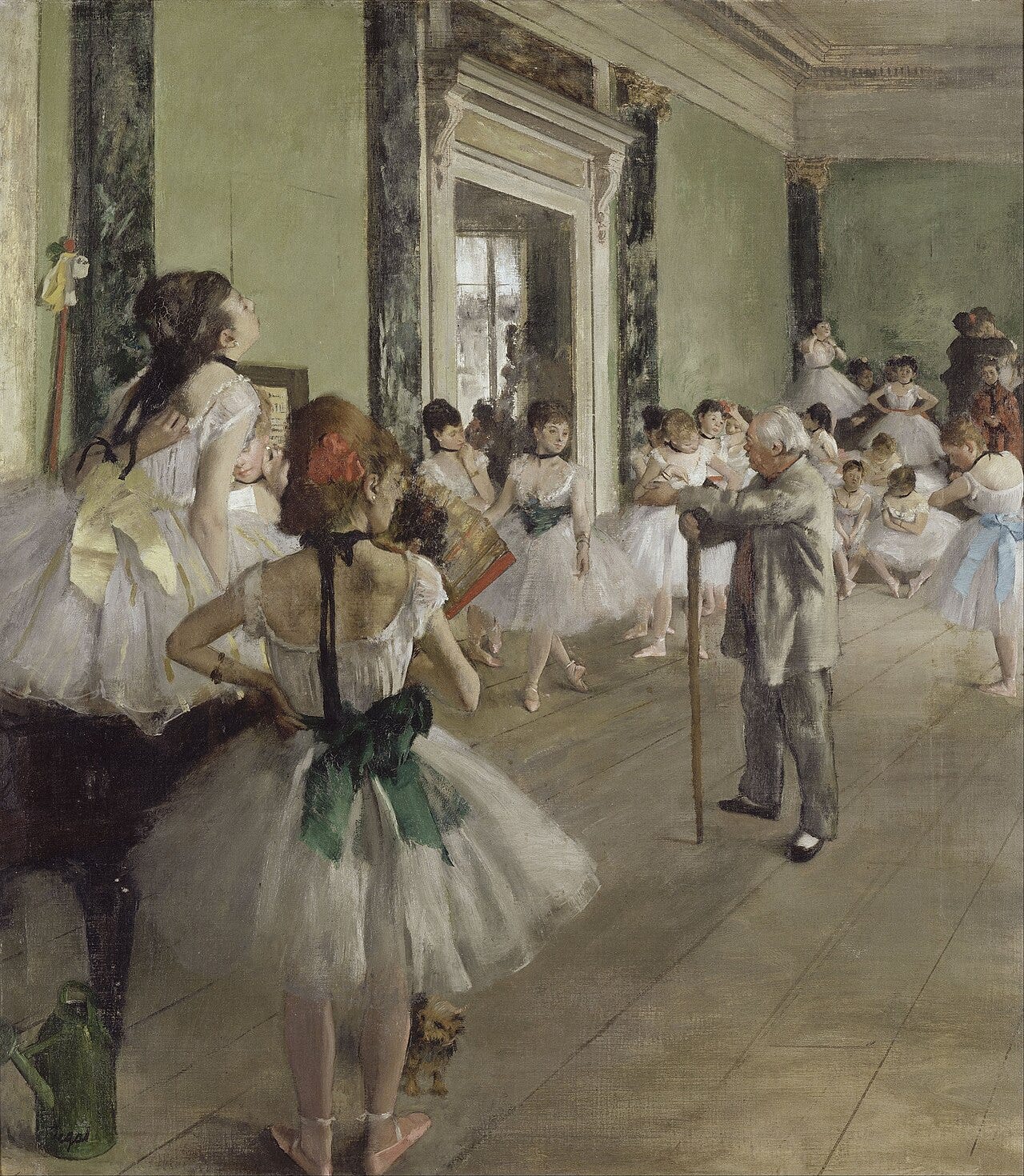
The old man leaning on the long stick is Jules Perrot, a real ballet master who had worked with the great dancers of the previous generation. Around him the class is falling apart: girls scratching, yawning, fixing a shoulder strap, waiting their turn.
Degas disliked being filed under Impressionism. He worked indoors, from drawings and memory, and had no interest in setting up an easel in a field. He called himself a realist. Dancers still account for roughly half of everything he made.
3. Edgar Degas, In a Café, known as L'Absinthe (1876)
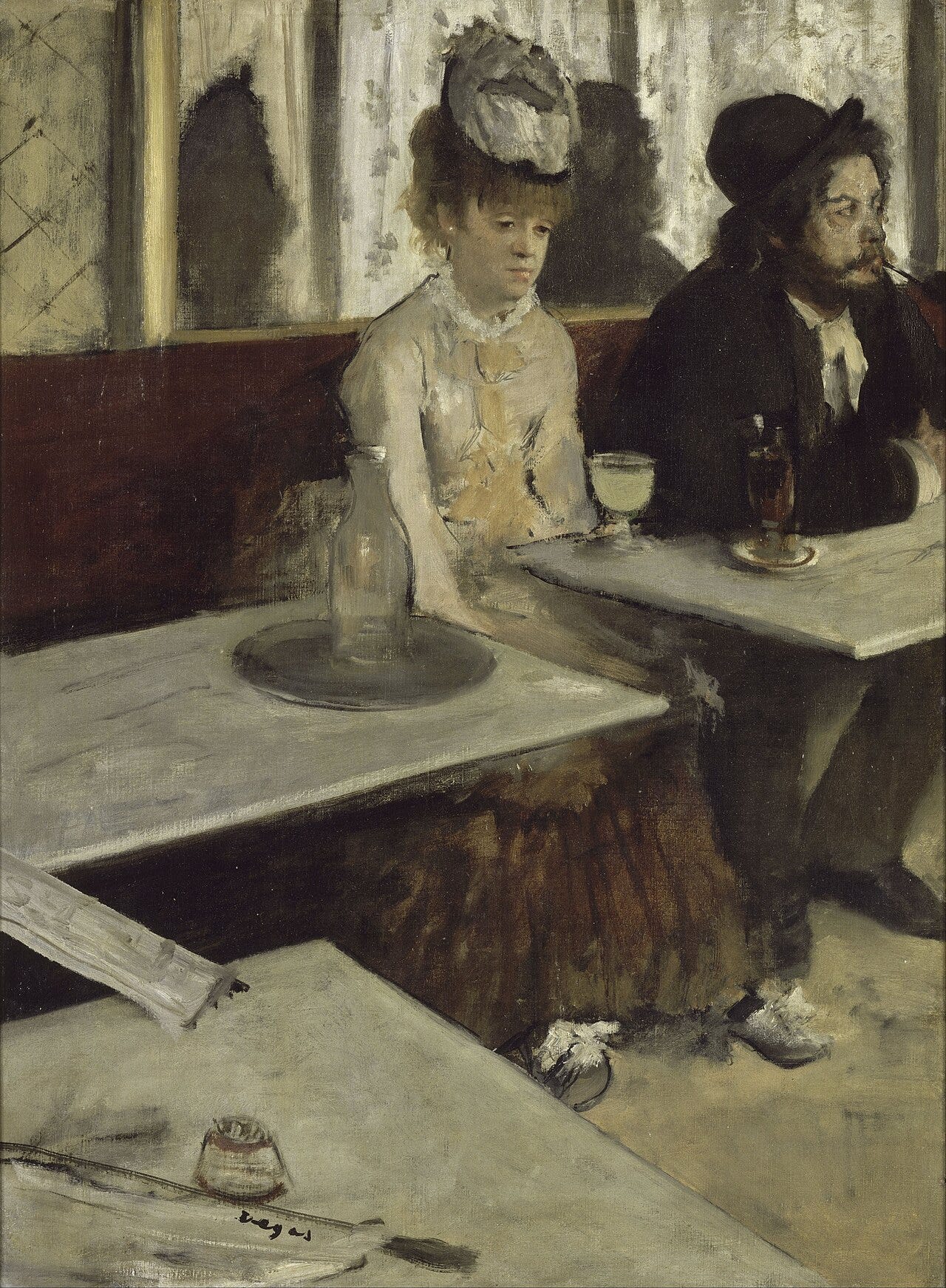
Nobody in this picture is a stranger. The woman is the actress Ellen Andrée, the man is the painter and engraver Marcellin Desboutin, and both were friends of Degas posing in a café the group used, the Nouvelle Athènes.
When it was shown in London in 1893 the reaction was furious. English critics read it as a lesson against drink and called it degrading. The title L'Absinthe was never Degas's. He called the picture In a Café.
4. Pierre Auguste Renoir, Bal du moulin de la Galette (1876)
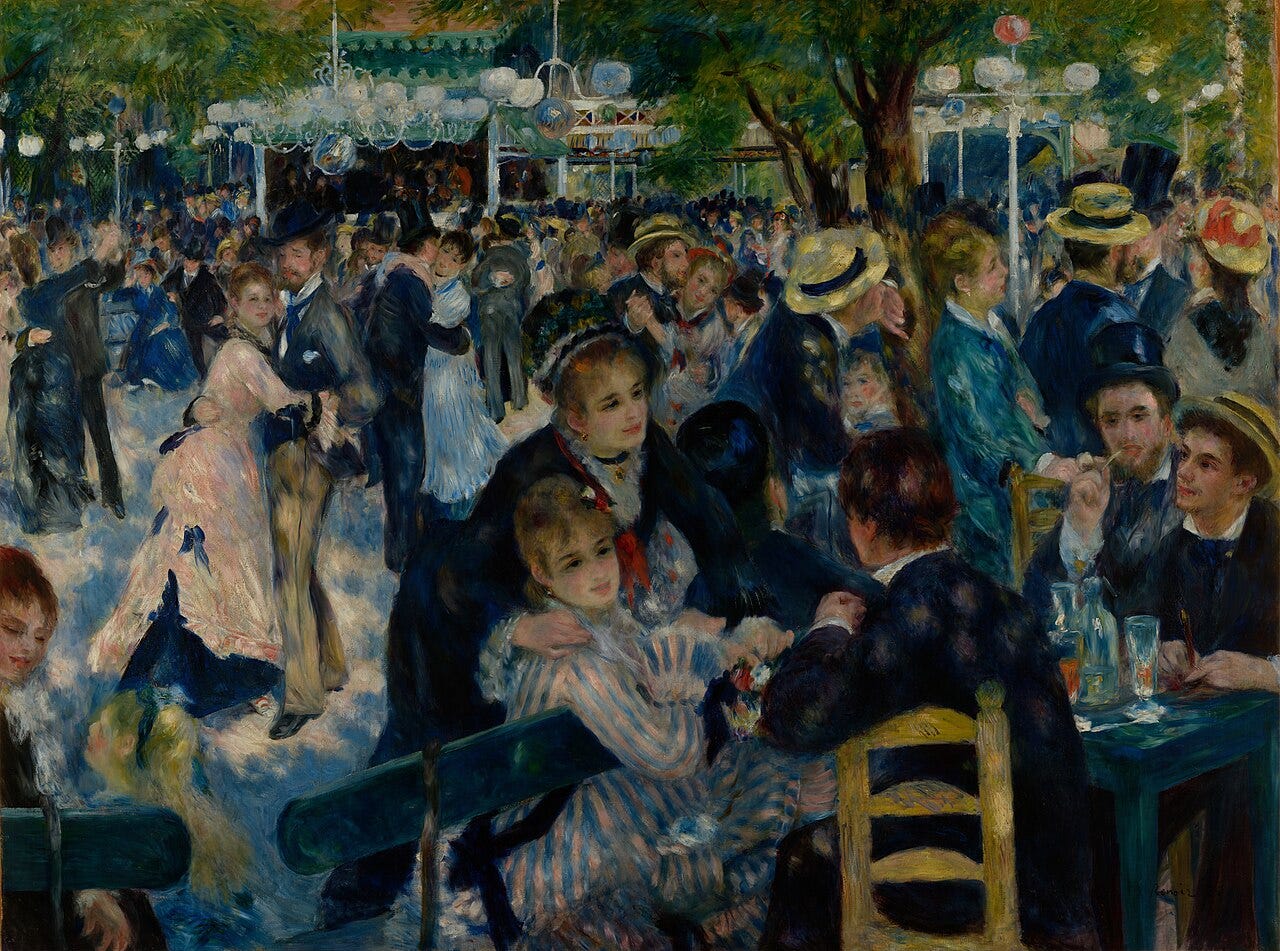
A Sunday afternoon dance in the garden of an open air ballroom in Montmartre, a few streets from where Renoir lived. The men in the foreground are his friends. The patches of blue and pink crawling over faces and coats are sunlight coming down through acacia leaves.
Gustave Caillebotte, who turns up at number seven on this list, bought the large version and left it to the French state when he died in 1894. That is how it reached the Musée d'Orsay. A smaller second version went into private hands, and it has a story of its own at the end of this page.
5. Alfred Sisley, Flood at Port Marly (1876)
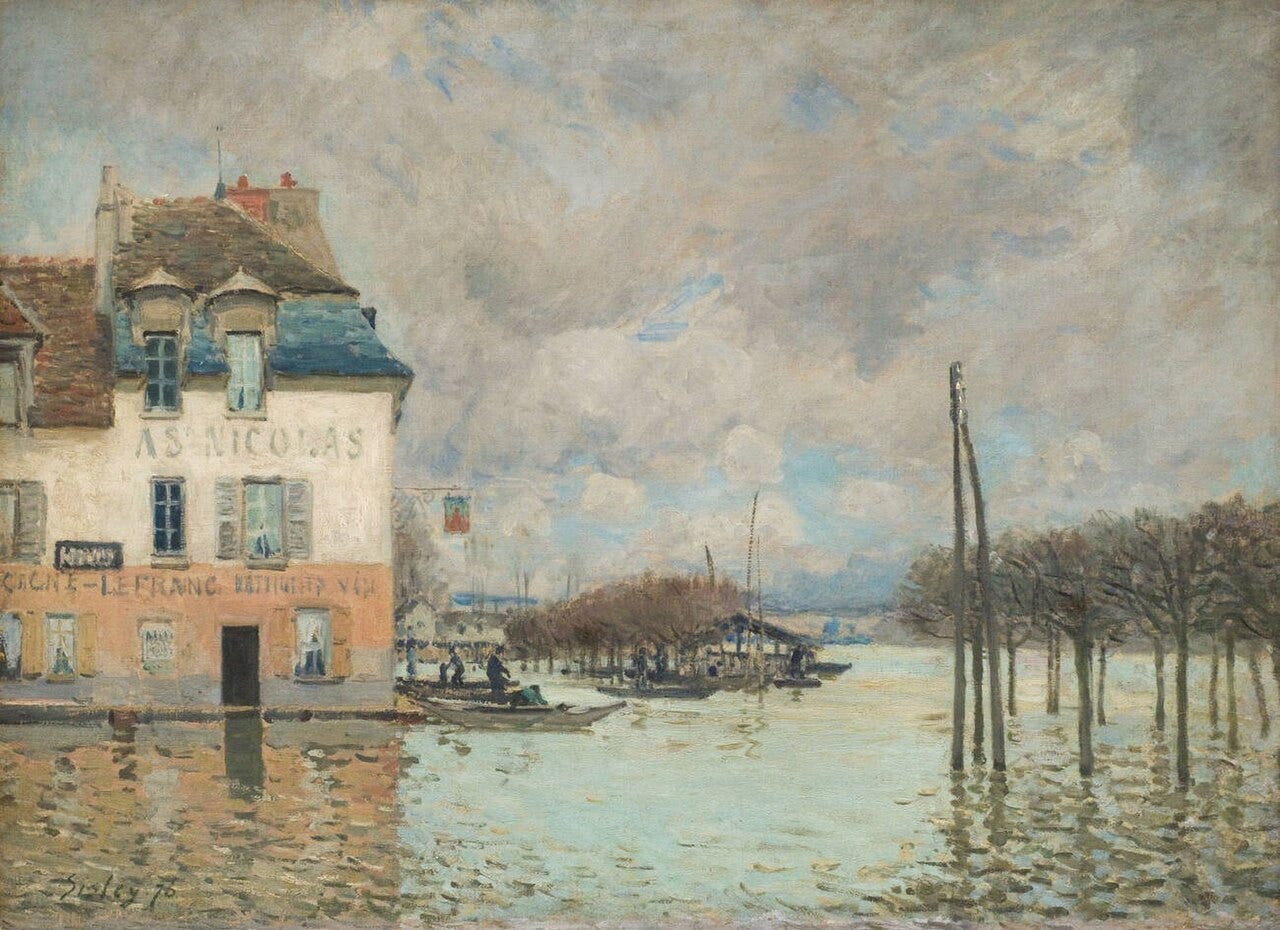
The Seine came over its banks at Port Marly in the spring of 1876 and Sisley went back to paint it again and again. He drops the horizon low and gives most of the canvas to sky and water, so the flooded wine merchant's shop sits on a mirror.
He was British by nationality, applied for French citizenship, and was still waiting when he died at Moret sur Loing in 1899, poor. This canvas reached the Musée d'Orsay through the collector Isaac de Camondo, who left his pictures to the state in 1911.
6. Claude Monet, The Gare Saint Lazare (1877)
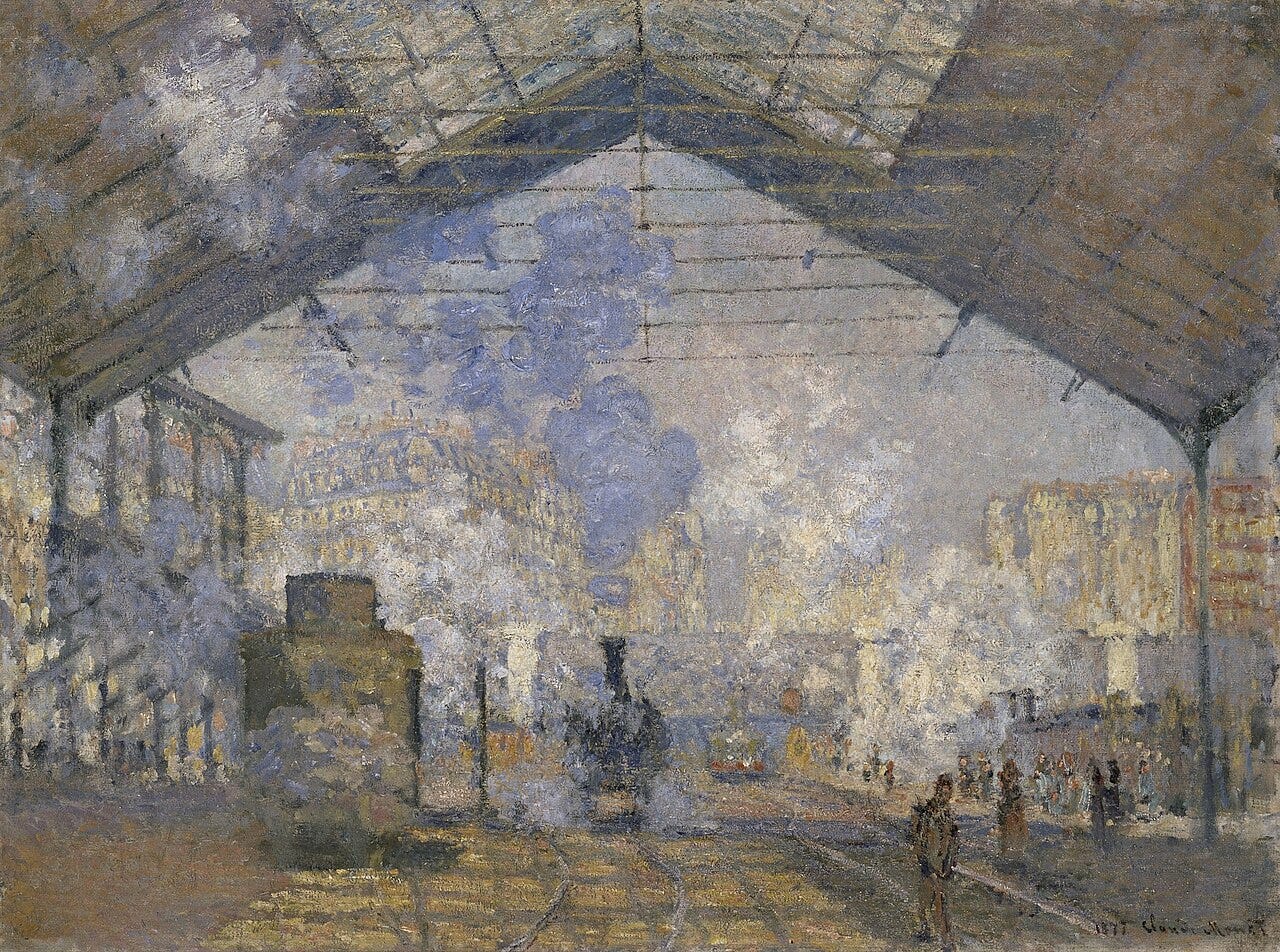
Monet made twelve canvases of this station in a few months of 1877 and showed seven of them at the third Impressionist exhibition that April. He rented a place nearby to do it. The subject is steam, which has no edge and no fixed colour, under a glass roof that changed the light every few minutes. This Gare Saint Lazare canvas is one of twelve gathered in Famous Monet Paintings: His 12 Greatest.
This was the station Parisians used to leave Paris, for Argenteuil and the Normandy coast, on the same lines the group took to reach the places they painted. Monet treated a railway shed the way earlier painters treated a cathedral, and fifteen years later he did the same thing to an actual cathedral at Rouen, a series I look at in how colour works in painting.
7. Gustave Caillebotte, Paris Street, Rainy Day (1877)
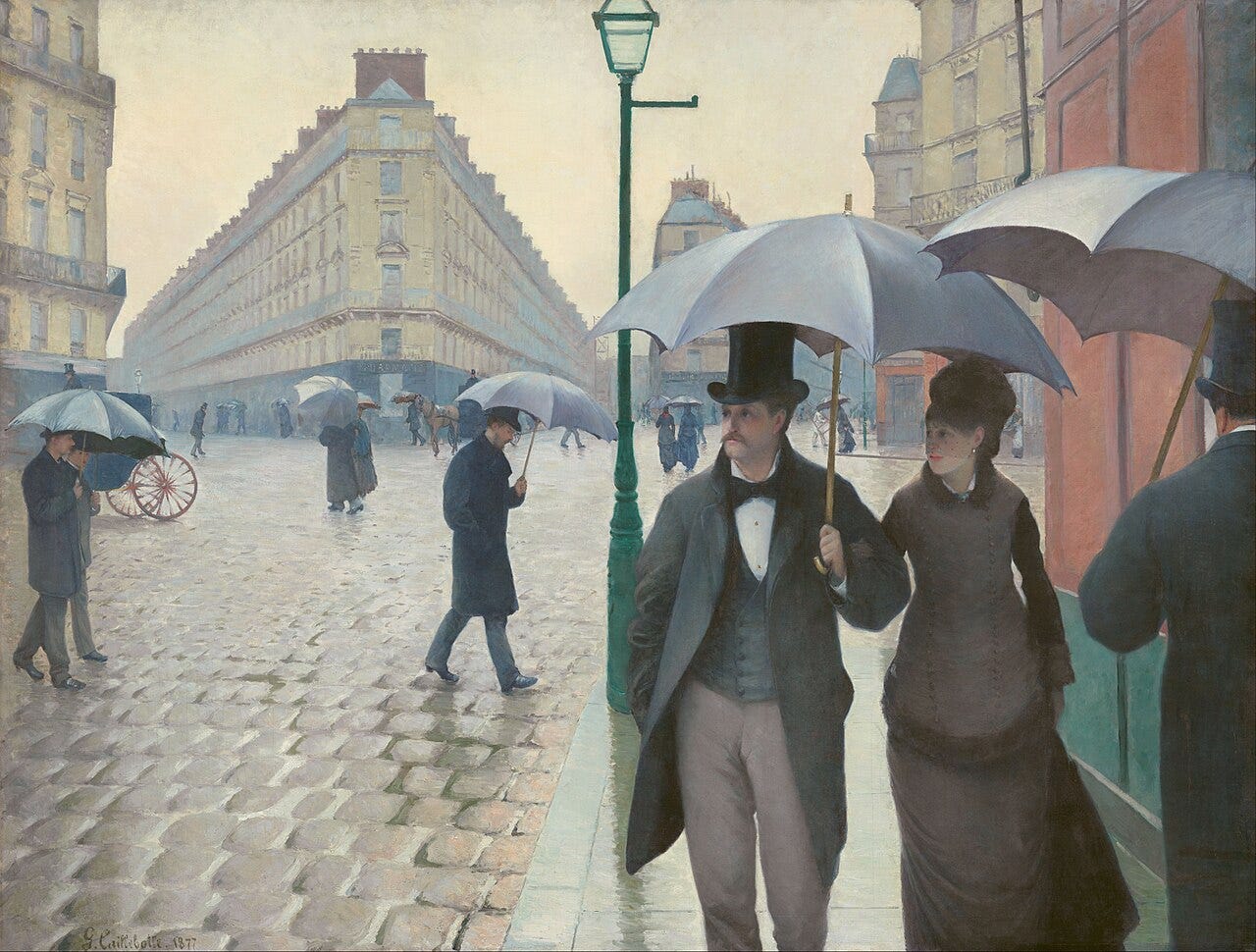
Caillebotte showed this at the third Impressionist exhibition in 1877, on a canvas over two metres tall and nearly three wide. The crossroads is the Place de Dublin, part of the new Paris that Haussmann had just cut through the old one, and everything in it is ruled straight.
He was the rich one. He paid for the group exhibitions, bought his friends' paintings when nobody else would, and left the whole collection to the French state at his death in 1894. The state accepted only part of it and argued about the rest for years.
8. Pierre Auguste Renoir, Luncheon of the Boating Party (1881)
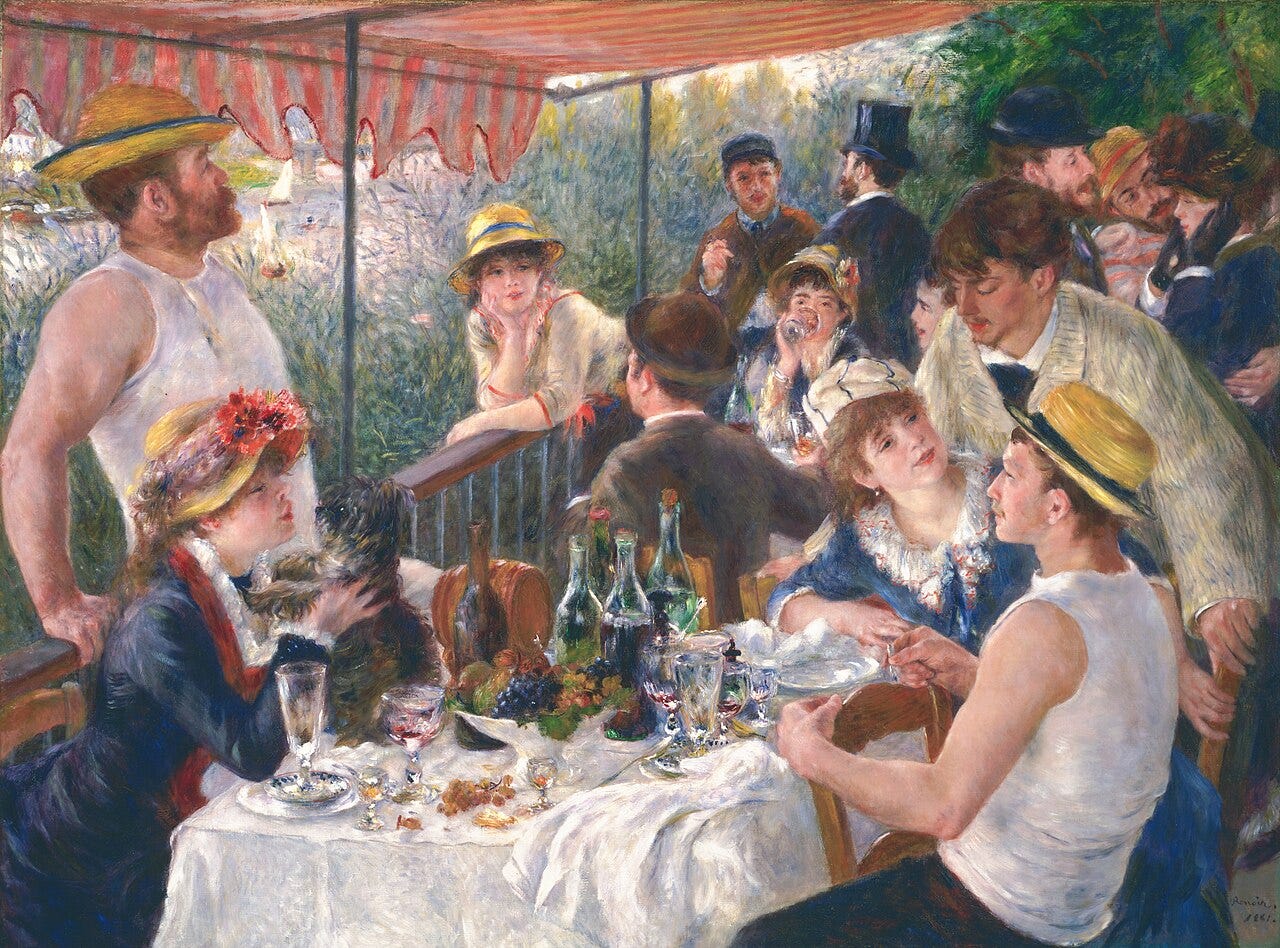
Lunch on the terrace of the Maison Fournaise at Chatou, on the Seine outside Paris. The woman playing with the small dog on the left is Aline Charigot, who married Renoir nine years later. The man straddling his chair on the right is Gustave Caillebotte, the painter and collector who also bought several other works on this list. The full cast is worth knowing.
Renoir built it across two summers, bringing people back one at a time, which is not how the group was supposed to work. In 1923 the American collector Duncan Phillips bought it for 125,000 dollars, far more than he had ever paid for anything, and it has hung in his museum in Washington ever since.
9. Édouard Manet, A Bar at the Folies Bergère (1882)
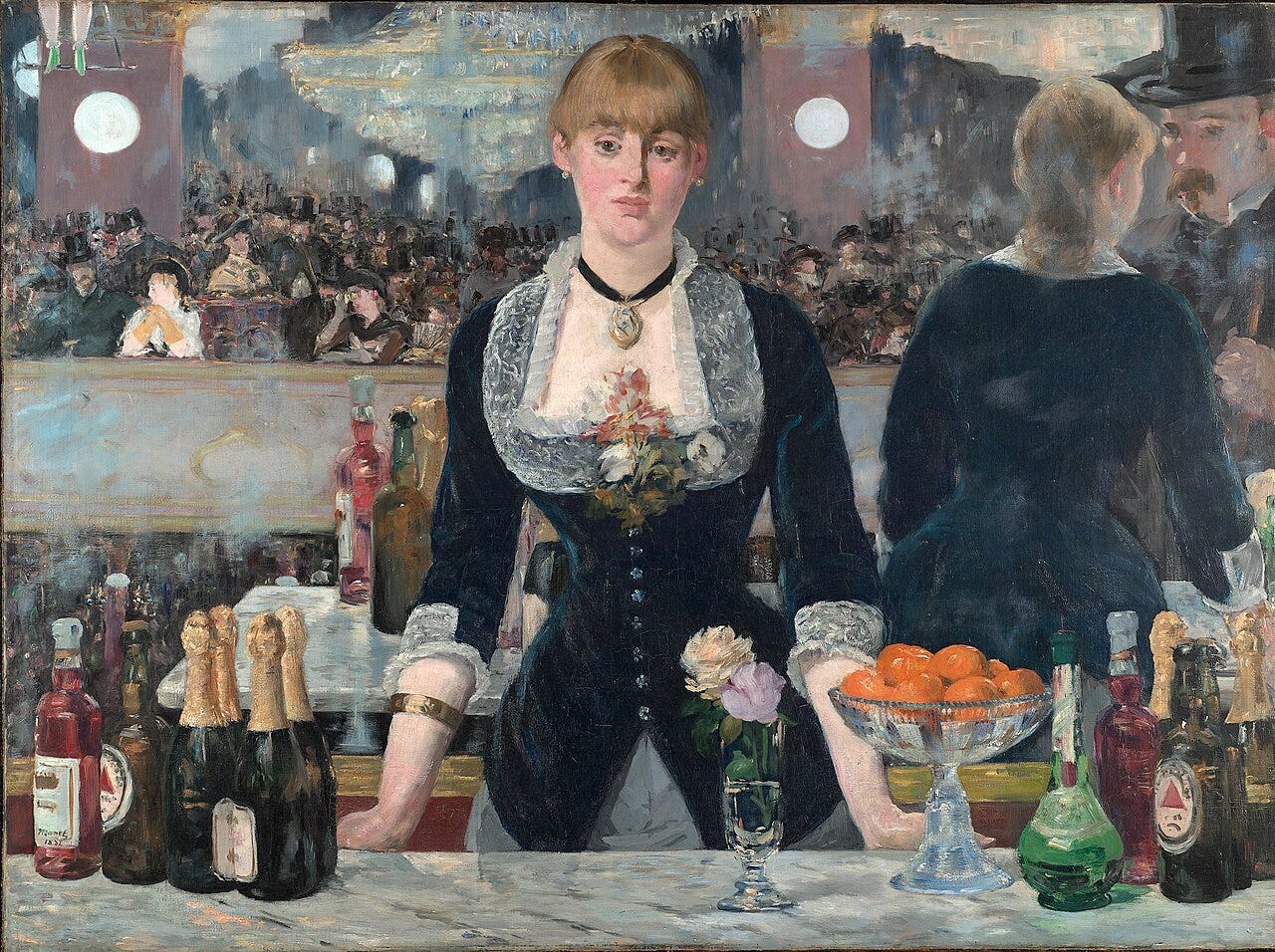
The barmaid was a real one, named Suzon, who worked at the Folies Bergère. Manet had her pose in his studio next to a table of bottles rather than painting on the spot. He was already very ill and died the year after. Manet sits on every list of Impressionists and never showed in a single one of their exhibitions.
The mirror does not add up. Her reflection stands too far to the right, angled toward a man who is nowhere in front of her, and the bottles behind do not match the bottles on the counter. People have been arguing about it for more than a century, and the theories are worth a page of their own. Manet never explained.
10. Claude Monet, Stacks of Wheat, End of Summer (1891)
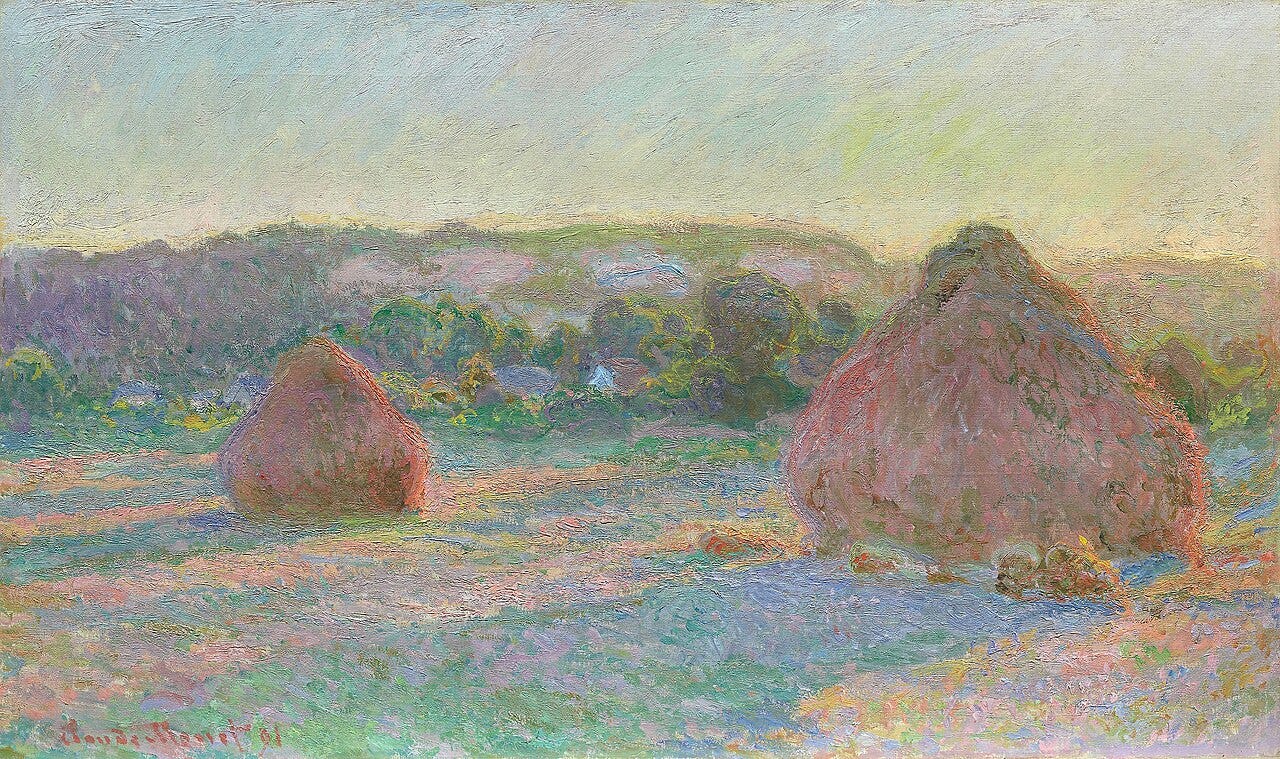
In English these are usually called haystacks. They are stacks of harvested wheat, left standing in a field behind Monet's house at Giverny. He painted them over and over at different hours and in different weather, working several canvases at once and swapping as the light moved. Why he did it is a longer story.
He showed fifteen of them at Durand Ruel's gallery in Paris in May 1891 and they sold fast, which is the moment Monet stopped worrying about money. Five years after that a young Russian law student saw one at an exhibition in Moscow, could not work out what it showed, and never got over it. He was called Wassily Kandinsky, and he later pointed to that afternoon as the start of the road to abstract painting.
11. Mary Cassatt, The Child's Bath (1893)
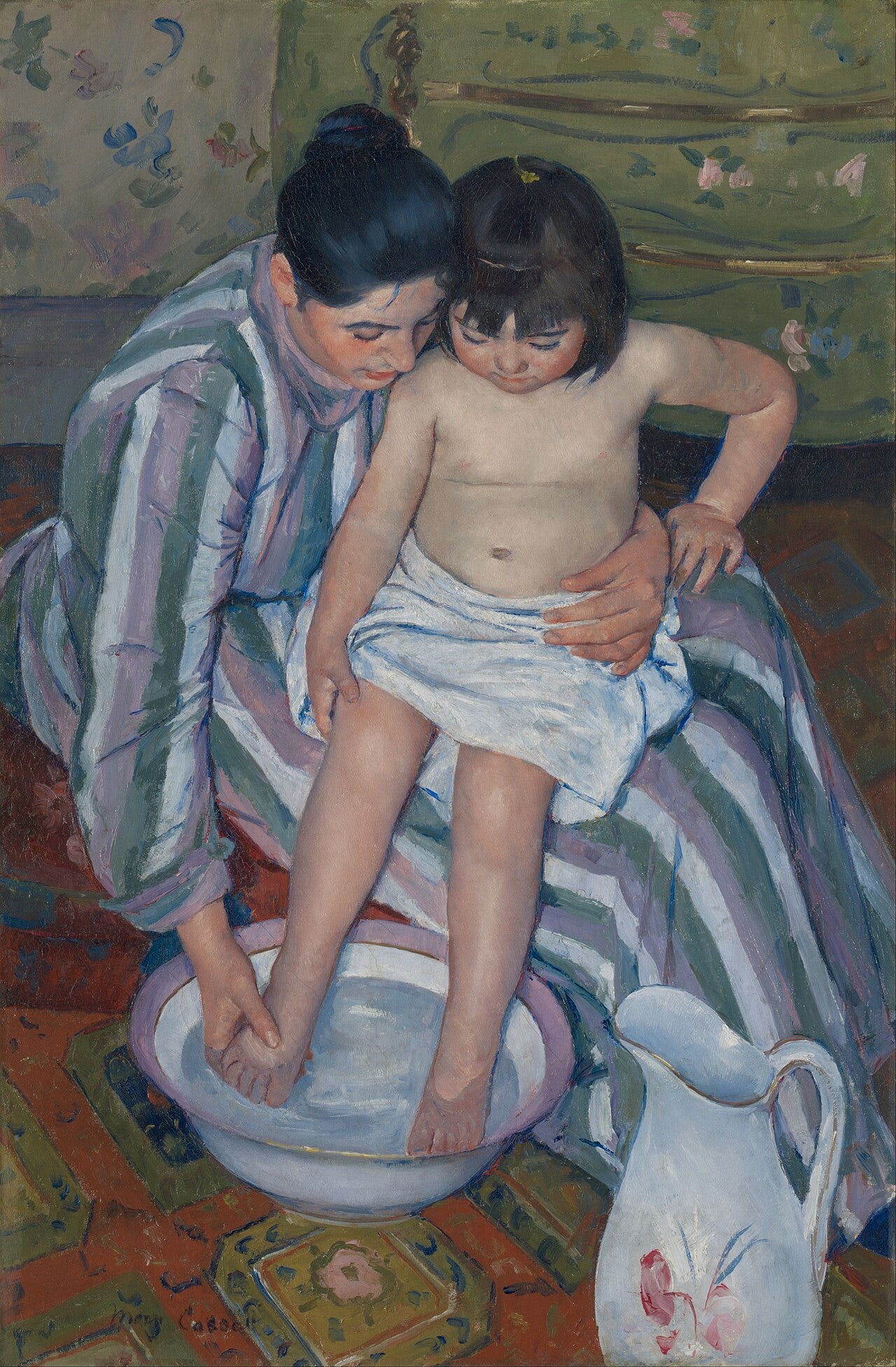
Cassatt was American, from Pittsburgh, and one of only three women who exhibited with the group. Degas invited her in 1877 and she showed with them four times. Here she looks down from above, so the floor tips up at you and the stripes, the wallpaper and the rug all press flat against the surface.
That tipped viewpoint came out of Japanese woodblock prints. Cassatt saw a large exhibition of them in Paris in 1890, went home and produced a set of colour prints in the same manner within months. The Child's Bath followed three years later. The craze had a name, Japonisme.
The same commitment to real outdoor light crossed borders too. In Spain, Joaquin Sorolla built an entire career on painting bodies and boats under direct Mediterranean sun.
12. Camille Pissarro, The Boulevard Montmartre at Night (1897)
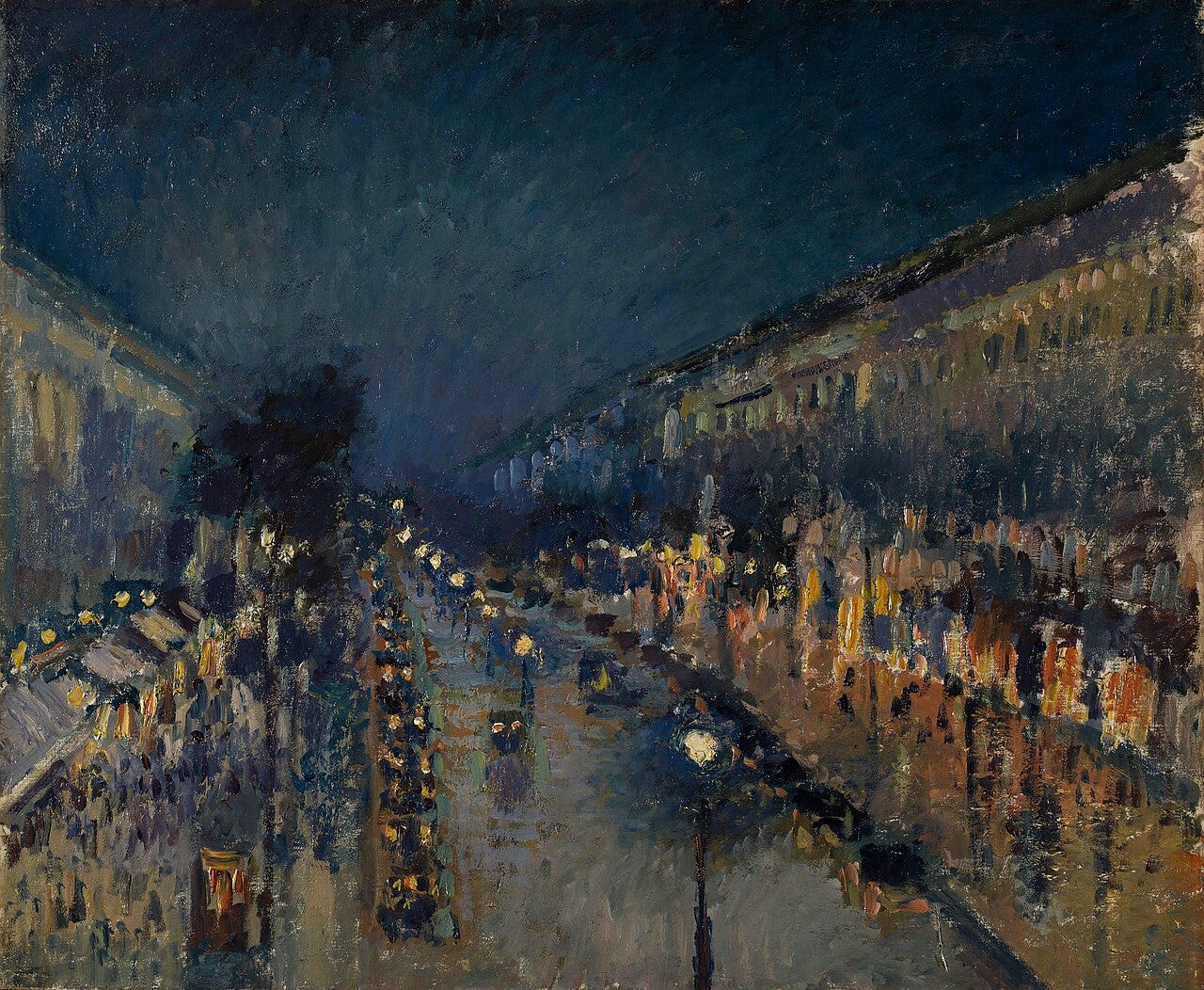
Pissarro took a room at the Grand Hôtel de Russie in the winter of 1897 and painted the boulevard below it around a dozen times, in morning light, in rain, in grey weather, in sun. This is the only one he did after dark.
His eyes were the reason he was up there. A chronic infection meant he could no longer work outdoors in cold or wind for long, so he spent his last decade painting cities through windows. He was also the only member of the group who showed in all eight Impressionist exhibitions, 1874 to 1886, without missing one.
Where to see these paintings
Musée d'Orsay, Paris: Morisot's The Cradle, both Degas, Renoir's Bal du moulin de la Galette, Sisley's flood and Monet's Gare Saint Lazare.
Art Institute of Chicago: Caillebotte's Paris Street, Rainy Day, Monet's Stacks of Wheat and Cassatt's The Child's Bath.
The Phillips Collection, Washington: Renoir's Luncheon of the Boating Party.
The Courtauld Gallery, London: Manet's A Bar at the Folies Bergère.
The National Gallery, London: Pissarro's Boulevard Montmartre at Night.
You Might Also Like


What readers usually ask about Impressionism
What is the most famous Impressionist painting? Monet's Impression, Sunrise, because it handed the movement its name. After that, Renoir's Bal du moulin de la Galette and Luncheon of the Boating Party are the most reproduced.
Who are the main Impressionist painters? Monet, Renoir, Degas, Pissarro, Sisley, Morisot, Cassatt and Caillebotte, with Manet as the older painter all of them looked at.
Why is it called Impressionism? A critic called Louis Leroy used Monet's title Impression, Sunrise to mock the 1874 show in the paper Le Charivari. The group kept the insult as a name.
Was Manet an Impressionist? He is on every list and he never once exhibited with them. He kept sending his work to the official Salon instead, including A Bar at the Folies Bergère in 1882.
Where can I see Impressionist paintings? The Musée d'Orsay in Paris holds the largest group by far. The Art Institute of Chicago, the Metropolitan Museum in New York and the Courtauld in London hold most of the other famous ones.
What was the first Impressionist painting? Most historians point to Monet's Impression, Sunrise, painted in 1872 and shown in April 1874. Read the full story.
Why did critics hate Impressionism at first? It broke the finish and detail the Paris Salon trained critics to expect, and reviewers said so in print. Read the full story.
Who funded the Impressionists when nobody would buy their work? Mainly the dealer Paul Durand-Ruel and the painter Gustave Caillebotte. Read the full story.
Why do Impressionist paintings look blurry up close? The strokes of pure color are meant to blend in the eye from a distance, not on the canvas. Read the full story.
Did Monet and Manet know each other? Yes, closely, for nearly two decades, despite the confusion their names still cause. Read the full story.
What is the difference between Impressionism and Realism? Realism painted ordinary life in precise, dark detail. Impressionism painted the same life fast, outdoors, chasing light. Read the full story.
The insult that stuck
Every painter on this list had been turned down by the official Salon, laughed at in the papers, or both. In April 1874 they gave up waiting and rented the empty studio of the photographer Nadar on the boulevard des Capucines to hang their own show.
Thirty artists took part. Most of the reviews were bad, and one of them handed the group the name it still carries, which is a story I tell in how Monet accidentally named a movement.
The money came late, and for some of them it never came at all. Sisley died broke in 1899. Pissarro was still painting from rented hotel windows in his late sixties.
In May 1990, the smaller of the two versions of Renoir's Bal du moulin de la Galette sold at Sotheby's in New York for 78.1 million dollars, to the same Japanese businessman who had bought Van Gogh's Portrait of Doctor Gachet for 82.5 million two days earlier.
Impressionism is the eleventh of twenty stops in Art Movements in Painting.
Money picked the wrong painting
Renoir's Bal du moulin de la Galette holds the highest price of the twelve. The smaller version sold for 78.1 million dollars at Sotheby's in May 1990, two days after the same buyer paid 82.5 million for Van Gogh's Portrait of Doctor Gachet at Christie's.
That price ranks the crowd scene above every other painting here. The composition argues otherwise.
Caillebotte's Paris Street, Rainy Day is the more advanced piece of picture making. The canvas runs to 212 by 276 centimetres, and its wide angle perspective came from an optical device, most likely a camera lucida, according to a 2015 investigative report by the Art Institute of Chicago.
Caillebotte never needed a sale. He paid for the group's exhibitions himself and died in 1894 at 45, before the market ever tested what his own paintings were worth.
