
Camille Pissarro was the steady heart of Impressionism, the only painter to show at all eight of the group's exhibitions and the mentor who guided Cezanne, Gauguin and a young Monet.
Older and quietly patient, he held the fragile movement together. Born on a Caribbean island in 1830, he spent forty years painting peasants, markets and Paris boulevards, and lost all but forty of some fifteen hundred canvases when Prussian troops sacked his home in 1870.
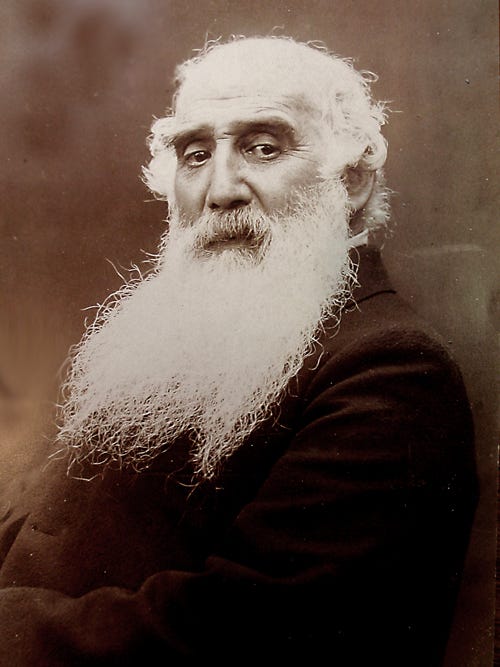
He is the least flashy of the Impressionists and, in many ways, the most important. Without Pissarro the group might never have survived its first decade.
More incredible painter stories
If Camille Pissarro pulled you in, you will love these too:


Camille Pissarro at a glance
1830. Born on St. Thomas in the Danish West Indies.
1855. Arrived in Paris in time for the world’s fair and a word of advice from Corot.
1874. Helped organize the first Impressionist exhibition. He alone would show in all eight. Pierre Auguste Renoir showed there too, one of the founding painters of the group.
1886. Adopted Seurat’s dots for four years, then dropped them.
1903. Died in Paris. His five painting sons carried the name on.
The father of the Impressionists
Pissarro was born in 1830 in the Danish West Indies, on the island of St Thomas, and he was the oldest of the Impressionists. He was the only one to show in every one of the group's eight exhibitions, from the first in 1874 to the last in 1886.
He mentored Cezanne, encouraged Gauguin, and gave steady advice to a young Claude Monet. Calm and fair, he was the man the others trusted to keep the peace. To me his patience matters as much as any single canvas.
Painting the everyday
He had no taste for glamour. Pissarro painted peasants in the fields, village markets, frost on a country lane, working outdoors to catch the real weather.
His landscapes give ordinary rural life the same dignity older painters reserved for saints and kings.
The broken dabs that give him away
A Pissarro rarely shouts. Look for small dabs of broken colour building a field or a street, a high pale sky, and ordinary working people going about their day.
In the 1880s he even adopted the tiny dots of Pointillism for a few years, then returned to his looser touch.
The painter who refused honors
Pissarro was a committed anarchist who believed in equality and dignity for working people, and he turned down official honors on principle.
His politics were not a pose; they ran straight into his choice of subjects, the laborers and small farmers most painters ignored.
Paris from a window
Late in life, troubled by a chronic eye infection that made working outdoors hard, Pissarro rented hotel rooms and painted the streets below.
The result was glorious: whole series of the Boulevard Montmartre and other Paris avenues, crowds and carriages seen from above in changing light and weather.
I go through all fourteen paintings, and where each one ended up, in Pissarro's Boulevard Montmartre series.
The fifteen hundred lost paintings
During the war of 1870 Pissarro fled to London and left his home near Paris behind. Prussian soldiers turned it into a barracks and used his canvases as floor mats and aprons in the muddy garden.
When he came back, only about forty paintings had survived out of some fifteen hundred, close to twenty years of work. He started again without complaint.
Orsay, London, and a New York still life
The Met in New York holds his Still Life with Apples and Pitcher, one of his rare still lifes.
The Musee d'Orsay in Paris holds many of his landscapes and city views. The National Gallery in London has his Boulevard Montmartre at Night, a rare painting of the city after dark.
A birth in the Danish West Indies
Camille Pissarro was born on 10 July 1830 in Charlotte Amalie, the port town of St Thomas. The island was then part of the Danish West Indies, a cluster of Caribbean trading colonies.
His family were Sephardic Jews of Portuguese descent who ran a general store selling hardware and dry goods near the harbor.
So the future painter of quiet French villages grew up among ships, sugar, and market crowds under a tropical sun. It is a detail most people miss.
The man later called the elder of the Impressionists was not French by birth at all. He spent his first years far from Europe, and that early habit of drawing ordinary working life never left him.
The clerk who ran off to Venezuela
At about twelve, Pissarro was sent to a boarding school near Paris, at Passy, where a teacher first told him to draw from nature.
Back on St Thomas by 1847, he was put to work as a clerk in the family store. He hated it and filled his ledgers with sketches instead of sums.
In 1852 he did something drastic. He left the business behind and sailed to Caracas, Venezuela, with a Danish painter named Fritz Melbye.
For roughly two years the two lived as working artists, drawing landscapes, huts and street scenes. When Pissarro came home, his mind was made up.
He would be a painter, not a shopkeeper, and his family, who wanted a steady trade, were not pleased.
France, and the advice from Corot
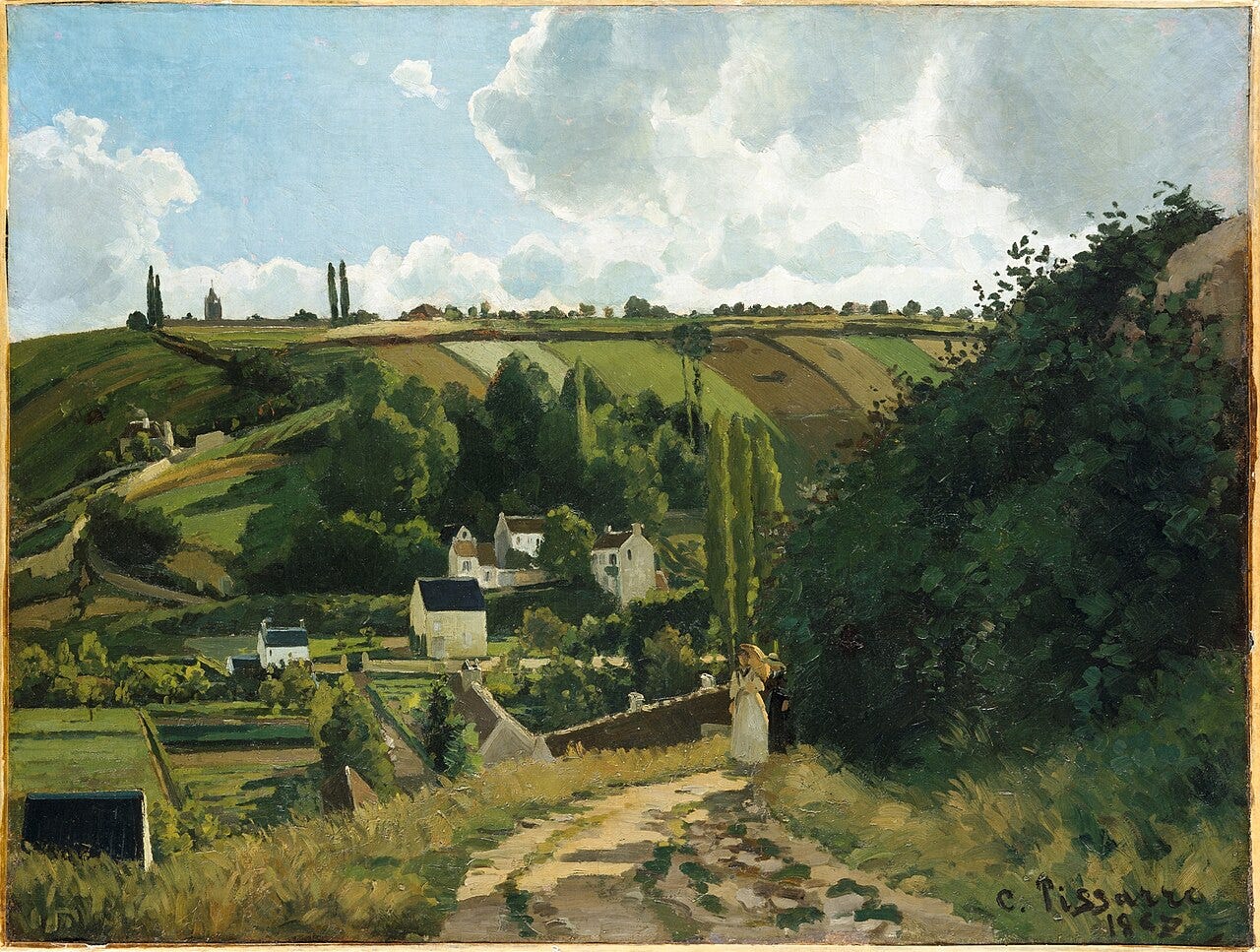
Pissarro settled in Paris in 1855, the year of the great Exposition Universelle. There he saw the calm landscapes of Camille Corot and was moved by them.
He sought Corot out for advice. The older man told him to study values and tones, to look hard at light rather than fuss over detail. Pissarro took it to heart, and in the 1864 Salon catalogue he even listed himself as a pupil of Corot.
He also enrolled at the informal Academie Suisse, where models were cheap and rules were few. There he met Claude Monet and a prickly young southerner named Paul Cezanne. Corot gave him the method. The friends gave him the movement.
Julie Vellay, and a family that said no
In the early 1860s Pissarro fell in love with Julie Vellay, a young woman from a Burgundy vineyard family who worked as a maid and cook in his mother's Paris household.
His mother objected fiercely. Julie was poor and a servant, and the family wanted better. Camille refused to give her up. The couple lived together for years without marrying, a common law union that scandalized his relatives.
They had eight children, though several died young.
It is worth correcting a lazy line you sometimes read. Julie was not simply the maid. She was a working woman Pissarro chose against real pressure, and she ran the household through decades of poverty. The pair finally married in 1871, in England.
London, and the two English painters
When the Franco Prussian war broke out in 1870, Pissarro was living at Louveciennes, west of Paris. As the Prussian army advanced, he fled with his family to London and settled in the southern suburbs around Norwood and Sydenham.
Monet was in London too.
Together they visited the museums and discovered the English landscape painters J M W Turner and John Constable. Turner's handling of mist, light and weather left a deep mark on both men.
While in exile Pissarro finally married Julie, in Croydon, in June 1871. He painted the London suburbs in rain and snow, and the National Gallery in London still holds several of those views.
Only about twelve pictures survive from the whole London stay.
The only one who showed all eight times
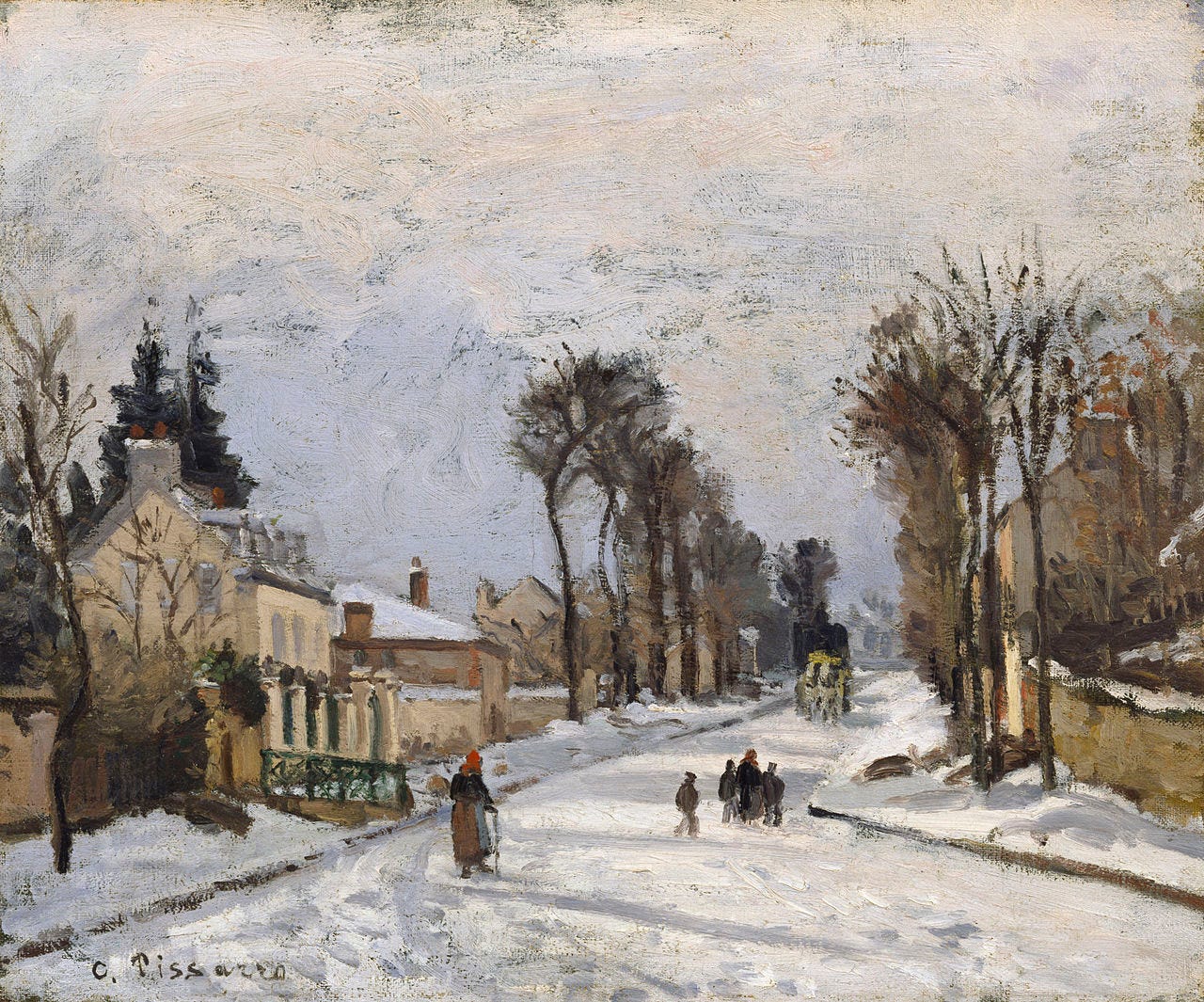
Between 1874 and 1886 the Impressionists held eight group exhibitions. Pissarro is the only artist who took part in every single one.
That fact says a lot about him. He believed in the group when others drifted away, quarreled, or chased the official Salon.
He was also its peacemaker and teacher. At Pontoise he painted side by side with Cezanne, who later said he had learned to see from Pissarro and called himself his pupil.
He also encouraged a young stockbroker named Paul Gauguin to keep painting. Patient, generous and steady, Pissarro held the fractious group together through years of ridicule and empty sales.
If Monet gave Impressionism its color, Pissarro gave it its backbone.
The dots he tried, then dropped
In the mid 1880s Pissarro did something no other founding Impressionist dared. In his fifties, he set aside his own style and joined the young Georges Seurat and Paul Signac in their new method.
They built pictures from tiny separate dots of pure color, a technique later called Pointillism or Divisionism. Pissarro showed work in this manner at the eighth and final Impressionist exhibition in 1886. He believed in its science and its logic.
But within a few years he grew frustrated. The dot by dot method was painfully slow and, he felt, too rigid to catch a passing moment. By about 1890 he had let it go and returned to a looser, freer touch. Few artists so senior ever start over twice.
The anarchist who painted the fields
Pissarro held firm political beliefs that surprised people who saw only his gentle landscapes. He was an anarchist, a follower of thinkers like Pierre Joseph Proudhon and Peter Kropotkin.
He read radical papers and contributed drawings to anarchist journals run by his friend Jean Grave. Around 1889 and 1890 he made an album of dark drawings called Turpitudes Sociales, showing the cruelties of modern money, and sent it to his nieces in England with a letter about justice.
His politics fed his art. When he painted peasants at work in the fields, he was not being quaint. He saw honest labor as the true foundation of society, and wanted to give it the same dignity that older painters had given to kings and saints.
A dynasty of painters, and the end
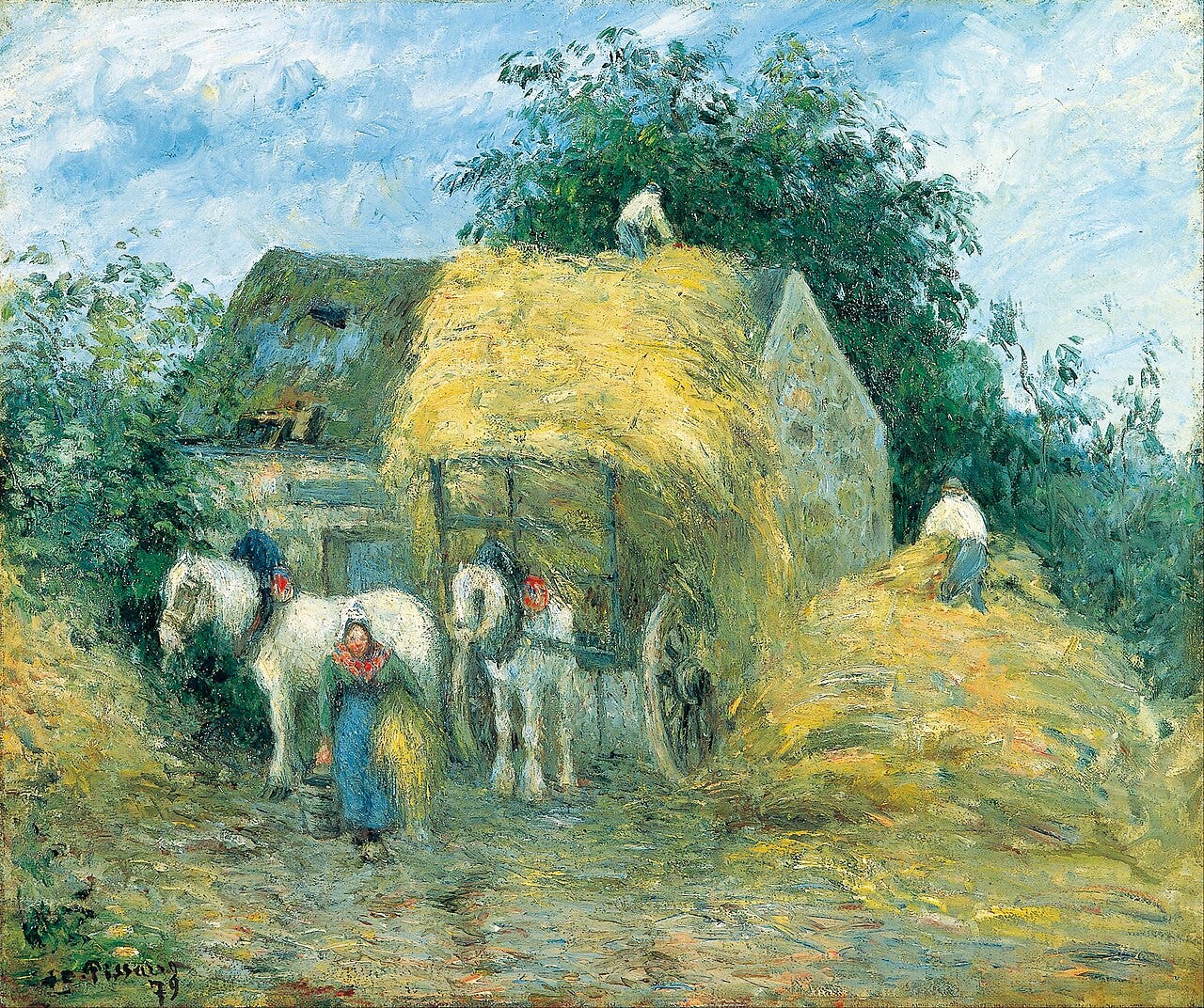
From about 1889 a chronic eye infection plagued Pissarro. Wind and dust made outdoor work painful, so in his last years he often painted from hotel and apartment windows in Rouen, Le Havre, Dieppe and Paris.
His family kept painting with him. His eldest son, Lucien, became a painter and printmaker in England. Georges, Felix, Ludovic Rodo and Paul Emile all took up art too, and the Pissarro line of painters runs on for generations.
Camille Pissarro died in Paris on 13 November 1903, aged 73, and was buried in Pere Lachaise cemetery. He had outlived several of his children and most of the scorn. By then the young rebels he had guided were famous. So, at last, was he.
More secrets to unlock


The Camille Pissarro questions that keep coming up
Who was Camille Pissarro? A founding Impressionist and mentor to many of the others.
When was he born? In 1830, on the Caribbean island of St Thomas.
When did he die? In Paris, in 1903.
What is he famous for? Impressionist landscapes and his Paris boulevard series.
Why does he matter so much? He held the Impressionist group together and taught its stars.
Where can I see his work? The Musee d'Orsay and major museums worldwide.
Was Camille Pissarro actually French? Not by birth. He was born on 10 July 1830 on the Caribbean island of St Thomas, then a Danish colony, into a Sephardic Jewish merchant family. He only settled in France in 1855, at the age of 24. Though he became a central figure of French Impressionism, his roots were Caribbean and Jewish, which made him something of an outsider in the Paris art world he helped to change.
Who did Pissarro teach or influence? He was the father figure of the group. Paul Cezanne worked beside him at Pontoise in the 1870s and called himself Pissarro's pupil. He encouraged Paul Gauguin in his early years. Later he traded ideas with the younger Georges Seurat and Paul Signac, and even adopted their Pointillist method for a time.
To the end he painted the city from upstairs windows, his eyes no longer able to bear the open air, and the late Paris series are among his best loved works.
His son Lucien kept his letters, and those blunt, warm letters are how historians later pieced together how the Impressionists really argued and made peace. I keep coming back to him for that: the man who quietly held the movement together.