Famous Mannerist Paintings: 12 Icons of Strange Grace

The most famous Mannerist paintings stretch the body past anatomy on purpose: Parmigianino's Madonna with the Long Neck, Bronzino's Allegory with Venus and Cupid, and El Greco's Burial of the Count of Orgaz. Here are twelve, with the year, the museum and the story behind each one.

Mannerism took over Italian courts after 1520, once Michelangelo and Raphael had already pushed the human body about as far as anatomy allowed. Painters like Pontormo and Parmigianino answered by breaking that anatomy on purpose, on commission, for popes and dukes who wanted something stranger than perfection.

The name comes from maniera, a word the painter and historian Giorgio Vasari used for a distinctive touch. Historians later narrowed it into the label for this stretched, deliberately artificial style.

What sets Mannerism apart:

  • Elongated figures. Necks, fingers and torsos stretched well past anatomical truth.

  • Compressed, ambiguous space. No single vanishing point, figures crowding the foreground.

  • Acid, unnatural color. Hot pinks and greens instead of naturalistic light.

  • Contorted poses. Bodies twist into the figura serpentinata, a spiral with no single front.

  • Virtuosity over harmony. Technique shown off, not hidden, unlike the balance of the High Renaissance.


Learn art the fun way. Free stories every week, no lectures.


1. Jacopo Pontormo, Deposition from the Cross (around 1528)

Deposition from the Cross by Jacopo Pontormo
Jacopo Pontormo, Deposition from the Cross, around 1528, Santa Felicita, Florence

Christ's body slides down through a knot of mourners, none of them touching the ground, none of them arranged the way a Renaissance painter would have arranged them.

Pontormo painted it for the Capponi Chapel in the church of Santa Felicita in Florence, finishing around 1528, and it has never left that chapel since.

The color runs to pink, orange and acid blue, with no horizon and no ground line, so the figures seem to float rather than stand.

2. Rosso Fiorentino, Deposition from the Cross (1521)

Deposition from the Cross by Rosso Fiorentino
Rosso Fiorentino, Deposition from the Cross, 1521, Pinacoteca Comunale, Volterra

Soldiers climb ladders like workers taking down scaffolding, their bodies flattened and sharp against a sky gone dark.

Rosso Fiorentino painted it in 1521 for the cathedral of Volterra, seven years before Pontormo painted his own Deposition in Florence.

The two Depositions, painted seven years apart by artists who trained in the same Florentine workshop, are usually read as the opening statement of Mannerism itself.

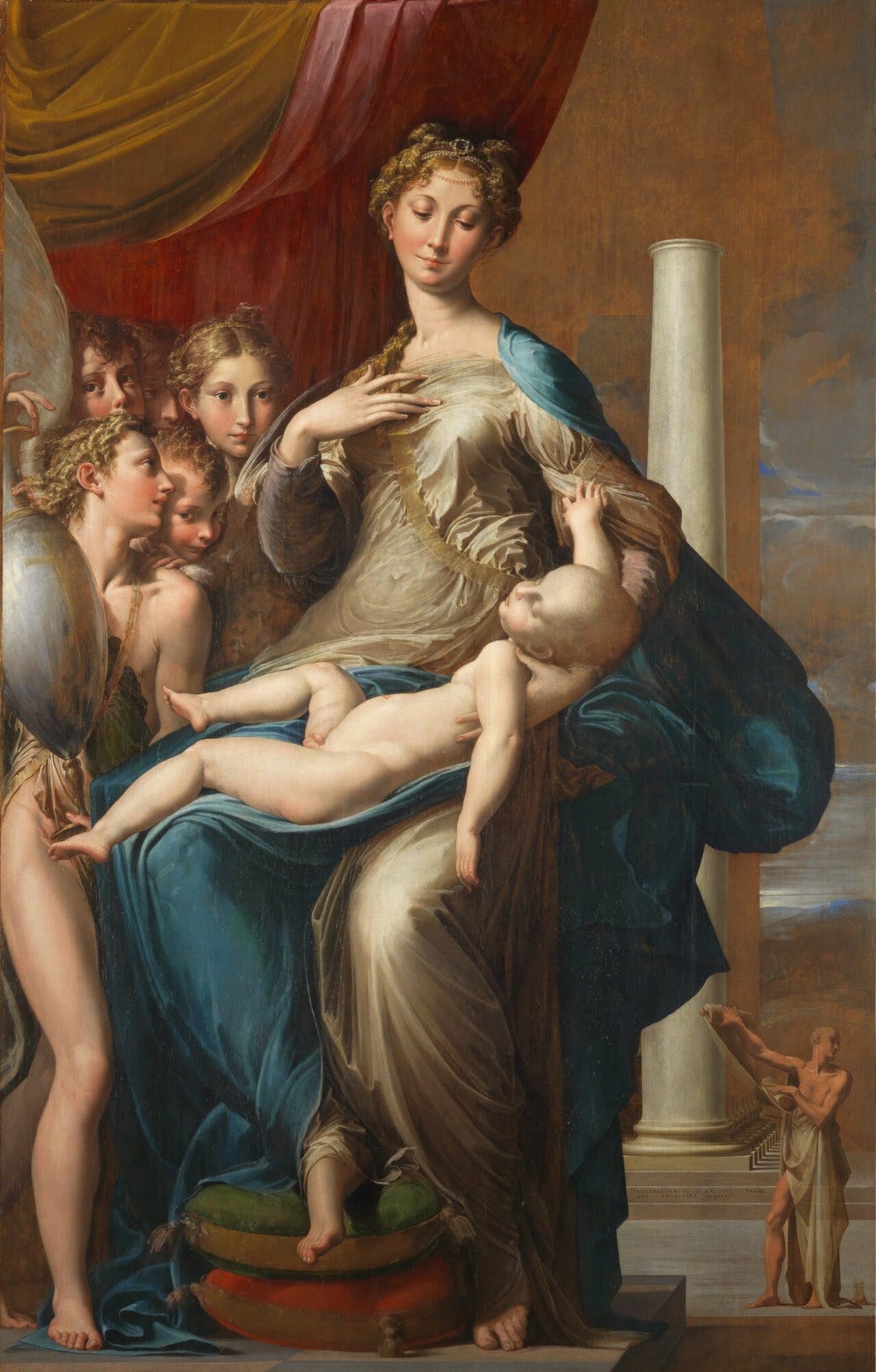
3. Parmigianino, Madonna with the Long Neck (1534 to 1540)

Madonna with the Long Neck by Parmigianino
Parmigianino, Madonna with the Long Neck, 1534 to 1540, Uffizi Gallery, Florence

Mary's neck, fingers and the infant Christ's body all stretch far past normal proportion, while a lone column stands in the background for no clear structural reason.

Parmigianino worked on it from 1534 until his death in 1540, and left it unfinished, one foot of a background prophet never painted in.

It hangs today in the Uffizi in Florence, still missing that foot, still one of the clearest single images of the whole style.

4. Parmigianino, Self-Portrait in a Convex Mirror (1524)

Self-Portrait in a Convex Mirror by Parmigianino
Parmigianino, Self-Portrait in a Convex Mirror, 1524, Kunsthistorisches Museum, Vienna

Parmigianino's own face sits small and centered while his painting hand swells huge in the foreground, curved exactly the way a barber's convex mirror would have shown it.

He was twenty one, painted it in 1524 on a specially built convex wood panel to match the distortion, and brought it to Rome to show Pope Clement VII.

It hangs today in the Kunsthistorisches Museum in Vienna, a technical trick that doubles as a summary of the whole Mannerist project: perspective bent on purpose.

5. Bronzino, Allegory with Venus and Cupid (around 1545)

Allegory with Venus and Cupid by Bronzino
Bronzino, Allegory with Venus and Cupid, around 1545, National Gallery, London

Venus and Cupid kiss with open mouths while Folly gets ready to throw rose petals, and a girl with a serpent's tail hides in the corner offering honey in one hand.

Bronzino painted it around 1545, likely as a diplomatic gift from Cosimo I de Medici to King Francis I of France.

Every inch of skin is polished to porcelain, cold and hard, the opposite of the warm brushwork Titian was using in Venice at the same moment.

6. Bronzino, Portrait of Eleanor of Toledo with Her Son Giovanni (1545)

Portrait of Eleanor of Toledo with Her Son Giovanni by Bronzino
Bronzino, Portrait of Eleanor of Toledo with Her Son Giovanni, 1545, Uffizi Gallery, Florence

Eleanor of Toledo looks out in a black and gold brocade dress so precisely rendered that textile historians have used it to study sixteenth century Florentine weaving.

Bronzino painted it in 1545 as the Medici court portraitist, with Eleanor's young son Giovanni tucked against her side.

Eleanor was buried in a version of that same dress in 1562, and the portrait stayed in Medici hands until it entered the Uffizi.

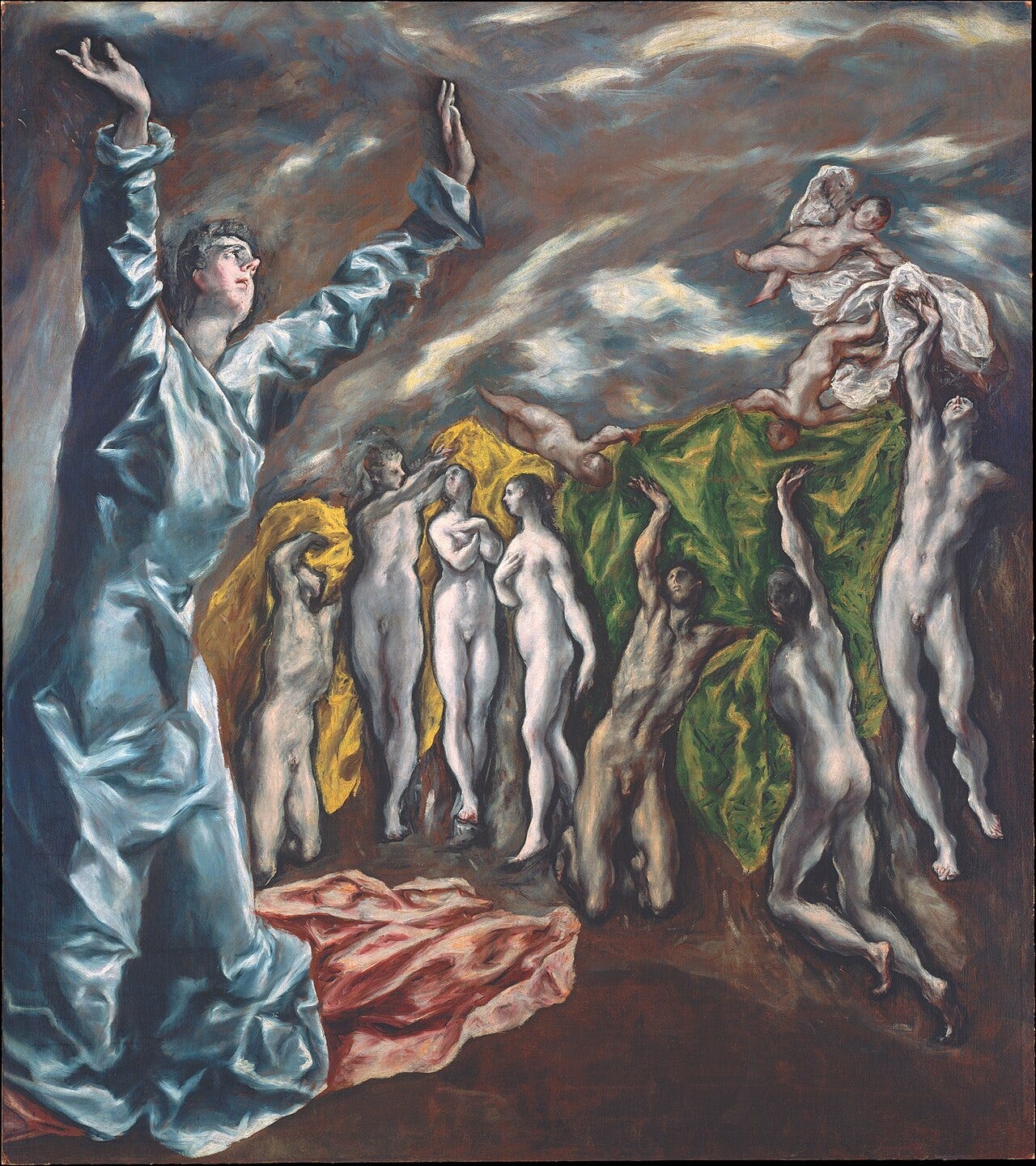
7. El Greco, The Burial of the Count of Orgaz (1586 to 1588)

The Burial of the Count of Orgaz by El Greco
El Greco, The Burial of the Count of Orgaz, 1586 to 1588, Church of Santo Tomé, Toledo

Saint Stephen and Saint Augustine descend from heaven to lower a Spanish nobleman into his grave, while a crowd of black robed mourners fills the lower half of the canvas.

El Greco painted it between 1586 and 1588 for the church of Santo Tomé in Toledo, where it still hangs today.

The upper half turns to a swirl of elongated saints and clouds, the clearest link between Mannerist Italy, where El Greco trained, and the Spanish court he worked for after.

8. Giuseppe Arcimboldo, Vertumnus (1590 to 1591)

Vertumnus by Giuseppe Arcimboldo
Giuseppe Arcimboldo, Vertumnus, 1590 to 1591, Skokloster Castle, Sweden

A face built entirely from fruit, vegetables and flowers turns out to be Holy Roman Emperor Rudolf II, cast as Vertumnus, the Roman god of the changing seasons.

Arcimboldo painted it in 1590 or 1591 as a gift to Rudolf II, his former employer in Prague, near the end of his own career in Milan.

Looted by the Swedish army during the Thirty Years War, it disappeared from art history until it resurfaced in 1845 at Skokloster Castle in Sweden, where it still hangs.

9. Tintoretto, The Last Supper (1592 to 1594)

The Last Supper by Tintoretto
Tintoretto, The Last Supper, 1592 to 1594, San Giorgio Maggiore, Venice

The table sits on a sharp diagonal instead of facing the viewer, lit by a swinging oil lamp and a burst of angels no earlier version of the scene had included.

Tintoretto painted it between 1592 and 1594 for the church of San Giorgio Maggiore in Venice, one of his final works.

The diagonal table and theatrical light point past Mannerism toward the Baroque, which is why some historians place Tintoretto at the hinge between the two styles.

10. Jacopo Pontormo, Portrait of a Halberdier (around 1529 to 1530)

Portrait of a Halberdier by Jacopo Pontormo
Jacopo Pontormo, Portrait of a Halberdier, around 1529 to 1530, J. Paul Getty Museum, Los Angeles

A young soldier in armor holds a halberd and looks past the viewer with a cool, guarded expression, his pose stiff against a fortified tower.

Pontormo painted it around 1529 to 1530, during the siege of Florence, and Vasari identified the sitter in 1568 as Francesco Guardi, a young defender of the city.

A 1612 inventory relabeled the sitter as Cosimo I de Medici, and the Getty Museum sold it under that name in 1989, though most scholars now side with Vasari's Guardi.

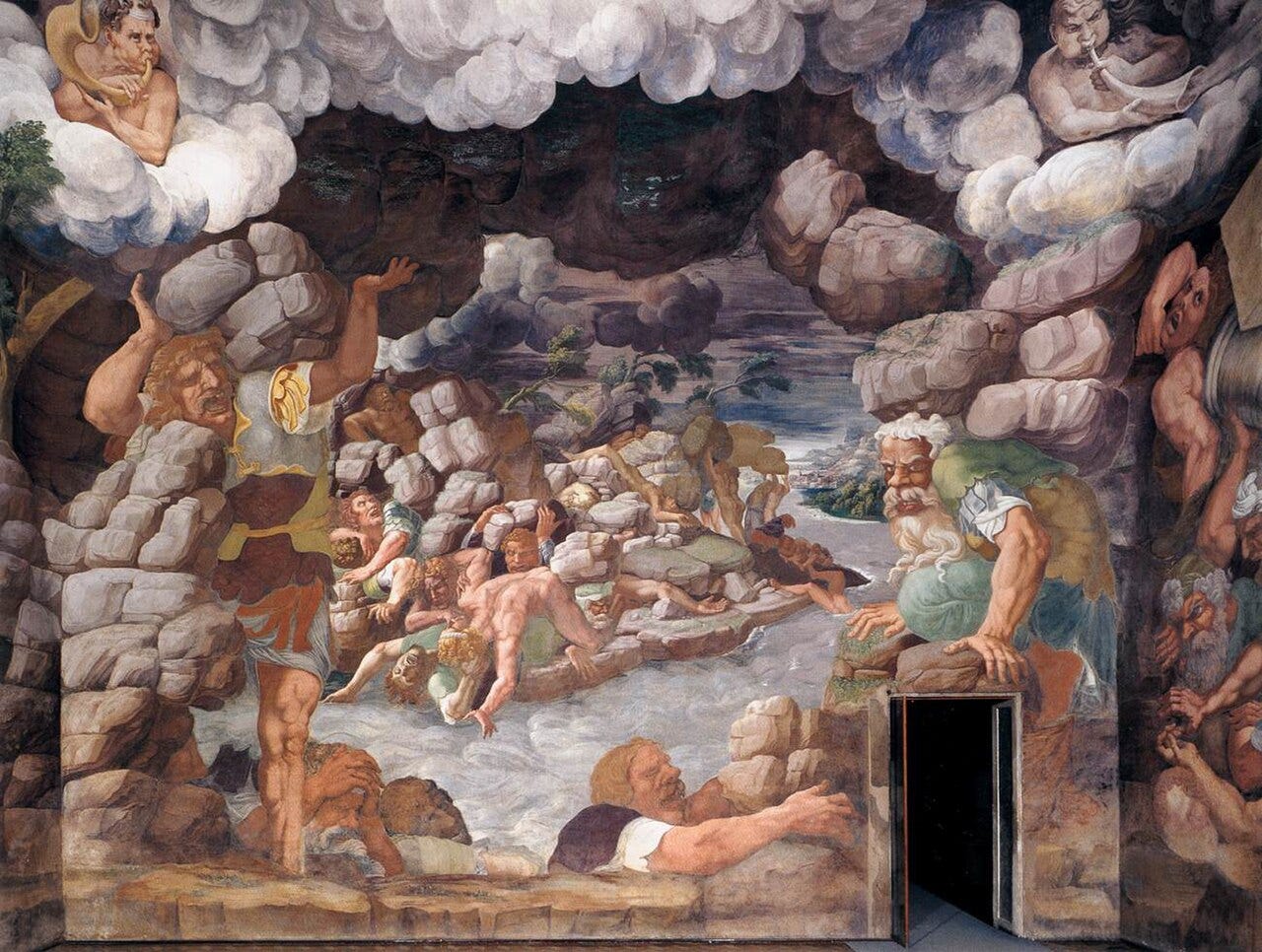
11. Giulio Romano, The Fall of the Giants (1532 to 1534)

The Fall of the Giants by Giulio Romano
Giulio Romano, The Fall of the Giants, 1532 to 1534, Palazzo del Te, Mantua

Giants crushed under collapsing columns and falling masonry cover every wall and the ceiling of a single room, painted so the room itself seems to be caving in.

Giulio Romano, a former assistant to Raphael, painted the room between 1532 and 1534 inside the Palazzo del Te, a pleasure palace he also designed for Federico II Gonzaga in Mantua.

There is no flat wall left standing in the room and no single place to stand where the collapse looks stable, an architectural joke built entirely out of paint.

12. Domenico Beccafumi, Descent into Limbo (around 1530 to 1535)

Descent into Limbo by Domenico Beccafumi
Domenico Beccafumi, Descent into Limbo, around 1530 to 1535, Pinacoteca Nazionale, Siena

Christ reaches into a dark cave to pull the patriarchs out of limbo, lit by a harsh, unnatural light that falls on some figures and skips others entirely.

Beccafumi painted it between about 1530 and 1535 for the Beccafumi Marsili family chapel at the Basilica of San Francesco in Siena.

It now hangs in the Pinacoteca Nazionale in Siena, where Beccafumi's twisting, sharply lit figures represent the Sienese branch of Mannerism, distinct from the Florentine style of Pontormo and Bronzino.

The museums holding all twelve

  • Uffizi Gallery, Florence. Madonna with the Long Neck and Portrait of Eleanor of Toledo with Her Son Giovanni, two of the twelve in one museum.

  • Santa Felicita, Florence. Pontormo's Deposition from the Cross, still in its original chapel.

  • Pinacoteca Comunale, Volterra. Rosso Fiorentino's Deposition from the Cross.

  • Kunsthistorisches Museum, Vienna. Self-Portrait in a Convex Mirror.

  • National Gallery, London. Allegory with Venus and Cupid.

  • Church of Santo Tomé, Toledo. The Burial of the Count of Orgaz.

  • Skokloster Castle, Sweden. Vertumnus.

  • San Giorgio Maggiore, Venice. The Last Supper.

  • J. Paul Getty Museum, Los Angeles. Portrait of a Halberdier.

  • Palazzo del Te, Mantua. The Fall of the Giants.

  • Pinacoteca Nazionale, Siena. Descent into Limbo.


Learn art the fun way. Free stories every week, no lectures.


Mannerist paintings, the questions readers ask

  • What is Mannerism in painting? A style that followed the High Renaissance, from about 1520 to 1590, stretching proportion and space on purpose instead of following natural harmony.

  • Who are the most famous Mannerist painters? Pontormo, Parmigianino, Bronzino and El Greco, working between Florence, Parma and Toledo across the sixteenth century.

  • What are the most famous Mannerist paintings? Parmigianino's Madonna with the Long Neck, Bronzino's Allegory with Venus and Cupid and El Greco's Burial of the Count of Orgaz lead any list.

  • Is El Greco a Mannerist painter? Trained in that style in Italy before he moved to Spain in 1577, where his figures grew even more elongated under his own hand.

  • Where can you see Mannerist paintings? The Uffizi in Florence holds the largest group, with more at the Kunsthistorisches Museum in Vienna and the National Gallery in London.


What ended the style

Mannerism lost ground after the Council of Trent closed in 1563 and pushed religious painters back toward clarity.

El Greco carried a version of the style into Spain and died in Toledo on 7 April 1614, twenty six years after finishing the Burial of the Count of Orgaz for that same city.