Famous Paintings of Musicians: 12 Silent Songs
Painting is silent, yet for centuries artists have tried to trap music inside it, a lute caught mid strum, a full orchestra, a girl frozen at the keys.
There is something teasing about a painted musician, held in the middle of a song you will never hear. From candlelit Baroque concerts to a modern woman at the piano, painters have chased the feeling of sound in a medium that makes none.
Here are twelve of the most famous paintings of music and musicians, all now in the public domain. I have chosen the ones where you can almost hear the note.
What else there is
If this is the kind of art history you want more of:
Ten women artists you need to know, the names the textbooks skipped
Was Monet really the first Impressionist, the painting that may have got there first
The secret behind Monet Magpie, one bird in the snow, and why it matters
1. Vermeer, The Guitar Player (about 1672)
Vermeer painted a young woman turning away from us with a smile, strumming a guitar, caught in a moment that feels overheard rather than posed. She looks off to the side as if someone has just walked in, her fingers still on the strings.
It is one of his last works, looser and quicker than his earlier jewel like scenes of daily life The picture was actually stolen from an English stately home in 1974 and held for ransom before it turned up in a London churchyard.
Today it hangs back at Kenwood House as if nothing had happened.
2. Caravaggio, The Lute Player (about 1596)
A soft faced young musician sits behind a table of fruit and flowers, singing from an open songbook while plucking a lute. The music on the page is real and readable, a madrigal about love, so we half know the very tune Caravaggio set down.
He lit the boy with a single beam of hard shadow, picking the figure out of the black. The androgynous look and the ripe fruit gave the picture a charge that scholars still argue about.
Caravaggio painted more than one version, and one of them has sung out into the dark of the Hermitage for four hundred years.
3. Judith Leyster, Boy Playing the Flute (about 1635)
A boy in a soft cap leans back and plays a recorder, his eyes drifting up as he listens to his own thin tune, painted by one of the few women to run her own studio in the Dutch Golden Age.
Leyster was so completely forgotten that this and her other works were sold for centuries as paintings by Frans Hals. Only in 1893 did a scholar spot her star shaped monogram, a pun on her name, which means lodestar.
She caught the exact moment a young player loses himself in the sound. Leyster is one of ten women artists worth rediscovering, and this boy, long sold under a man's name, now hangs under her own in Stockholm.
4. Antoine Watteau, Mezzetin (about 1720)
A lovelorn character from Italian comedy sits in a garden in striped silk, strumming a guitar and singing up at a window with his mouth open in song.
Watteau, the painter who invented the dreamy French garden party, gave this clown a real ache under the costume. Mezzetin was a stock figure of the theater, the servant forever unlucky in love, and here he serenades someone who plainly is not listening.
Behind him a stone statue of a woman turns her back, a quiet joke about being ignored. Watteau himself was dying of tuberculosis as he painted these light, wistful oil scenes, and was gone at thirty six.
5. Manet, The Fifer (1866)
A boy soldier stands alone playing the fife, set against a plain background with almost no shadow and no floor, as flat and clear as a playing card.
Manet had learned the trick of that flat space from Japanese prints and from Spanish painting, above all Velazquez, whom he called the painter of painters.
The boy simply stands and plays, cut out against nothing, one of the first truly modern portraits. The jury of the official Salon rejected it as crude and unfinished.
When they turned it down in 1866, his friend Emile Zola defended it in print, an early shot in the war for modern art.
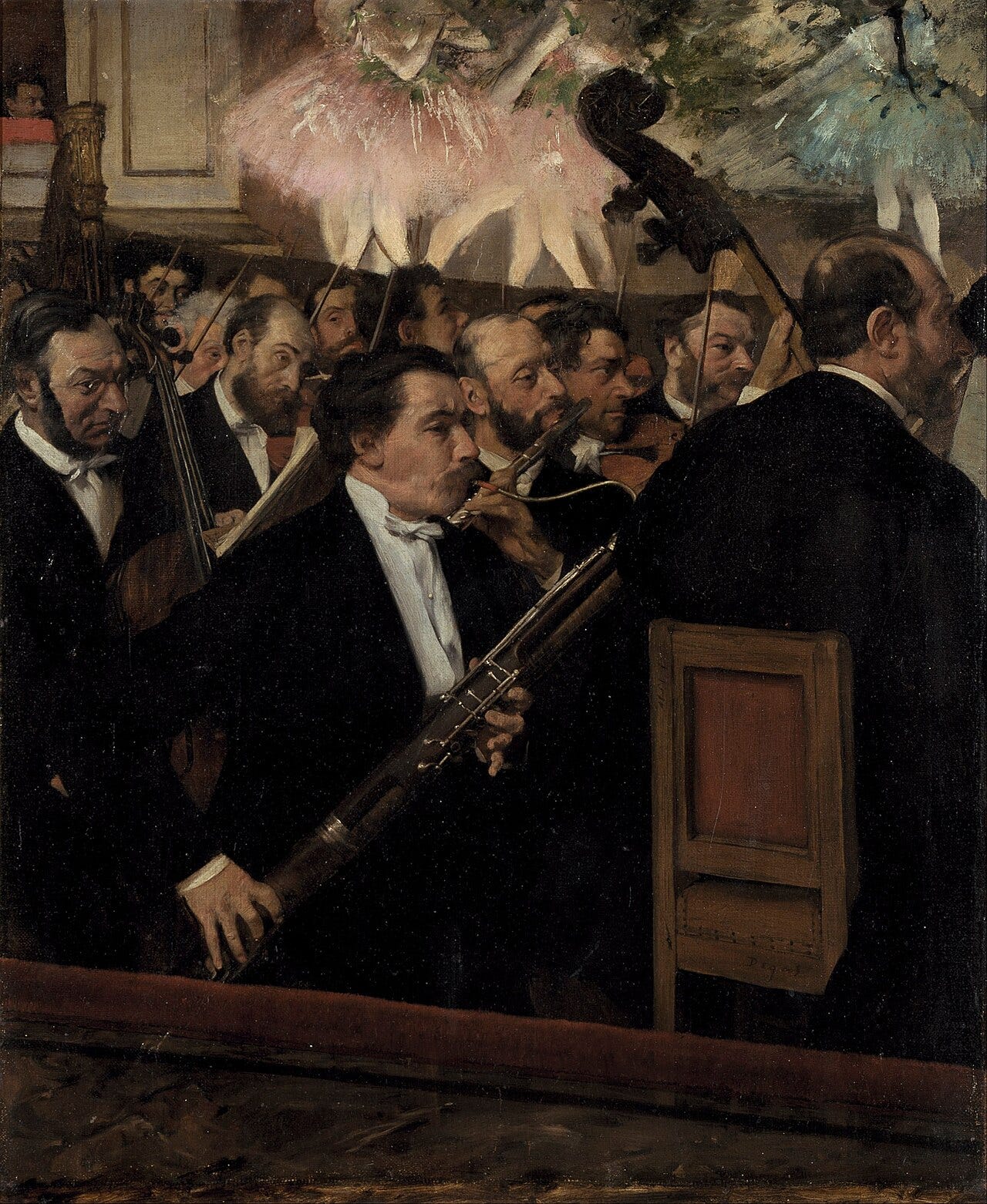
6. Degas, The Orchestra at the Opera (about 1870)
Degas painted the Paris opera from a strange angle, down in the pit, so the dancers on stage above are sliced off at the knees and the real subject becomes the musicians.
Front and center is his friend the bassoonist Desire Dihau, surrounded by the everyday working men of the orchestra. Degas loved the backstage, unglamorous truth of performance, the labor behind the beauty, a world I dig into in the piece on who painted the first Impressionist He crammed a cellist, a flute and a double bass into a shallow box of a space, and slipped a composer friend into a stage box as a private joke.
7. Renoir, Young Girls at the Piano (1892)
Two girls in white lean together over a piano, one seated and playing, the other standing with an arm draped across her sister, following the music on the page.
Renoir painted this warm scene of two sisters making music at the exact moment the French state finally wanted to buy his work. He was so anxious to get it right that he made at least five full versions of the same pair at the keys.
The soft, sunny surfaces are pure late Renoir, all flushed cheeks and glowing fabric. One version was the first Renoir a museum ever bought, entering the Luxembourg in Paris in 1892.
8. Klimt, Music (1895)
In a hazy golden world a woman plays a Greek lyre, flanked by a sphinx and an ancient mask, music treated as something sacred and half dreamed. This early Klimt already shows his love of gold, Symbolism and beautiful women lost in a trance.
He made it as a design for the music room of a Vienna mansion, part of a scheme about the power of art. A larger version painted a few years later was destroyed in 1945, burned in a castle fire as the war ended.
Only this smaller study survives, in Munich, a fragment of a lost golden room.
9. Gerrit van Honthorst, The Concert (1623)
A candlelit group crowds around a single sheet of music, mouths open in song, a lute and a violin among them, all lit by one hidden flame.
Honthorst was a Dutchman who went to Rome and came home obsessed with Caravaggio, so hooked on candlelight that Italians nicknamed him Gerardo of the Nights.
His musicians are not saints or gods but ordinary, slightly rowdy people enjoying a tune together. The single light source turns a plain sing along into something warm and secret.
This particular Baroque concert vanished for centuries and only resurfaced at auction in 2013, bought by a museum in Washington.
10. Thomas Eakins, The Concert Singer (1892)
An American woman in a pale pink gown stands mid note, mouth open, one hand lifted, singing an aria you can almost hear across the years.
Eakins, the most exacting realist in American art, was obsessed with getting the precise shape of a mouth forming a specific sound.
He had the singer, Weda Cook, perform the same passage over and over so he could paint the exact note, a line from Mendelssohn. He even painted a conductor's hand and baton at the bottom edge, cueing her from outside the frame.
On the gilded frame he carved the actual bars of the music she is singing.
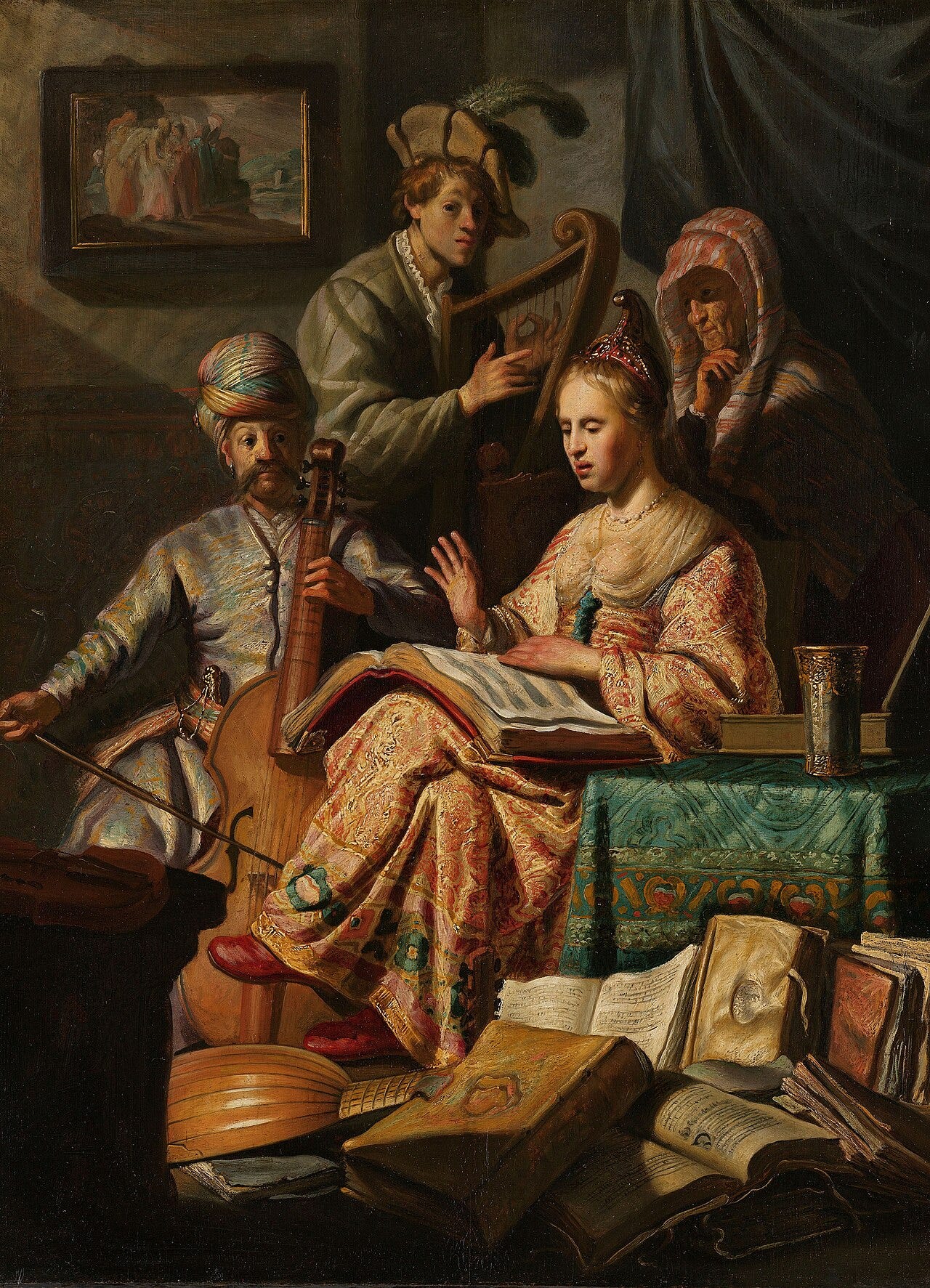
11. Rembrandt, The Music Party (1626)
Rembrandt was barely twenty when he painted this crowded little scene of young people making music together, a woman at a keyboard, a man with a lute, a singer following along.
It is one of his earliest surviving paintings, dressed up in the exotic silks and turbans he loved to collect and paint. The faces may be his own family, with his mother perhaps seated as the older woman keeping time.
The whole thing glows with the fussy, ambitious detail of a young painter showing off everything he can do. He signed it with the tangled monogram of his youth, before he was famous enough to need nothing but Rembrandt.
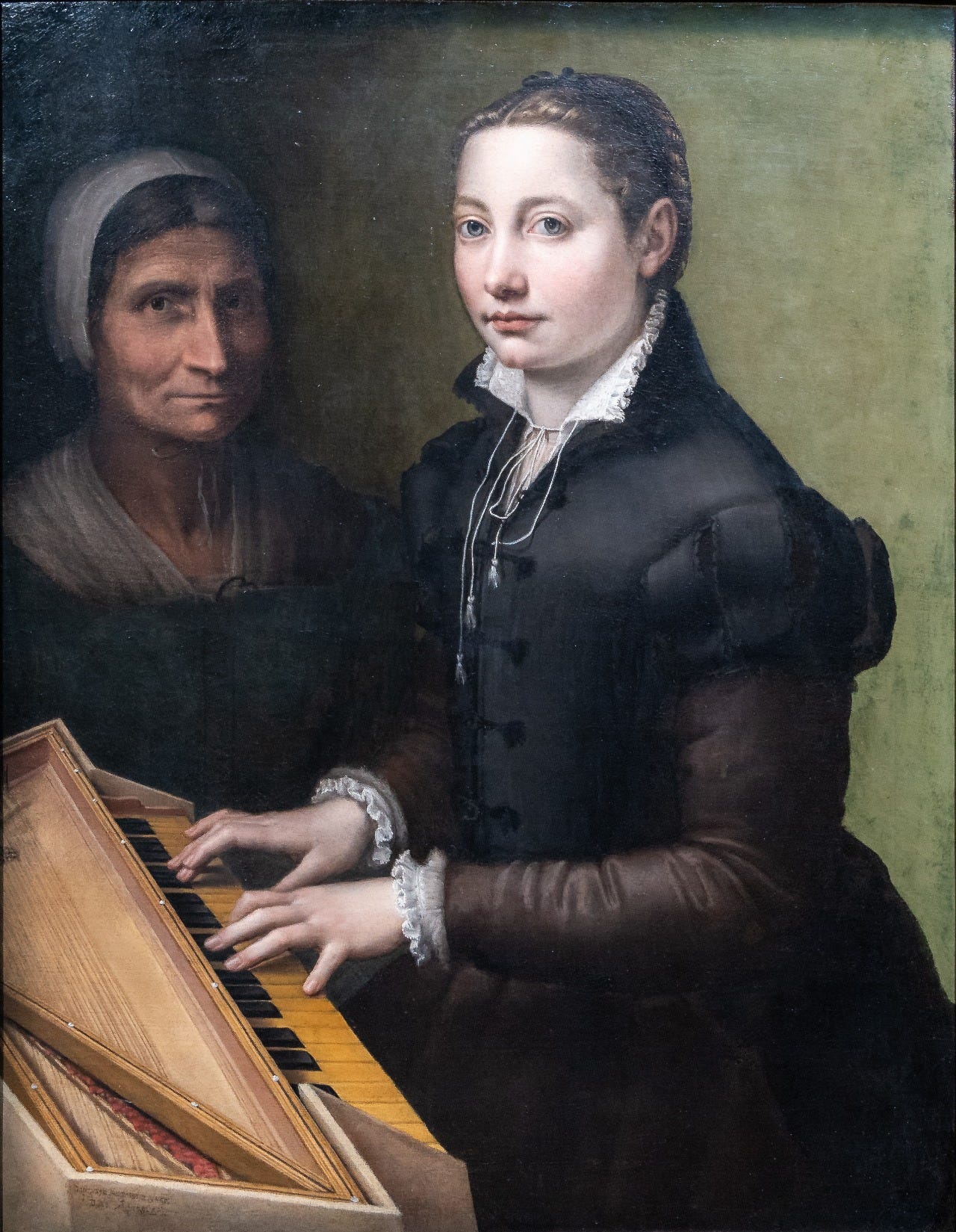
12. Sofonisba Anguissola, Self Portrait at the Spinet (about 1561)
A young noblewoman sits playing a keyboard, turning to meet your eye with calm confidence, in one of the earliest self portraits of a woman making music.
Anguissola was a rare thing in the Renaissance, a woman trained as a painter, admired by Michelangelo himself in letters. Playing an instrument was a proper accomplishment for a lady, so she chose to show herself doing exactly that, both refined and quietly skilled.
An older woman, probably her governess, watches from the shadows behind. She went on to become a court painter in Spain and lived to about ninety three, painting almost to the very end.
Music and musicians in art, a few questions
What is the most famous painting of a musician? Vermeer's Guitar Player and Manet's Fifer are among the best known, along with Caravaggio's singing Lute Player.
Why did artists paint musicians? Music stood for harmony, love and the fleeting pleasures of life, and a lute or songbook let a painter hint at sound and feeling.
Can you tell what music is being played? Sometimes yes. Caravaggio painted a readable score, and Eakins carved the exact bars onto his frame, so scholars have worked out the actual tunes.
Who painted concerts and music parties? Dutch and Utrecht painters like Honthorst, Leyster and the young Rembrandt loved candlelit groups making music.
What does a lute mean in a painting? It often stood for love and harmony, while a broken string could hint at discord, death or a love gone wrong.
If these players pulled you in, you will love these too:
Lady with an Ermine, detail by detail, why she is holding that animal
The secret behind Hopper Soir Bleu, the clown picture that went wrong
Titian, Sacred and Profane Love, which of the two women is which
The note you never hear
Every one of these paintings holds a sound just out of reach, a chord half struck, a breath about to become a word. That is their quiet trick, making you strain to hear something that was never there.
Painters could not record music, so they did the next best thing and painted the face of a person lost inside it. Look long enough and the room almost fills with sound.