Famous Still Life Paintings: 12 That Turned Objects Into Art
The most famous still life paintings prove that a table of fruit, flowers or a bare skull can hold as much drama as any battle. From Caravaggio's blighted basket to Cezanne's wobbling apples, these are twelve objects that changed art.
A still life has no story and no hero to hide behind, only pure looking, which makes it the hardest test a painter can set. I have picked twelve that carry far more than they show, and you can read how the genre began in what still life painting is.
What a still life is really saying:
The wealth. Exotic shells, lemons and silver that show off a nation's trade and money.
The warning. A skull, a snuffed candle, a rotting fruit, all whispering that time runs out.
The skill. No drama to lean on, just the eye and the hand, fully exposed.
The rebellion. When Cezanne wobbled an apple, still life quietly launched modern art.
If this pulled you in, keep going
If you want the detail rather than the summary:
Vermeer, Woman Holding a Balance, what is actually on those scales
The Arnolfini Portrait, detail by detail, the mirror, the dog, and the question everyone asks
Six women, one monster, what Picasso did to the women who loved him
1. Caravaggio, Basket of Fruit (about 1599)
This humble basket of fruit is often called the first true still life in Italian art. Caravaggio painted it around 1599, setting a plain wicker basket on a bare ledge at eye level, with nothing else to distract you.
He refused to prettify it. One vine leaf is spotted with blight, an apple has a wormhole, and a few leaves have curled and dried, so the picture quietly insists that real things rot.
By treating cheap fruit with the seriousness of a portrait, Caravaggio made still life a subject worth a great painter's time, a shift you can trace in what still life painting is.
2. Juan Sanchez Cotan, Quince, Cabbage, Melon and Cucumber (about 1602)
In 1602, Juan Sanchez Cotan hung a quince and a cabbage on strings and set a melon and a cucumber on a stone ledge, all against pure black.
This Spanish bodegon runs along a precise curve, each object lit like sculpture while everything else is swallowed by darkness.
Soon after painting scenes like it, Cotan gave up the world to become a monk, which may be why his humble vegetables can feel like a form of prayer.
3. Clara Peeters, Still Life with Cheeses (about 1615)
Look hard at the shiny lid of the jug and you find a tiny painter reflected in it, over and over. Clara Peeters hid her own miniature self portrait in the metalwork of her still lifes around 1615, one of the only records we have of her at all.
She was among the first women to build a career from painting, stacking cheeses, pretzels and costly glasses with total control. Almost nothing is known of her life, so these reflections work as her signature, a woman quietly insisting that she was here.
4. Ambrosius Bosschaert the Elder, Bouquet of Flowers (about 1620)
The bouquet in this Dutch flower piece could never have stood in a real vase. Ambrosius Bosschaert the Elder painted tulips, roses and irises together around 1620, blooms that open in different months, gathered from separate studies into one impossible arrangement.
In the decades of the Dutch tulip craze, a single rare bulb could cost more than a house, and a painted bouquet let a collector own a fortune of flowers that would never wilt.
Bosschaert set his in a window, opening onto a tiny far off landscape, a whole world behind the glass.
5. Pieter Claesz, Vanitas Still Life (about 1630)
The message here is not subtle: a skull rests beside a toppled glass, a snuffed candle and a ticking watch. Pieter Claesz built vanitas still lifes like this in 1630 to remind a wealthy buyer that time is short and death is certain.
Every object is a clock in disguise, the smoke still curling from the wick, the glass already knocked over. This whole language of warning has a name, and you can read it in what a vanitas is.
6. Willem Claesz Heda, Banquet Piece with a Gilt Cup (1635)
Almost all the color has drained out of this abandoned meal, leaving silver, pewter and soft neutral tones in a hushed harmony. Willem Claesz Heda painted these banquet pieces in 1635, and his fellow Dutch called them banketjes, little breakfasts.
A lemon sits half peeled, its bright rind spiralling over the table edge to show off pure skill with reflection and texture. Nobody is present and the meal is half eaten, so the whole scene feels like a room somebody left in a hurry.
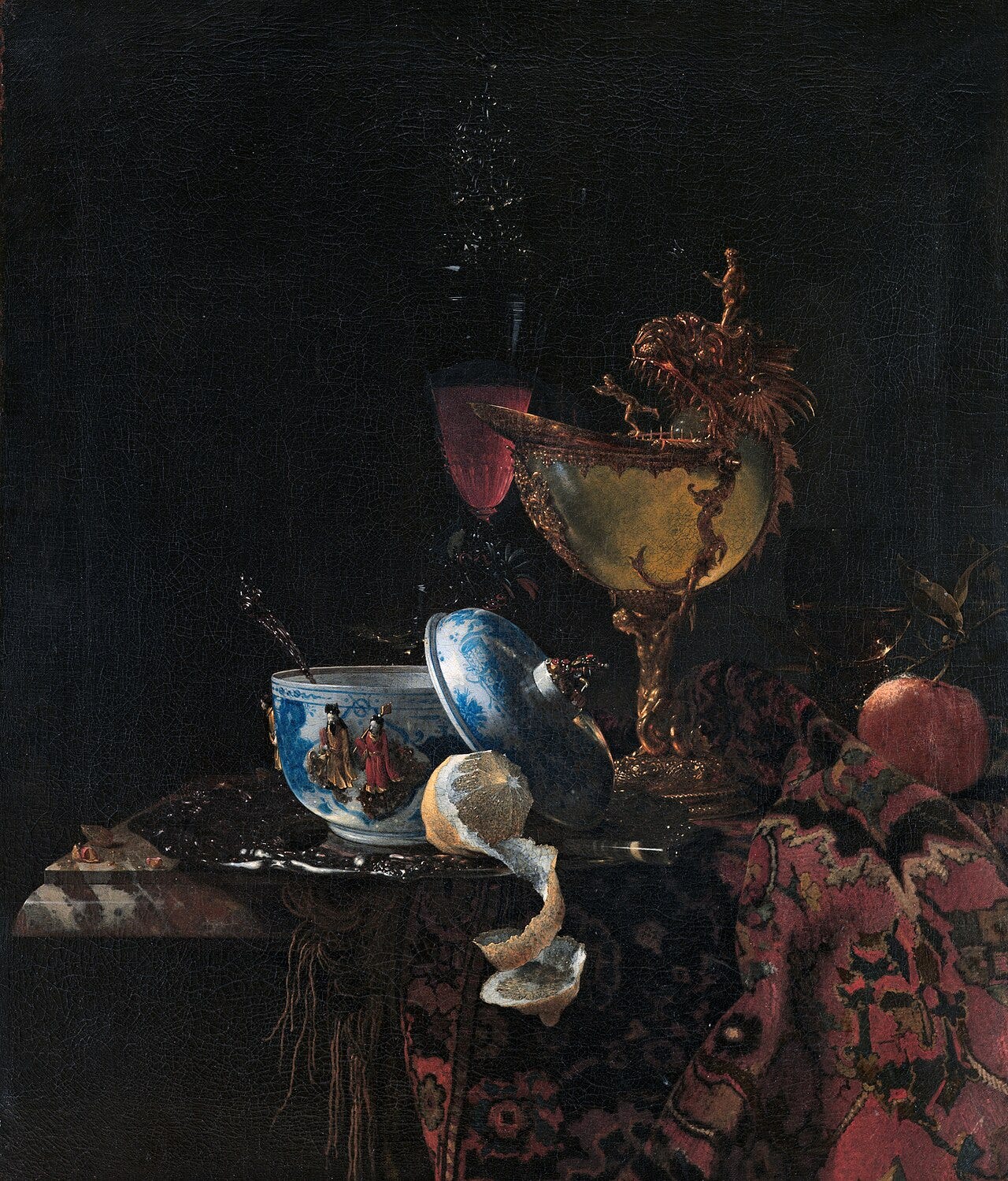
7. Willem Kalf, Still Life with a Nautilus Cup (about 1662)
A spiralling nautilus shell mounted in gold sits beside a Chinese porcelain bowl and a half peeled lemon, glowing out of deep shadow. Willem Kalf painted luxury still lifes like this in the 1660s, at the peak of Dutch wealth from global trade.
Every object had crossed an ocean, the shell from the Pacific, the bowl from Ming China, the spices from the Indies, so the picture is really a portrait of an empire's reach.
The Dutch called this rich style pronk, meaning show, and no one did show better than Kalf.
8. Rachel Ruysch, Flower Still Life (about 1700)
Rachel Ruysch painted flowers for roughly sixty years and was famous across Europe while still alive, a rare thing for a woman of her day. Around 1700 she was arranging dark, deep bouquets that seem to grow straight out of shadow, every petal exact.
Raised around her father's collection of preserved animals and plants, she tucked insects, lizards and beads of dew into her arrangements like tiny surprises.
She kept painting into her eighties, raised a large family, and once won a Dutch lottery, proof that a flower painter could also have a full life.
9. Jean Simeon Chardin, Basket of Wild Strawberries (1761)
A simple pyramid of wild strawberries, a glass of water and two cherries, and somehow it stops you cold. Jean Simeon Chardin painted quiet, humble things like this in 1761, and few painters have made so little say so much.
He avoided the loud luxury of his rivals, painting kitchen jugs and fruit with a soft, grainy touch that later thrilled Cezanne and Matisse.
In 2022 this small basket of strawberries sold for around twenty four million euro, a record for the artist, and proof that stillness can be worth a fortune.
10. Paul Cezanne, Still Life with Apples (about 1890)
Cezanne once said he wanted to astonish Paris with an apple, and he spent his life trying. Through the 1880s and 1890s he was painting tables of ordinary fruit where the plates tilt, the perspective wobbles, and the apples feel more solid than the real thing.
He was not being clumsy. By bending the strict rules of perspective, Cezanne turned a bowl of fruit into a study of pure form that helped open the door to Cubism and modern art, and I make the case for him in is Cezanne the greatest painter.
11. Vincent van Gogh, Sunflowers (1888)
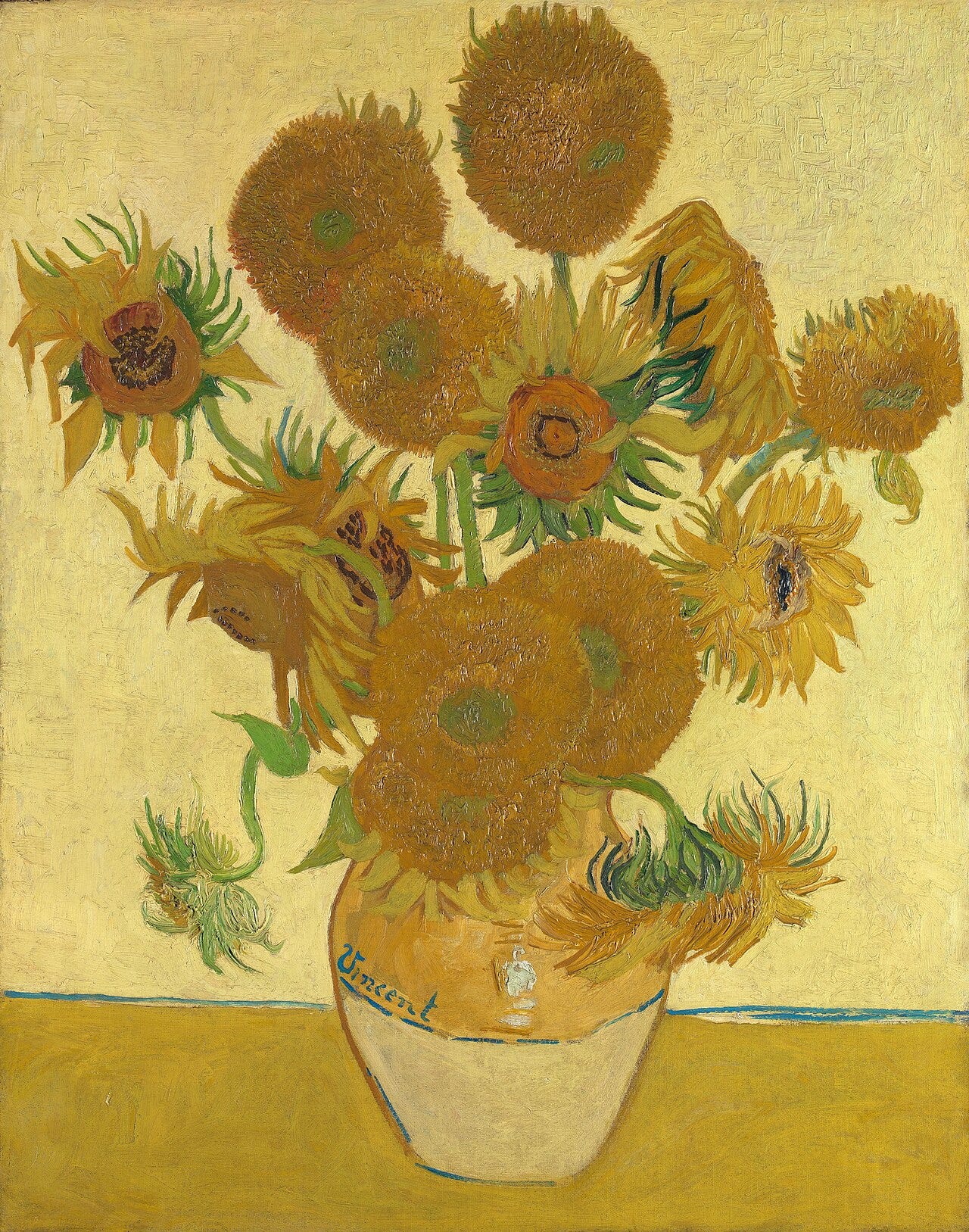
Van Gogh painted his blazing Sunflowers in 1888 to decorate the bedroom of his friend Gauguin, who was coming to stay. He wanted a wall of yellow on yellow, a warm welcome made of paint.
He used a brand new pigment, chrome yellow, straight from the tube, which is why some of the flowers have since darkened toward brown as the color quietly ages.
Several versions survive, hanging in the great museums of the world, and each one still holds the same restless heat.
12. Edouard Manet, A Bunch of Asparagus (1880)
There is a small, perfect story hidden in this simple bundle of asparagus. Edouard Manet painted it in 1880 and sold it to a collector for eight hundred francs, but the delighted buyer sent one thousand instead.
So Manet painted a second tiny picture, a single stalk of asparagus lying on a table, and sent it over with a note saying one had been missing from the buyer's bunch.
In two small canvases he turned a plain vegetable into wit, generosity and pure painting all at once.
Which museums hold these objects now
Caravaggio, Basket of Fruit: the Ambrosiana, Milan.
Sanchez Cotan, Quince, Cabbage, Melon and Cucumber: the San Diego Museum of Art.
Kalf, Claesz and Heda: the Rijksmuseum and other Dutch collections.
Cezanne, Still Life with Apples: the Museum of Modern Art, New York.
Van Gogh, Sunflowers: the National Gallery, London, among others.
If a good table drew you in, keep going:
The darker truth about Gauguin, the part of the Tahiti story that never makes the wall label
Luncheon of the Boating Party, detail by detail, who everybody at that table actually was
Ten women artists you need to know, the names the textbooks skipped
Still life, a few quick questions
What is the most famous still life painting? Van Gogh's Sunflowers and Cezanne's apple still lifes are among the most famous, along with Caravaggio's Basket of Fruit.
What does a still life mean? Often more than it shows. Objects can stand for wealth, faith, the five senses, or the certainty of death.
What is a vanitas? A type of still life built around a skull, a candle or a clock, made to remind the viewer that life is short.
Who painted the first still life? As a standalone subject, Caravaggio's Basket of Fruit of around 1599 is often named the first great Italian example.
Why is still life hard to paint? There is no story or drama to hide behind, so every flaw in the looking and the hand shows.
The quiet things that outlast us
Set them in a row and you notice the objects barely change: fruit, flowers, silver, a skull. What changes is what people needed them to say.
A Dutch merchant wanted his wealth to shine, a Spanish monk wanted a vegetable to feel like God, and Cezanne wanted an apple to break the rules of seeing.
The smallest of them, a single stalk of asparagus Manet dashed off in 1880, was really a thank you note, and it now hangs in a museum, worth far more than the vegetable that first inspired it.