
Giovanni Battista Tiepolo was a Venetian painter, born in Venice on 5 March 1696 and dead in Madrid on 27 March 1770, who became one of the great painters of palace ceilings in eighteenth century Europe. He is remembered above all for the sky he painted over the staircase of the Würzburg Residence in Germany in 1752 and 1753, a ceiling often called the largest in the world, and for the way his career ended, far from Venice, in a court that no longer wanted his style.
He painted gods, continents and clouds for prince bishops, kings and Venetian families. One of his ceilings came through a night in which almost everything around it burned.
Cool Stories About Art is a newsletter to learn art the fun way.
Join 200,000+ readers and get:
10 new art stories / month
The entire archive of content (1,000+ articles)
Comment, ask questions, and chat with other readers
On 16 March 1945 an air raid destroyed ninety percent of the old town of Würzburg. The Residence, the palace of the city's prince bishops, burned almost completely, the fire running from the attic through the wooden ceilings and floors until the roofs were gone. But the stone vault that the architect Balthasar Neumann had built over the great staircase withstood the collapse, and the painted sky beneath it survived.
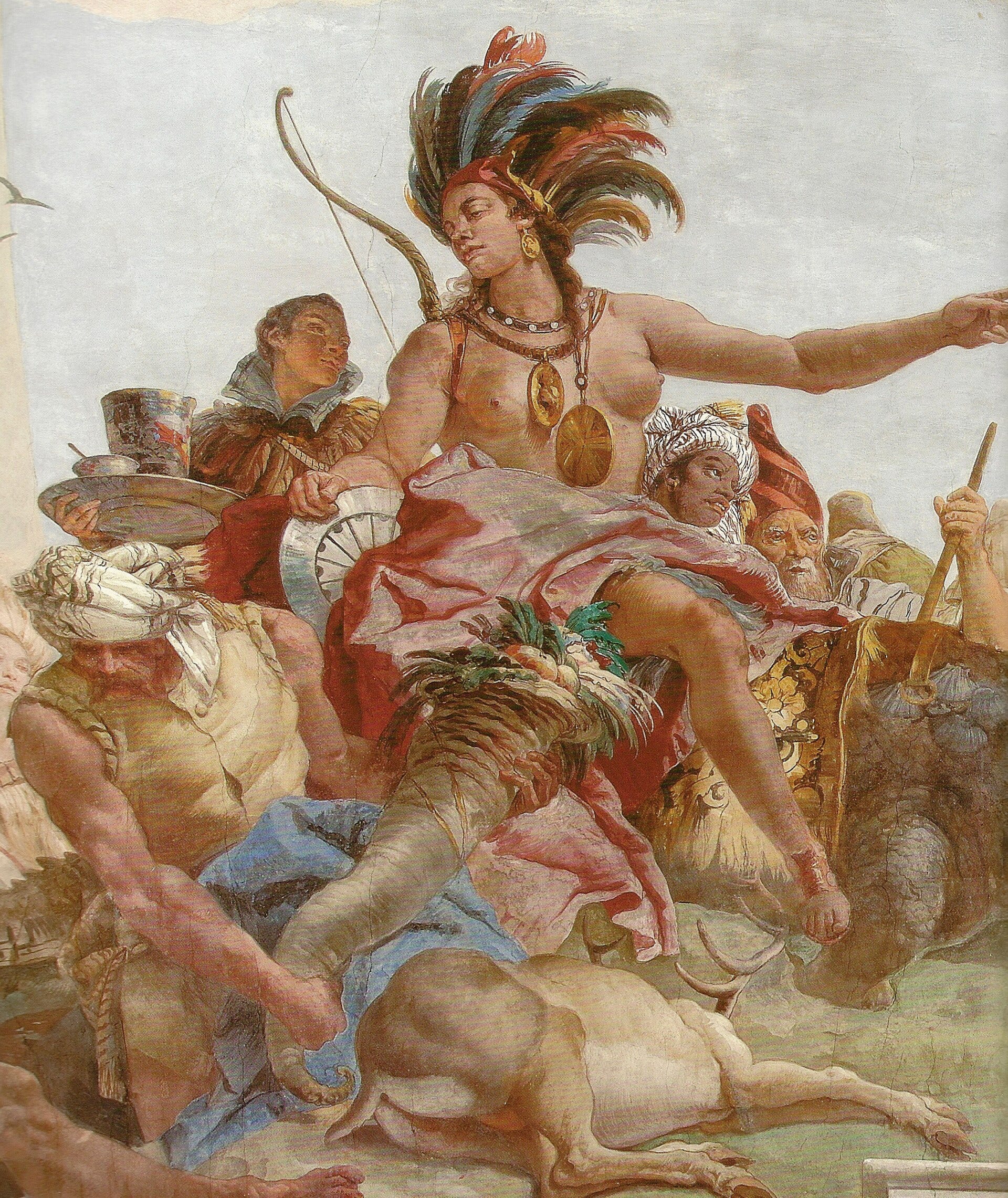
Tiepolo had painted that sky in 1752 and 1753. The prince bishop had summoned him from Venice, and he arrived at fifty four with two of his sons. Over the stairs he put Apollo and the four continents, more than a hundred figures, and somewhere in the crowd a painter in his everyday cap.
In 1762 he left Venice a second time, for Madrid, where the king's advisers favored a different kind of painting. Five years after his death the altarpieces he had made for the king were taken down. He died there at seventy four, and he never saw Venice again.
What You'll Discover
What his father did for a living.
What an X ray found under his Cleopatra.
Who he hid inside the ceiling.
Why a sixty six year old left home.
Whose taste replaced his own.
Which prints may have reached Goya.