
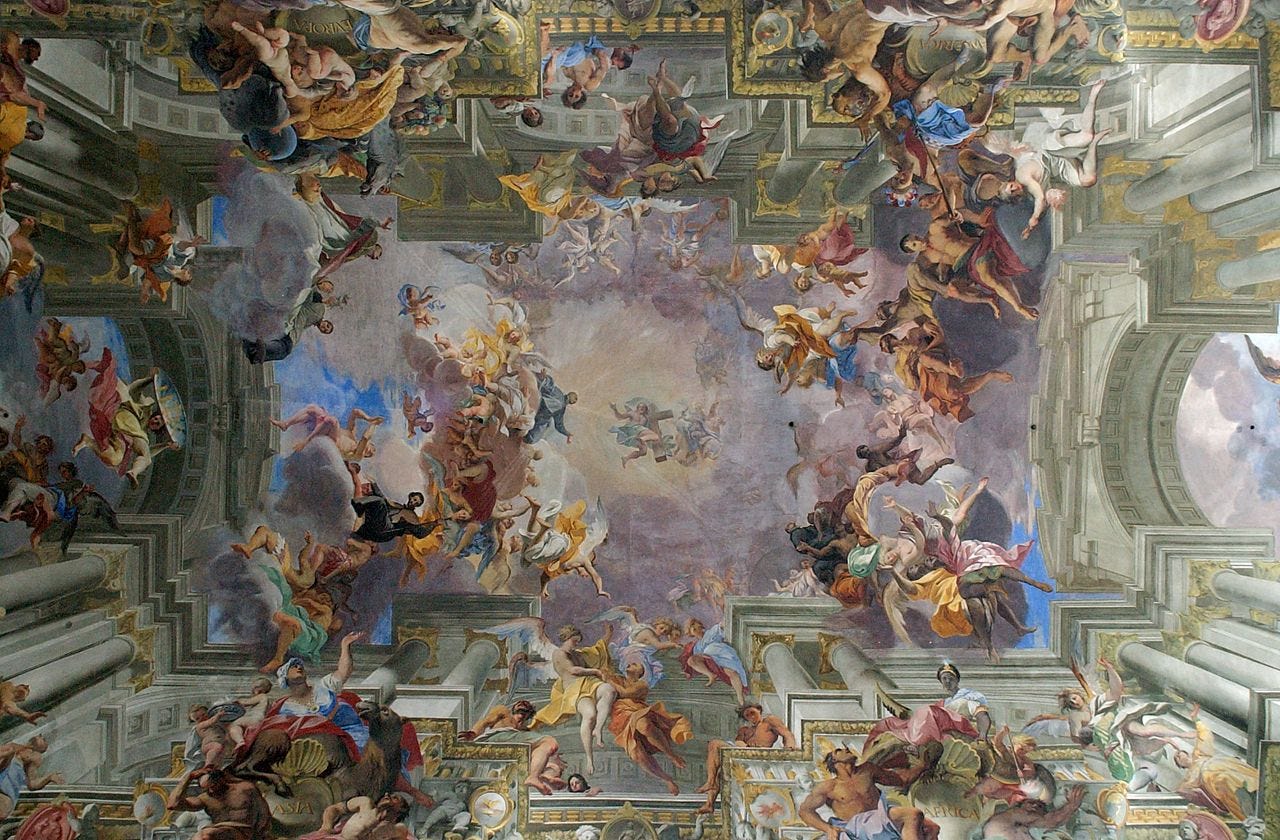
Quadratura is the art of painting fake architecture, usually on a ceiling, so convincingly that the solid roof seems to open into more columns, balconies and sky.
Using extreme perspective, the painter extends the real building upward into a painted one.
Its most famous feat is a dome that was never built at all, only painted flat on a canvas disc.
Quadratura up close
What it is: painted fake architecture, usually on ceilings.
The effect: the roof seems to open into more building and sky.
The tool: extreme perspective from one ideal viewpoint.
The home: Baroque churches and palaces.
The master: Andrea Pozzo, at Sant'Ignazio in Rome.
Keep learning art the fun way


Building with paint
Quadratura is illusion engineered like architecture.
The painter studies the real room, then designs painted columns, arches and cornices that seem to rise straight out of the actual walls, continuing the building into an imaginary upper storey.
It is worked out with rigorous perspective and steep foreshortening, and usually painted in fresco directly onto the plaster.
That turns a flat ceiling into a soaring, open structure crowded with figures and light.
The architect built up to the ceiling. The painter keeps building past it.
The one spot where it works
Quadratura has a secret I love: it is perfect from only one place.
Because the illusion relies on extreme perspective, it snaps into full, convincing depth from a single ideal viewpoint, often marked on the floor below.
Stand on that spot and the ceiling rockets open into the heavens. Walk away and the painted columns begin to lean and warp.
It is a close cousin of trompe l'oeil, the art of fooling the eye, and one of the grandest secrets hidden in famous paintings, stretched across an entire ceiling.
Pozzo and the vanishing roof
The supreme example is one ceiling in Rome.
In the 1690s the Jesuit priest and painter Andrea Pozzo (1642 to 1709) covered the ceiling of the church of Sant'Ignazio with a quadratura so total that the solid vault seems to dissolve into an endless painted sky.
Columns climb impossibly upward and saints soar into the light. From the marble disc set in the floor, the effect is overwhelming.
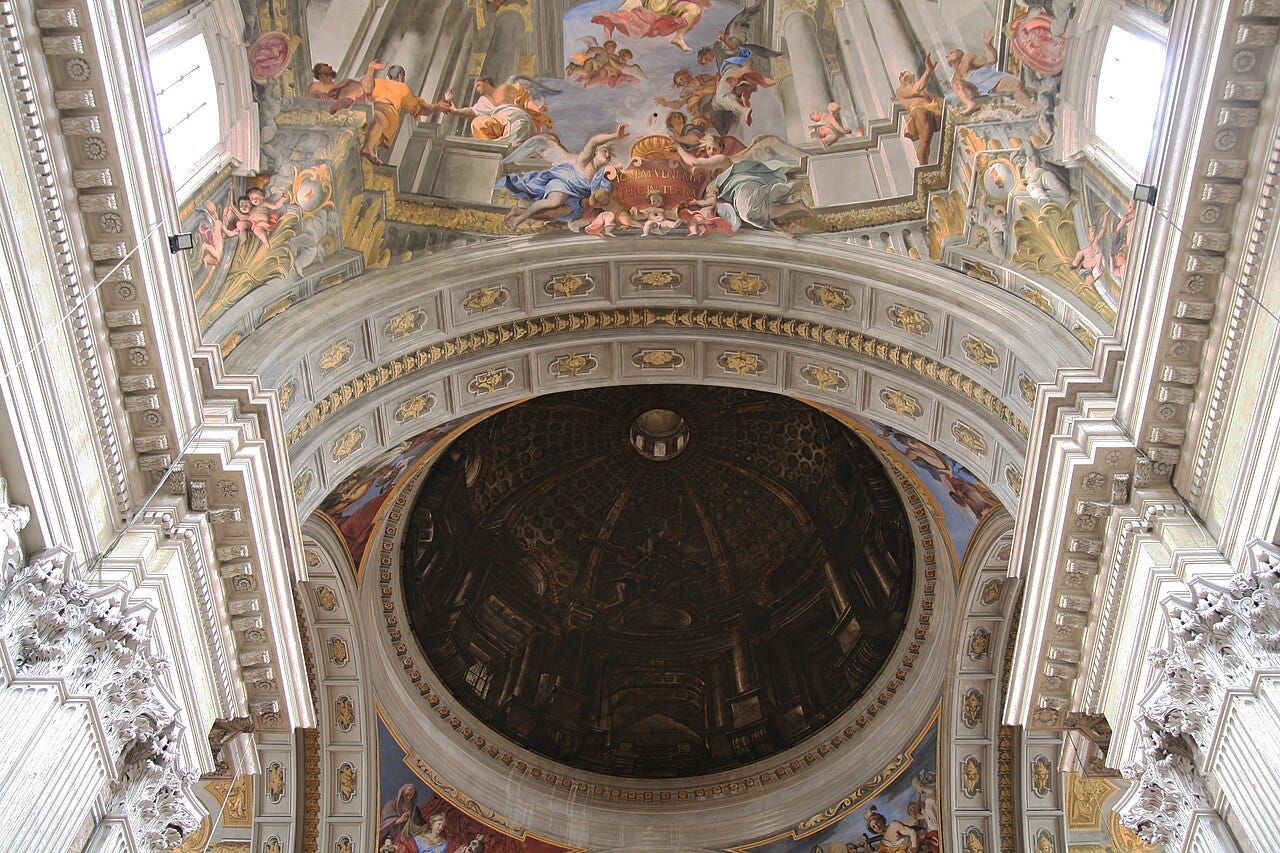
Pozzo pulled an even stranger trick in the same church. The Jesuits had planned a real dome over the crossing, but the neighbouring monks complained it would block their light.
So around 1685 Pozzo painted the dome instead, flat on a canvas roundel. Stand on the spot and it billows overhead; step aside and it sags into a lopsided oval. To me it is the best joke in Baroque art, a marvel born of a property dispute.
Pozzo even wrote the textbook that taught others how to do it, his Perspectiva Pictorum et Architectorum of the 1690s, translated and copied across Europe.
He did not paint a picture on the ceiling. He removed the ceiling and painted the infinite.
Heaven on the ceiling
Quadratura was a perfect tool for its moment.
The Baroque church wanted to overwhelm the worshipper, to stage heaven as a thrilling, physical event overhead. Quadratura delivered exactly that: walls that climbed into glory, roofs that opened onto floating saints and blinding light.
It is propaganda, theatre and engineering fused into one dizzying upward rush.
You stood under the divine as it opened above you, head tipped back, pulled up into the painted sky.
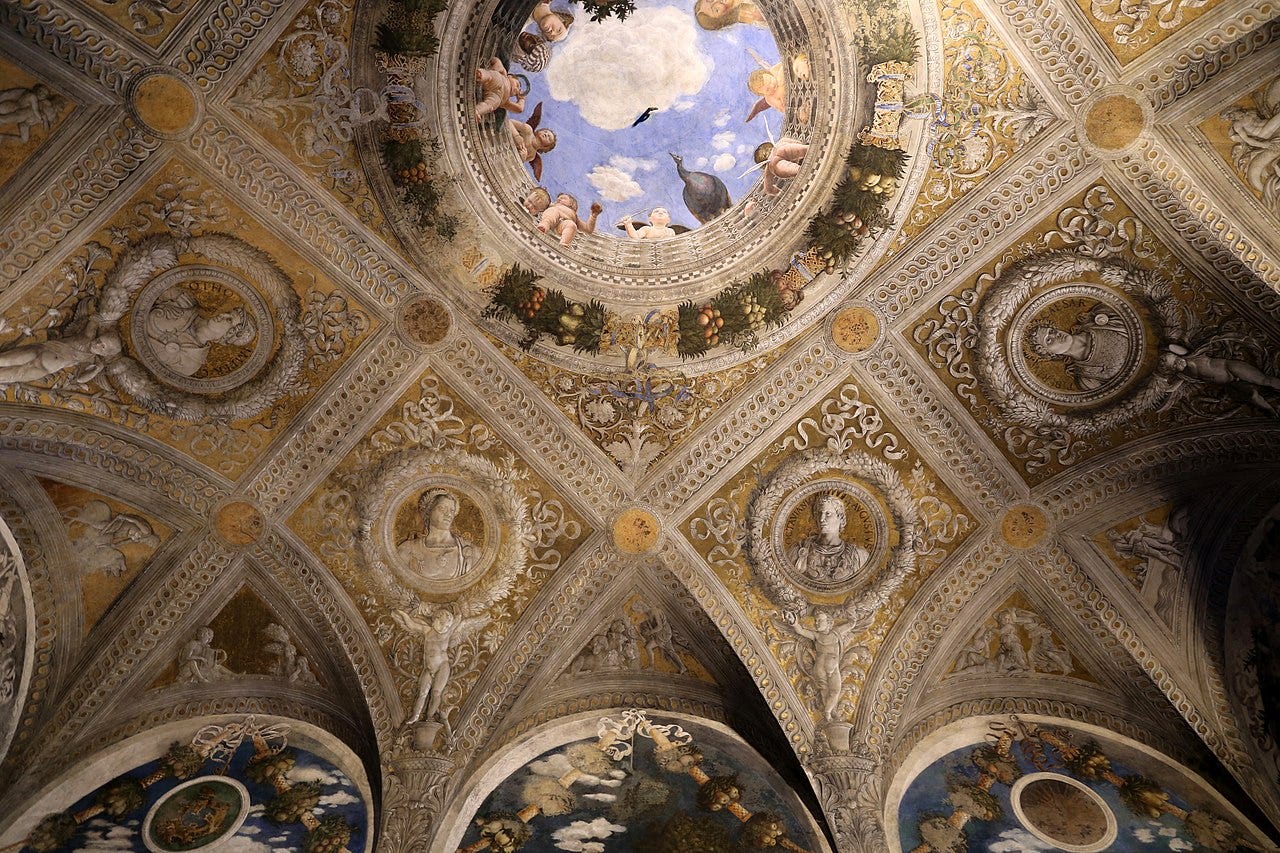
You can stand under the illusion. Pozzo painted the ceiling of Sant Ignazio in Rome, and Mantegna had opened the first painted oculus around 1474 at the Palazzo Ducale in Mantua.
Five questions about quadratura
What is quadratura? Painted fake architecture, usually on a ceiling, that makes the roof seem to open upward.
How does it work? Extreme perspective extends the real building into a painted one, convincing from one ideal spot.
Where is the most famous example? Andrea Pozzo's ceiling at Sant'Ignazio in Rome.
Why is there a mark on the floor? It shows the single viewpoint from which the illusion is perfect.
Is it the same as trompe l'oeil? It is a form of trompe l'oeil, applied to architecture and ceilings.
More secrets to unlock


The ceiling that refuses to be a ceiling
Most painting hangs on a wall and admits it is a flat picture. To me quadratura is the most extreme refusal of that, climbing past the real stone into an invented sky that, from one marked spot on the floor, looks completely solid.
It is an art that does not so much hang in a room as try to abolish it.
