
Andrea Mantegna was the early Renaissance painter who treated paint like sculpture and turned perspective into a magic trick. His figures look carved from stone, his backgrounds bristle with Roman ruins, and in two famous works he tilted the viewpoint so hard that a dead Christ and a painted ceiling seem to break through the wall.
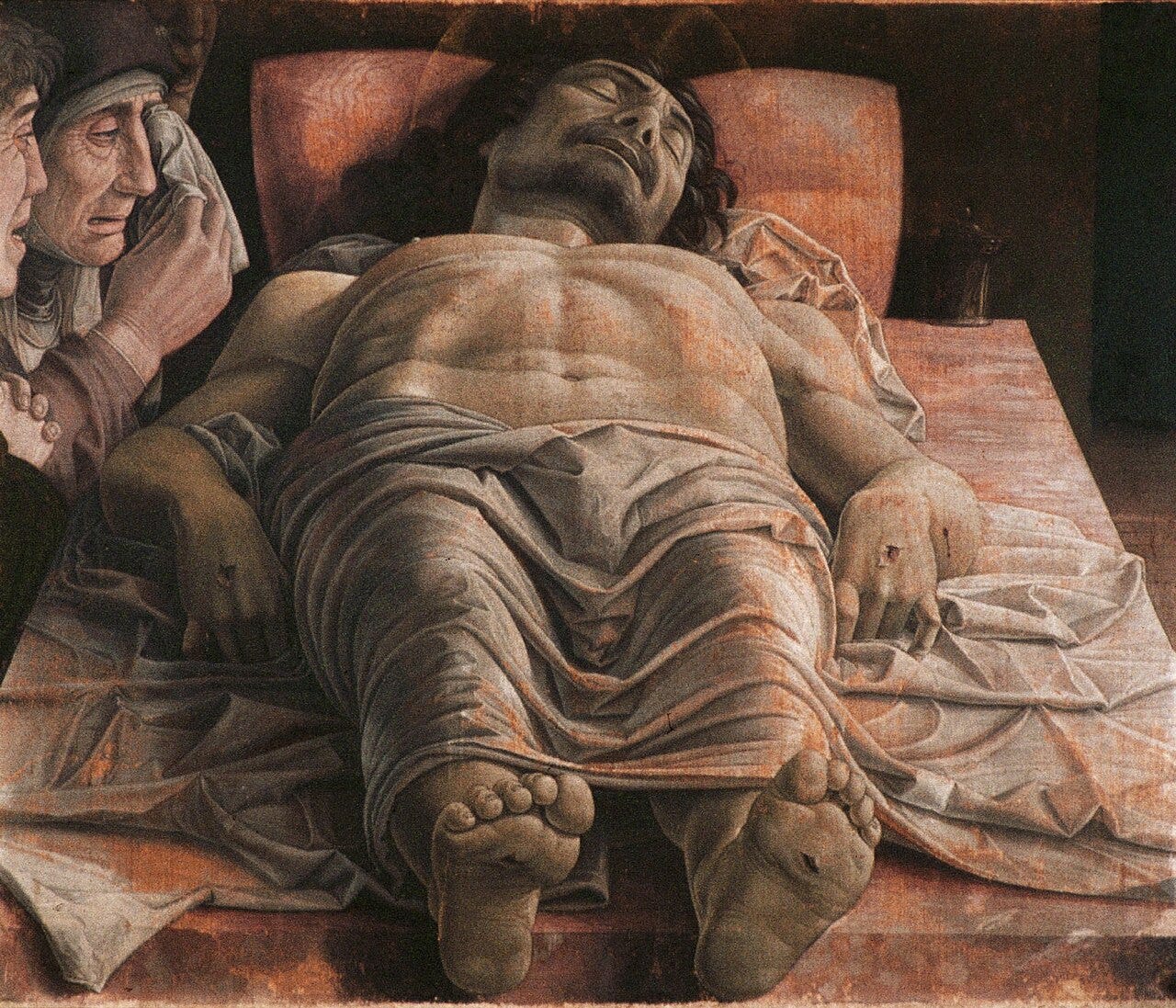
He was obsessed with ancient Rome, fiercely proud, and good enough to spend nearly fifty years as court painter to one ruling family.
Born: near Padua, around 1431
Known for: hard sculptural figures, extreme perspective, Roman antiquity
Died: Mantua, 1506
More incredible painter stories
If Andrea Mantegna pulled you in, you will love these too:


Andrea Mantegna at a glance
1431. Born around this year near Padua, a woodworker’s son.
1448. At about seventeen, contracted for the Ovetari Chapel frescoes in Padua.
1453. Married Nicolosia Bellini, sister of Giovanni and Gentile.
1460. Entered the service of the Gonzaga in Mantua, where he stayed for life.
1506. Died in Mantua. His memorial chapel stands in the basilica of Sant’Andrea.
Paint that looks carved
Mantegna trained in Padua, where humanist scholars were digging up Roman statues and inscriptions. It marked him for life. His people have the weight of marble, sharp folds, stern faces, bodies that seem chiselled rather than brushed.
He chose hard clarity over soft atmosphere. Even his rocks and clouds look engraved.
The perspective magician
Two works built his reputation for sheer nerve. The Lamentation over the Dead Christ shows the body feet first, brutally compressed, so the soles almost touch your face. See what is foreshortening.
In the Camera degli Sposi in Mantua, he painted a ceiling that opens into a fake blue sky, with figures and a baby peering down over a painted balustrade.
It is the first illusionist ceiling of its kind, grandfather of every painted heaven that followed. See what is fresco painting.
Rome in his bones
No painter of his time was more devoted to antiquity. Mantegna collected ancient fragments, filled his backgrounds with accurate Roman arches and reliefs, and turned his nine huge canvases of the Triumphs of Caesar, now at Hampton Court, into a parade of the classical world.
He also worked in engraving, spreading his designs far beyond Italy and feeding the young Albrecht Durer. See what is engraving.
You can explore works by Andrea Mantegna in the collection of the Metropolitan Museum of Art.
Out of the Padua workshops
Mantegna was born around 1431 in the countryside near Padua, into what the National Gallery calls possibly humble origins. Art was not the family trade.
As a boy he was taken into the busy Padua workshop of the painter Francesco Squarcione, who trained a whole generation of northern Italian artists.
The arrangement did not end well. Believing his talent was being used for someone else's profit, the young Mantegna broke his agreement with Squarcione in the early 1450s and set out on his own.
The friends who played at being Roman
Padua in these years was gripped by ancient Rome. Scholars were digging up Roman statues and inscriptions, and Mantegna fell in with humanists such as Felice Feliciano.
Their enthusiasm went past the study desk. In 1464 the group dressed up as ancient Romans for a boating trip on Lake Garda, treating the past as something to inhabit rather than just admire.
That habit of mind is why his painted figures look less like people than like statues brought to the edge of life.
The commission that made his name
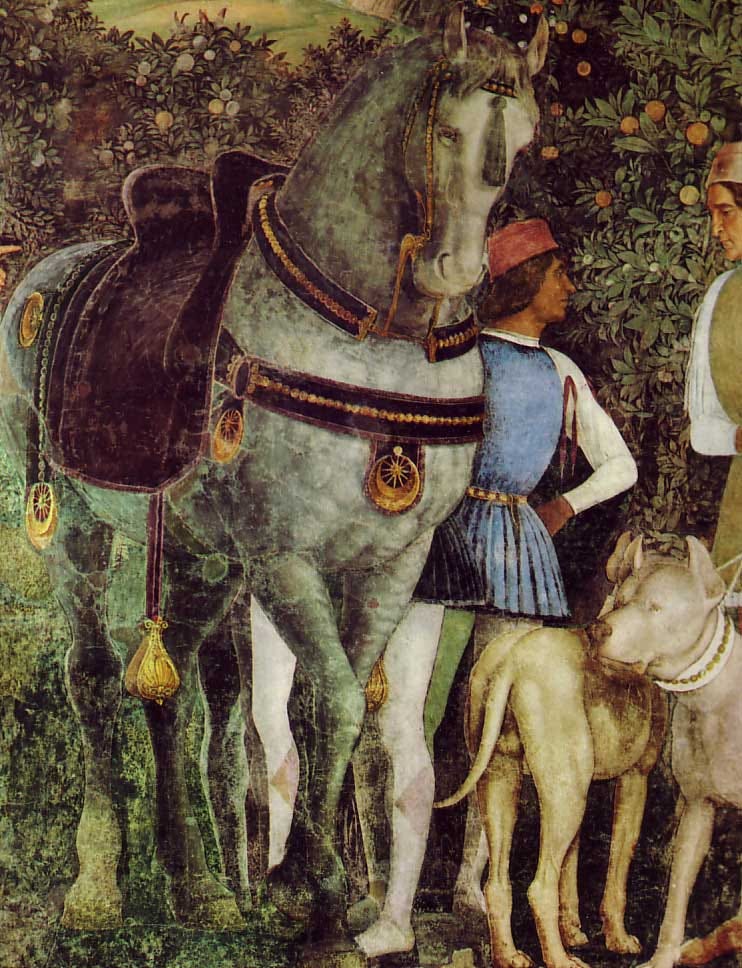
His first important job came in 1448, when he was still a teenager, painting frescoes for the Ovetari Chapel in the church of the Eremitani in Padua.
The work put a very young artist on the map. Before he had left Padua, patrons in Verona and Venice were already competing for him.
Most of those frescoes were destroyed by a bomb in 1944, so the early Mantegna survives mainly in photographs and fragments.
The marriage that bridged Padua and Venice
In 1453 Mantegna married into the Bellini family, the leading painting firm of Venice. It was a shrewd move for a man who had just walked out on his Padua master.
The alliance tied him to the Venetian painter Giovanni Bellini, and the two families traded ideas across the lagoon. Mantegna's hard, sculptural view of antiquity became a model that Bellini absorbed and softened into something warmer.
Locked into the Gonzaga court
In 1459 Mantegna agreed to serve Ludovico Gonzaga, ruler of Mantua, and by 1460 he had moved there for good. He would spend the rest of his life as court painter to one family.
The post came with a fixed salary, which did not always actually arrive, and with limits on his freedom to travel or work for others.
Even so, in 1466 and 1467 he reached Florence and Pisa, where he studied works by Donatello, Fra Filippo Lippi and Paolo Uccello.
He was prized at court. From those modest country beginnings he had risen so far that he was knighted by 1484, an honour almost never granted to a painter.
The dead Christ, seen feet first
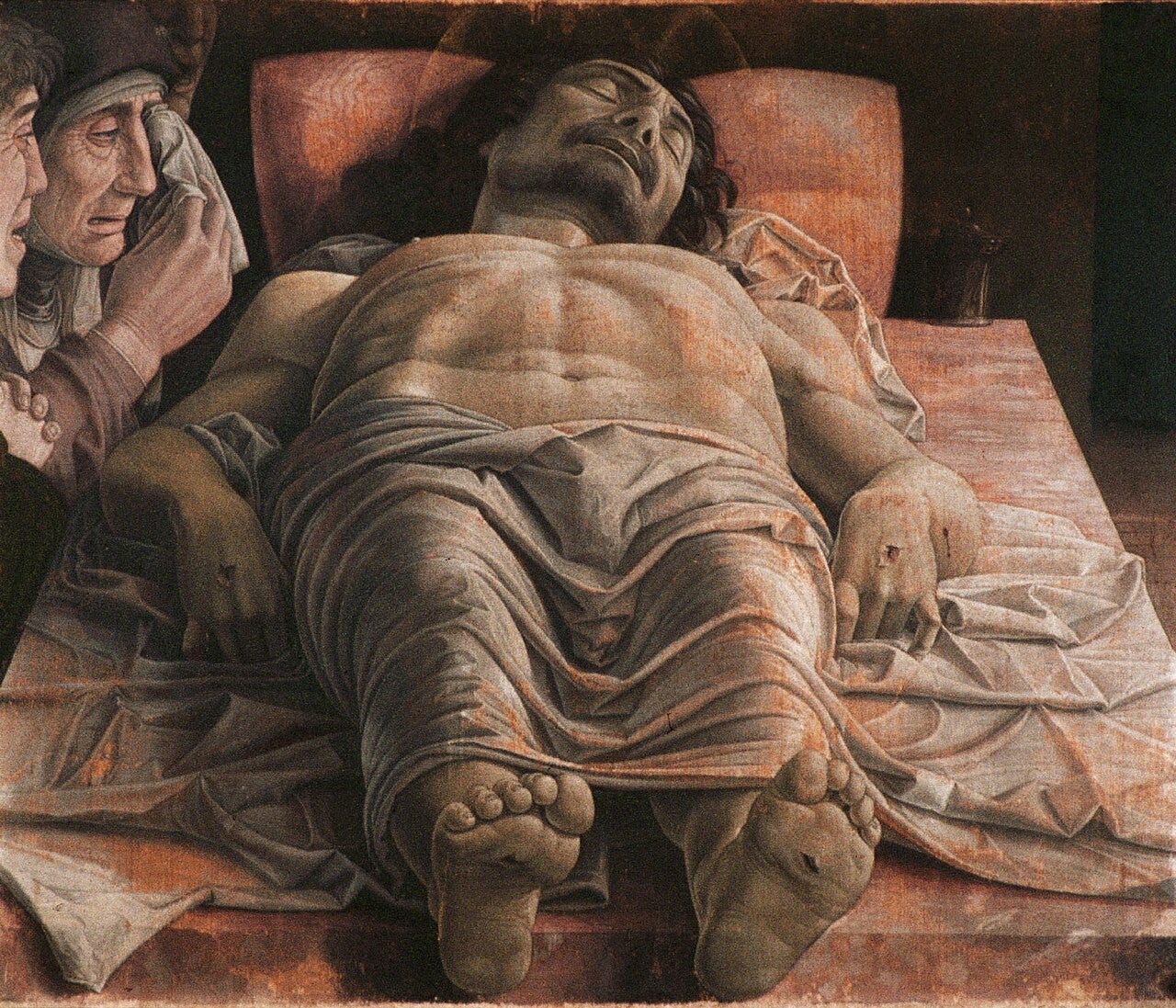
His Lamentation over the Dead Christ, painted around 1480, is the picture people remember. The body lies on a slab with the soles of the feet turned toward us, the whole figure sharply compressed so that we look straight down its length.
Mantegna bent the perspective on purpose. A true view from the feet would have shrunk the head to almost nothing, so he kept it large, and the wounds in the feet and hands sit right at the front of the scene.
It was found in his studio at his death and may have been a private work.
Nothing before it had put a sacred body so close and so bluntly to the viewer. It still stops people in the gallery.
The room that opened the ceiling
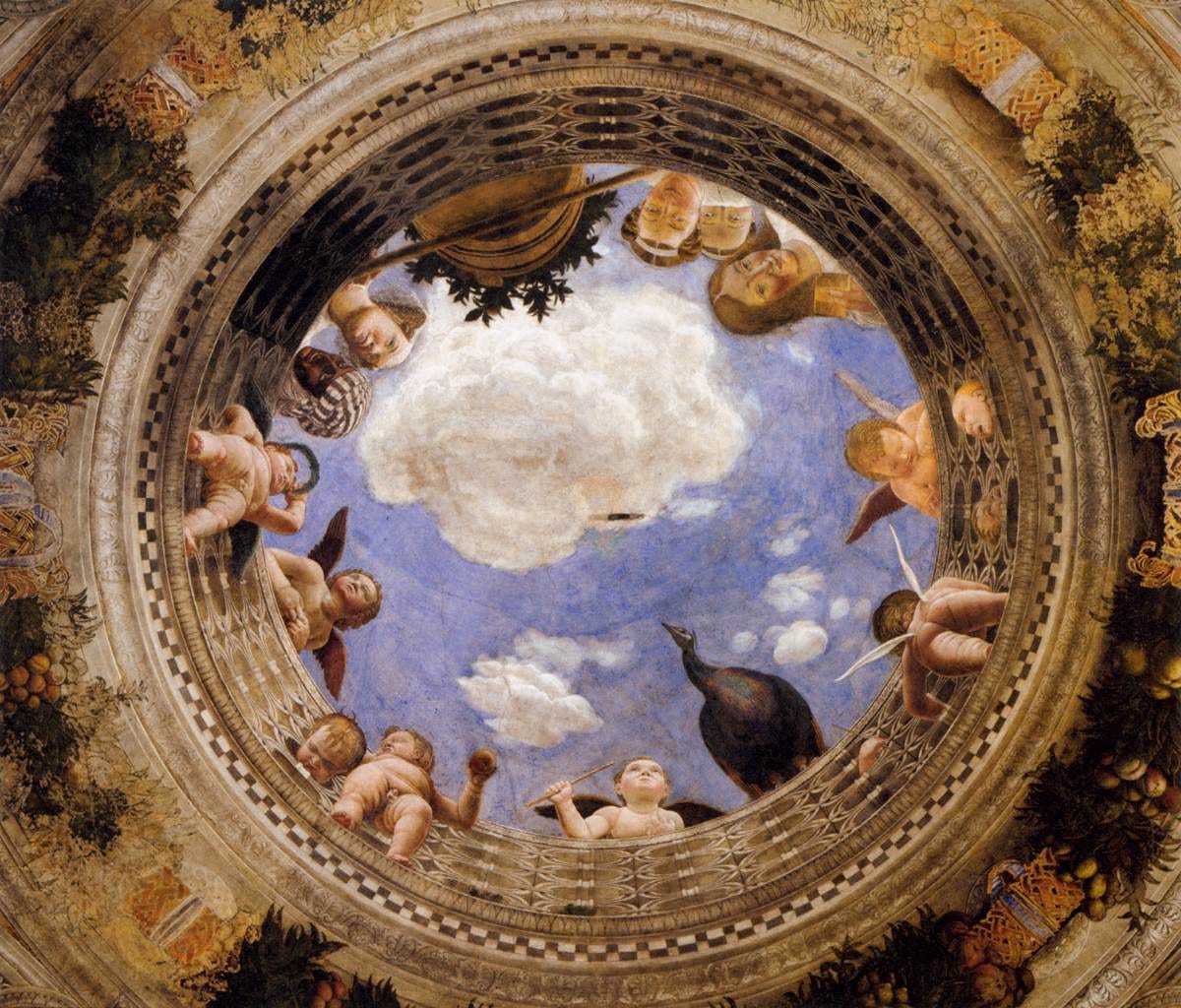
His best known surviving work is the Camera degli Sposi in the Palazzo Ducale at Mantua, finished in 1474. Rather than paint a single scene, he covered all four walls and the ceiling with a system of make believe architecture.
The flat ceiling appears to curve into a shallow dome. Above the centre he painted a circular opening to the sky, with women and small children leaning over a balustrade, seen sharply from below in the technique Italians call di sotto in su.
The trick only works from one spot in the room, which places the viewer exactly where a member of the court would have stood. The idea took time to catch on, picked up later by Correggio in Parma, and then by the Baroque ceiling painters.
The ceiling or the Dead Christ: my pick
Mantegna left two works people always mention together, the ceiling oculus of the Camera degli Sposi and the Lamentation over the Dead Christ. One fills a room roughly eight meters by eight meters. The other fits inside a canvas measuring 68 by 81 centimeters.
My pick is the ceiling. Mantegna sustained one illusion across four walls and a vault for nine years of work, from 1465 to 1474, and the trick still holds from the single spot in the room where it was designed to be seen. That is a harder problem to solve than compressing one body on a slab.
The Dead Christ needs none of that. No architecture, no fixed vantage point, just tempera on canvas that still draws a crowd at the Pinacoteca di Brera in Milan.
The painting stayed in Mantegna's studio until his death in 1506. The Brera museum dates it to around 1483 and describes it as a work probably made for his own devotion, never sold to a patron in his lifetime.
Money trouble and a plea to the Medici
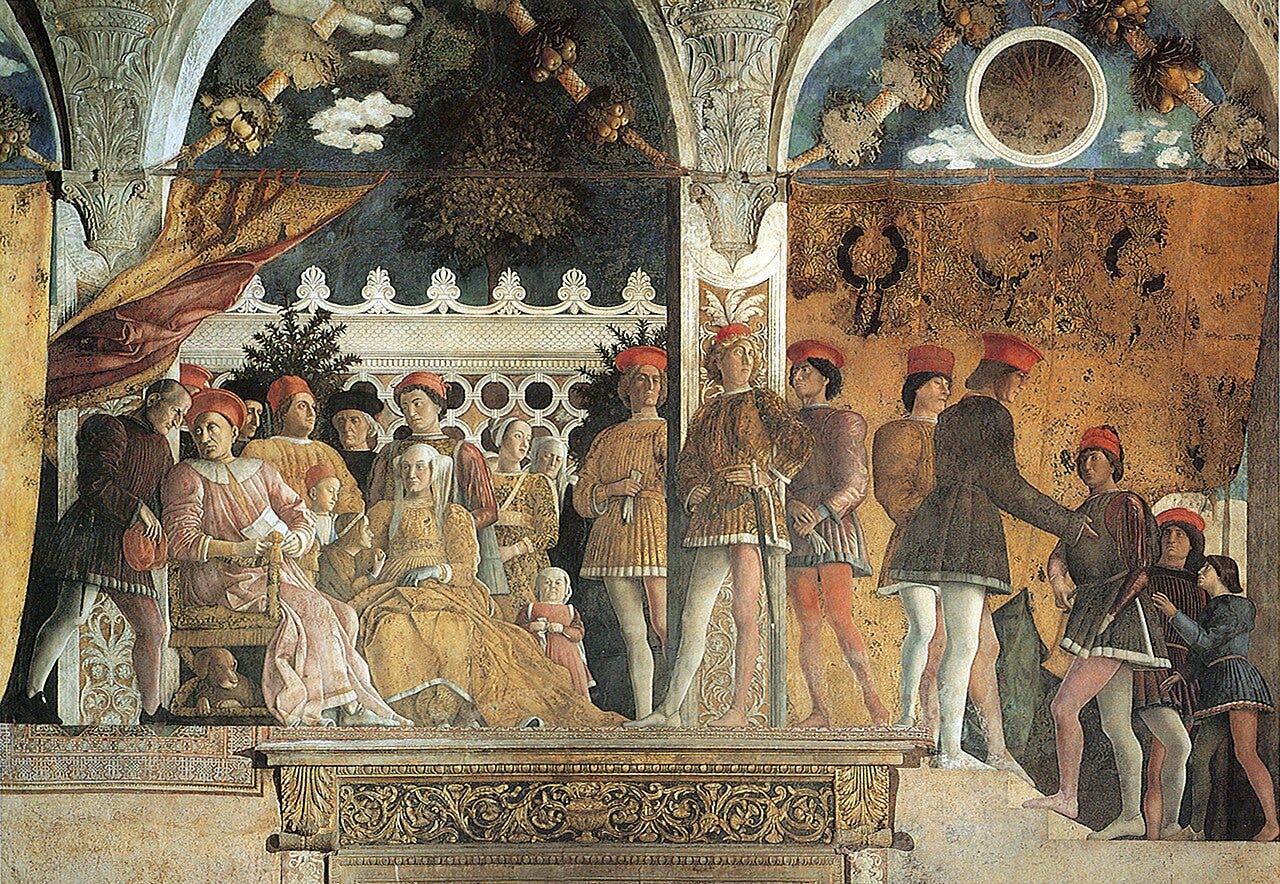
The good years did not last. Ludovico died in 1478, and Mantegna's own son Bernardino, groomed to run the studio, died soon after.
By 1484 his finances were so poor that he wrote to the Florentine banker Lorenzo de Medici asking for help, and even thought about leaving Mantua for Florence. He stayed, and when the young Francesco II Gonzaga came to power his fortunes recovered.
Rome, and a pope's private chapel
His fame reached the papacy. Pope Innocent VIII called him to Rome to decorate a private chapel in the Belvedere Palace, work he carried out between 1488 and 1490.
That chapel no longer exists. It was torn down in 1780, so one of his Roman commissions survives only in records.
The Triumphs of Caesar and their long afterlife
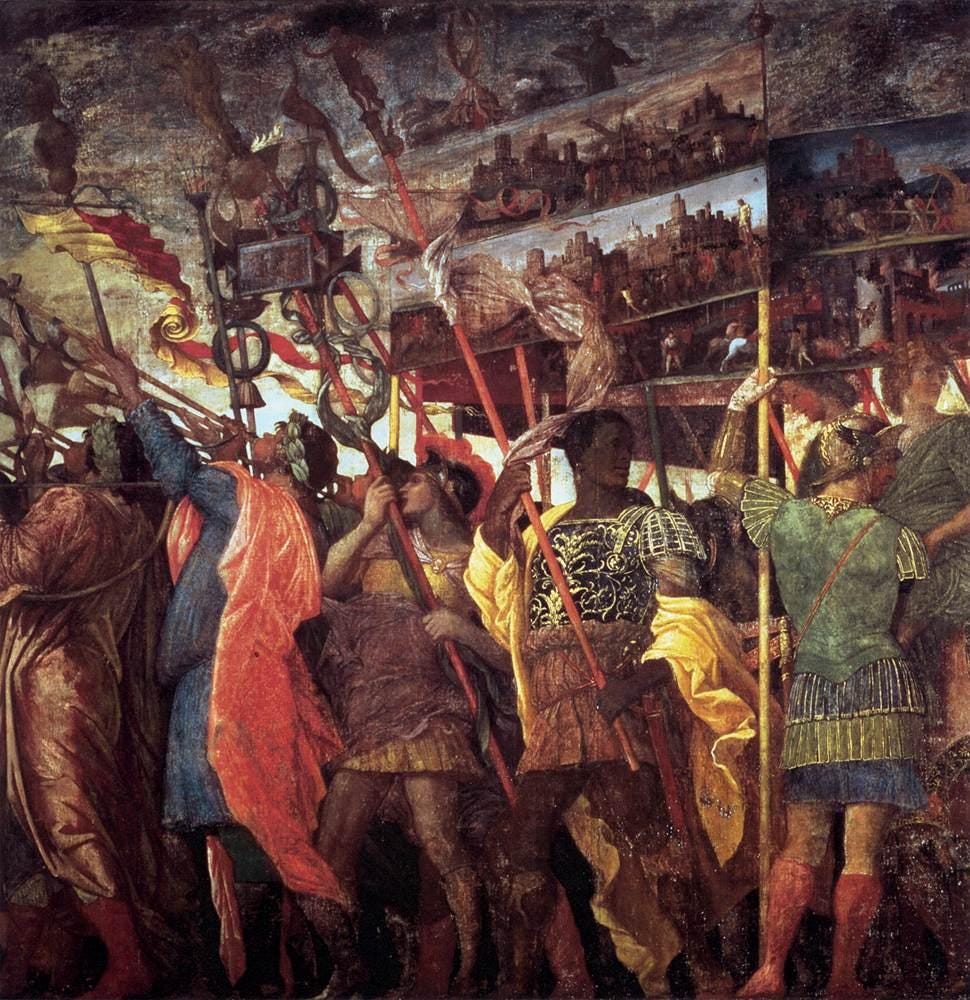
Around 1486 Mantegna began the nine large canvases known as the Triumphs of Caesar, worked on across several years for Francesco Gonzaga.
The set runs like a strip of film of a Roman victory parade, from trumpeters and carts to trophy bearers and a file of elephants. The surviving canvases now hang at Hampton Court in the British Royal Collection.
Their reach went far beyond Mantua. The engraver Andrea Andreani turned the nine scenes into large woodcuts meant to be pasted together as a single frieze.
Prints, altarpieces and a tomb of his own
Mantegna treated printmaking as a serious branch of his art. His engravings, with help from workshop hands, carried his designs across the Alps and fed the young Albrecht Durer in Germany.
His late pictures scattered across Europe. The Louvre holds the Madonna of the Victory of 1496 and Minerva Expelling the Vices, made around 1500 for the private study of Isabella d'Este.
He worked almost to the end and died in Mantua on 13 September 1506, aged 75. A funerary chapel was set up in his memory in the church of Sant'Andrea in Mantua, with a dome that may have been painted by Correggio, an honour no other painter of the century received in his adopted city.
Mantegna, briefly answered
What is Mantegna famous for?
Sculptural figures, his love of Roman antiquity, and the adventurous foreshortening of the Dead Christ.
Where did he work?
Mostly Mantua, as court painter to the Gonzaga family for almost fifty years.
Did he influence other artists?
Yes. His engravings reached Durer, and his illusionist ceiling shaped centuries of painted domes.
More secrets to unlock


Why Mantegna still startles
Mantegna built a world that feels colder and harder than the warm Renaissance we picture, all stone and ruins and unflinching faces.
Then he cracked the ceiling open and let the sky in. That mix of severity and showmanship is why he never feels dusty.
One last fact. He married Nicolosia Bellini, sister of the great Venetian painter Giovanni Bellini. The two brothers in law traded ideas, and you can watch hard Paduan stone meet soft Venetian light move between their families.
Mantegna trained in the Paduan workshop of Francesco Squarcione, whose rigorous, sculptural style also shaped Carlo Crivelli's linear, almost metallic figures. Crivelli's career is covered in Carlo Crivelli, The Complete Story.