
Paolo Uccello was the early Renaissance Florentine who fell so deeply in love with perspective that it nearly swallowed his life.
He arranged broken lances, fallen soldiers and rearing horses into careful geometric grids, turning a cavalry battle into a geometry lesson.
The results are strange, rigid and unforgettable. Ignored as an eccentric in his own century, he was reclaimed by modern painters who saw in his flat color and rigid depth a distant ancestor of abstraction.
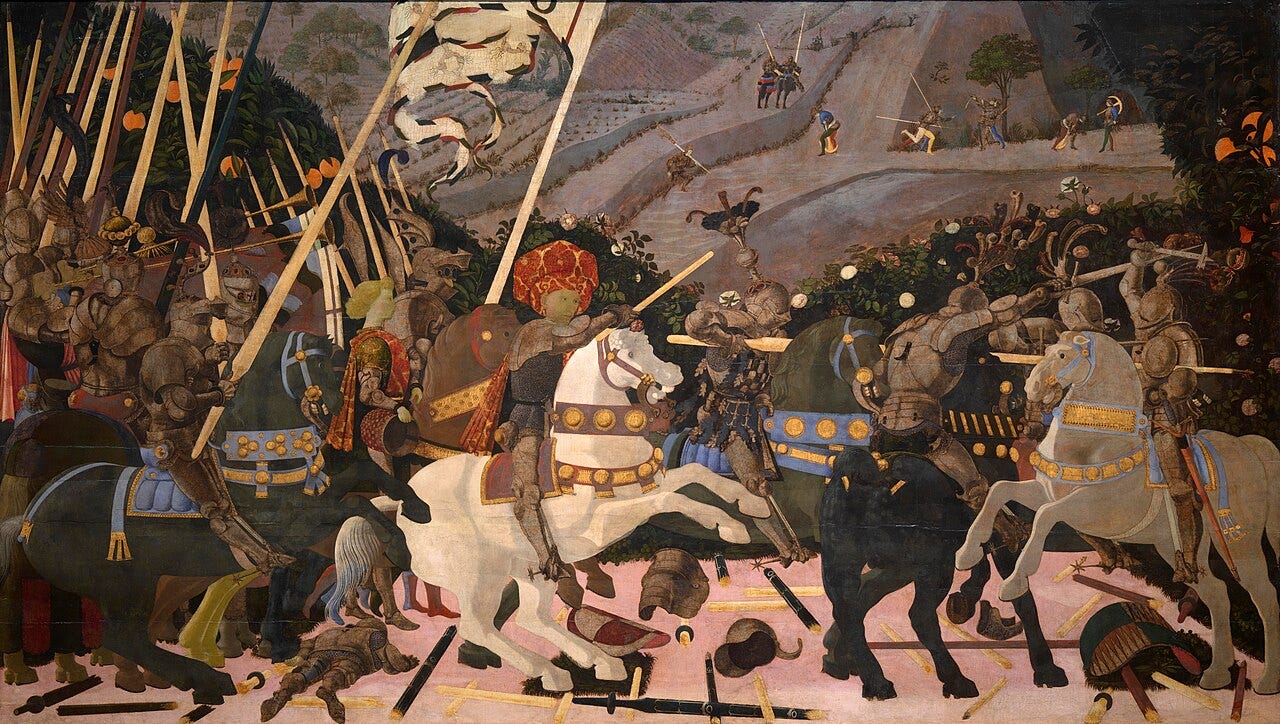
According to legend he stayed up all night doing the maths, murmuring how sweet a thing perspective was.
Born: Pratovecchio, near Florence, 1397
Known for: The Battle of San Romano, obsessive perspective, Saint George and the Dragon
Died: Florence, 1475
More incredible painter stories
If Paolo Uccello pulled you in, you will love these too:


Paolo Uccello at a glance
1397. Born Paolo di Dono in Florence around this year.
1407. Apprenticed in Ghiberti’s workshop as the bronze Baptistery doors took shape.
1425. Left for Venice to spend five years on the mosaics of San Marco.
1436. Painted the giant equestrian memorial to the English mercenary John Hawkwood in Florence cathedral.
1475. Died in Florence at about 78, six years after a tax return describing himself as old, ailing, and out of work.
Battle as geometry
His best known work, The Battle of San Romano, is three large panels of a Florentine cavalry clash. Look closely and the chaos is rigged: lances line up like rulers, a fallen soldier lies in perfect foreshortening, broken weapons point toward a vanishing point.
It is war frozen into a diagram, beautiful and a little uncanny, like a dream of a battle drawn by a mathematician. See what is history painting.
The all night obsession
The biographer Vasari tells how Uccello's wife begged him to come to bed while he sat up over his perspective studies. He waved her away, lost in the new science of depth.
Whether or not the story is exact, it captures the man. Where other painters used perspective as a tool, Uccello chased it like a passion for its own sake.
Knights, dragons and a flood
He painted a crisp Saint George and the Dragon, the monster pinned on a neat lance, the princess oddly calm. In a fresco of The Flood he crammed in foreshortened bodies and bizarre forms to push depth to the limit.
His colours can be dreamlike too, with pink and green horses that owe more to design than to nature. See what is tempera.
Clock faces and toy bright colour
Uccello's curiosity went past panels. In 1443 he painted the great clock face inside Florence Cathedral, a strange dial with four heads in the corners that still keeps unusual time.
His palette is just as odd, with pink cities and green fields that owe more to design than to nature. It is one more reason the twentieth century, raised on flat graphic colour, claimed him as a distant ancestor.
The boy called Paolo di Dono
Paolo Uccello was born around 1397. His name at birth was Paolo di Dono, meaning Paolo son of Dono.
The family had roots in Pratovecchio, a small town in the hills near Florence, and Paolo grew up a Florentine through and through.
We know almost nothing about his childhood. What the records do show is that by 1414 he had joined the confraternity of Florentine painters, and in 1415 he entered the city guild that painters belonged to.
That means he was a working artist in his teens. Florence at that moment was the busiest art city in Europe, racing to rebuild its cathedral, and the young Paolo stepped straight into that world.
How Paolo became the Bird
Nobody called him Uccello at the font. Uccello is Italian for bird, and it was a nickname he earned.
The Ashmolean Museum, which owns one of his finest panels, explains that the name points to his love of painting animals and the natural world. He filled his pictures with birds, dogs, horses and greenery, and the tag stuck.
By the time the writer Giorgio Vasari told his story in the 1500s, the painter was known to everyone simply as Paolo Uccello. The birth name faded and the nickname won.
It tells you what people noticed first about him. Not the saints or the battles. The creatures.
An apprentice on Ghiberti's bronze doors
Paolo learned his trade in one of the most famous workshops of the age. He was an apprentice as a boy in the studio of the sculptor Lorenzo Ghiberti.
Ghiberti was then casting bronze doors for the Baptistery of Florence, a set of panels showing scenes from the Bible. The work took decades and trained a whole generation.
So Paolo did not begin as a painter at all. He began around metal, relief and the careful staging of figures in shallow space. The National Gallery dates his time with Ghiberti to about 1407 to 1414.
You can feel that sculptor's eye later, in the way his horses and riders sit in space like carved objects.
Five years of mosaics in Venice
Around 1425 Paolo left Florence for Venice. He spent roughly five years there, until about 1430, working not as a painter but as a mosaicist.
Tradition places him at the basilica of Saint Mark, setting tiny pieces of glass and gold into the walls. None of that Venice work survives, so we cannot check it with our own eyes.
Still, the years mattered. Mosaic forces you to think in small units of colour and light, built up patch by patch. When he came home to Florence, that habit stayed with him.
His paintings often read as fields of bright, separate shapes rather than smooth blended surfaces. The toy bright colour that people love in his work has a Venetian root.
A painted statue of an English soldier
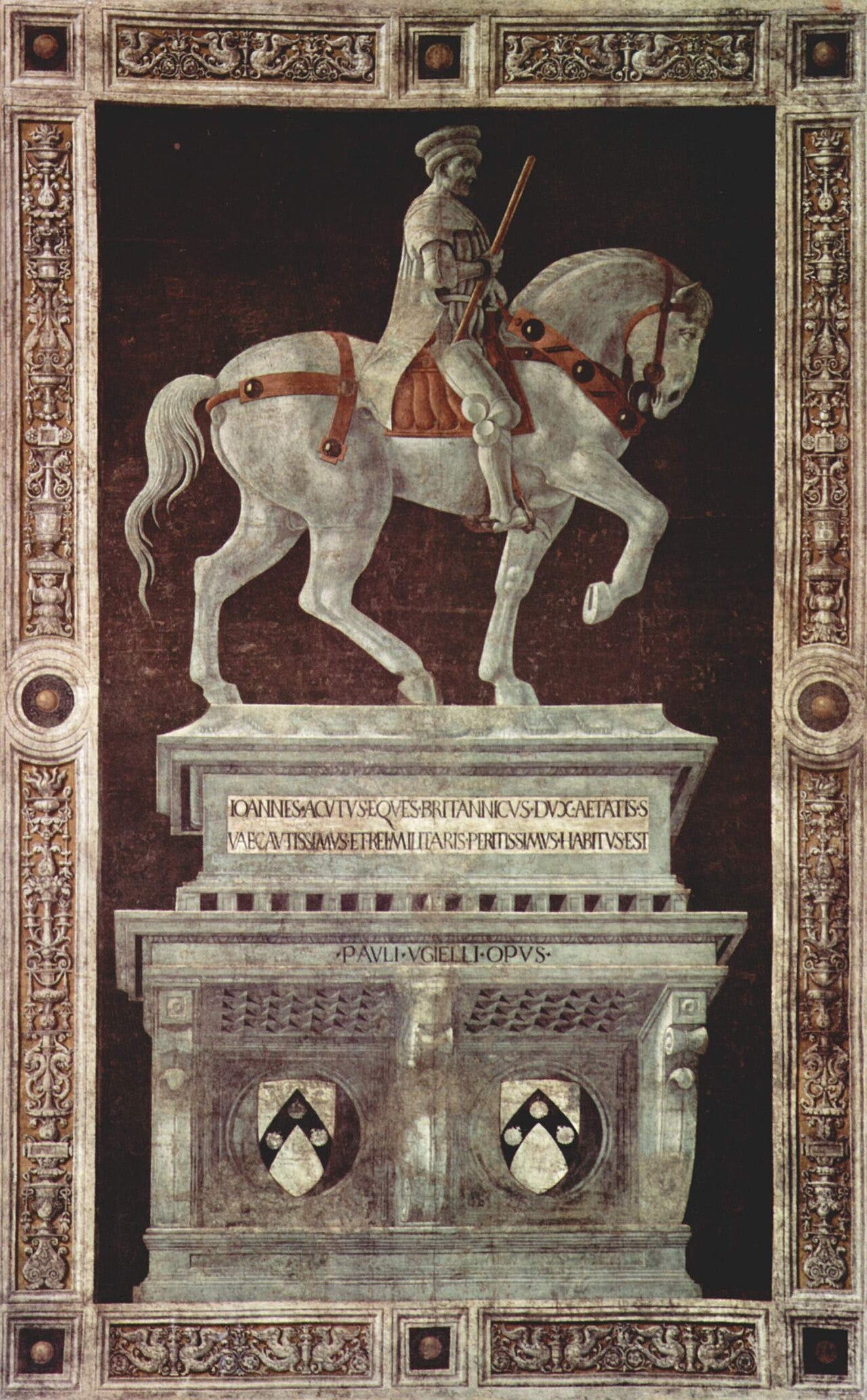
In 1436 Paolo painted one of the strangest tributes in Florence. Inside the cathedral he made a giant fresco of Sir John Hawkwood, an English mercenary the Italians called Giovanni Acuto.
Hawkwood had led Florentine armies in the late 1300s. The city had promised him a real tomb monument in stone. Instead, decades after his death, it gave him a painting that pretends to be one.
Paolo painted the soldier on horseback in flat green tones, mounted on a fake marble base, using one point perspective so the whole thing reads as a carved statue set high on the wall. It was a clever, cheap solution. A monument in paint.
One battle, three museums
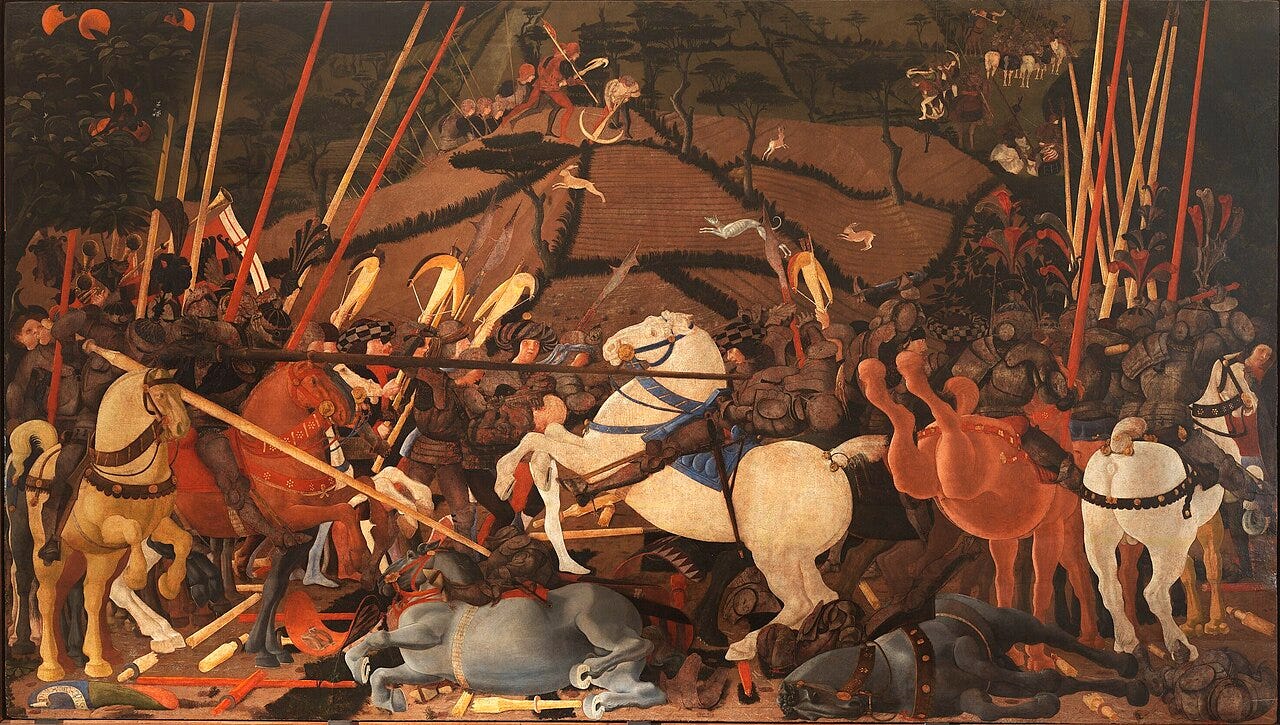
Paolo's best known work is a set of three long panels showing the Battle of San Romano, a Florentine victory over Siena. Today the three pieces are split between three cities: London, Florence and Paris.
Here is the myth worth correcting. People often say Paolo painted them for the Medici. He did not.
The National Gallery and the Uffizi agree the panels were commissioned around 1435 to 1440 by a wealthy Florentine, Lionardo Bartolini Salimbeni, for his own palace.
Only later did Lorenzo de Medici want them, and around 1484 his people took the panels from the Bartolini house and moved them into the Medici palace.
The Medici got the glory. They did not order the work.
The dark little predella in Urbino
Late in life Paolo took a job far from home. Between 1467 and 1468 he was in Urbino, painting a predella, the strip of small scenes that runs along the base of an altarpiece.
It is called the Miracle of the Desecrated Host, and it hangs today in the Galleria Nazionale delle Marche in Urbino. Six panels tell a grim medieval legend about a stolen communion wafer.
The story is an old antisemitic tale, the kind the Church spread at the time, and museums now present it with that warning. What draws the eye is the staging.
Paolo builds each scene as a shallow, tiled box, with figures placed like chess pieces. Even a cruel story became, for him, a problem of space.
A night hunt for a bedroom wall
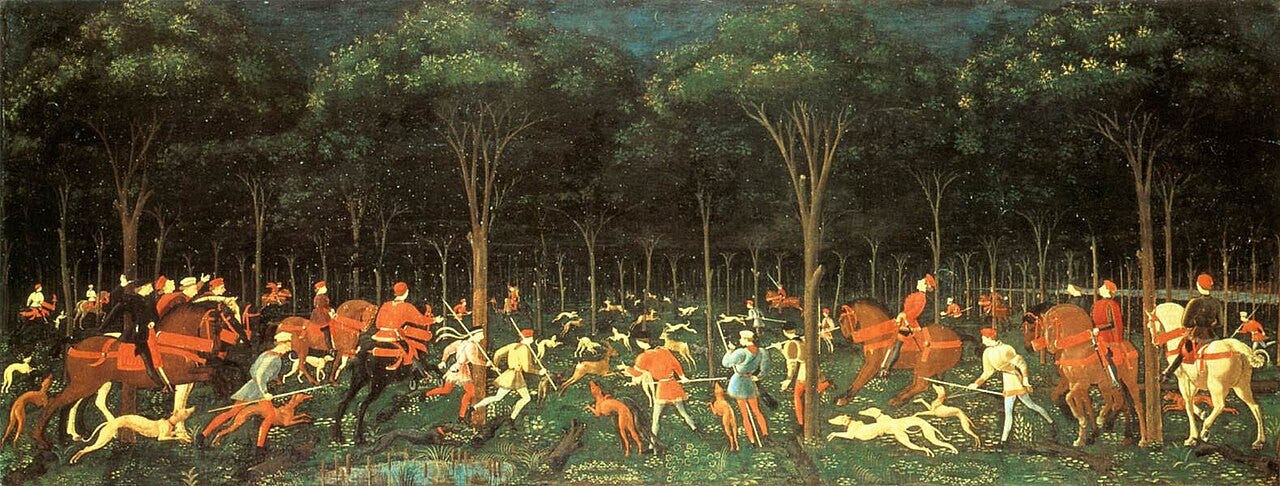
One of Paolo's last paintings is also his most magical. The Hunt in the Forest, in the Ashmolean Museum in Oxford, dates to about 1465 to 1470.
It is long and low, made to sit at shoulder height in the panelling of a rich person's room. Hunters, dogs and deer race into a dark wood at night.
The Ashmolean points out the trick hidden inside it. Paolo drew a grid across the panel and set a single vanishing point deep among the trees, so every spear, log and running figure funnels your eye toward that one spot.
Flecks of gold in the leaves would have caught candlelight. A hunt you were meant to watch by flame.
The hat that turned into a puzzle
Paolo was obsessed with one odd object: the mazzocchio. It was a ring shaped hat frame, worn under the draped hoods of the day, and it looks like a fat doughnut of wood or wicker.
For most painters it was just headgear. You can spot one on the commander's head in the London Battle of San Romano.
For Paolo it was a laboratory. He drew the mazzocchio as a see through cage of dozens of facets, turning a hat into a study of how curved things sit in space.
Surviving perspective drawings linked to him, kept in Florence, are the proof. Vasari said he was intoxicated by this kind of work.
Old, ailing and out of work
The last glimpse of Paolo is a sad one, in his own words. In a Florence tax return filed in August 1469, he described himself as old, unable to work, with an ailing wife and little to live on.
Some historians think he laid it on thickly to lower his tax bill. Records show he was still taking on painted panels as late as 1474, working from his house rather than a full workshop.
Either way, the great years were behind him. He had outlived the fashion for his bright, patterned style. Paolo Uccello died in Florence on 10 December 1475, aged about 78.
He left little money, and a way of seeing that Piero della Francesca, Leonardo and Durer would later build on.
What readers want to know about Uccello
What is Paolo Uccello famous for?
The Battle of San Romano and his obsessive, almost scientific use of perspective.
Why is his work so geometric?
He treated perspective as a passion, arranging figures and objects into careful spatial grids.
Where are the Battle panels?
The three panels are now split between London, Florence and Paris.
When did he die?
In 1475, in Florence, reportedly poor and half forgotten.
More secrets to unlock


Why the obsessive endures
Uccello died neglected, but modern eyes love exactly what his own age found odd: the dreamlike rigidity, the toy horses, the war turned into pure pattern. The twentieth century, raised on abstraction, finally caught up with him.
One last detail. His three Battle of San Romano panels were seized for the Medici, then scattered across Europe, so seeing the full work today means visits to three countries. The geometry obsessive ended up a puzzle spread across the map.