
Giovanni Bellini was the father of Venetian Renaissance painting. Over a very long career he taught Venice to paint with warm, glowing oil colour and soft natural light, replacing stiff gold backgrounds with serene Madonnas set in real landscapes.
Almost every great Venetian who followed learned from him. Born around 1430 and still painting in his eighties, he ran the leading workshop in Venice for over half a century, and both Titian and Giorgione came up through it.
Two of his pupils were Titian and Giorgione, which makes him the root of the whole Venetian tradition.
Born: Venice, around 1430
Known for: luminous oil colour, serene Madonnas, the Venetian school
Died: Venice, 1516
More incredible painter stories
If Giovanni Bellini pulled you in, you will love these too:


Giovanni Bellini at a glance
1430. Born around this year into the Bellini workshop family in Venice.
1453. His sister Nicolosia married Mantegna, tying two great workshops together.
1479. His brother Gentile left to paint the Sultan in Constantinople. Giovanni took over the Doge’s Palace commissions.
1506. Dürer wrote from Venice that Bellini, though very old, was still the best in painting.
1516. Died in Venice, having taught both Giorgione and Titian.
The man who lit up Venice
Bellini embraced oil paint as it arrived in Venice and used its glazes to make light seem to come from inside the picture. His skies soften, his colours deepen, and his holy figures sit in calm, believable air. See what is oil painting.
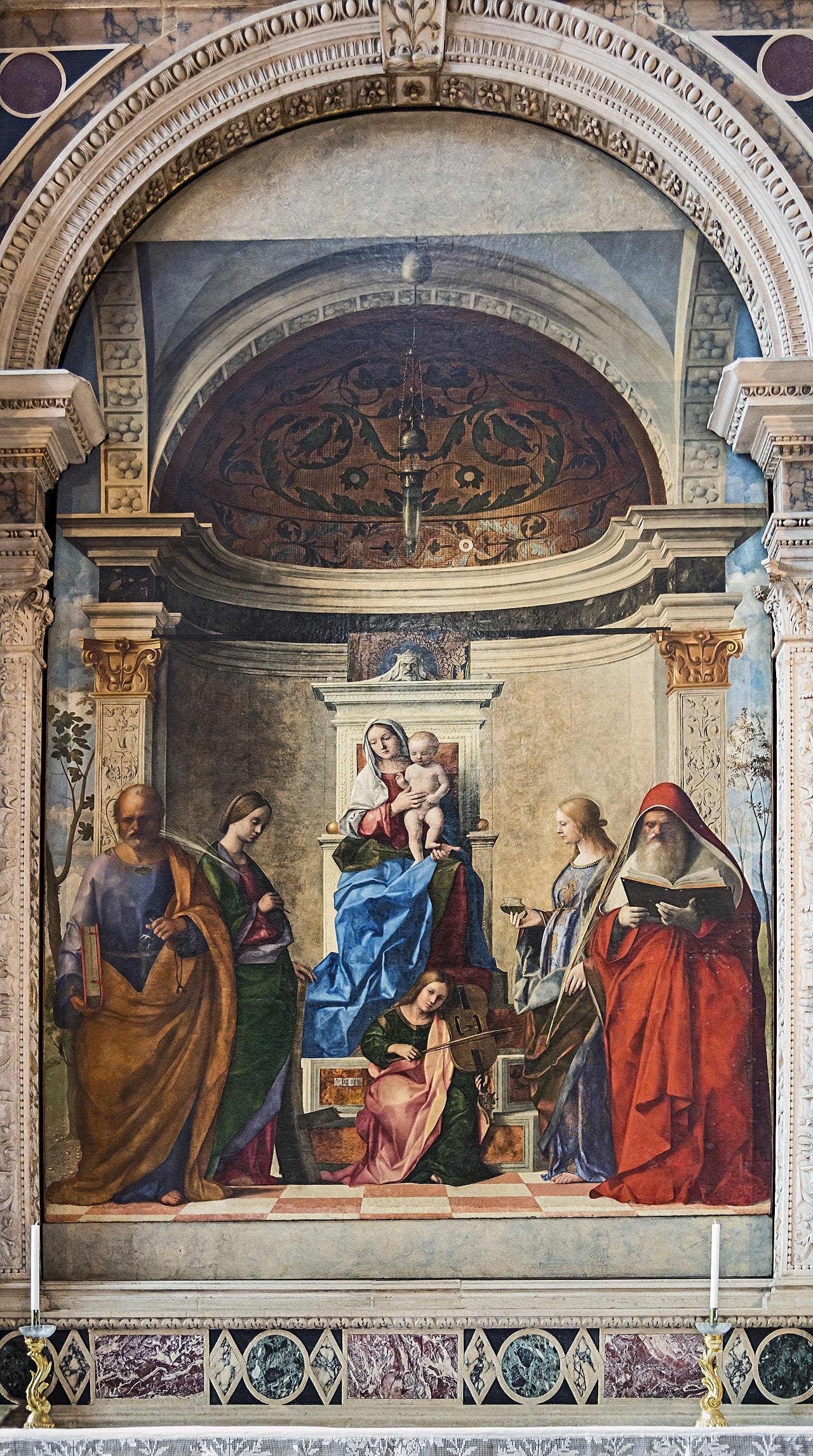
His altarpieces, like the San Zaccaria Altarpiece, place the Virgin and saints in a painted chapel so gently lit it feels continuous with the church around it.
A family business and a famous in law
The Bellini were a painting dynasty. His father Jacopo and brother Gentile were painters too, and his sister married Andrea Mantegna, the hard edged genius of Padua.
You can watch the families trade ideas: Mantegna's stony precision meeting Bellini's soft Venetian warmth, two ways of seeing in one extended family.
Old, and still the best
Bellini kept working and updating his style into his eighties, absorbing what his own students invented. When the German master Albrecht Dürer visited Venice, he reported that Bellini, though very old, was still the finest painter in the city.
Late works like The Feast of the Gods show him still learning, painting mythology with a freshness that fed straight into Titian. See what is iconography.
The quiet invention behind the altarpieces
Bellini perfected a calm new format, the sacred conversation, in which the Virgin and saints share one believable space instead of separate gold panels. It made holy figures feel like a gathering you could join.
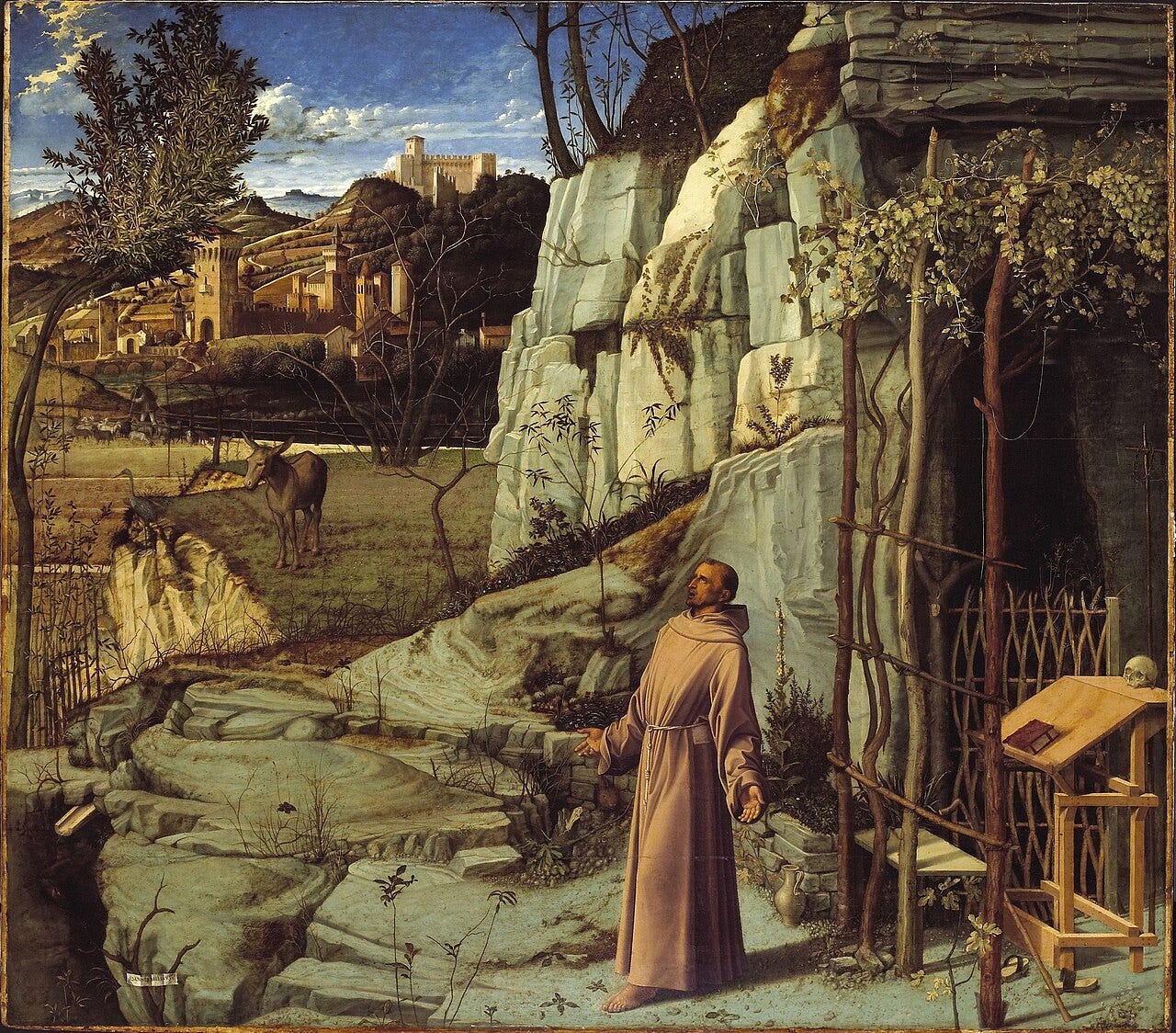
He also let real landscape flood in behind them, dawn light on distant hills, a road, a far off town. Devotion set in the open world, an idea his Venetian heirs never let go.
The workshop that began with a sketchbook
The Bellinis were a painting family before Giovanni was born. His father, Jacopo Bellini, ran a busy Venetian workshop and filled two books of drawings with careful studies of buildings, landscapes and Bible scenes.
Those pages were a private library of ideas. When Giovanni painted his early Agony in the Garden, around 1458 to 1460, he leaned on one of Jacopo's drawings for the strange altar like rock that Christ kneels on.
So Giovanni did not start from nothing. He inherited a method, a set of compositions and a shop full of assistants. Later his own studio grew so large that it turned out small Virgin and Child pictures for Venetian homes by the dozen.
Gentile, the brother sent to the Sultan
For much of their lives, Giovanni's older brother Gentile was the more famous Bellini. Gentile held a top job in Venice, painting the official history canvases inside the Doge's Palace.
In 1479 Venice sent Gentile on an unusual mission. He sailed to Constantinople to work at the court of the Ottoman Sultan Mehmed II, who had asked Venice for a good portrait painter.
Gentile painted the Sultan from life, and that portrait is now in the National Gallery in London.
It tells you how these brothers worked. One brother travelled and handled the grand public commissions, while Giovanni stayed in Venice, quietly reshaping the way the city painted saints, landscapes and light.
Two gardens, two brothers in law
Andrea Mantegna married Giovanni's sister Nicolosia, which tied the two artists together for life. Mantegna worked near Venice in Padua, and his hard, sculptural style hit Giovanni like a challenge.
You can see the conversation between them in one room of the National Gallery in London. Both men painted The Agony in the Garden, and the pictures hang close together.
Mantegna carves his rocks and drapery as if with a chisel, sharp and stony. Giovanni copies some of that hardness, then softens everything with a peach coloured dawn that spreads across the whole scene.
He took Mantegna's precision and traded its coldness for warmth and open sky.
When Bellini turned to oil, and a myth to drop
Here is a story you will hear often. In 1475 the Sicilian painter Antonello da Messina arrived in Venice, and supposedly taught Bellini how to paint in oil.
It makes a neat tale, and it is not true. Records show Bellini was already working with oil in the 1460s, before Antonello ever reached the city.
What is fair to say is that Antonello's visit, around 1475 and 1476, helped push oil painting deeper into Venetian practice. Oil suited Bellini perfectly.
The slow drying paint let him blend one tone into the next, so flesh, cloth and evening light seem to breathe rather than snap into place.
Colorito, the Venetian way of seeing
Florentine painters built their pictures on drawing, on firm outlines and worked out anatomy. Venice went a different way, and Bellini set the tone for it.
The Venetian approach is often called colorito. It means letting colour and graded light do the work of describing a form, rather than a hard drawn edge.
Bellini watched how real light behaves. In his Madonna of the Meadow the clouds shift from thin and wispy to fat and heavy, and the whole landscape feels like one particular morning.
That sensitivity passed straight from Bellini to Giorgione and Titian, and shaped Venetian painting for the next hundred years.
Three altarpieces that changed Venetian churches
Bellini perfected a calm arrangement known as the sacra conversazione, meaning holy conversation, where the Virgin and saints share one quiet space instead of separate panels.
The Frari Triptych, signed and dated 1488, sits in the church of Santa Maria Gloriosa dei Frari in Venice. Commissioned by the Pesaro family, it frames the Virgin in painted architecture that matches the real frame around it.
The San Giobbe Altarpiece, painted in the 1480s and now in the Gallerie dell'Accademia, does the same on a grand scale. Then came the San Zaccaria Altarpiece of 1505, still in its Venetian church, an enthroned Madonna with four saints in soft, even light.
The doge who will not meet your eye
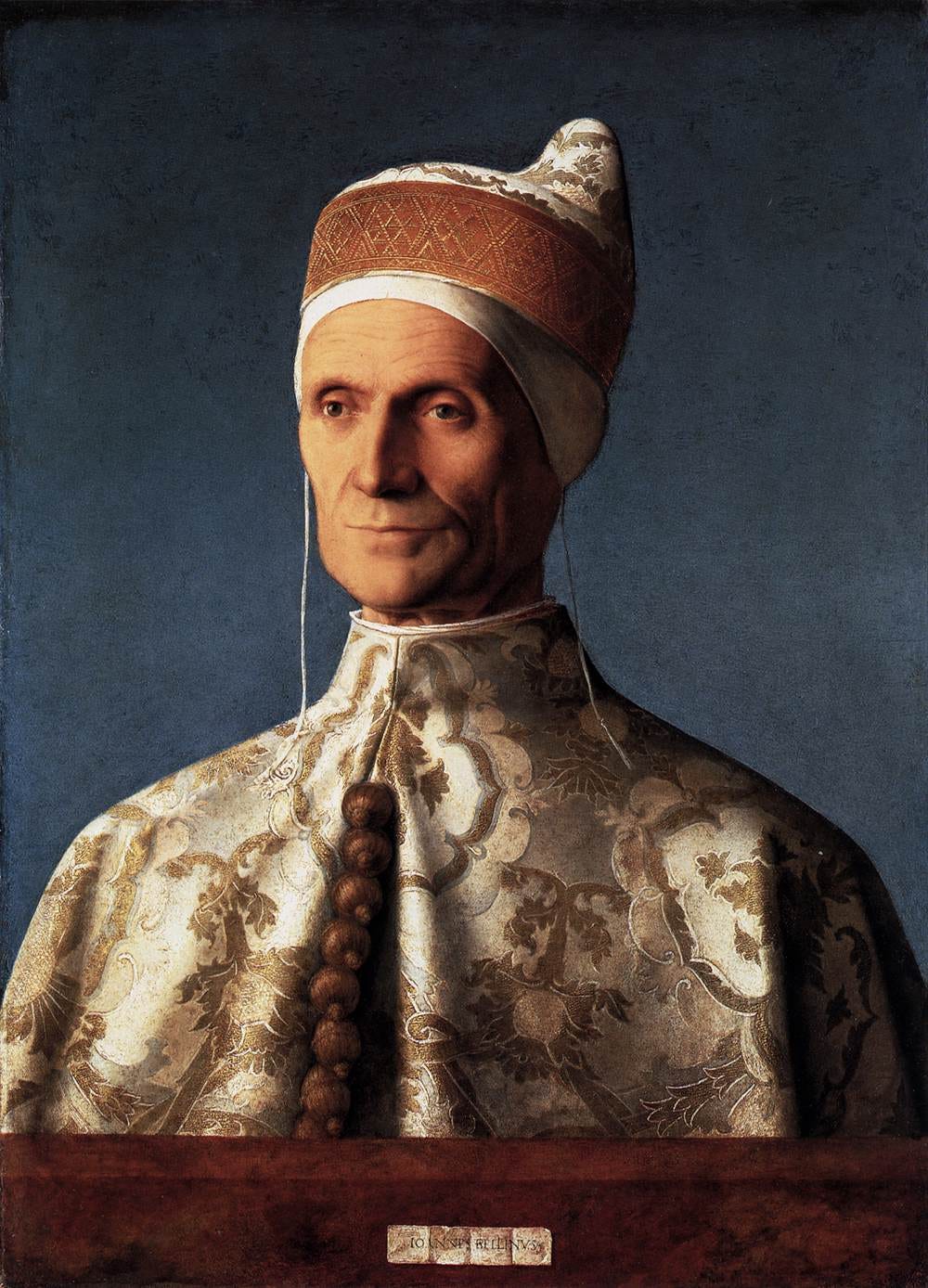
Around 1501 to 1502 Bellini painted the new ruler of Venice, Doge Leonardo Loredan, who had been elected in 1501 and would govern until his death in 1521.
The portrait, now in the National Gallery in London, is oil on poplar and signed by the artist. Loredan wears white silk damask woven with gold and silver thread, the robes kept for the greatest state occasions.
He knows you are looking, yet he does not look back. His gaze slides just past you. The armless, chest high pose recalls the marble busts of Roman emperors, but Bellini gives the doge skin that looks warm and alive above his cold, glittering robe.
The feast that a younger man finished
Late in life Bellini took on something rare for him, a scene of Greek and Roman gods rather than Christian saints. The picture is The Feast of the Gods, and he signed and dated it 1514.
It was ordered by Alfonso d'Este, Duke of Ferrara, for a private study lined with art. The subject comes from the Roman poet Ovid.
Bellini died two years later, in 1516, and the painting stayed in the duke's collection. To match newer works around it, the young Titian later reworked the landscape in the background.
Today it hangs in the National Gallery of Art in Washington, carrying two hands, the old master's and his brilliant successor's.
Painter to the Venetian Republic
Bellini did not just work in Venice. For a long stretch he was the official painter of the Republic, trusted with its most public art.
His biggest task was the series of history canvases in the Great Council Hall of the Doge's Palace, the room where Venice governed itself. He and Gentile spent years on these giant scenes.
Then came a cruel loss. A fire tore through the palace in 1577, and those Bellini canvases were destroyed. We know them only from descriptions. His standing was no secret even to foreigners, as one German visitor would soon record.
The old man who taught Giorgione and Titian
Bellini kept painting into his eighties, and he kept learning. That openness is why the next generation of Venice grew up inside his workshop.
Two of his pupils changed art history. Giorgione and Titian both trained with Bellini, absorbed his feeling for colour and soft light, and then carried Venetian painting to new heights.
Visiting Venice in 1506, the German artist Albrecht Dürer wrote home that Bellini was very old, and still the best painter of them all.
He worked on until his death in 1516. The father gave Venice a workshop. Giovanni gave it a way of seeing light and colour that ran on for generations.
The Giovanni Bellini questions that keep coming up
Why is Giovanni Bellini important? He turned Venetian painting from line to light: the soft color and atmosphere he perfected, colorito, became the Venetian way of seeing, inherited directly by his pupils Giorgione and Titian.
What did Dürer say about Bellini? Visiting Venice in 1506, Dürer wrote home that Bellini was very old and still the best painter in the city, the most quoted compliment in Renaissance art.
Did Bellini teach Titian? Yes. Both Giorgione and Titian passed through his workshop, and Titian finished Bellini's last great canvas, The Feast of the Gods, after his death in 1516.
What is Bellini's most famous painting? The San Zaccaria altarpiece of 1505, still on the altar it was painted for in Venice, and the Doge Leonardo Loredan portrait in the National Gallery in London.
Is the Bellini cocktail named after him? Yes. Giuseppe Cipriani invented it at Harry's Bar in Venice in 1948 and named it for the pink glow of a robe in a Bellini painting.
Where can I see Bellini? Venice above all: San Zaccaria, the Frari triptych, and the Accademia. Then the National Gallery in London for Loredan and Washington for The Feast of the Gods.
More secrets to unlock


What Venice kept from Bellini
Pull Bellini out of the story and Venetian art loses its foundation. The glowing colour we call Venetian, the warmth later poured into Titian and Veronese, starts with the patient old master who painted Madonnas for sixty years.
One last detail. He also painted one of the great portraits of power, the Doge Leonardo Loredan of about 1501, now in the National Gallery in London. The doge gazes out in his gleaming robe of state with a calm that has outlasted the whole Venetian Republic.