
Painters worked out how to make a building look haunted long before cinema did, and they used four tricks: an empty window, a light source you cannot locate, a door left open, and a scale that puts you below the house looking up.
Four tricks, listed
One American painter made a career out of houses that stare back, and Hitchcock borrowed one for Psycho.
Gothic novels arrived in 1764, and painting followed within a generation.
An empty window is scarier than a ghost in the window, and painters knew it.
Ruined abbeys were painted so often that they became a genre with a name.
One painter sat in an asylum garden painting the building he could not leave.
Learn art the fun way
1 | The House by the Railroad, Edward Hopper (1925)
A tall wooden house cut off at the base by a railway line, painted from below, with nothing around it. Every window is a different shade of black.
It hangs at MoMA and fed the design of the Bates house in Psycho. More on him in Edward Hopper.
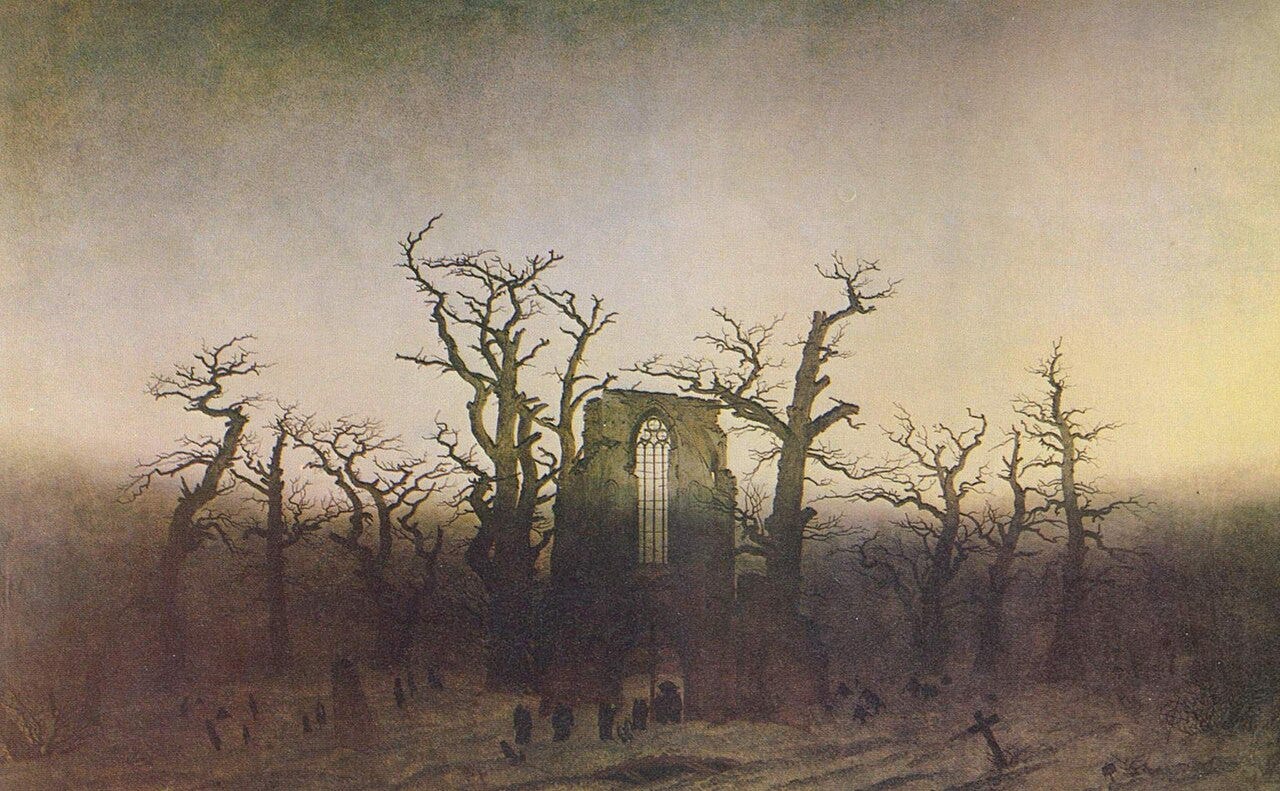
2 | The Abbey in the Oakwood, Caspar David Friedrich (1809 to 1810)
A ruined church in fog, dead oaks, and a line of monks carrying a coffin so small you almost miss them. There is no horizon to hold on to.
More on him in Caspar David Friedrich.
Friedrich showed it at the Berlin Academy in 1810 with Monk by the Sea, and Frederick William III bought the pair on the advice of the fifteen year old crown prince. The ruin is Eldena, near Greifswald.
3 | The Nightmare, Henry Fuseli (1781)
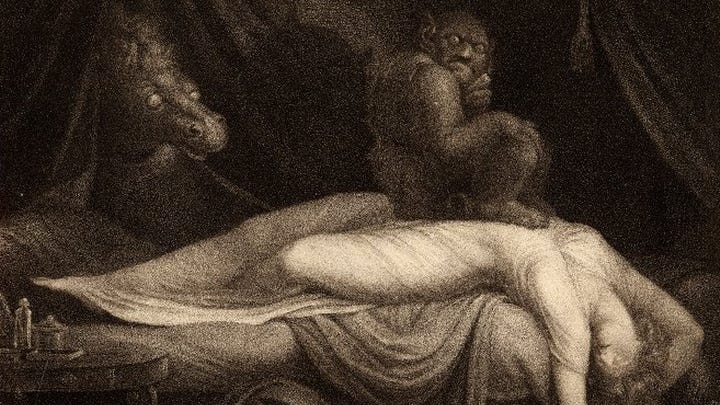
Not a house but a bedroom, which is the same idea indoors: a sleeping woman, a demon on her chest, and a horse’s head coming through the curtain.
More in nightmares in painting, and on him in Henry Fuseli.
Fuseli exhibited it at the Royal Academy in 1782 and it made his name. He painted at least four versions, and a print of it hung in Freud’s apartment in Vienna.
4 | Piranesi and the imaginary prison
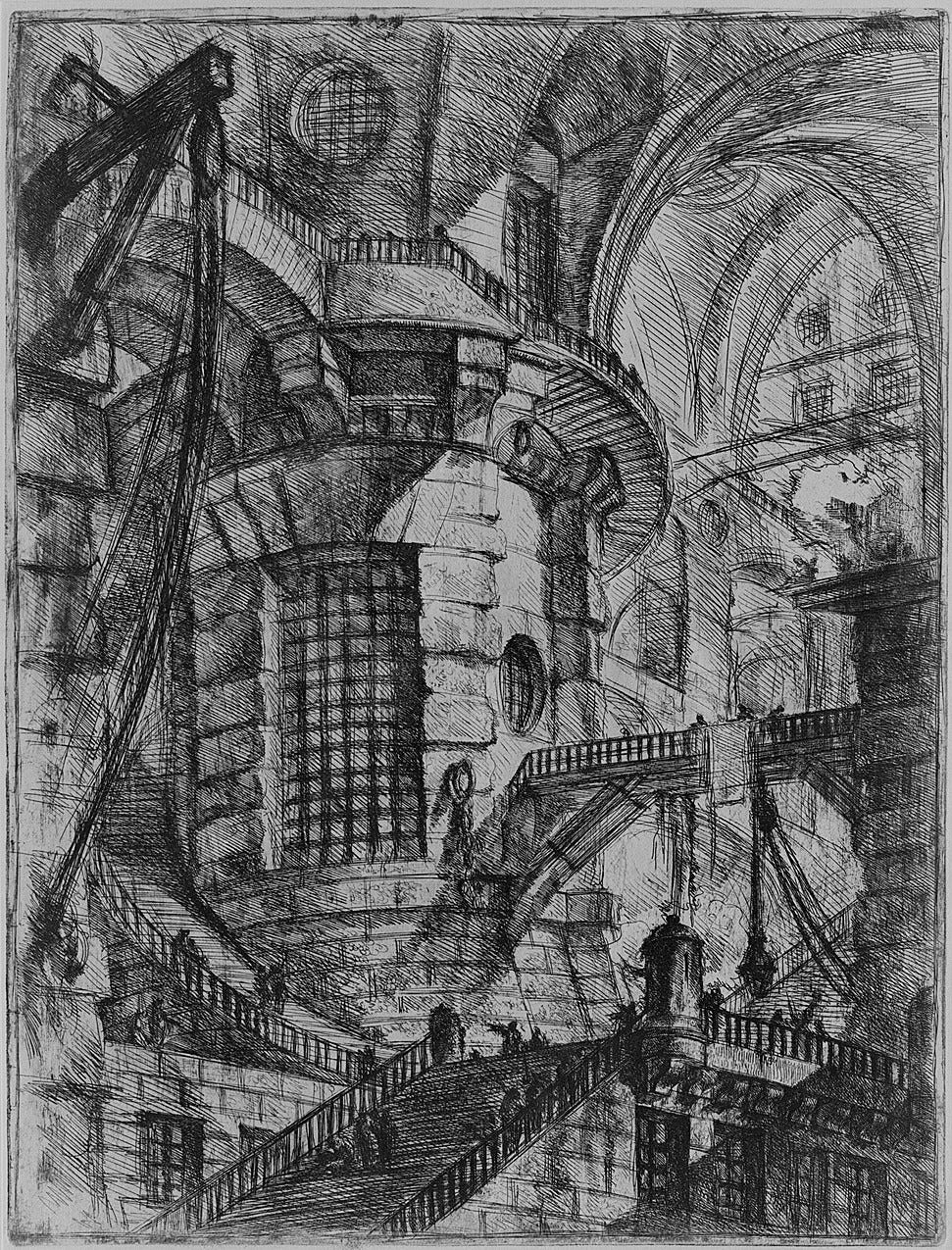
The Carceri etchings of the 1740s and 1750s show vast interiors with staircases that go nowhere and machinery with no purpose. Nobody is being tortured. That is the point.
The technique is in what is etching.
The first Carceri appeared around 1749 and were reissued around 1761 with the shadows deepened and the architecture made more oppressive. Coleridge and De Quincey both wrote about them as opium visions.
5 | The ruin as a genre
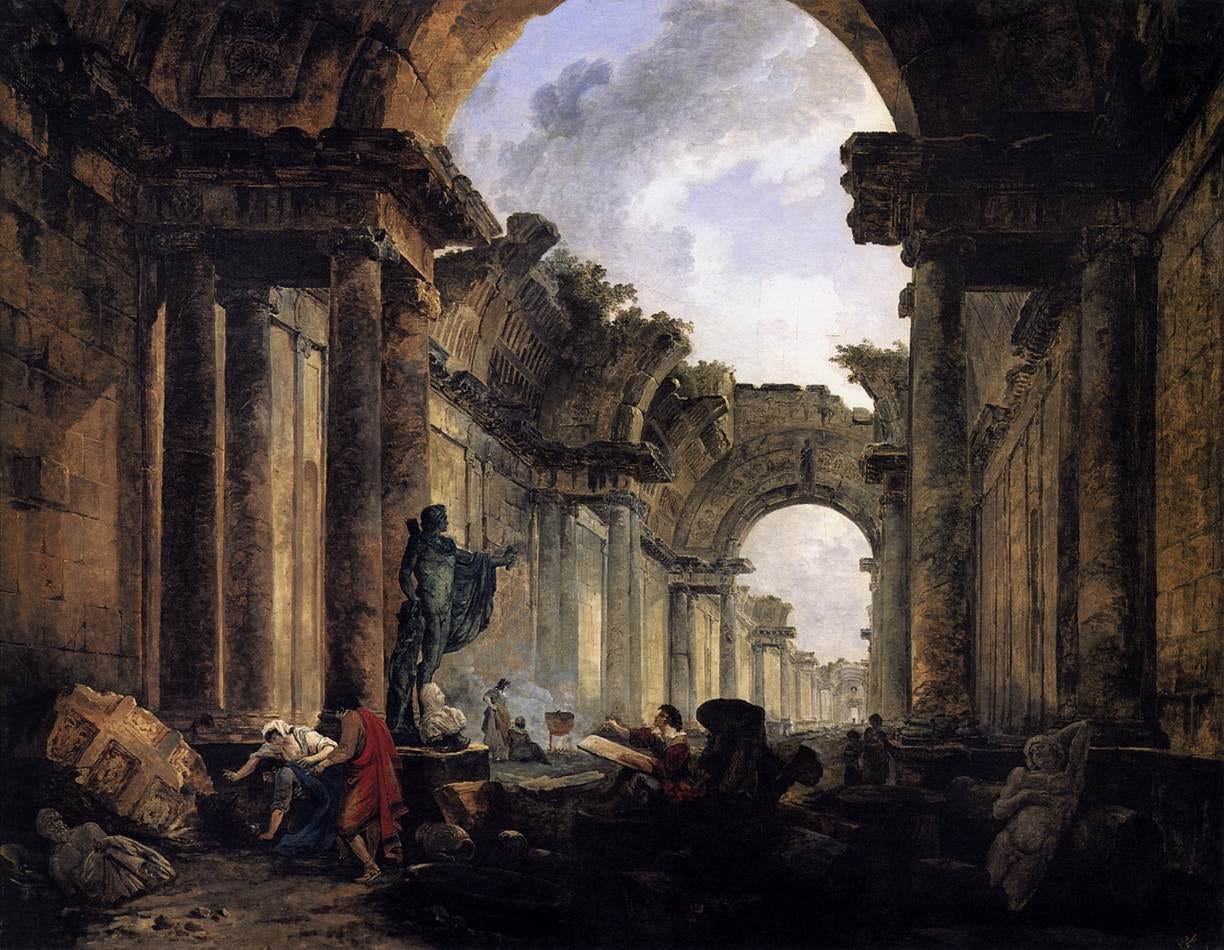
Eighteenth century painters produced ruins to order, and some patrons had fake ruins built in their gardens to match the paintings.
Hubert Robert even painted the Louvre as a ruin while working inside it. More in what is a capriccio.
Hubert Robert was nicknamed Robert des Ruines. He painted the Grande Galerie of the Louvre as a ruin in 1796 while employed as one of the museum’s first curators.
6 | The empty window
A ghost at a window tells you where to look. A black window tells you nothing, so you keep looking. Hopper, Friedrich and Magritte all use the second.
More on him in Rene Magritte.
Hopper said he was after the loneliness of a city, not a story, and refused to explain his pictures. The unlit window works because the eye keeps returning to it looking for something.
7 | The Empire of Light, Rene Magritte (from 1949)
A house at night under a daylight sky. Nothing is wrong in either half, and the wrongness only appears when you notice both at once.
He painted around seventeen versions of it.
Magritte began the subject in 1949 and returned to it until his death in 1967, producing around seventeen oils and a further ten gouaches. He said the idea came to him as a simple contradiction, night below and day above.
8 | Van Gogh and the asylum
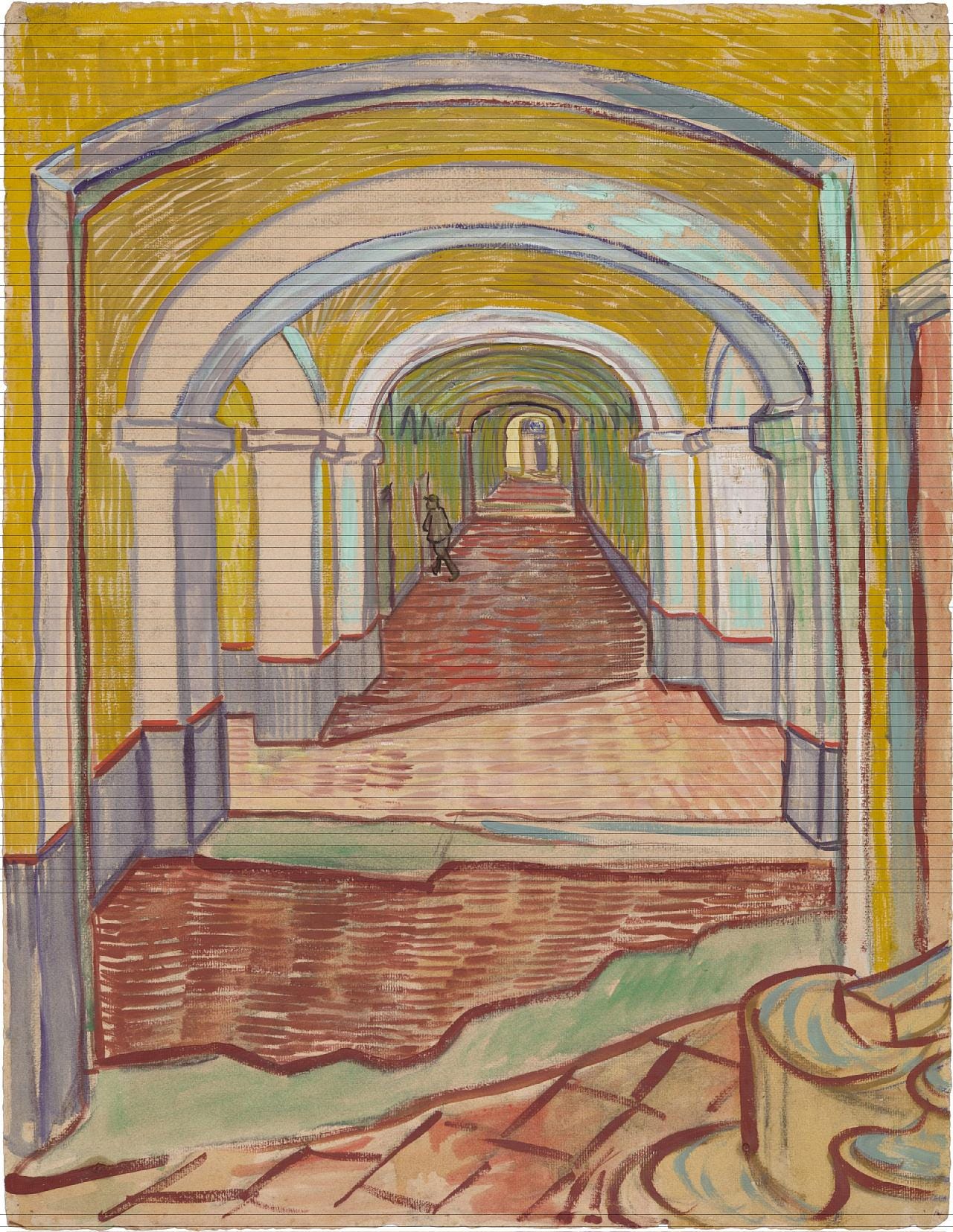
At Saint Remy he painted the corridor and the garden of the institution he was living inside, in perspective lines that lean.
More on him in Vincent van Gogh.
What actually happened in those last weeks is not the story most people tell. I set it out in the last day of Vincent van Gogh.
9 | The haunted castle in Symbolism
Around 1900 painters replaced the ghost with weather. A tower in mist, a lit window seen across water, a garden going back to wilderness.
More on that world in what is symbolism in art.
10 | Interiors that feel watched
Dutch painters put a door ajar at the back of a room, showing a second space with someone in it. Two hundred years later Hammershoi did the same with nobody there.
The trick is the same: a room you can see into but not enter.
11 | Charles Addams and the American Gothic house
The cartoon Addams house of 1938 is a caricature of the Second Empire style Hopper painted, and it fixed the shape of the haunted house for everyone since.
The mansard roof does most of the work.
12 | Why an empty house frightens us
A house is built for people, so a house without them reads as a person missing. The painter does not need a ghost. The absence is the ghost.
Cover the windows of any of these and most of the fear goes.
Haunted houses: the questions I get most
Did Hopper inspire the Psycho house? The House by the Railroad of 1925 is widely cited as a source for the Bates house design, and it hangs at MoMA.
What are Piranesi’s Carceri? A set of etchings of imaginary prisons made from the 1740s, with impossible staircases and no visible prisoners.
Why did painters paint ruins? Ruins sold. They carried ideas of time, decline and mortality, and some patrons built artificial ruins to match.
What is The Empire of Light? A Magritte subject begun in 1949, a night house under a daytime sky, painted in around seventeen versions.
Where is The House by the Railroad today? MoMA for Hopper, the Alte Nationalgalerie in Berlin for Friedrich, the Detroit Institute of Arts for Fuseli.
Count the light sources. In almost every painting on this page there is one more source of light than there is a reason for, and that single unexplained glow is what makes the building feel occupied.
For the rest, go to the Met and the Rijksmuseum.