
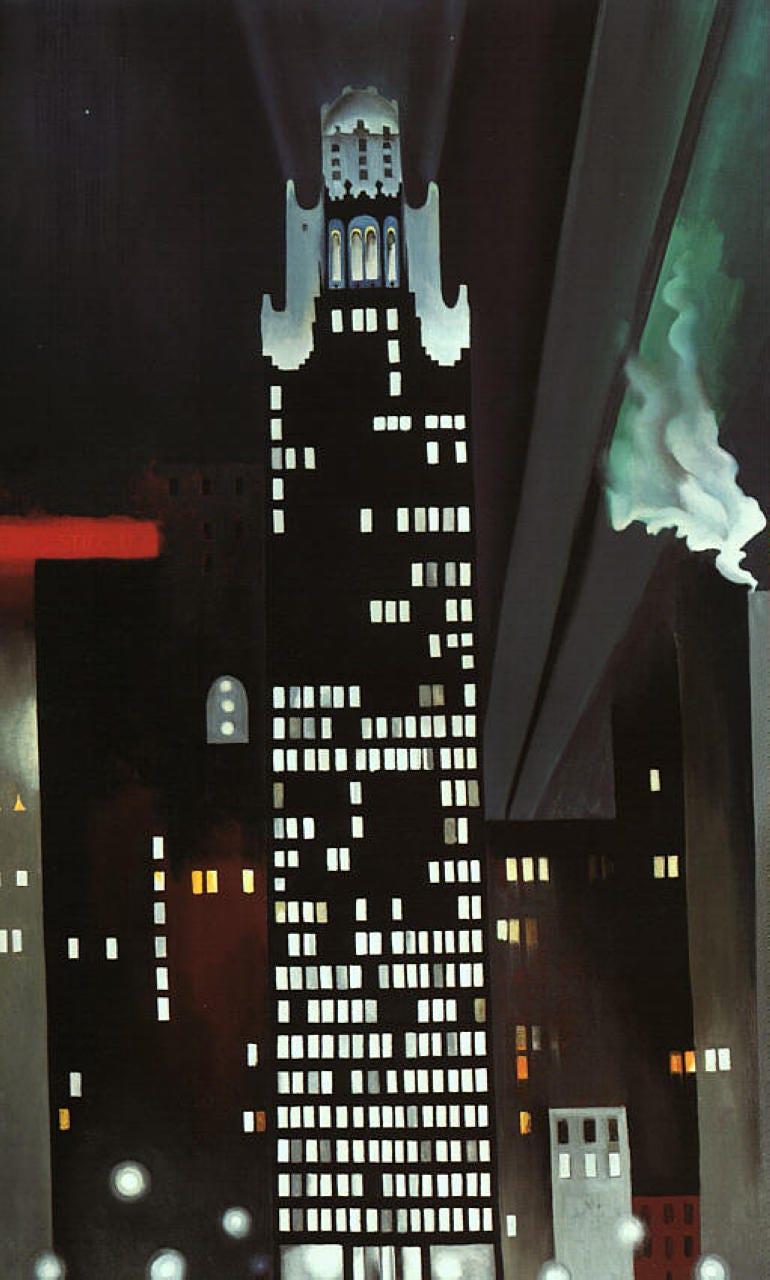
Georgia O'Keeffe (1887 to 1986) was an American painter famous for giant flowers, New York skyscrapers and bleached desert bones, and one of the most surprising things about her is that the line said to have launched her career, "At last, a woman on paper," may not date from 1916 at all.
She lived to 98, long enough to watch a legend grow up around her, and when it came to her flowers and her bones she argued with it in print.
Cool Stories About Art is a newsletter to learn art the fun way.
Join 200,000+ readers and get:
10 new art stories / month
The entire archive of content (1,000+ articles)
Comment, ask questions, and chat with other readers
The legend of her discovery has a perfect opening scene. A friend carries a roll of charcoal drawings to a small gallery in New York, a famous photographer unrolls them, and he says, "At last, a woman on paper." The Metropolitan Museum's biography of her tells it that way.
The Georgia O'Keeffe Museum went back to the paper trail and found a problem. The friend, Anita Pollitzer, wrote to O'Keeffe on December 31, 1915, and her letter calls the drawings "genuinely fine things." The famous words are not in it. A similar phrase, "Finally, a Woman on Paper," appears in pencil between the lines of her ink, and the museum's essay concludes that Pollitzer most likely added it in 1946 or shortly after.
What the photographer, Alfred Stieglitz, is on record saying in 1916 is a different sentence.
What You'll Discover
Where the famous line came from.
What she told critics about her flowers.
The car she used as a studio.
What she sent herself from the desert.
Where her biggest painting was made.
What she painted last.