Georgia O'Keeffe: The Complete Story
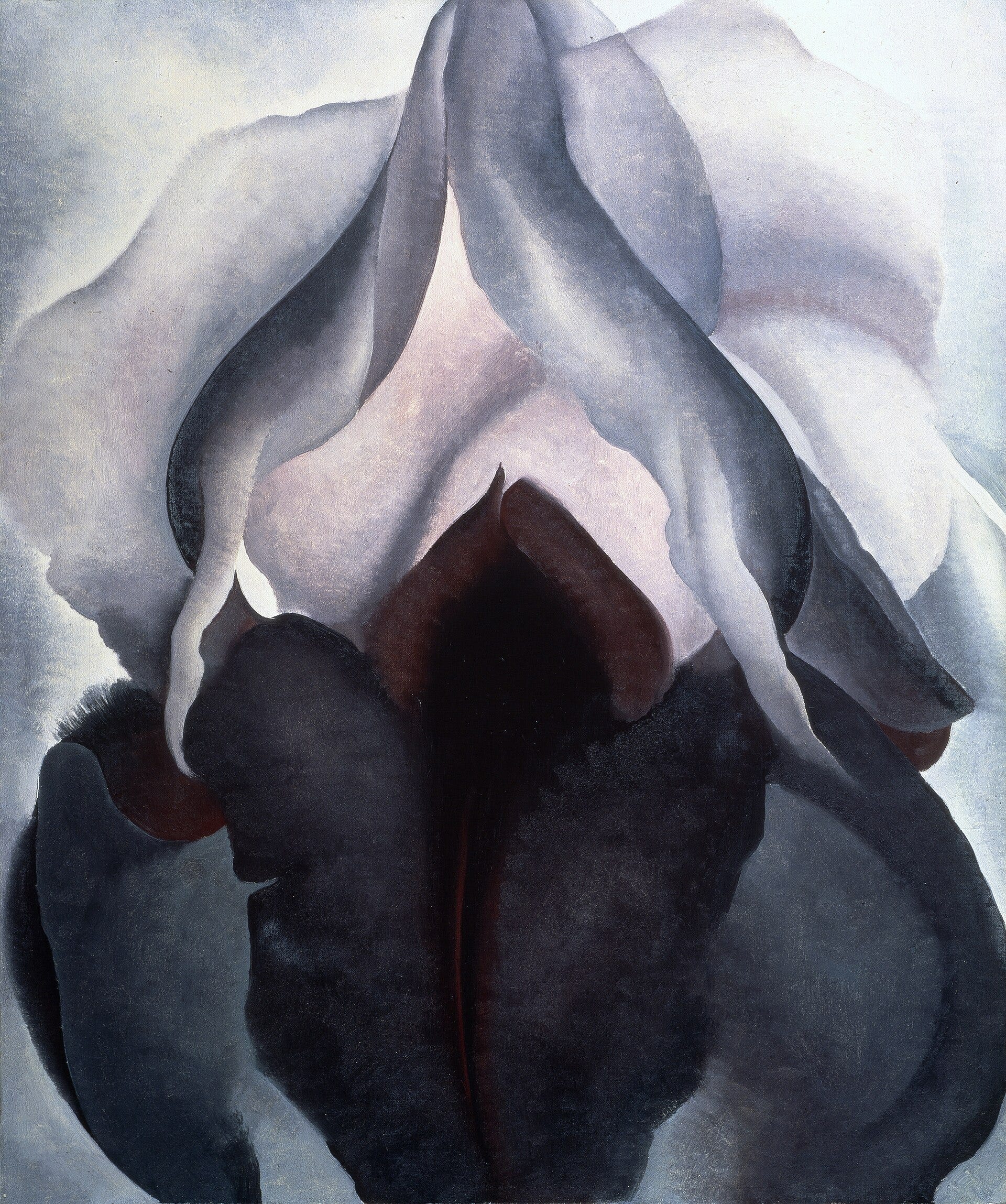
Georgia O'Keeffe's first New York exhibition happened without her permission, the erotic reading of her flowers happened against her explicit denial, and her ashes were scattered on a mountain she claimed God had promised her if she painted it enough. She painted it 28 times.
The story of American modernism's most independent figure is a long argument about who gets to say what her pictures mean. She won it by outliving everyone.
Georgia O'Keeffe at a glance:
1887: born on a Wisconsin dairy farm, second of seven; by ten she has announced she will be an artist.
1915: a friend shows her charcoals to Stieglitz, who exhibits them without asking; the career detonates from there.
1925 to 1929: paints Manhattan's towers from the Shelton Hotel while the men around her call skyscrapers a male subject.
1949: moves to New Mexico for good, splitting the year between Ghost Ranch and the house at Abiquiú.
1986: dies in Santa Fe at 98; her ashes are scattered on Cerro Pedernal, the mountain she painted 28 times.
Charcoals in the mail, 1915
O'Keeffe was born in Sun Prairie, Wisconsin, on November 15, 1887, and was teaching art in Texas when a friend mailed her abstract charcoals to the photographer and dealer Alfred Stieglitz in New York.
His reaction, at last, a woman on paper, became legend; so did what followed, because in 1916 he exhibited them at his gallery 291 without asking her. She marched in to protest; he talked her into the future instead.
Stieglitz, the nudes, and the flower problem
They married in 1924. Stieglitz photographed her more than 300 times, and his 1921 exhibition of the nudes framed her, in public, as an erotic phenomenon before her mature painting was even known.
So when she enlarged petunias and jimson weed to the size of doors from 1924 onward, critics read anatomy into botany, and the reading has stalked the work ever since.
Her answer never changed: the associations were the viewers' own, hung onto her flower, and she found them beside the point.
More incredible painter stories
If Georgia O'Keeffe pulled you in, you will love these too:
New Mexico, half a life
She first summered near Taos in 1929 and returned nearly every year, collecting bones from the desert floor. Cow's Skull: Red, White and Blue came in 1931, the Pelvis series in the 1940s.
She bought the Ghost Ranch house in 1940 and the ruined hacienda at Abiquiu in 1945, moving to New Mexico for good in 1949 after settling Stieglitz's estate following his death in 1946.
In 1965, at 77, she painted Sky Above Clouds IV, seven meters of clouds seen from a plane, now at the Art Institute of Chicago.
The myth she refused
The myth is that O'Keeffe painted female anatomy in floral disguise. She denied it plainly, for sixty years, and the insistence on it, she noted, said more about the writers than the paintings.
The correction restores what she was actually doing: scale as attention, forcing the hurried modern eye to see a flower the way one sees a skyscraper.
When macular degeneration took her central vision in the 1970s she worked in clay and watercolor with assistance until nearly the end.
The mountain, and where to see her
O'Keeffe died in Santa Fe on March 6, 1986, at 98, and her ashes were scattered on the flat-topped Cerro Pedernal she had painted more than two dozen times, joking that God had promised it to her.
In 2014 Jimson Weed/White Flower No. 4 million dollars, then the record for any woman artist at auction. The Georgia O'Keeffe Museum in Santa Fe holds the core, with the Art Institute of Chicago, MoMA, and the Met close behind.
The skyscraper years
Before the desert there was Manhattan: from the Shelton Hotel's upper floors she painted the city at night, the Radiator Building lit like an altar.
The men of the Stieglitz circle considered skyscrapers their subject and said so. She painted a dozen anyway, and they sold.
The city pictures are the hinge of the career: the same appetite for monumental simplicity, aimed up instead of out.
The pelvis and the airplane window
In the 1940s she held pelvis bones against the sky and painted the blue through the socket: the desert's version of a telescope.
Air travel in her seventies delivered the last great subject: Sky Above Clouds IV, a 24-foot runway of clouds, painted in a garage at 77 because no studio wall was long enough.
It now fills a stairwell at the Art Institute of Chicago, too large to travel, which suits a painting about leaving the ground.
Losing sight, not stopping
Macular degeneration took her central vision in the early 1970s. She kept working: clay coiled by hand, watercolors, canvases finished with studio assistance.
Juan Hamilton, a young potter who came for odd jobs in 1973, became assistant, gatekeeper and heir; the will was contested after her death and settled with much of the estate passing to museums.
The Georgia O'Keeffe Museum opened in Santa Fe in 1997, the first American museum devoted to a woman artist.
The Georgia O'Keeffe questions that keep coming up
Do O'Keeffe's flowers mean what people say? She said no, flatly and often: viewers hung their own associations on her flowers. She painted them huge so busy New Yorkers would finally look at one.
Why did O'Keeffe move to New Mexico? The desert light and forms held her from her first Taos summer in 1929. She bought Ghost Ranch in 1940 and Abiquiu in 1945, moving permanently in 1949.
How much is an O'Keeffe worth? Jimson Weed/White Flower No. 1 brought 44.4 million dollars in 2014, a record at the time for any woman artist.
Where can I see O'Keeffe? The Georgia O'Keeffe Museum in Santa Fe, plus the Art Institute of Chicago, MoMA, the Met, and her houses at Abiquiu and Ghost Ranch on tour.
What did she wear? Black and white, plainly cut, decade after decade: a uniform chosen so no morning began with a decision that was not painting. The wardrobe now tours as a museum exhibition of its own.
Did she teach? For a decade before fame: school posts in Texas and South Carolina. The charcoals that reached Stieglitz in 1915 were made by a teacher on evenings and weekends.
More secrets to unlock
Her private mountain kept the deal
She painted Cerro Pedernal at least 28 times and told friends it was her private mountain, promised by God in exchange for the attention. Her ashes have been part of its summit since 1986. The deal, on the evidence, held.