
Jan Steen was the great comedian of the Dutch Golden Age. While Vermeer painted silence, Steen painted noise: rowdy feasts, drunken parents, naughty children and households tipping into glorious chaos.
The jokes are warm, but most hide a wagging finger about how not to live. Born in Leiden around 1626 and working there until his death in 1679, he ran a tavern and a brewery lease, so the drunken feasts he painted were reported from life as much as invented.
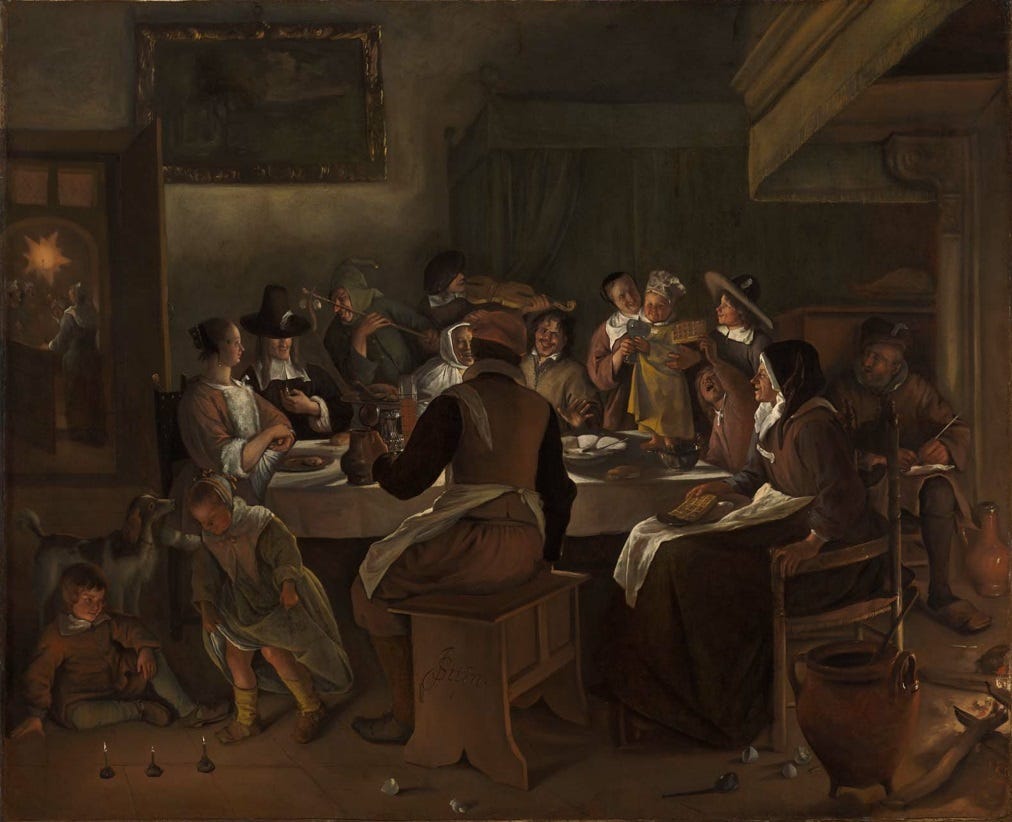
He made such a specialty of mess that the Dutch still call a disorderly home a Jan Steen household.
Born: Leiden, around 1626
Known for: comic household scenes, feasts, moral humour
Died: Leiden, 1679
More incredible painter stories
If Jan Steen pulled you in, you will love these too:


Jan Steen at a glance
1626. Born in Leiden into a family of brewers.
1648. Helped found the Leiden painters’ guild at 22.
1649. Married Margriet, daughter of his teacher, the landscape painter Jan van Goyen.
1654. Leased a brewery in Delft that never prospered.
1679. Died in Leiden, where he had also been licensed to run a tavern in his final years.
The painter of happy chaos
Steen's interiors burst with life. A pancake party gone wild, a feast where everyone has had too much, kids teaching a cat to dance while the adults misbehave. See what is genre painting.
He often slipped his own grinning face into the crowd, laughing along with the disorder he painted. The energy is infectious and deliberately overcooked.
A joke with a lesson
Behind the comedy sits old fashioned moralising: proverbs and warnings acted out in paint, with the painter himself often grinning from the middle of the sinners.
His Feast of Saint Nicholas captures a Dutch Christmas with one child crying over an empty shoe while another gloats. Sweet, funny and pointed all at once.
The tavern keeper who painted
Steen knew rowdy rooms from the inside. He came from a brewing family, ran a tavern, and held a brewery lease, so the drinking and chaos he painted were drawn from daily life.
That firsthand knowledge gives his crowds their convincing buzz. He was reporting from the bar as much as inventing it. See what is oil painting.
The fine painter who chose mess
Steen trained in Leiden, home of the fijnschilders, the fine painters who prized tiny, polished detail. He had the skill to join them and chose noise instead.
He returned again and again to the lovesick girl and the doctor's visit, a running gag about diagnosis and desire. Beneath the slapstick sits a careful craftsman who knew exactly how loose he was being.
Born into a family of Leiden brewers
Jan Steen was born in Leiden around 1626. His full name was Jan Havickszoon Steen.
The family was Catholic and comfortable. His father dealt in grain and brewed beer, and the Steens ran a Leiden tavern across two generations.
Jan was the eldest of a large family, one of eight or more children. He grew up around barrels, banter, and crowded rooms. That was the exact material he would later paint.
Like Rembrandt, he went to the Latin school in Leiden, so he read and wrote well. In 1646 his name appears at the University of Leiden. Few comic painters started from so much schooling, and it shaped the sly, literate wit that runs through his work.
The three men who taught him
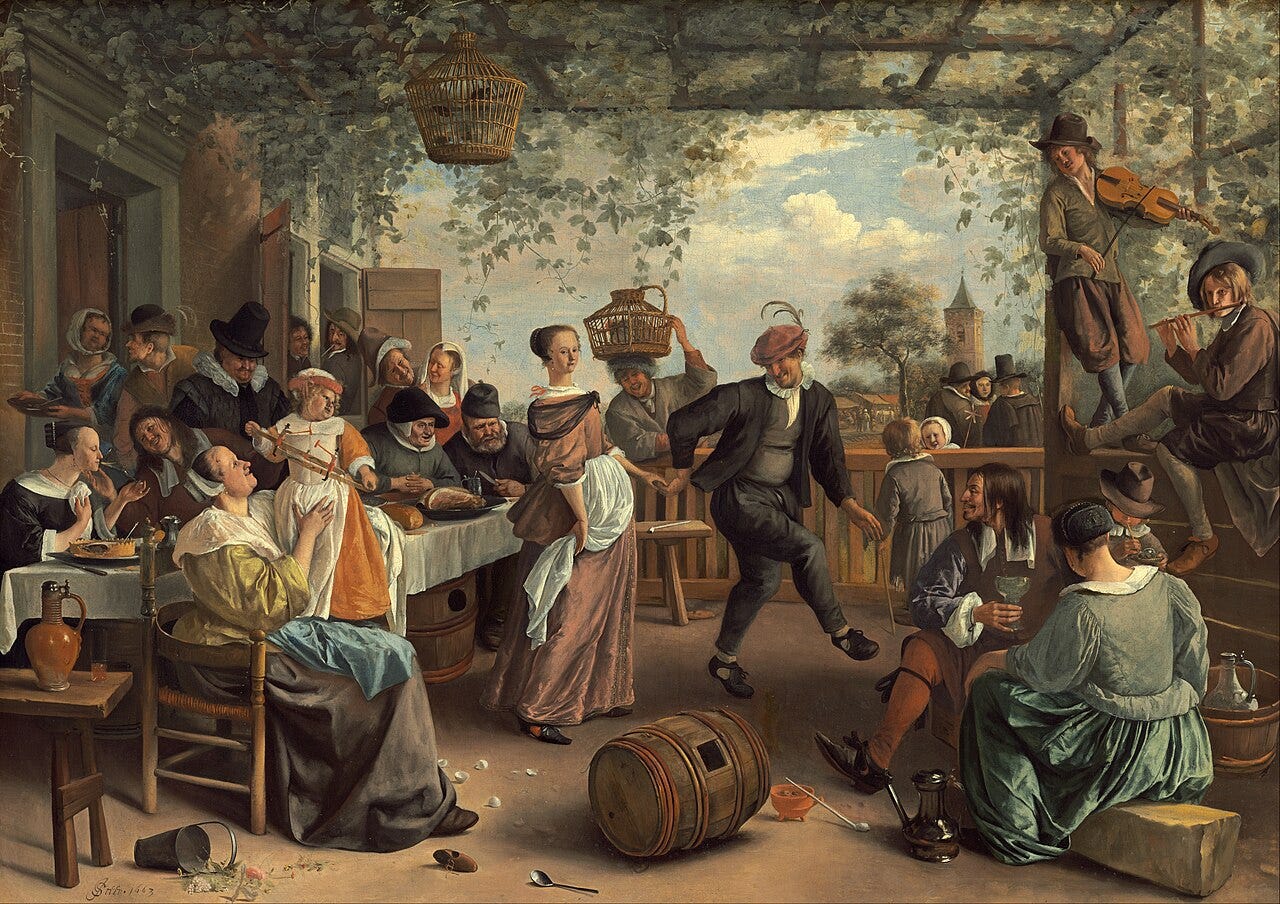
No training contract survives, but early sources name three teachers, and each left a clear mark.
The first was Nicolaes Knupfer, a German painter in Utrecht who worked on history and figure scenes. From him Steen learned to build a busy composition and tell a story through grouped figures.
The second was Adriaen van Ostade in Haarlem, a specialist in peasant life and rowdy interiors. The third was Jan van Goyen, one of the great landscape painters of the age.
Knupfer gave Steen his theatrical staging. Van Ostade gave him the crowded farmhouse. Van Goyen gave him open air and setting. Steen blended all three into a style no single teacher could claim.
He helped start a painters guild at 22
In 1648, at about twenty two, Steen did something very practical. With the young painter Gabriel Metsu he helped set up the Guild of Saint Luke in Leiden.
A guild was the professional body that let painters sell work, take on pupils, and protect their trade. Founding one is not the act of a careless man. It shows Steen taking his career seriously from the very start.
Leiden was a demanding art town, home to the fijnschilders, the fine painters who worked in tiny, polished detail. Steen knew that circle well. The year 1648 marks the moment he became a registered professional rather than a hopeful amateur.
He married his teacher's daughter
Soon after the guild, Steen went to work as an assistant to Jan van Goyen in The Hague, and moved into van Goyen's house on the Bierkade.
On 3 October 1649 he married the landscape painter's daughter, Margriet van Goyen. The couple would go on to have eight children.
It was a marriage inside the trade, the kind that tied workshops and families together. Steen stayed with his father in law until 1654, learning the business as well as the brush.
Margriet died in 1669, after twenty years together. Her death, followed by his father's in 1670, pulled Steen back to Leiden for good. The steady family man behind the rowdy scenes is easy to forget, but he was always there.
The restless map of a Dutch career
Steen rarely sat still. Born in Leiden, he worked in The Hague from about 1649, then Delft from 1654.
He spent the years 1656 to 1660 in Warmond, a village just north of Leiden. From 1660 to 1670 he lived in Haarlem. Both periods were among his most productive. In 1670 he came home to Leiden and stayed.
Each move placed him near different painters and patrons. Haarlem meant Frans Hals and Adriaen van Ostade. The Hague meant van Goyen.
This constant motion helps explain his range. He picked up ideas in every town and folded them into his own crowded, talkative pictures.
The Delft brewery that never took off
Painting did not always pay the bills, so Steen tried business too. From 1654 to 1657 his father leased him a brewery in Delft called De Slang, which means The Snake. It went badly.
The Delft gunpowder store had exploded in 1654, the local market was weak, and the brewery never turned a real profit. Steen kept painting through all of it.
One work from these years, known as The Burgomaster of Delft and His Daughter, dated 1655, proves he could switch to grand portraiture when a commission arrived.
The failed brewery is telling. Steen spent his life juggling paint and trade, and the trade side often struggled while the brush carried him.
Where a Jan Steen household began
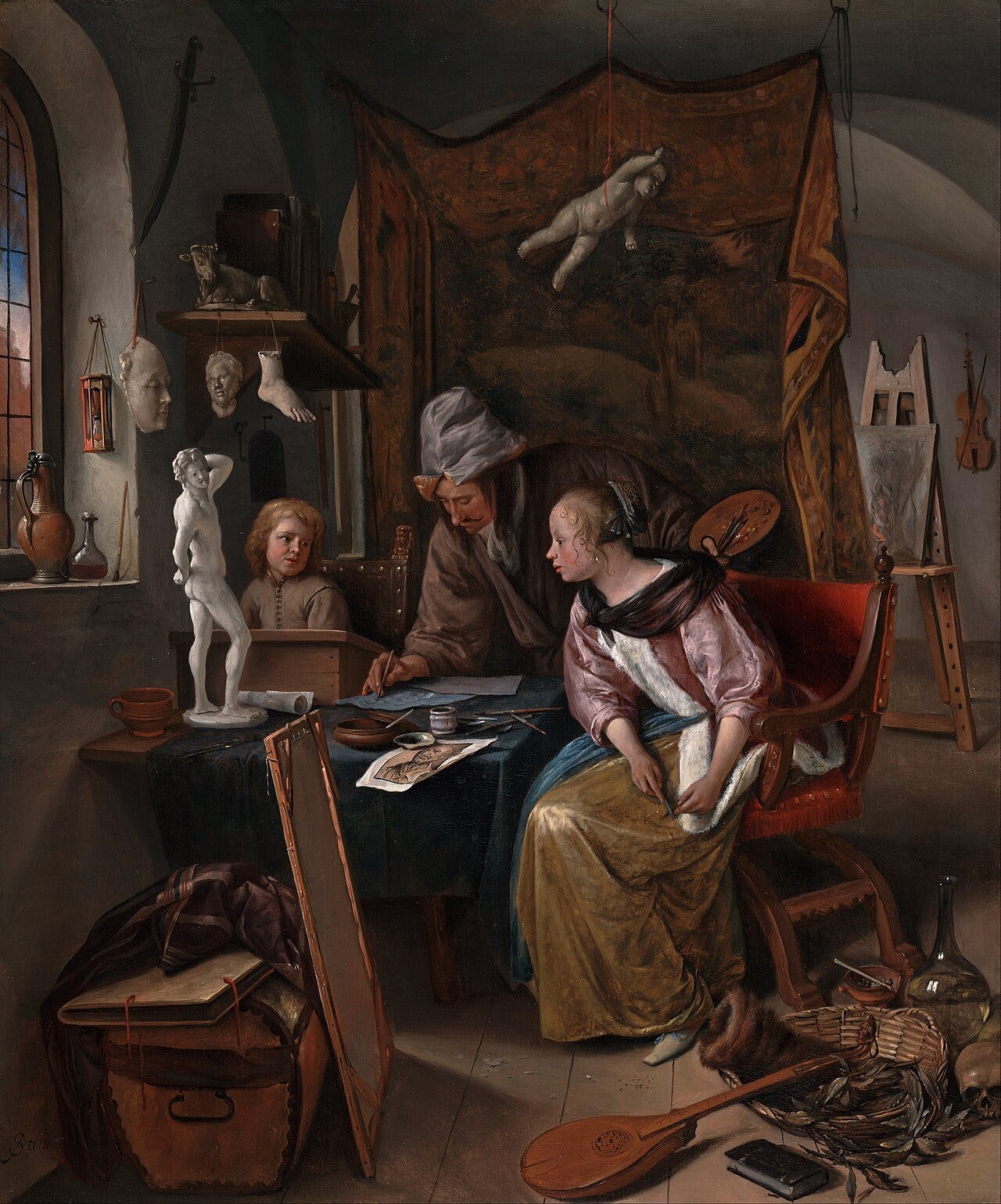
The Dutch still say een huishouden van Jan Steen, meaning a Jan Steen household. It describes a home in happy uproar, with children running wild, food on the floor, and no one in charge. The phrase comes straight from his paintings.
Scenes like The Merry Family of 1668 show parents singing and drinking while the children copy every bad habit in the room. Steen painted disorder so well that his name became the word for it.
The joke has a sting. A note in The Merry Family warns that children learn exactly what they see. So the proverb records both the laughter and the lesson. Few artists have entered daily speech this way.
The grinning man hidden in his own crowds
Look closely at a Steen crowd and you often find Steen himself. He plays the laughing drinker, the grinning rake, the man raising a glass.
His self portrait in the Rijksmuseum, from about 1670, shows the face to watch for: narrowed eyes and a large fleshy nose. He worked by the old motto that every painter paints himself.
Here is the myth worth correcting. Because he played the drunk so often, later viewers assumed he was one. He was not. Steen ran businesses, founded a guild, read Latin, and produced hundreds of paintings.
The staggering fool in the picture is a role, a comic mask, not a diary.
Four scenes that hide a warning
Steen wrapped hard lessons inside comedy.
The Feast of Saint Nicholas, painted around 1665 to 1668, looks like pure holiday joy until you spot the boy sobbing because he found only a birch rod in his shoe.
The Effects of Intemperance shows a mother who has drunk herself to sleep while chaos spreads through the room around her.
As the Old Sing, So Pipe the Young turns a cheerful family party into a lesson about bad example passing from parents to children.
Beware of Luxury, known in Dutch as In Weelde Siet Toe, crams a whole household into disorder to warn against comfort and excess.
In each one the fun is the bait and the warning is the point.
The serious side, and a huge output
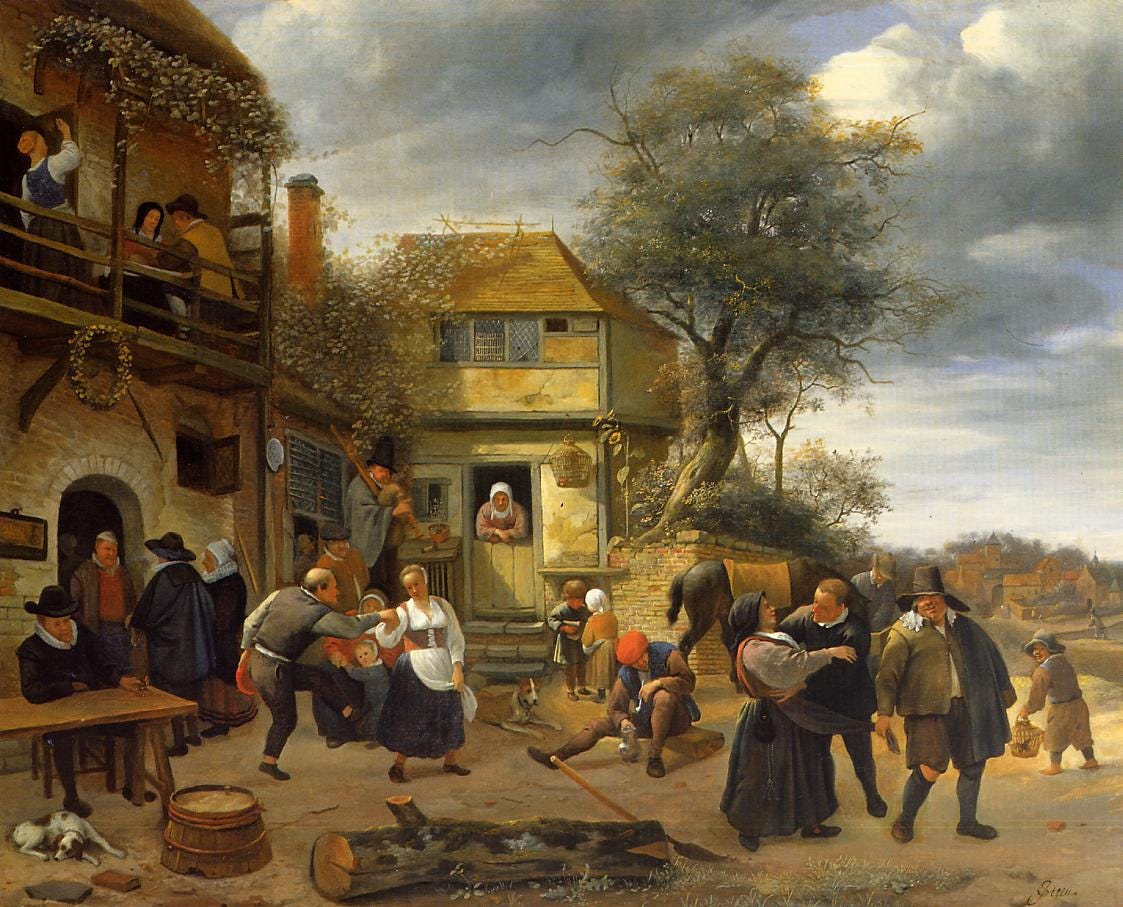
Steen is filed under comedy, but his range was wide. He painted biblical stories, scenes from ancient myth, history subjects, portraits, and landscapes.
His many versions of The Doctor's Visit show a physician who realises his young patient is not truly ill but suffering from love, staged like a moment from a play. Steen adored the theater, and it shows in the costumes and gestures.
He was also prolific. Scholars count roughly 800 paintings, of which about 350 survive today. That is a large body of work for one lifetime. Oddly, he trained almost no one, with only a single pupil, Richard Brakenburgh, on record.
The Jan Steen questions that keep coming up
What is Jan Steen famous for?
Funny, lively scenes of chaotic Dutch households that carry a moral message.
What is a Jan Steen household?
A Dutch saying for a messy, disorderly home, named after his comic interiors.
Did he really run a tavern?
Yes, he came from a brewing family and kept an inn alongside painting.
When did he die?
In 1679, in his home town of Leiden.
More secrets to unlock


Why the comedian lasts
It is easy to file Steen as light entertainment, but his timing, character and storytelling are first rate, and his moral jokes still land. The painter of mess turned everyday Dutch life into comedy that has outlived three centuries.
One last detail. So fixed is his reputation for disorder that the idiom outran the man: many Dutch speakers use a Jan Steen household today without knowing it honours a real painter who lived by the joke.