
Masaccio was the young Florentine who launched the Renaissance in painting and then died at about twenty seven. In a handful of frescoes he replaced flat medieval gold with real space, real weight and real human feeling, using the new mathematics of perspective to punch what looked like a hole through a solid wall.
He worked mostly in Florence, alongside the older painter Masolino, and left barely a handful of finished works before his sudden death in Rome.
His career lasted barely six years, yet Michelangelo and Leonardo went to school on his work.
Born: San Giovanni Valdarno, 1401
Known for: the Holy Trinity, the Brancacci Chapel, early Renaissance realism
Died: Rome, around 1428
More incredible painter stories
If Masaccio pulled you in, you will love these too:


Masaccio at a glance
1401. Born Tommaso di ser Giovanni in San Giovanni Valdarno, outside Florence.
1422. Enrolled in the Florentine painters’ guild at 20.
1425. Began the Brancacci Chapel frescoes alongside Masolino.
1426. Painted the Pisa altarpiece, now scattered across the museums of Europe.
1428. Died suddenly in Rome at 26. Poison was rumored, never proved.
The two friends who handed him the tools
Masaccio did not arrive at his breakthrough alone. He learned depth from the architect Brunelleschi, who had worked out linear perspective, and weight from the sculptor Donatello, whose figures stood like real bodies in real space.
Masaccio carried both lessons into paint. Geometry from the builder, solidity from the carver, feeling from himself. That is the recipe that made Florentine painting modern in a single decade.
The boy from San Giovanni Valdarno
He was not a Florentine by birth. Tommaso di Ser Giovanni was born in 1401 in San Giovanni Valdarno, a small town in the hills southeast of Florence. His father was a notary who died young.
The family later moved toward Florence, the richest art city in Europe at that moment. That is where the boy would learn to paint and where he would change everything in about six working years.
Nothing survives of his training, and we do not know who taught him. What we know is that by his early twenties he was already a working painter with his own commissions.
The town has not forgotten him and keeps a small museum, the Casa Masaccio, in his name.
Careless Tom, the man who forgot everything but paint
Masaccio is not a real name. It is a nickname, and not a flattering one. The painter Giorgio Vasari, writing in the next century, explained it.
Tommaso was called Masaccio, a rough version of Tom, not because he was vicious, for he was said to be kind, but on account of his extreme carelessness about everyday life.
The idea is of a man so absorbed in his work that he let everything else slide. Unpaid bills. Untidy clothes. There was a practical reason too.
His frequent partner was called Masolino, meaning little Tom, so Masaccio, big or clumsy Tom, kept the two apart. The clumsy one turned out to be the careful eye.
The year he signed on as a painter
Painting in Florence was not a free profession. To work, you joined a guild.
In 1422 Masaccio enrolled in the guild that Florentine painters belonged to, the company of doctors and apothecaries. Painters sat there because they bought and ground their pigments like pharmacists mixing powders.
That same year gives us his first dated work, a small three part altarpiece for the country church of San Giovenale near Reggello, close to where he grew up.
It is an early piece, still finding its feet, but the weight is already there. The figures sit and stand like real bodies, not flat patterns.
He was about 21, with roughly six years left.
The Tribute Money and light that obeys the room
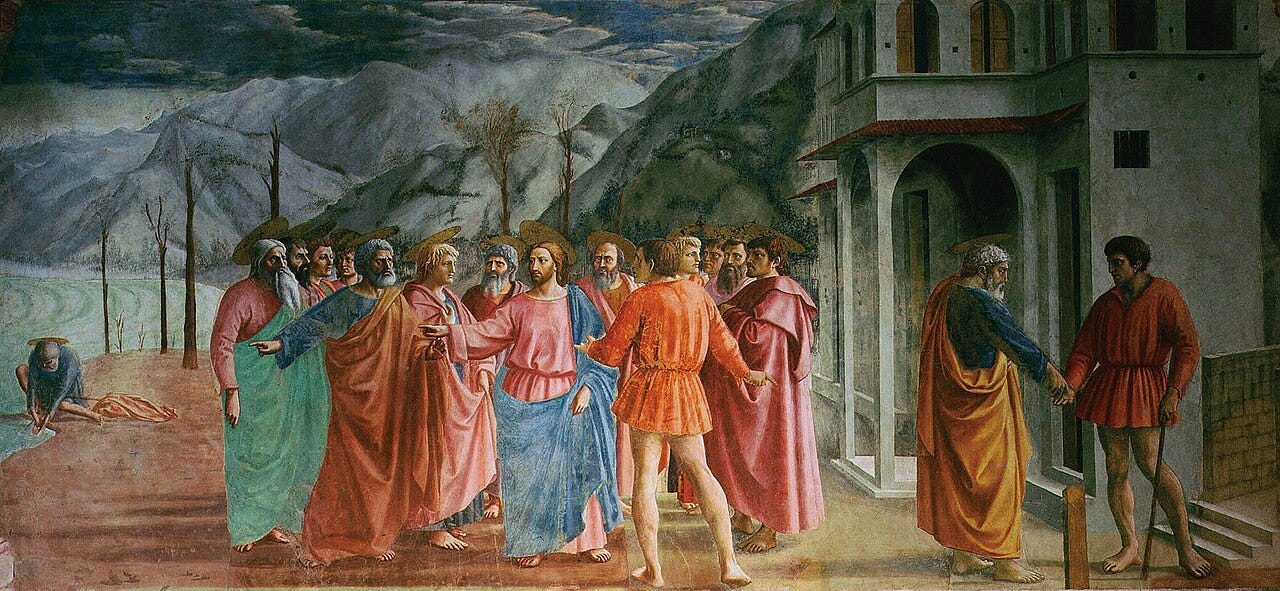
His most famous frescoes cover the Brancacci Chapel in the church of Santa Maria del Carmine in Florence, painted around 1423 to 1427 alongside Masolino.
The scene everyone remembers is the Tribute Money. Christ and his apostles stand in a wide half circle, heavy and solemn, telling the story of a tax demanded at the city gate.
Look at where the light falls. Every figure is lit from the upper right. That is not decoration. The real window of the chapel sits on the right wall, so the painted light matches the light you are standing in.
For the first time, a Bible scene shared the viewer's own space, weather and hour.
Adam and Eve, shame you can watch
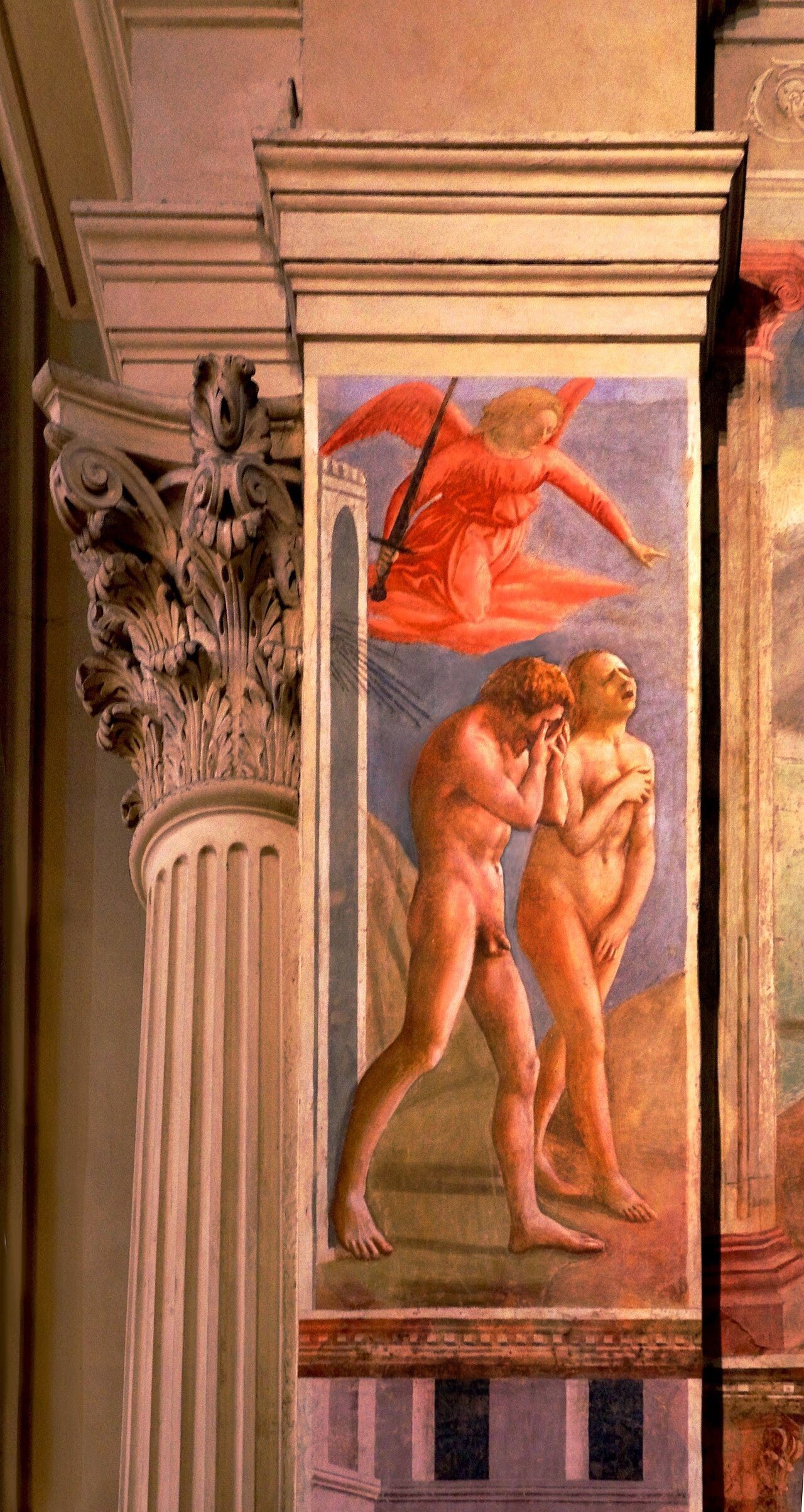
On the entrance pillar of the same chapel, Masaccio painted the Expulsion from the Garden of Eden.
Adam and Eve stumble out through the gate. Adam presses both hands over his face. Eve throws her head back and her mouth opens in a howl you can almost hear.
Their bodies are not idealized. They are soft, exposed and awkward, built from areas of light and shadow rather than neat outlines, so they seem to have real weight.
Next to it Masolino painted the earlier moment, Adam and Eve calm and elegant before the fall. Set side by side, the contrast is the whole point.
The skeleton at the bottom and its warning
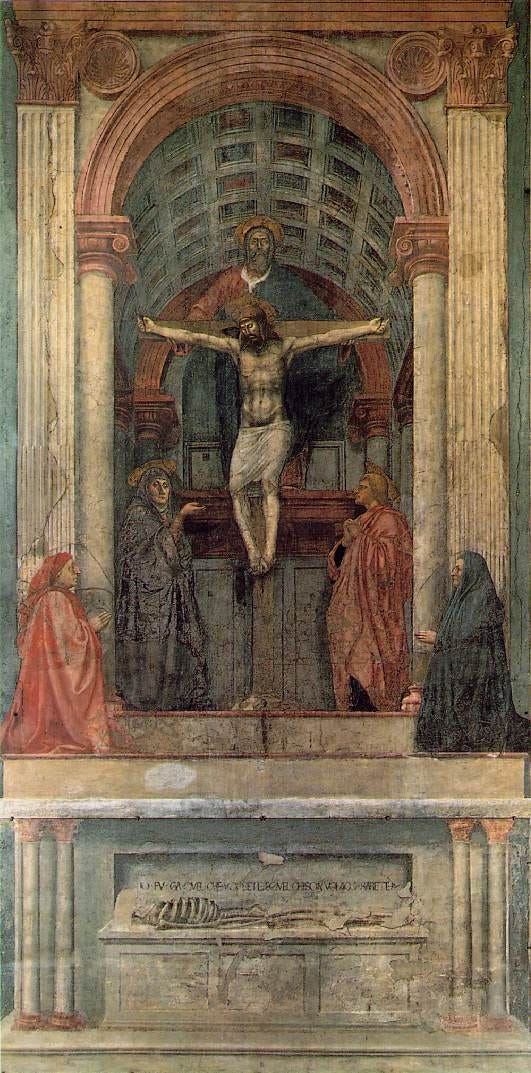
In the church of Santa Maria Novella, Masaccio painted a fresco of the Holy Trinity around 1425 to 1426, probably his last work in Florence.
It looks like a stone chapel cut back into the wall, with a vaulted ceiling receding into depth. This is the first surviving painting to use a full one point perspective system, where every line runs back to a single vanishing point. We open our tour of space in art with this exact fresco, as the first rigorous example of the trick.
Now look below the holy figures. A tomb holds a painted skeleton, laid out flat. Above it runs a line that translates as, I once was what you now are, and what I am, you too shall be.
It is a memento mori, a reminder of death, spoken by the bones straight to the living viewer.
The Pisa altarpiece, now scattered across Europe
In 1426 Masaccio took a job away from home. A merchant hired him to paint a large altarpiece for a burial chapel in the Carmine church in Pisa.
He built it as a many paneled structure, with the Virgin and Child at the center, saints around them and small narrative scenes below. Then history pulled it apart. The Pisa church was remodeled, the altarpiece was broken up and the pieces drifted.
Today the central Virgin and Child hangs in the National Gallery in London. Other fragments sit in Berlin, Naples, Pisa and Vienna, and some panels are simply lost. To see one altarpiece whole again, you would need to travel across several countries.
A death in Rome, and a rumor that never proved out
Around 1428 Masaccio left Florence for Rome. He died there, and he was only about 27.
For a talent that large, the sudden silence bred stories. Word spread that he had been poisoned by a jealous rival, and Vasari passed the whisper along a century later.
There is no evidence for it. Historians today think the far likelier cause was plague, which swept through the crowded cities of the age and killed the young without asking who they were.
So the poisoning tale, appealing as it is, stays exactly that, a tale. He left no workshop and no pupils, and the career had lasted roughly six years.
The chapel that became a classroom
Masaccio died young and forgotten by many. His paintings did the remembering for him. Vasari records that generation after generation of Florentine artists came to the Brancacci Chapel to study and copy the frescoes.
It became a school without a teacher.
The proof is in the paper. Some of Michelangelo's earliest surviving drawings are copies of figures from the Tribute Money.
There is even a bruise attached to that classroom. While young Michelangelo was drawing in the Carmine, a fellow student named Pietro Torrigiano punched him and broke his nose, a crooked mark he carried for life.
Leonardo, Michelangelo and Raphael all finished the lesson these walls began.
A handful of paintings, and that was all
Here is the strange arithmetic of Masaccio. His influence reshaped Western painting for centuries. His actual output would barely fill a room.
The Brancacci frescoes, shared with Masolino. The Holy Trinity in Santa Maria Novella. The scattered Pisa altarpiece. The San Giovenale triptych of 1422.
The Saint Anne panel he made with Masolino, now in the Uffizi. A few Madonnas. That is close to the whole surviving list.
A cleaning of the Brancacci Chapel between 1985 and 1989 stripped away centuries of soot and candle grime, and the original clear colors came back. For a career of six years and so few works, the reach is hard to believe.
Masaccio, briefly answered
What is Masaccio famous for?
Bringing real perspective, weight and emotion into painting at the dawn of the Renaissance.
What is the Holy Trinity?
A Florentine fresco whose exact perspective seems to open a deep chapel in a flat wall.
How did he die so young?
He died in Rome around 1428, aged about 27, of unknown cause, with rumours of poisoning.
Who did he influence?
Generations of Florentines, including Leonardo and Michelangelo, who studied his frescoes.
More secrets to unlock


Why six years was enough
Few artists have changed so much in so little time. Masaccio died before thirty, yet every solid, believable body painted after him owes something to the careless young man who taught Florence to see.
One last detail. The Brancacci Chapel survived a major fire in the 1700s that darkened its walls, and only a modern cleaning brought back the clear daylight Masaccio first painted. His revolution had been hiding under soot.
Of the handful of surviving works, the Holy Trinity ranks above the Tribute Money and the Expulsion. The Tribute Money is a crowd scene handled with control, and the Expulsion is raw physical grief. The Trinity required Masaccio to invent an entire system for representing space on a flat wall, which is why the history of perspective in painting usually starts on this exact spot.
Masolino was the established name when the two worked side by side in the Brancacci Chapel, and his Adam and Eve keep the smooth, decorative manner of the Gothic style Florence was already leaving behind. Masaccio's version, painted a few feet away, looks like it belongs to a different century. Six hundred years later, art students still study Masaccio's wall far more than Masolino's.
A working career of six years is short by any measure, shorter than Vermeer's output over two decades or Van Gogh's decade of painting. What Masaccio managed in that time was to solve depth and weight in painting before his contemporaries had caught up. The Brancacci Chapel and the Holy Trinity were already enough to change the direction of Florentine painting, whatever else a longer life might have added.