

170 000+ readers. Learn art the fun way.
This is a preview. Paid subscribers get the full story.
You’ll also get:
10 new stories every month
The full archive (130+ Art stories)
Your personal art guide. Comment, ask questions, DM me anytime
iPhone user? Subscribe at coolstoriesabout.art, not via the app. Apple adds 30% to the price.
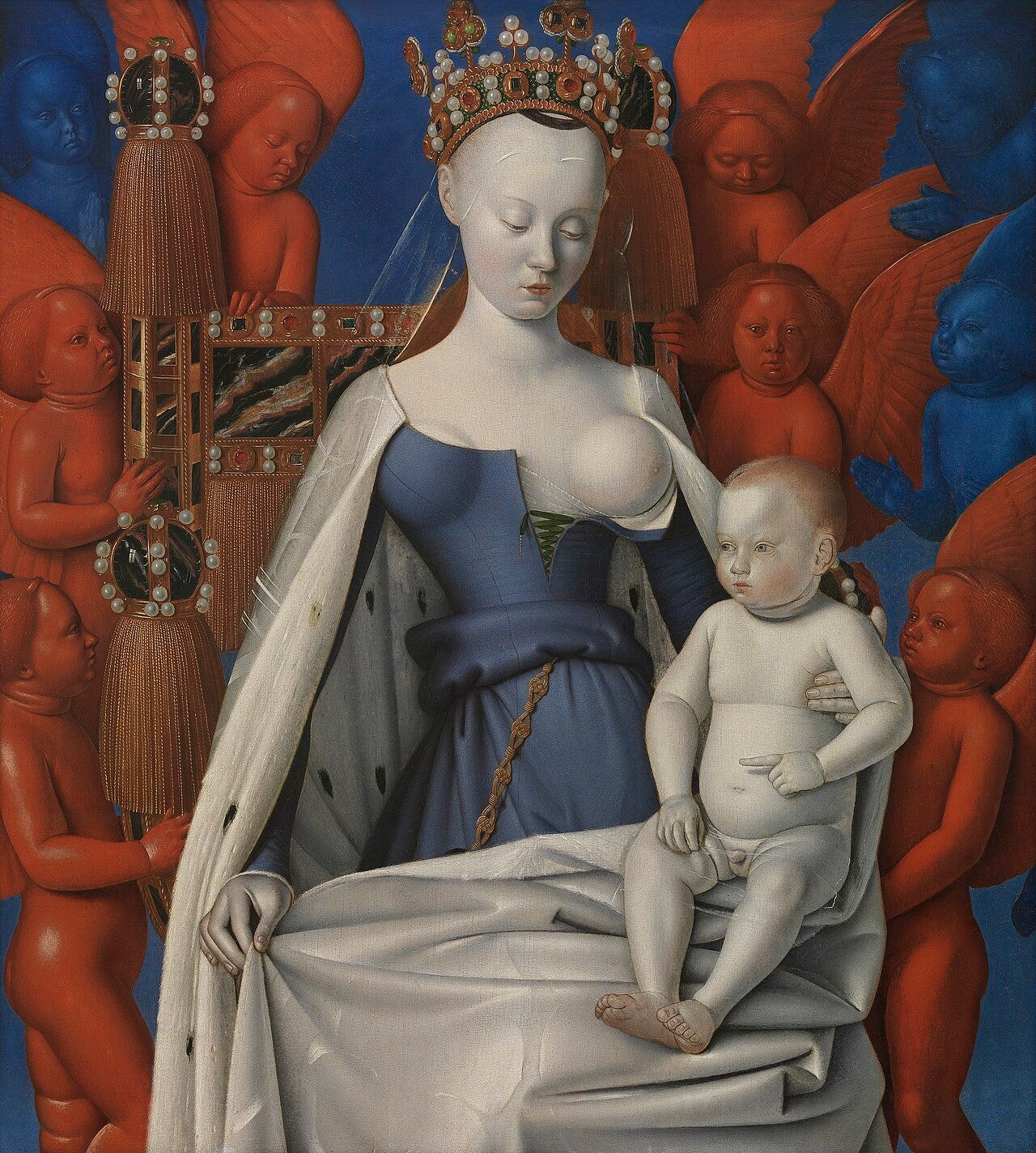
At the museum in Antwerp, one wooden panel draws a particular kind of look. Not admiration. Closer to unease.
A woman sits there, crowned. One bare breast, perfectly round. Skin as white as the wax of a candle.
Around her, a wall of angels. Blood red, and midnight blue.
She looks like no other Virgin. More like an apparition, risen out of time.
The unease is old. People have always spoken of her coldness, her strangeness, of a figure almost out of place in a church.
She is the strangest Virgin in all of French painting. And the closer you look, the more every detail says the same thing. Something is wrong.
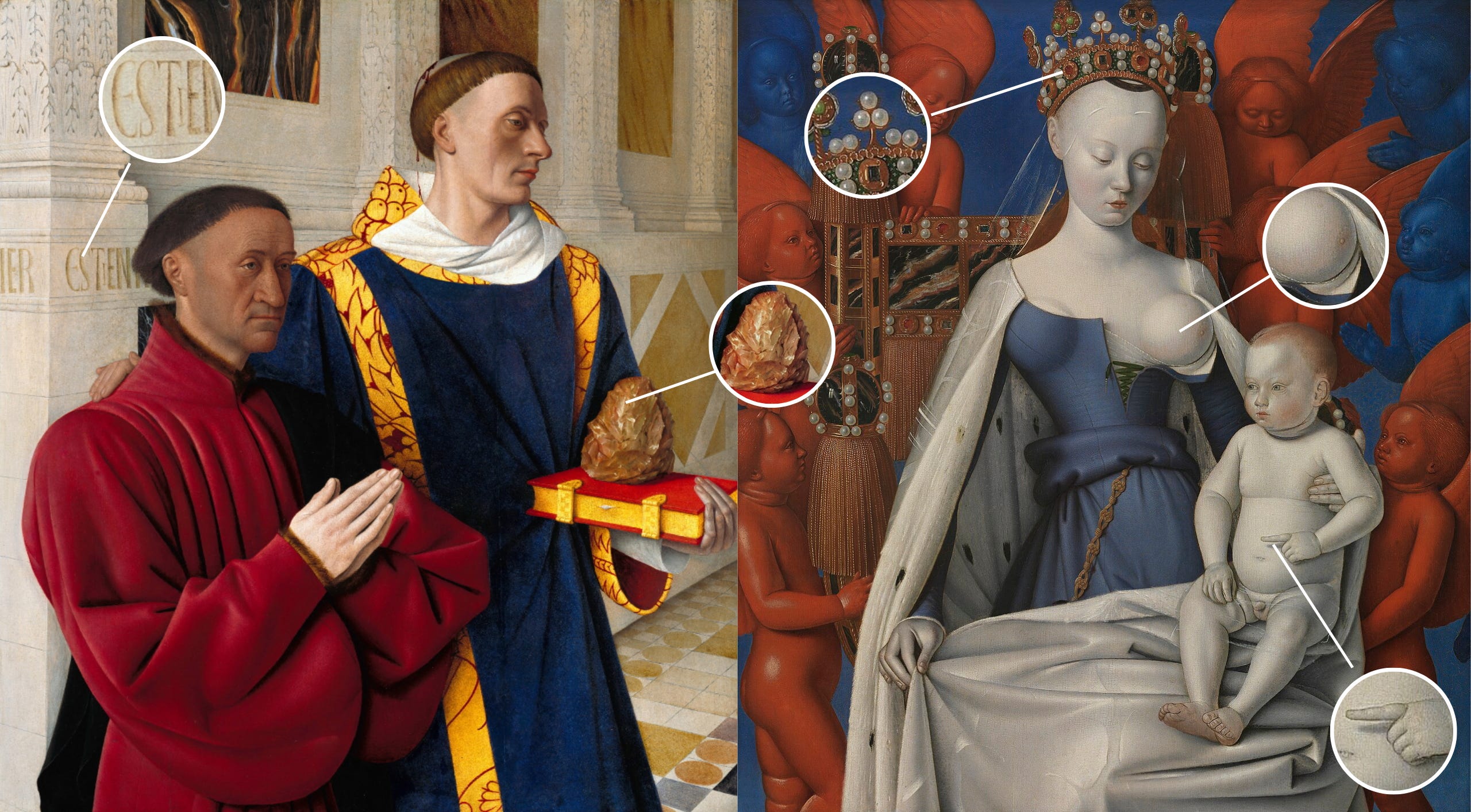
The panel was painted around 1452 by Jean Fouquet, the greatest French painter of his century, for Étienne Chevalier, treasurer to King Charles VII. It once had a second half, the man who kneels in prayer before her. The two were separated. That half now hangs in Berlin.
We are going to look at this painting, detail by detail.
The Skin
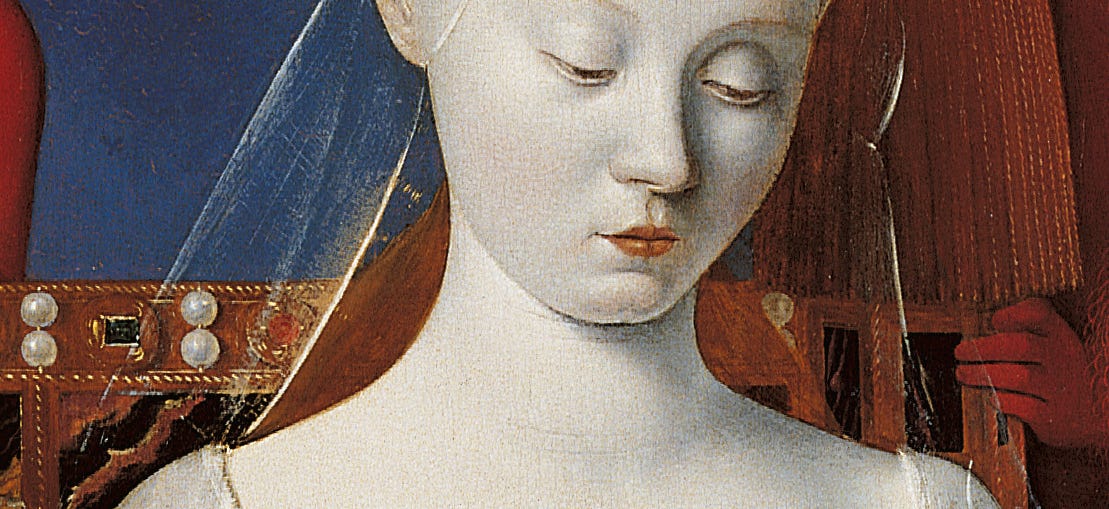
Her skin, first. It is what strikes you, and what unsettles you.
It is white. Not pale, white. The white of marble, of wax, of snow. No warmth, no flush, not a vein beneath the surface.
Fouquet knew how to paint living flesh. On the other panel, the men's faces are pink, ruddy, lined. Here, nothing. Smooth, cold flesh, drained of all its blood.
In time, people stopped calling her the Virgin. They nicknamed her the White Queen.
As if she were no longer quite a Virgin.
Discover my new newsletter !

The Crown and the Ermine


Her mantle now. White, lined with ermine.
Ermine is no ordinary fur. It belongs to kings and princes, the cloak of power and blood. The mother of a carpenter from Nazareth does not wear it.
On her head, a heavy crown of pearls and precious stones.
You do not dress a saint this way. You dress a sovereign.
The Breast the Child Ignores

Now the detail everyone stares at, and no one explains.
The bodice is unlaced. The left breast is bare. Whole, round as a sphere, set very high, almost below the collarbone, where no breast belongs.
Usually, a Virgin baring her breast is nursing. It is the familiar image of the mother feeding the Christ Child.
Except here, the Child does not look at it. He reaches with neither mouth nor hand. He is turned the other way.
The breast is offered, and no one takes it. So this gesture means more than feeding. It is the key to the painting, and we are keeping it for the end.
The Wall of Angels
Step back. Everything around the woman is packed with angels.
No floor. No sky. No horizon. Not the slightest depth. Only these bodies pressed together, filling the entire surface.
Six are entirely red. Three entirely blue. These are not just any angels.
The red ones are seraphim. Their name means the burning ones, those consumed by the love of God. That is why they are painted the color of fire. The blue ones are cherubim, the order of knowledge and contemplation, the color of the sky.
They are the two highest ranks in the hierarchy of angels, the ones who stand closest to God. Fouquet painted only these two.
He did not place this woman in some ordinary heaven. He set her in the highest sphere, the one that touches the throne of God.
The Hidden Window

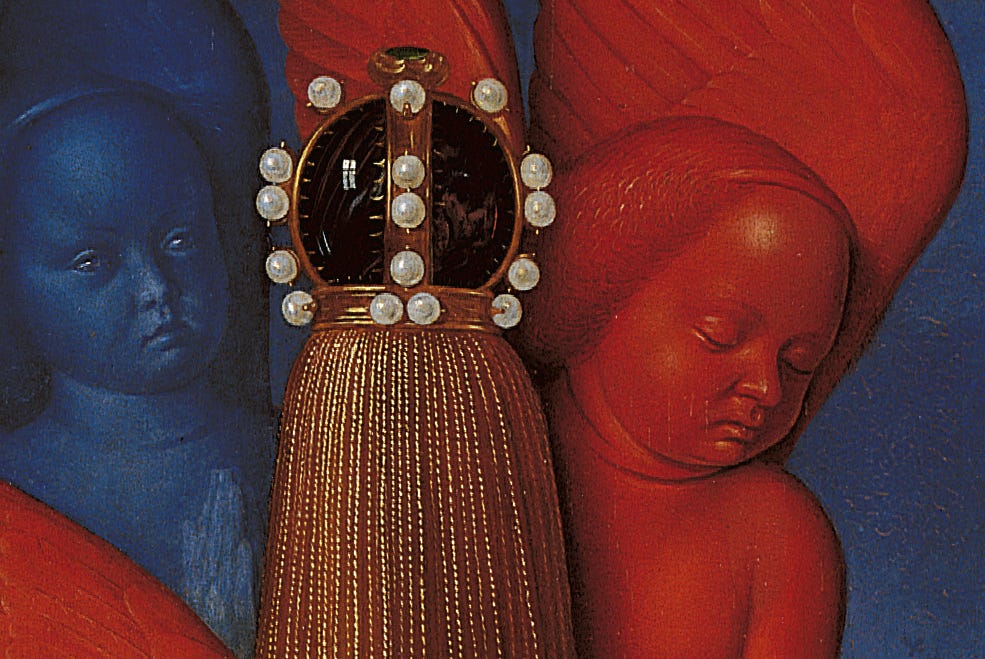
Step closer to the throne, right up against one of the polished black onyx orbs that adorn it.
On its surface, a tiny reflection. A window.
That window is nowhere in the painting. It comes from elsewhere, from a room we cannot see, where the light gets in. In a bead no wider than a fingernail, Fouquet painted the kind of detail only the Flemish masters could manage. The tiny proof that this apparition stands in a real place, lit by a real window.
And the Child is pointing to the way out. His arm is extended, the finger aimed not at his mother, but to the left, beyond the frame.
He is pointing at someone. Someone in the other half of the painting, the half that left for Berlin.
Let us go and see him.
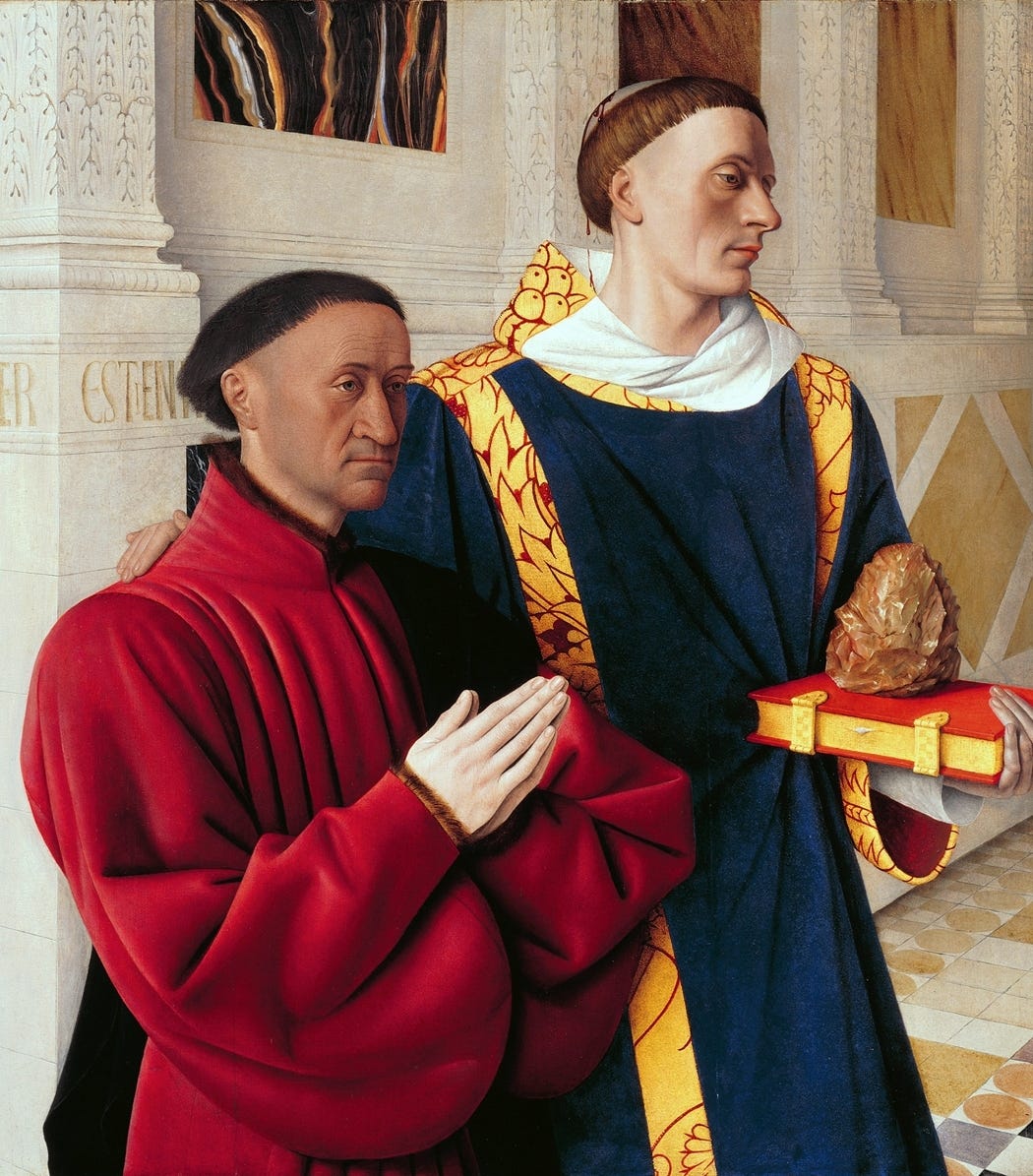
The Man Who Prays
Here he is. Kneeling, hands joined, in a robe of red cloth with a fur collar. About fifty, his head shaved high on the forehead.
This is Étienne Chevalier. The son of a king's secretary, risen to become one of the most powerful men in the realm.
Look at his eyes. They are not fixed on the sky, or on a book, or on nothing. They are locked on the Virgin, in the other panel.
A rich and powerful man, on his knees, praying as he stares at a woman's face.
Hold on to that gaze. At the end, it will tell you what this prayer truly hides.
The Stone on the Book

Beside him, a second man, standing, his hand on Chevalier's shoulder. Saint Stephen, his patron saint, the saint he was named after.
In his hand, the closed Gospel. And resting on it, plainly displayed, a rough stone with cutting edges.
This is no ornament. It is the murder weapon.
Saint Stephen is the very first martyr in Christian history. He was stoned at the gates of Jerusalem, around the year 36, with stones like this one.
Before he died, the account of his death tells us, he saw heaven open and God appear to him. That is why he is prayed to as an intercessor. The man who has seen God face to face is the best placed to speak to him.
Blood beads on his skull, and runs down to his collar.
The Name in the Marble

Behind the two men, the setting. Pilasters, slabs of marble, gilded moldings. Architecture in the Italian style, straight, calculated.
Fouquet painted it because he had seen it with his own eyes. Around 1446, he made the journey to Rome, where he painted the portrait of the pope. He brought these columns back to France at a time when almost no one there knew this language.
And in the stone, in golden letters, the name of the patron. His name, Chevalier, runs on into his first name, Étienne, woven into the wall.
A man who carves his name into marble, beside God, forever. This painting is not only a prayer. It is a monument he is building for himself.
Keep learning art the fun way


The Same Forehead
One last detail, before we leave the two men. Chevalier's forehead, shaved high on the skull. And the Virgin's, across from it.
It is the same. The same receding hairline, the same fashion, the one worn by the women of the French court at that exact date.
The mother of Christ and the king's treasurer wear their hair the same way.
This ageless, countryless Virgin, risen from heaven, wears the hairstyle of a lady you might have passed at court that very year.
And yet the format of this painting is nothing unusual. A donor presented by his patron saint, praying to the Virgin. They were painted by the hundreds.
What unsettles is her. This Virgin is not really one. Beneath the Queen of Heaven hides a real woman, one who wore this face and who lived.
We need her name. And what happened to her, one evening in February 1450…