
Twins and doubles in painting are rarely just family portraits. Two identical girls in a Victorian hallway became a horror icon, a pair of Elizabethan sisters share a bath, and Frida Kahlo painted herself twice on one canvas the year her marriage ended.
Seeing double
One Elizabethan double portrait shows two sisters in a bath, one pinching the other’s nipple, and nobody agrees why.
One 1780 painting of two girls inspired the most copied horror image of the 20th century.
Frida painted two versions of herself, one with a severed artery, in 1939.
One Renaissance panel shows the same man twice: himself and his reflection.
And Van Gogh painted his own face 35 times, which is its own kind of doubling.
Learn art the fun way
1 | The Two Fridas, Frida Kahlo (1939)
Two Fridas hold hands on a bench under a storm sky: one in a European lace dress with a cut artery, one in Tehuana costume holding a portrait of Diego.
She painted it the year she and Rivera divorced. It is her largest canvas. I cover her properly in Frida Kahlo.
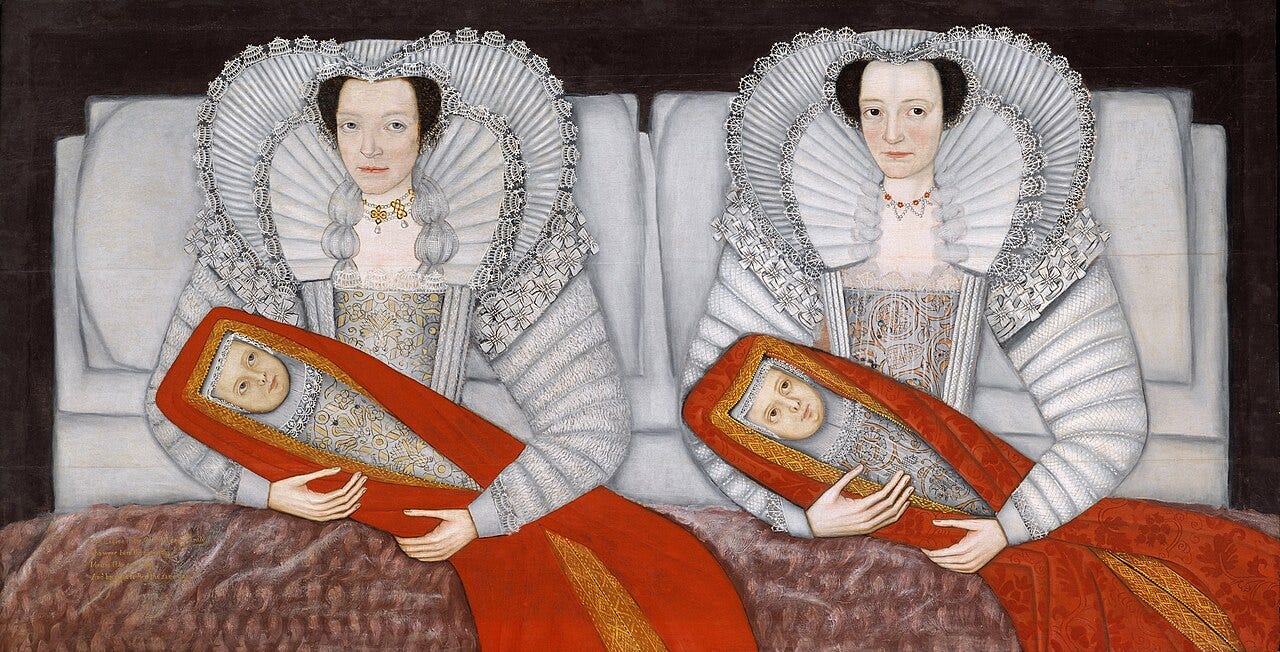
2 | The Cholmondeley Ladies (about 1600)
Two women, born the same day, married the same day and delivered the same day, sit upright in bed holding identical swaddled babies. The inscription says exactly that.
Look closely and the faces differ slightly. Nobody knows who they were. Tate has it.
The inscription says two ladies born the same day, married the same day and brought to bed the same day. The panel is by an unknown British artist and hangs at Tate Britain, and the faces are almost but not quite identical.
3 | The Gabrielle d’Estrees Double Portrait (about 1594)
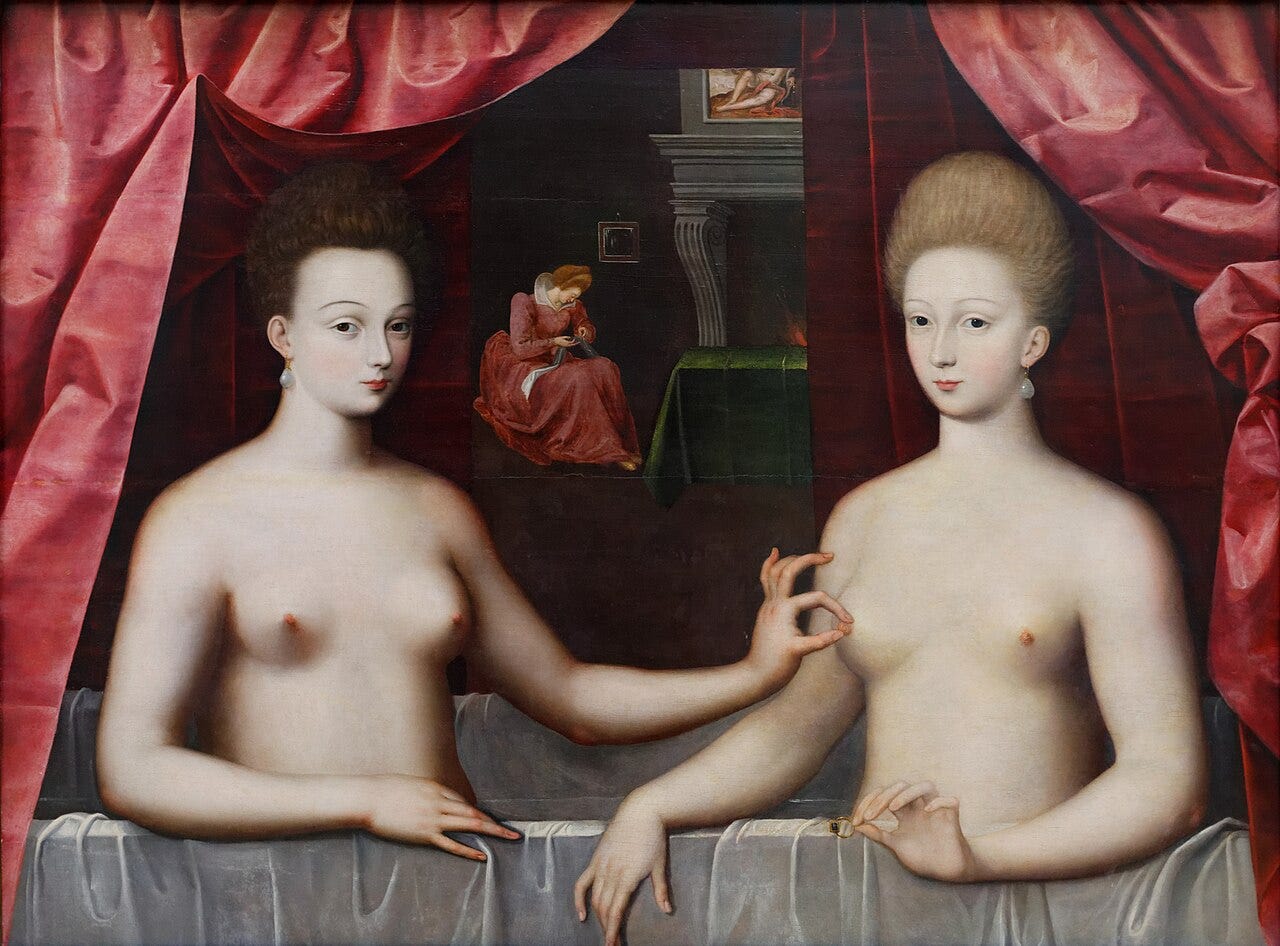
Two aristocratic women sit naked in a bath and one pinches the other’s nipple, while a woman sews in the background.
The most common reading is an announcement of pregnancy for the king’s mistress. Nobody has ever proved it. The Louvre keeps it unattributed.
The panel was painted around 1594 by an unknown artist of the Fontainebleau school and hangs in the Louvre. The gesture is usually read as an announcement of pregnancy, Gabrielle d’Estrees being the mistress of Henri IV.
4 | The Douglas Sisters and the Victorian twin portrait
Victorian families commissioned matched portraits of twin daughters in identical dresses, a fashion that produced hundreds of unsettling paired canvases.
Photography took the habit over and made it stranger still.
Victorian photography made the double portrait cheap and common, and painters answered by making theirs stranger. The uncanny effect depends on tiny differences, not on perfect symmetry.
5 | The Bissonnette Twins and Diane Arbus’ ancestors
Before photography, the double portrait was already a display of wealth: two children, twice the fee, twice the frame.
Painters used tiny differences, a ribbon, a held toy, to let the family tell them apart.
Diane Arbus photographed Cathleen and Colleen Wade in New Jersey in 1967, not the Bissonnettes, and the picture became one of the most reproduced portraits of the century. Kubrick denied it inspired The Shining.
6 | The Shining and the painted twins of 1780
Stanley Kubrick’s corridor twins descend from an entire genre of paired child portraits, and directly from Diane Arbus’ 1967 photograph of identical sisters.
That photograph in turn imitates the frontal symmetry of eighteenth century family painting. The chain is 250 years long.
The girls in the film are not twins in Stephen King’s novel, they are sisters of different ages. The doubling is Kubrick’s addition, and it borrows from a visual tradition that was already four centuries old.
7 | Castor and Pollux and the mythological twins
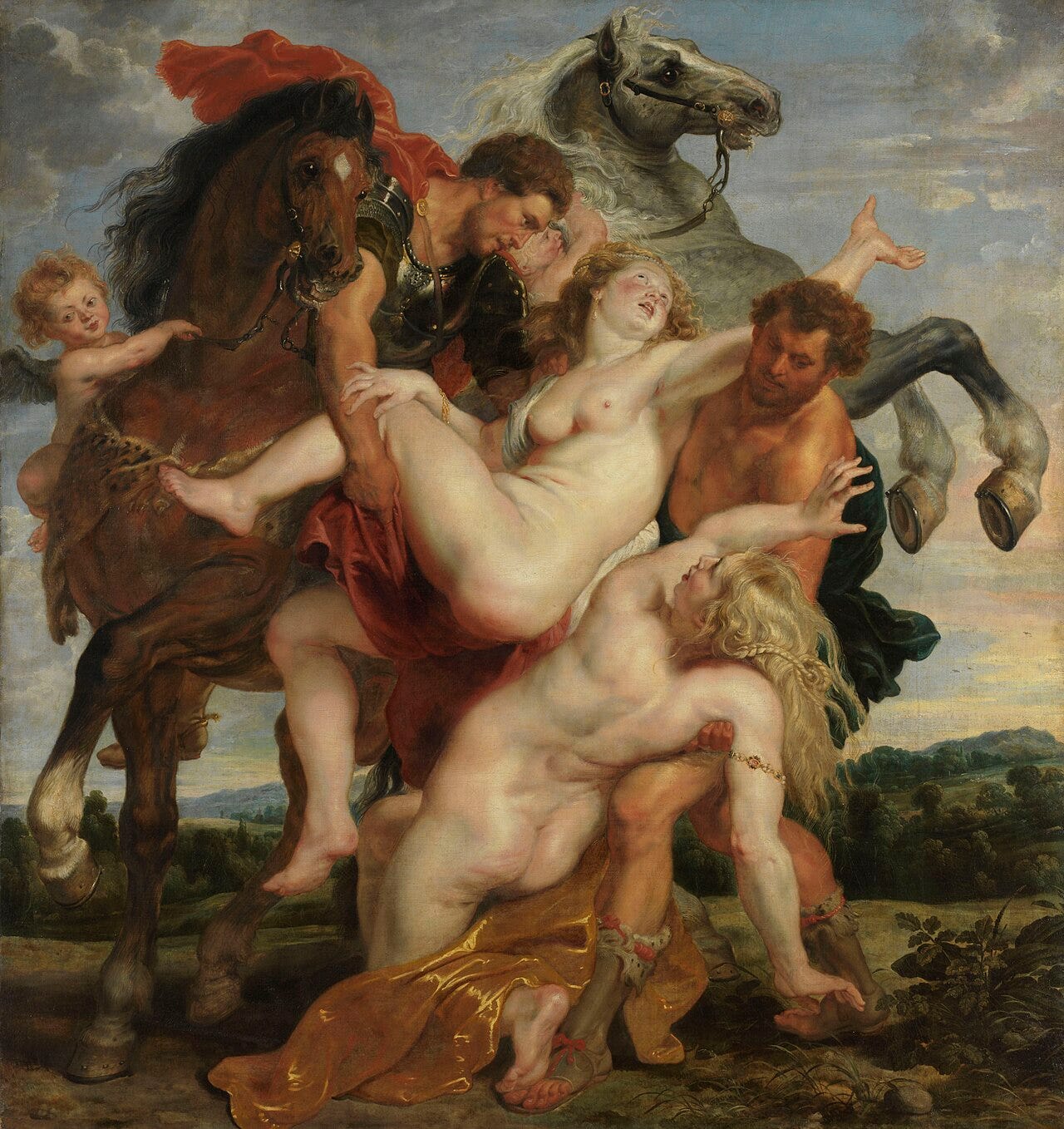
The heavenly twins, one mortal and one immortal, gave painters an excuse to paint two identical young men and one impossible choice.
Rubens used them for the Rape of the Daughters of Leucippus, all muscle and horses. Greek myths on canvas are in famous Greek mythology paintings.
8 | Narcissus and the reflected double, Caravaggio (about 1599)
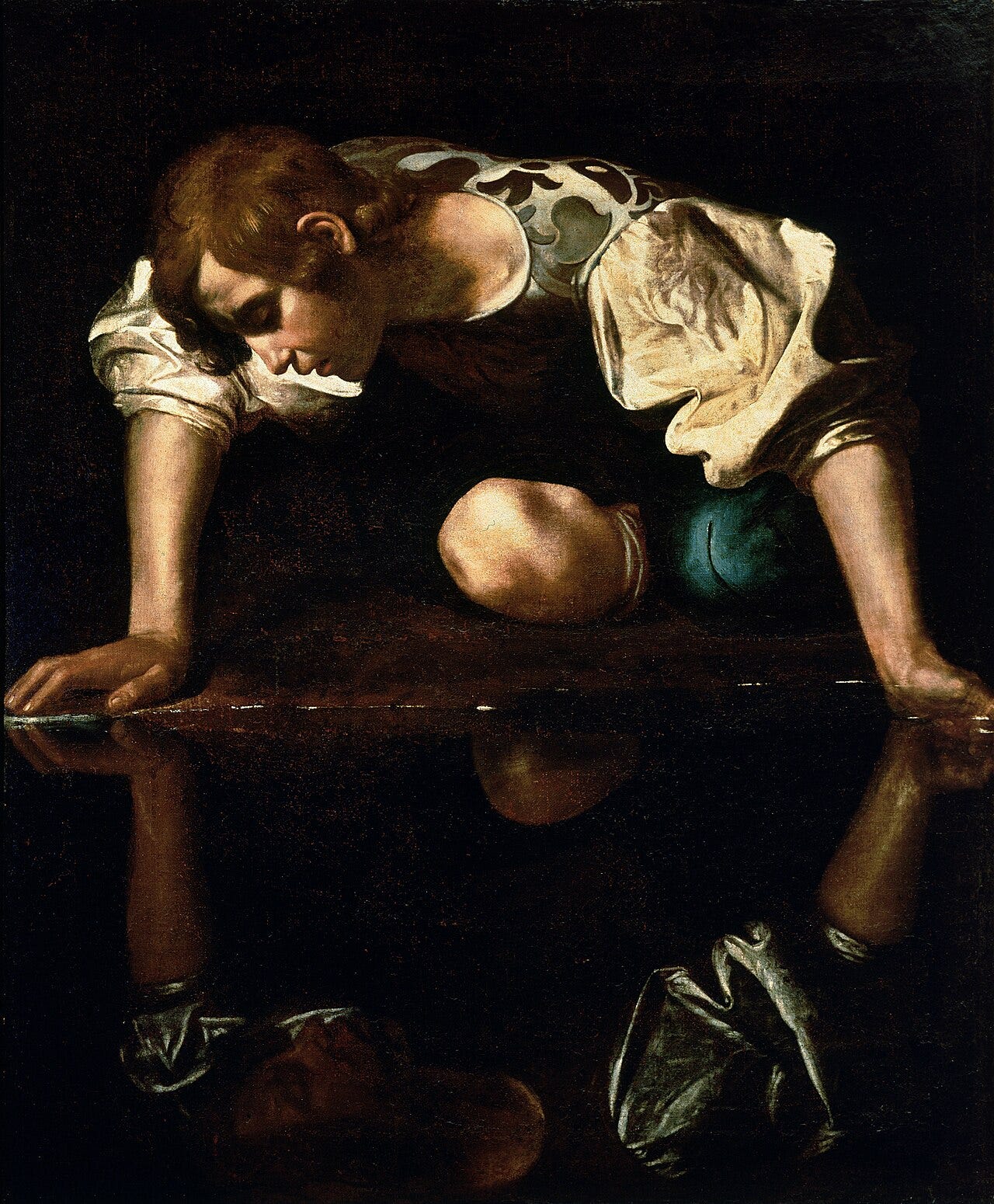
A boy leans over dark water and meets himself, the two bodies forming a closed circle with the pool as the seam.
It is the oldest doubling in art: not a twin, a reflection. I go into his whole story in Caravaggio.
Caravaggio painted him around 1599, bent over his own reflection so that the figure and its double form a closed circle. Ovid tells the story in the Metamorphoses, and the word narcissism comes from it by way of Freud.
9 | The double self portrait tradition
Painters have put themselves twice in one picture for centuries: as painter and as sitter, as young and old, as living and dead.
The whole genre is in what is a self portrait.
10 | Jacob and Esau, the hostile twins
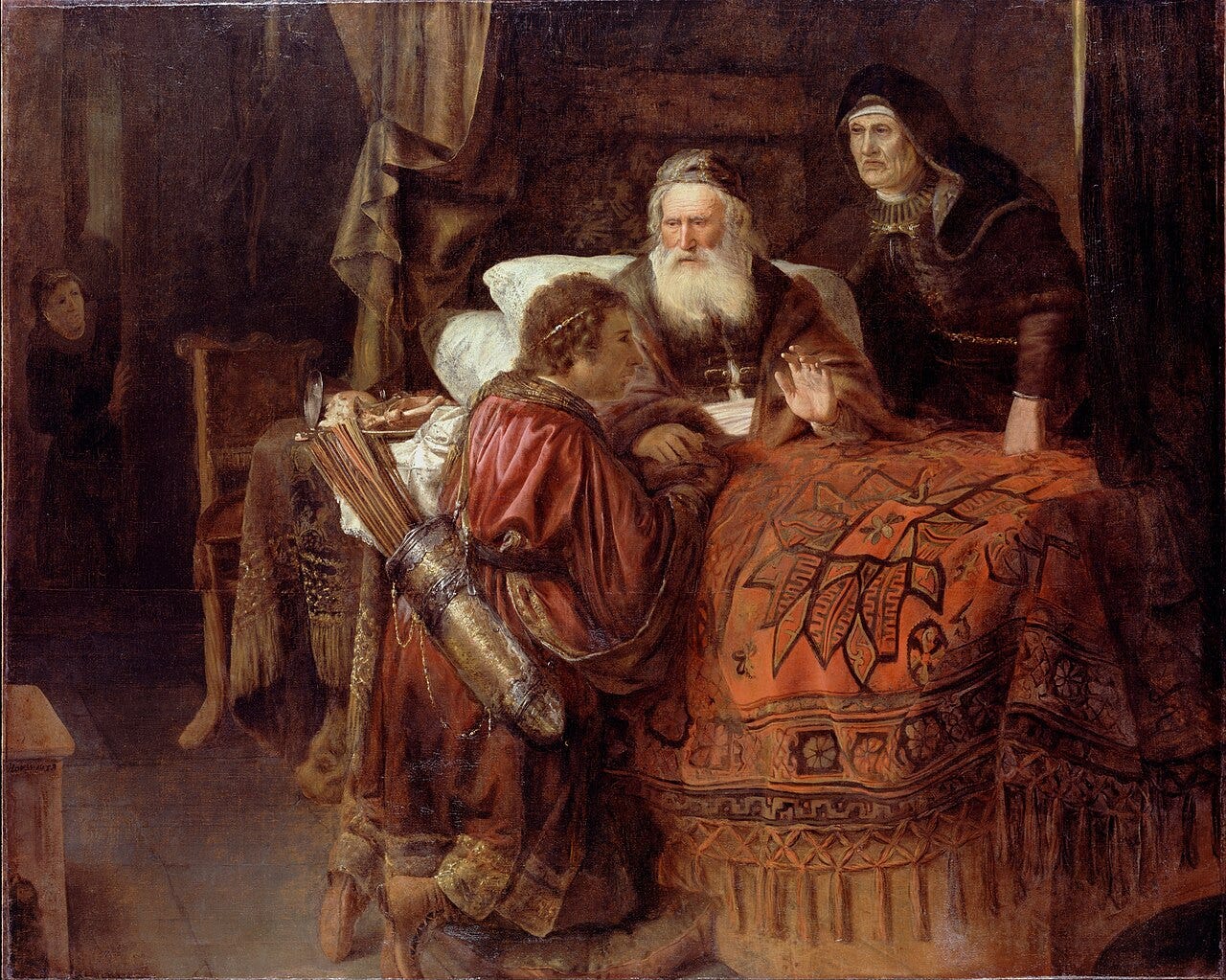
Rebecca’s sons wrestle in the womb, sell a birthright for soup and are separated by a blind father’s hands in the dark.
Rembrandt returned to blind Isaac blessing the wrong son more than once. More on him in Rembrandt.
11 | The Arnolfini mirror and the doubled room
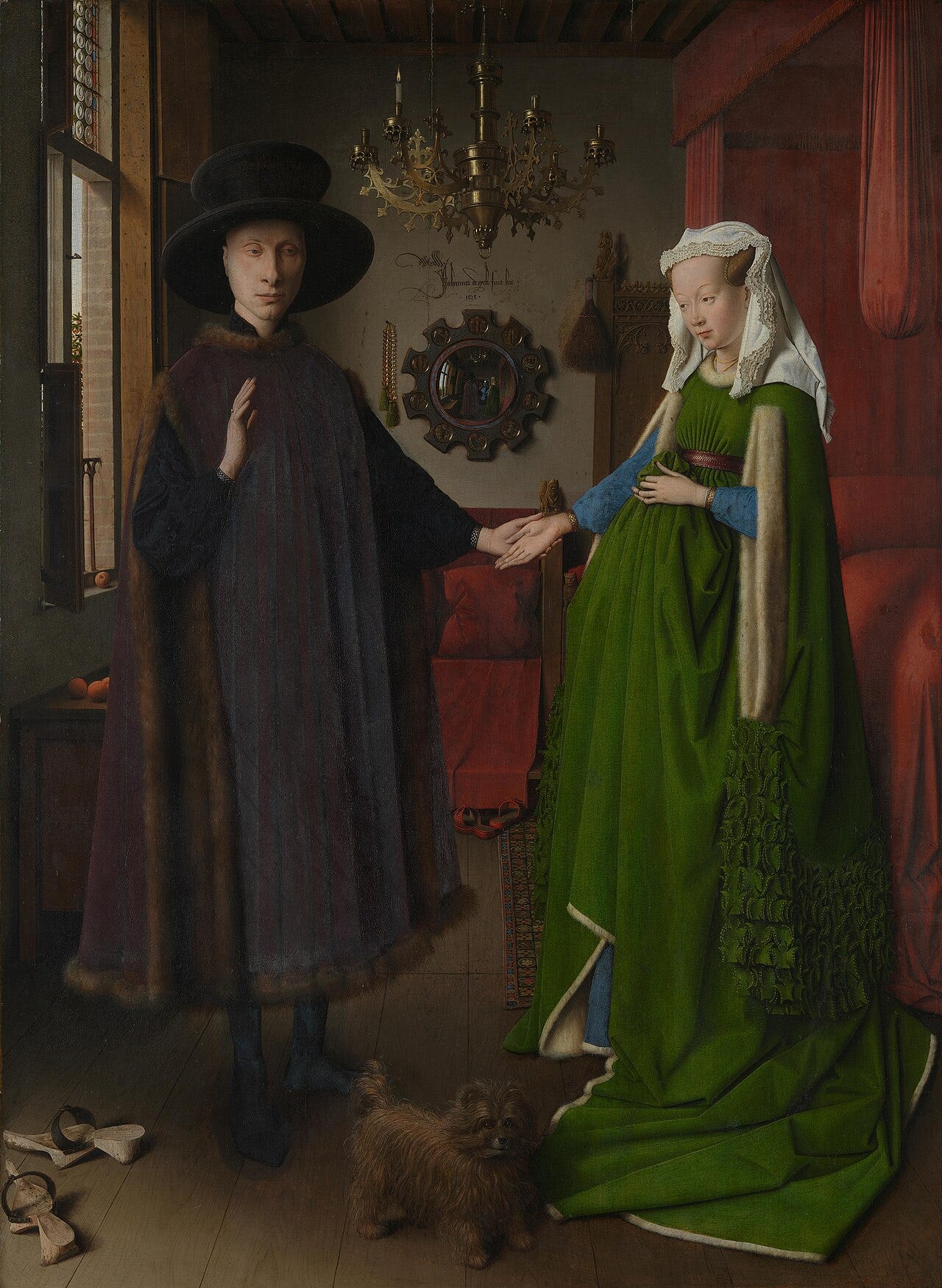
Van Eyck put a convex mirror on the back wall showing two extra figures, doubling the room and adding witnesses nobody expected.
I go through the whole room in the Arnolfini Portrait.
12 | Las Meninas and the doubled king, Velazquez (1656)
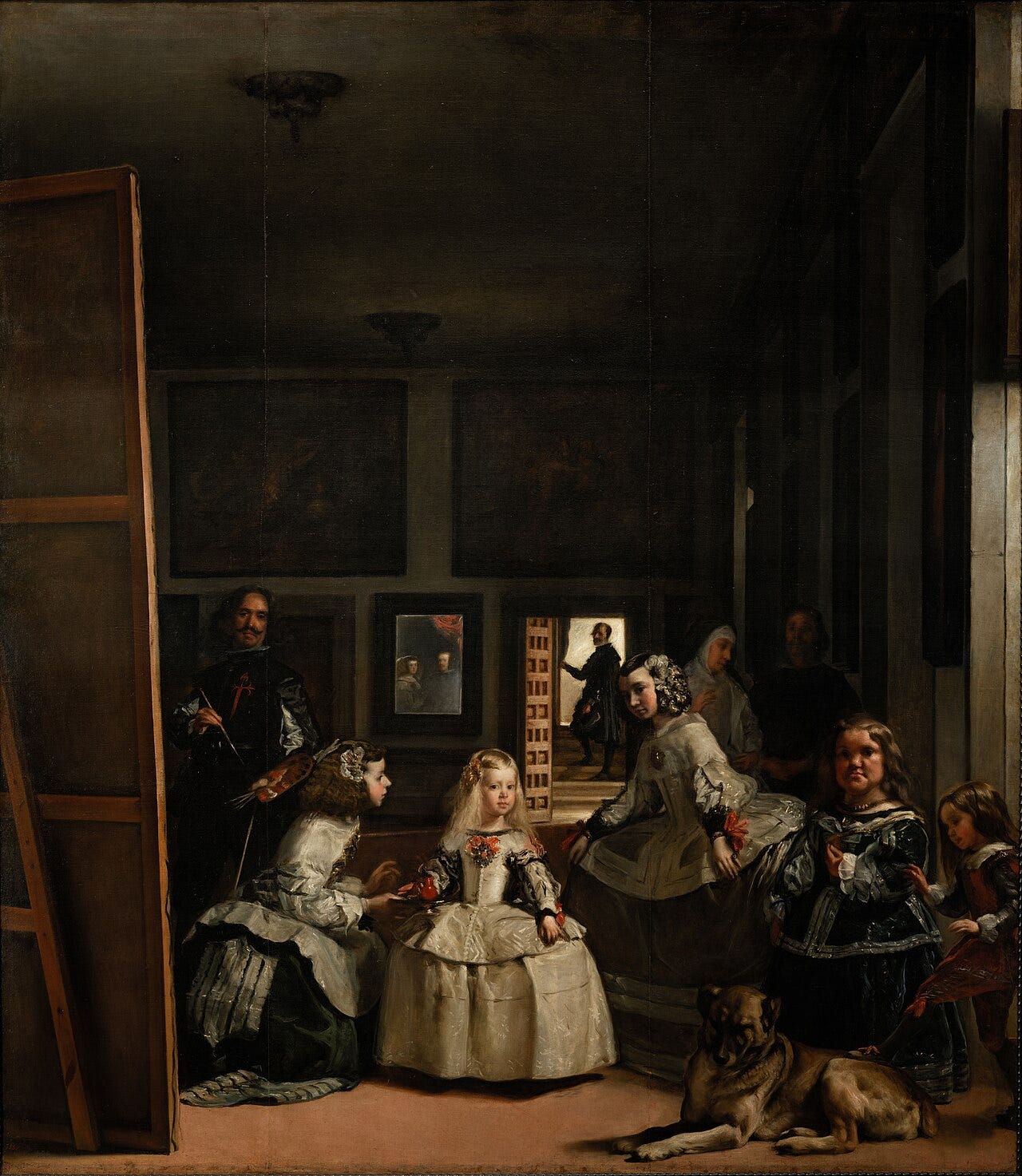
The king and queen appear only as a small reflection in a mirror at the back, which means the whole enormous painting is a picture of what they can see.
The most argued about mirror in art. The rest of his life is in Diego Velazquez.
The Met and the Rijksmuseum both hold double portraits where the second figure changes the whole reading.
The Cholmondeley Ladies get filed under twins by habit, but the inscription only claims the two women were born, married and delivered on the same three days, and the article itself admits the faces are almost but not quite identical. Three matching dates read more like a coincidence worth recording than proof of a shared birth.
The reading of the Gabrielle d’Estrees bath scene as a pregnancy announcement gets repeated twice here as if repetition settled it, though the piece also admits no document confirms it. An explanation nobody has proved deserves one mention, not two.
The line from painting to The Shining gets called a chain, but the twins in Kubrick’s film are not twins in the novel, and the direct source was a Diane Arbus photograph rather than any painting on this list. Calling that an unbroken tradition flatters the connection more than the facts support.
Seeing double: the questions that come up
Which is the one people name? The Cholmondeley Ladies, with Frida Kahlo’s Two Fridas as the psychological version.
Are the Cholmondeley Ladies really twins? The inscription says only that they were born, married and delivered on the same days. Their identities are unknown.
What does the pinch mean in the Gabrielle d’Estrees portrait? The most accepted reading is an announcement of pregnancy, but no document confirms it.
Did The Shining twins come from a painting? Indirectly. Kubrick worked from a Diane Arbus photograph, itself echoing centuries of paired portraits.
Where do I find them in person? Tate for the Cholmondeley Ladies, the Louvre for Gabrielle d’Estrees, Mexico City for the Two Fridas.
One last fact, rarely printed: the Two Fridas was the first large scale work Kahlo ever sold to a museum, bought by the Mexican government in 1947 for 4,000 pesos, roughly 1,000 dollars at the time.