Umberto Boccioni wrote the manifestos that declared speed more beautiful than any statue, sculpted a striding bronze man now stamped on Italy's 20 cent coin, and glorified war as hygiene. War obliged: he died at 33, thrown from a horse.
Futurism's best painter and only great sculptor packed a whole movement into six years, and the ending reads like a parable he would have hated.
Umberto Boccioni at a glance:
1882: born in Reggio Calabria to a prefecture clerk; the family moves constantly, and so will he.
1910: drafts the Manifesto of Futurist Painters with Milan's young guard, signing the century's loudest promissory note.
1911: paints the States of Mind triptych, three versions of one railway platform.
1913: models Unique Forms of Continuity in Space in plaster; he will never see it cast in bronze.
1916: dies at 33 after a fall from a startled horse during cavalry training near Verona.
From Calabria to Milan at full throttle
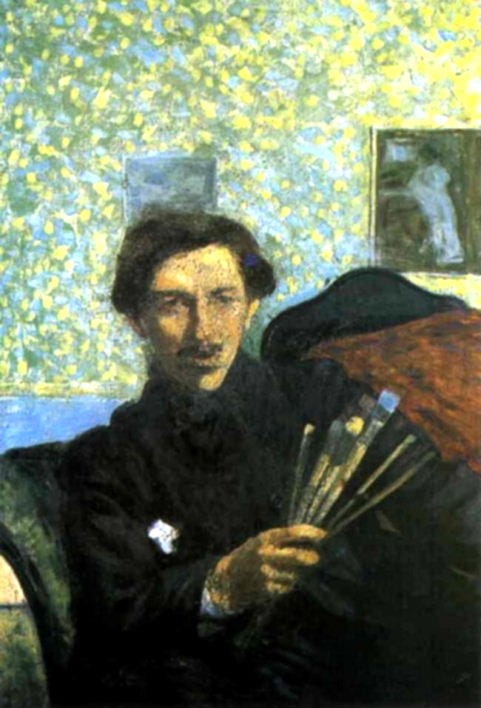
Boccioni was born in Reggio Calabria on October 19, 1882, and learned divisionist color in Rome around 1901 alongside Gino Severini, in the studio of Giacomo Balla.
Settling in Milan in 1907, he met the poet Marinetti, whose 1909 Futurist manifesto had declared a roaring motorcar more beautiful than the Victory of Samothrace.
Boccioni drafted the painters' answer: the Manifesto of Futurist Painters and its technical sequel, both 1910, signed with Balla, Carra, Russolo, and Severini.
Painting the city rising
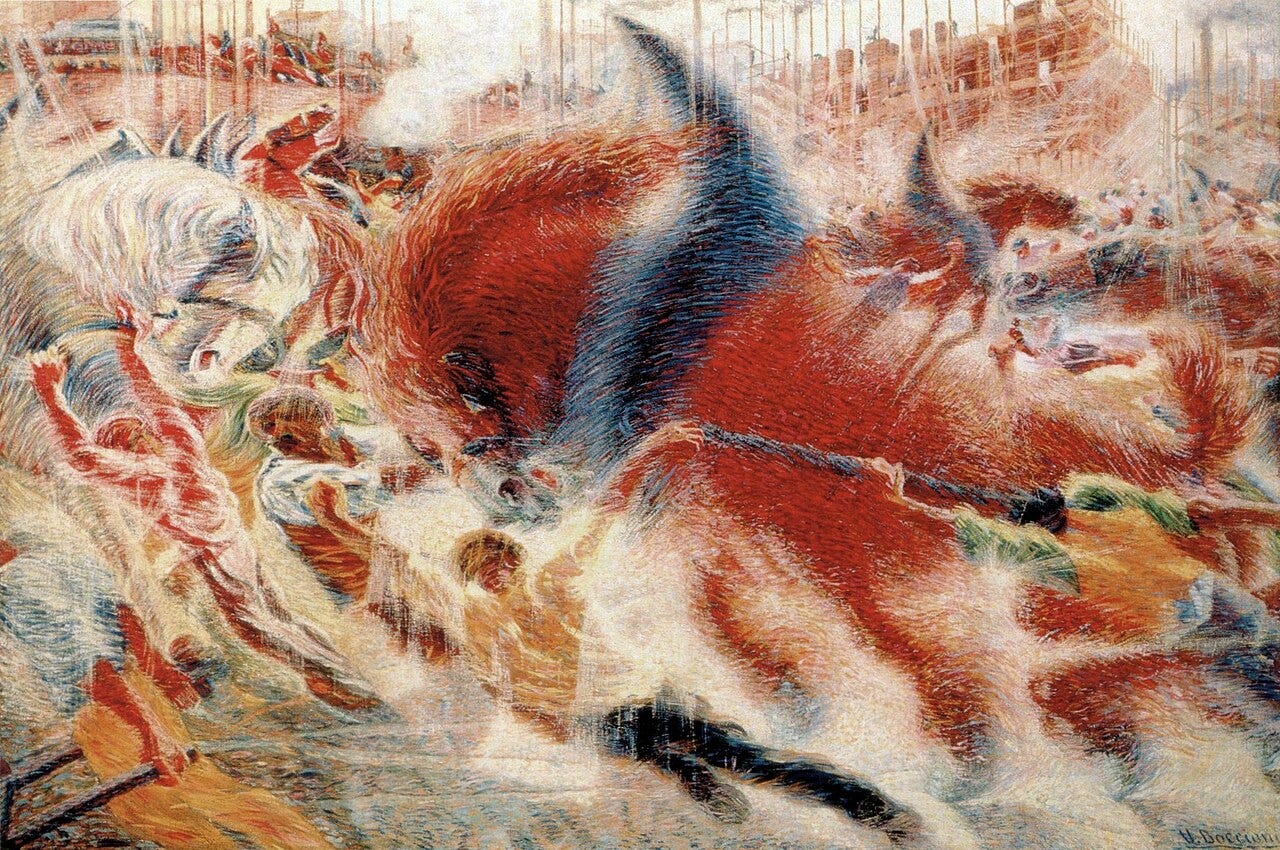
The City Rises of 1910-11, a construction site dissolving into a vortex of straining horses and men, hangs at MoMA as Futurism's first full-scale statement.
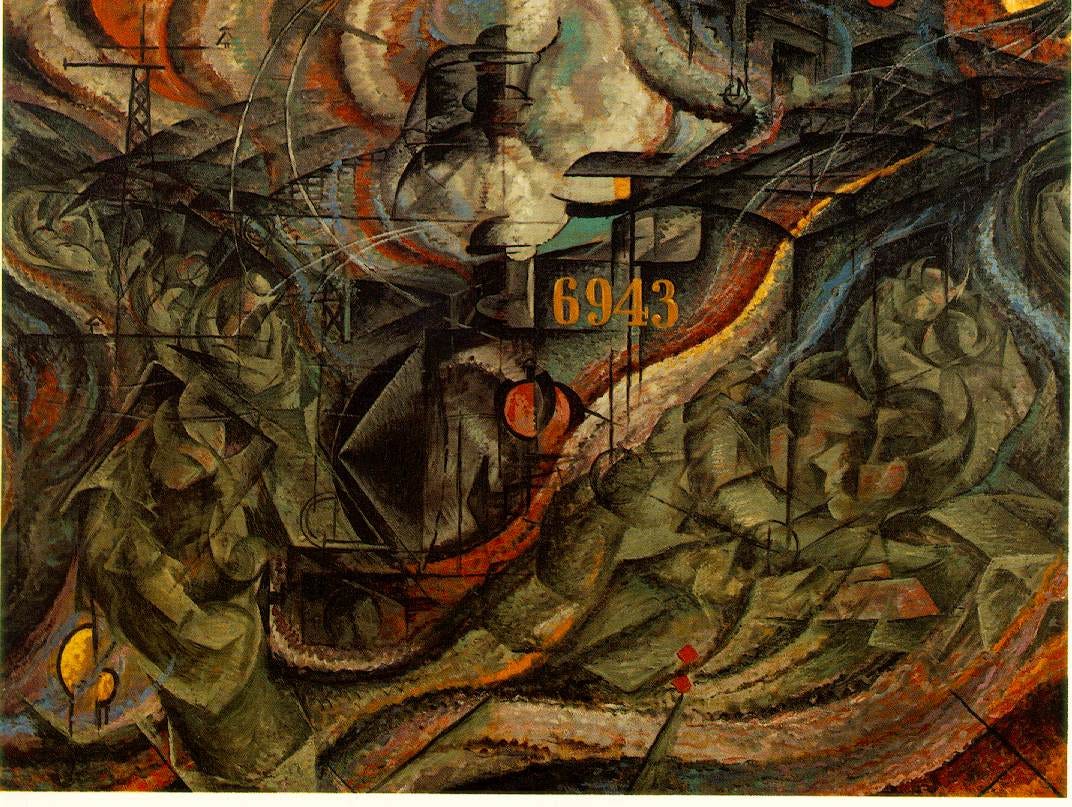
The States of Mind triptych of 1911, farewells and departures in a railway station, turned Bergson's ideas about memory and motion into paint.
Boccioni wanted not the object but its force lines, the way a running thing drags its whole environment with it.
More incredible painter stories
If Umberto Boccioni pulled you in, you will love these too:


1913: the bronze that walks
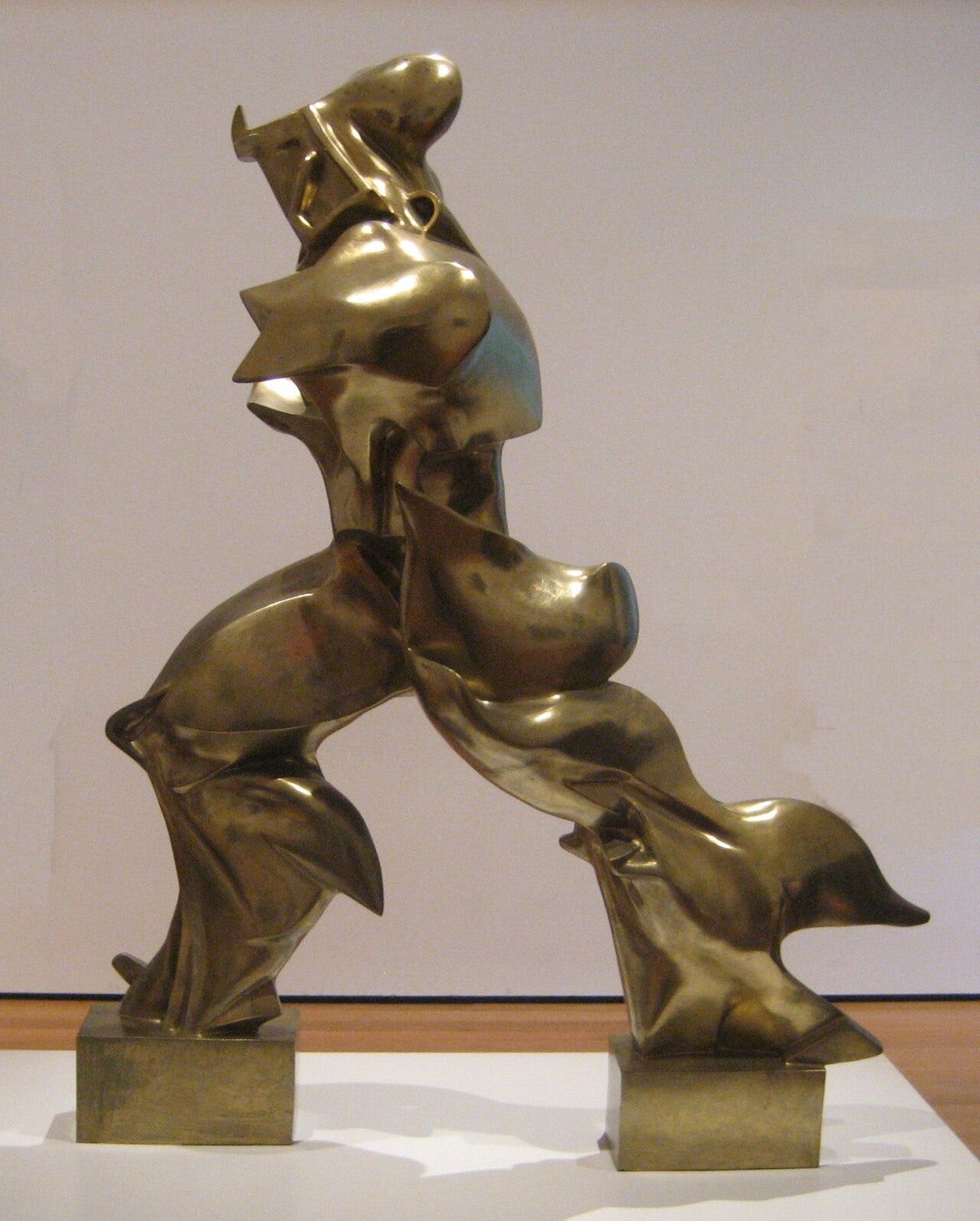
His Technical Manifesto of Futurist Sculpture of 1912 demanded sculpture abandon marble nobility for motion itself, and in 1913 he delivered Unique Forms of Continuity in Space: a figure striding so hard its calves become flames.
Boccioni never cast it in bronze in his lifetime; the casts in MoMA and elsewhere are posthumous, from the surviving plaster. Since 2002 the figure has been in every Italian pocket, on the national 20 cent euro coin.
The myth of the brute of speed
Because the manifestos shout, Boccioni gets remembered as a proto-fascist thug of the machine age.
The work complicates it: he was a trained divisionist and a serious reader of Bergson, his portraits of his mother are tender to the point of ache, and his last canvases of 1916 turn toward Cezanne, structure over speed, a direction cut off mid-thought.
The movement's politics curdled later, without him.
A horse, 1916, and where to see him
Boccioni volunteered in 1915 with Marinetti in a cyclist battalion, was discharged, and was recalled to an artillery regiment in 1916.
On August 16, near Verona, his horse bolted during a training exercise and threw him; trampled, he died the next day, at 33.
The man who called war the world's only hygiene was killed not by shellfire but by the oldest transport there is.
MoMA holds The City Rises, the States of Mind, and a Unique Forms cast; Milan's Museo del Novecento keeps the largest Italian collection, and the original plaster is in Sao Paulo.
Three ways to stand on a platform
The States of Mind triptych takes one railway farewell and paints it three times: The Farewells, Those Who Go, Those Who Stay.
Embraces dissolve into steam and stenciled numbers; travelers stream in diagonals; the ones who remain hang in vertical rain.
It is Futurism's tender secret: the movement that worshipped machines painted its best picture about missing people.
The sculptures we lost
Unique Forms exists in bronze only through posthumous casts; Boccioni knew it in plaster.
Most of his other sculptures barely outlived him: stored plasters were lost or destroyed in the 1920s, and photographs are all that remain of pieces like Spiral Expansion.
Four sculptures survive of at least eleven documented. The movement that promised to burn museums lost its own best contents to a warehouse.
The 1916 turn
In uniform in 1916 he painted the pianist Ferruccio Busoni in a manner closer to Cézanne than to any manifesto.
His letters from that year worry about solidity, construction, the old masters: the arch-Futurist was quietly renegotiating with the past.
The fall from the horse ended the argument mid-sentence. What Italian art lost was not more speed; it was whatever came after speed.
Boccioni ranked against the other Futurists
Giacomo Balla painted movement as a diagram, a dog's legs multiplying frame by frame in Dynamism of a Dog on a Leash. Boccioni painted movement as force, letting a body drag its surrounding space along with it. One explains motion, the other turns it into violence.
Gino Severini brought real Cubist structure back from Paris and never let go of decoration and color. Carrà wrote louder manifestos than he painted. Marinetti supplied the noise and barely touched a brush.
Ranked by ambition alone: Unique Forms of Continuity in Space first, the States of Mind triptych second, The City Rises third. The sculpture solved what the paintings could only approximate, giving motion actual volume instead of just direction. Severini's Cubist canvases from the same years read as decorative footnotes beside it.
Balla lived until 1958, Severini until 1966 and Carrà until 1966 too, decades to keep revising the idea. Boccioni had six years and one sculpture that outlasted the argument.
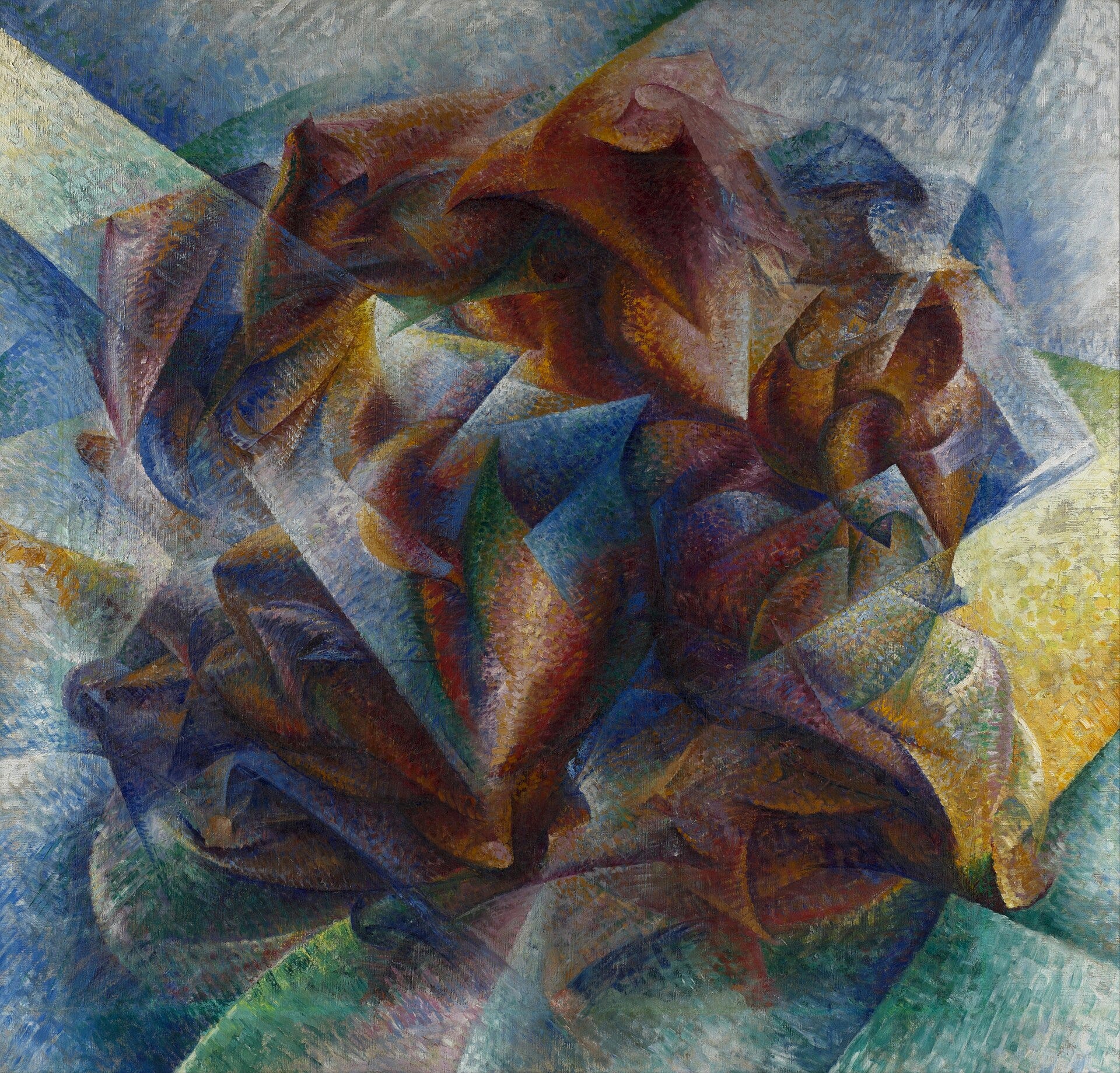
The Umberto Boccioni questions that keep coming up
What is Futurism? The Italian movement launched by Marinetti in 1909 that worshipped speed, machines, and the modern city, with Boccioni as its chief painter and theorist.
What is Unique Forms of Continuity in Space? His 1913 striding figure, sculpture as pure momentum, cast in bronze only after his death and engraved on Italy's 20 cent euro coin since 2002.
How did Boccioni die? Thrown and trampled by his own bolting horse during army training near Verona in August 1916, at 33.
Where can I see Boccioni? MoMA in New York, the Museo del Novecento in Milan, and the original plaster of Unique Forms in Sao Paulo.
How much does a Boccioni cost? Almost nothing circulates: the paintings sit in Milan and New York, and a drawing that surfaces commands six figures on rarity alone.
Are his writings available? Yes: Futurist Painting Sculpture, from 1914, plus diaries and letters. He was the movement's best theorist as well as its best hand, which is why the loss stayed unrepaired.
More secrets to unlock


Legal tender, handled daily
The man who declared a racing car more beautiful than ancient sculpture is now himself the ancient sculpture: his striding bronze has been legal tender's face in Italy for a quarter century, handled daily by millions who never read a manifesto.