Bronzino: The Complete Story

His portraits feel carved from cold stone. The dukes and duchesses of Florence stare out with smooth, masklike faces, dressed in fabrics so finely painted you could count the threads, betraying nothing. This icy elegance was the signature of Bronzino, the court painter who made the Medici look immortal.

Venus, Cupid, Folly and Time by Bronzino
Bronzino, Venus, Cupid, Folly and Time

He was the leading portraitist of sixteenth century Florence, a master of polished surfaces and aristocratic distance whose chilly perfection defines Mannerist portraiture.


The faces of power, free in your inbox.


The enamel finish

Bronzino painted with a hard, glassy smoothness, as if his sitters were made of porcelain. Skin glows like polished marble, jewels and silks gleam, and emotion is held firmly in check.

This refined, artificial elegance is Mannerism at its most controlled, beauty as a kind of armour.

The Medici machine

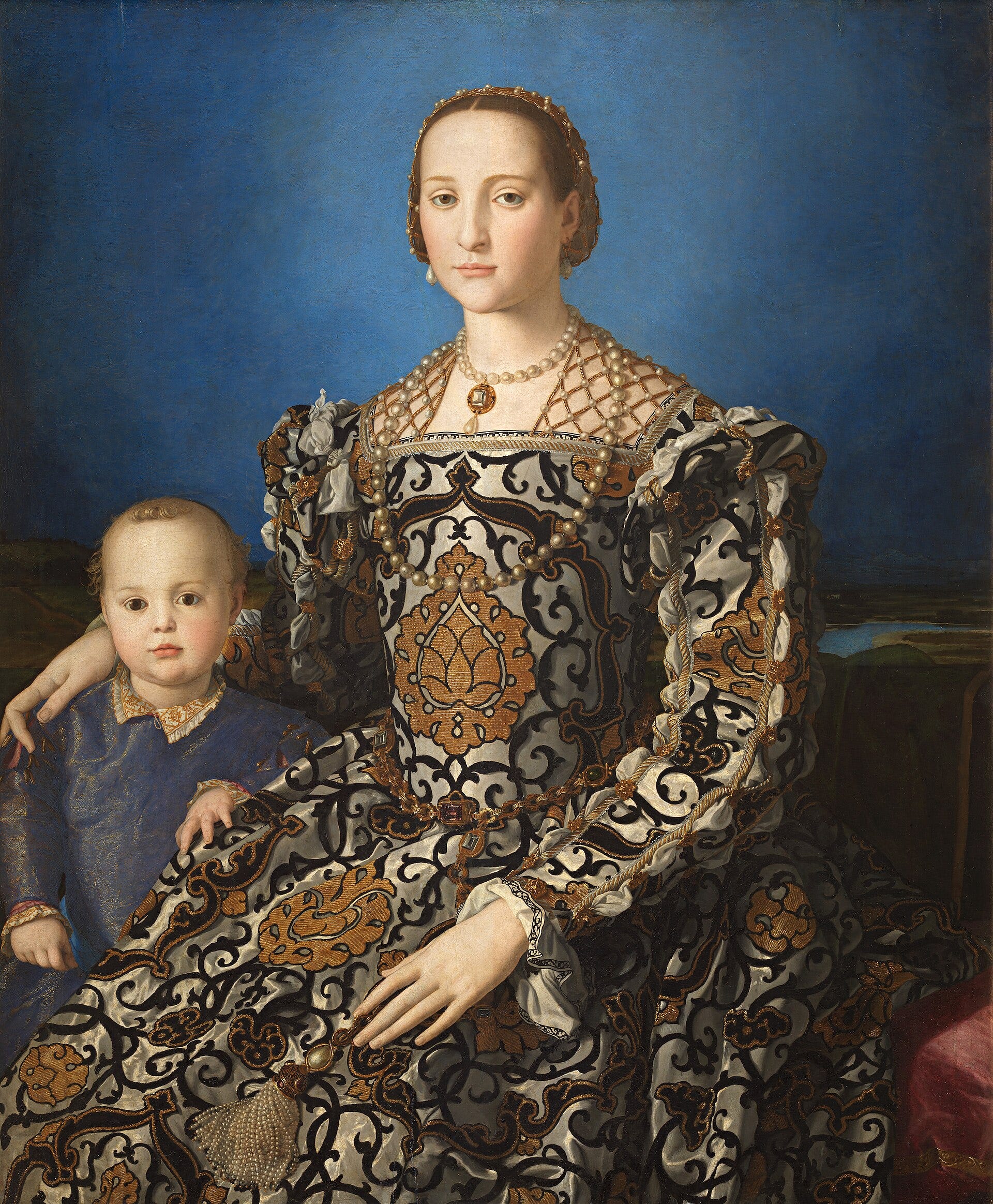
Portrait of Eleonora of Toledo by Bronzino
Bronzino, Portrait of Eleonora of Toledo

As court painter to Duke Cosimo the First, Bronzino produced the official images of the Medici family. His portraits were tools of power, designed to make the rulers of Florence look dignified, untouchable and eternal.

His portrait painting of Eleonora of Toledo, in a gown of breathtaking detail, is one of the most famous court portraits ever made.

The riddle in London

Portrait of Lucrezia Panciatichi by Bronzino
Bronzino, Portrait of Lucrezia Panciatichi

One of his strangest works is the allegory often called Venus, Cupid, Folly and Time, now in London. It is a cold, erotic puzzle packed with figures and hidden meanings that scholars still argue over.

Beautiful and unsettling, it shows how Mannerism loved cleverness and ambiguity as much as straightforward beauty.

The pupil and the chapel

Portrait of Cosimo de Medici by Bronzino
Bronzino, Portrait of Cosimo de Medici

Bronzino was the devoted pupil of Pontormo, and absorbed his master strange grace before cooling it into something more polished and controlled.

His frescoes in the chapel of Eleonora in the Palazzo Vecchio show that side of him, while he also painted lighter touches, including a memorable portrait of the court dwarf Morgante.

What people ask about Bronzino

What is he known for?

Cold, elegant Mannerist portraits of the Medici court of Florence.

Who did he work for?

Duke Cosimo the First de Medici, as official court painter.

Who taught him?

Pontormo, the great Florentine Mannerist.

When did he die?

In 1572, in Florence.

Why the cold faces hold us

Bronzino turned distance into an art form. His sitters give nothing away, and that very coldness is what keeps us looking, searching faces that were painted, on purpose, to stay shut. He fixed the Medici in time exactly as they wished to be seen.


Your weekly dose of art, loved by 110,000 readers. Join free.


He was also a published poet, moving easily between paint and verse in the cultured world of the Medici court. So fully did he merge with that court that for centuries his name meant, above all, the cool official face of Florence under its dukes. His enamel like finish was so prized that rulers across Italy wanted their likenesses in his hand, and copies of his Medici portraits were sent abroad as gifts of state, spreading the cold Florentine ideal of dignity through the courts of Europe. He worked closely with the writer and historian Vasari on grand decorative schemes for the Medici, binding his art tightly to the propaganda of the ruling house. Late in life he also oversaw the famous Medici tapestry workshops, designing scenes that were woven in gold thread for the halls of the Palazzo Vecchio, so his cold elegance reached even into the fabric on the walls.


Two stories a week, a hundred secrets unlocked. Start free.