

170 000+ readers. Learn art the fun way.
This is a preview. Paid subscribers get the full story.
You’ll also get:
10 new stories every month
The full archive (130+ Art stories)
Your personal art guide. Comment, ask questions, DM me anytime
iPhone user? Subscribe at coolstoriesabout.art, not via the app. Apple adds 30% to the price.
In Valletta, Caravaggio is everywhere. On hotel signs, souvenir shops, pizzerias, on posters for immersive experiences and tour operators. The Maltese capital lives off the brief stay of this man who spent only a year and three months there.
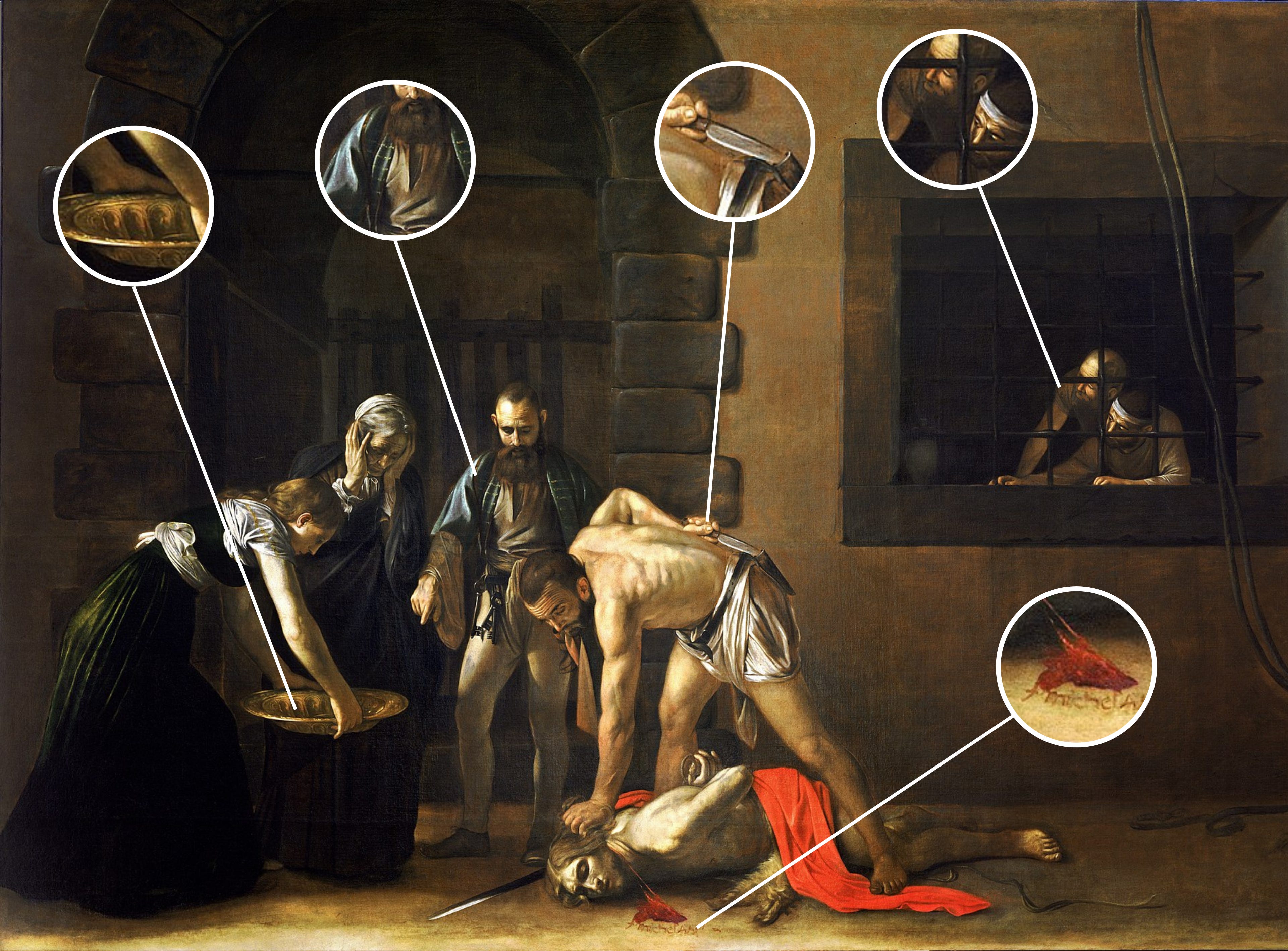
In front of the Co-Cathedral of Saint John, sunburned shoulders and necks white with sunscreen wait in line. They all come for the same thing: a painting. At the back of a side oratory, on a single wall, since 1608. 3.61 meters high by 5.20 meters wide. The largest he ever painted in his life, with life-size figures.
The Co-Cathedral is the church of the Knights of Saint John, the military order born in the Holy Land at the time of the Crusades. Their patron saint has always been John the Baptist, and it is his beheading that Caravaggio painted above the altar where his relics are displayed on feast days.
The painting dates from 1608. It tells the story of the Baptist as much as the story of the man who held the brush.
Dirty Feet
Before him, in the Renaissance, saints were painted as idealized figures: perfect faces, sumptuous drapery, golden light. With Raphael or Leonardo, everything was about elevation.
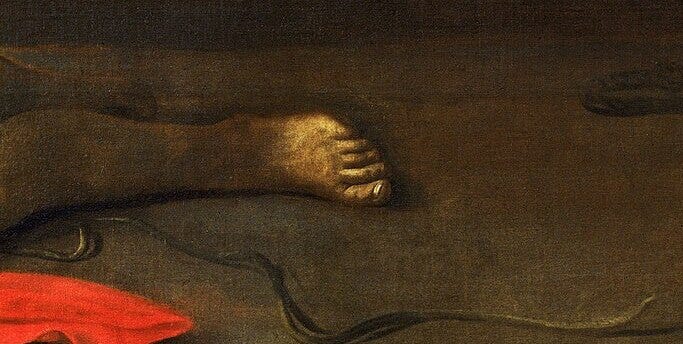
Caravaggio takes the opposite path. He paints saints as ordinary men, with dirty feet, broken nails, worn clothes. He picks his models from the street: porters, prostitutes, thieves.
For The Death of the Virgin, his painting now at the Louvre, he uses the body of a prostitute as his model. The Carmelites who commissioned the painting reject it.
This approach has a precise purpose. For Caravaggio, a believer cannot be moved by a saint unless he can recognize himself in him. And a believer in Rome at the start of the 17th century does not look like a Raphael: he looks like a porter, a servant, a prisoner.
The Knife Being Drawn
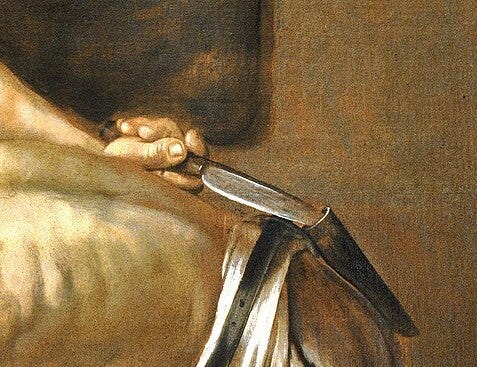
Look at the executioner. His right hand plunges into his belt to pull out a short dagger with a straight blade.
The weapon is designed to slip between the armor plates of a wounded knight on a battlefield, and finish him off in one strike. It carried a name throughout military Europe, from the Latin: misericordia, mercy. The blade that shortens suffering.
The executioner is about to give his mercy to the saint.
The Finger That Falls
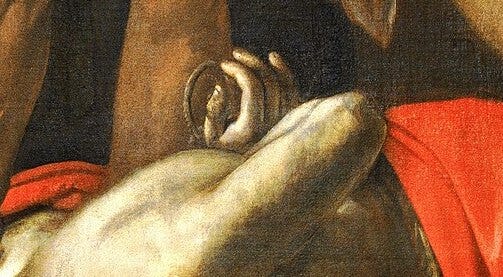
Look down at the body. The Baptist’s right hand, tied behind his back, palm facing up, index finger curled.
In all Christian painting, and notably in Leonardo da Vinci’s work, John the Baptist has his right index finger raised toward the sky. It is his signature gesture, the one that distinguishes him in every painting. It points to the coming of Christ.
Caravaggio painted him seven times with that finger raised. Here, for the only time, he paints it slack. The finger that announced God announces nothing anymore. The prophet’s mission is over.
Discover my new newsletter !

The Maid With the Platter
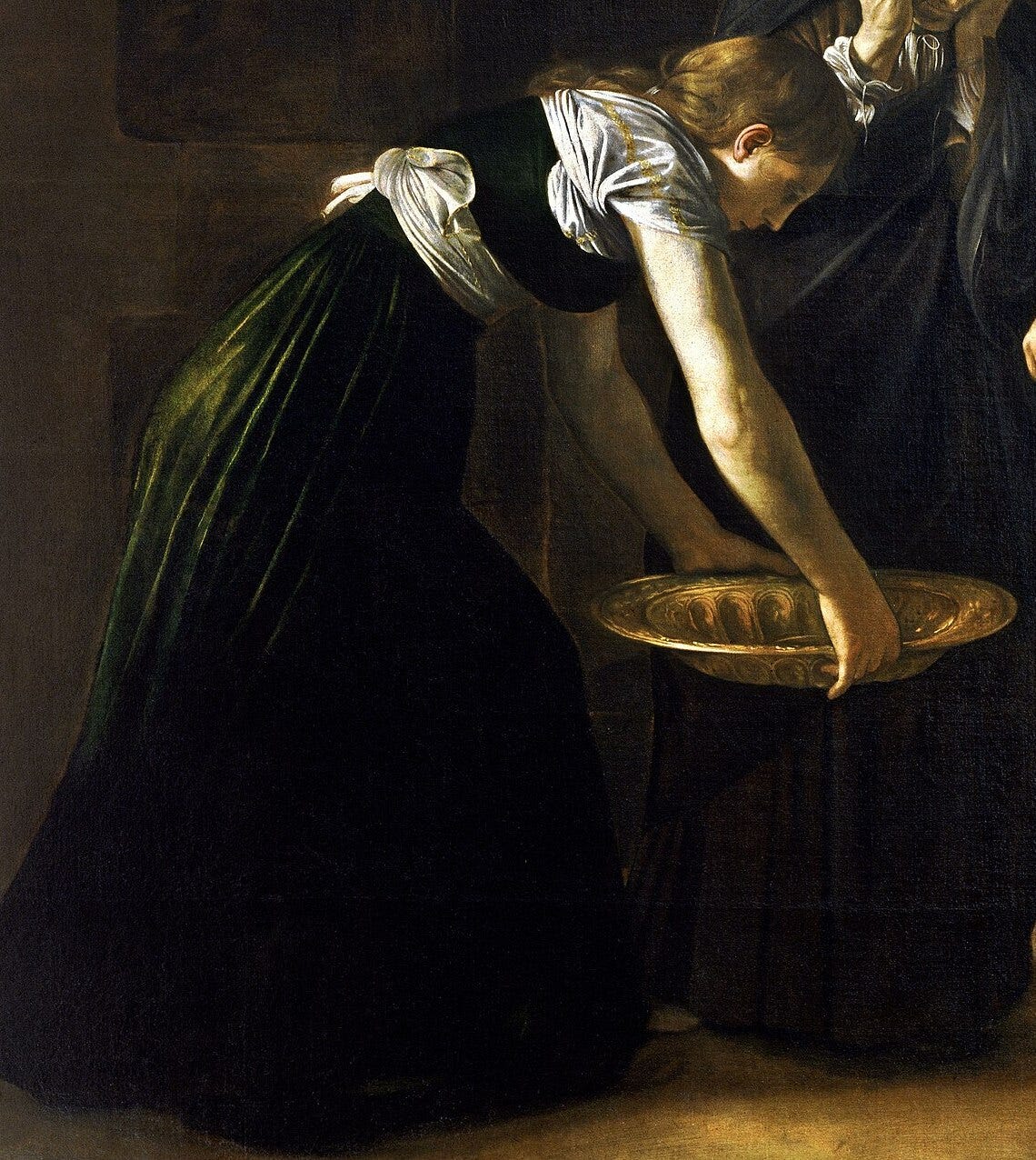
Look to the right of the executioner. A young woman leans forward, simple clothes, no silk, no jewelry. With both hands, she holds a large golden dish that she lowers almost to the ground to receive the head.
The story comes from the Gospel of Mark, chapter 6. In the first century, in Galilee, King Herod Antipas had John the Baptist imprisoned in a fortress near the Dead Sea. The prophet had publicly denounced him for marrying Herodias, his brother’s wife who was still alive.
During the banquet for his birthday, Herod watches Herodias’s daughter, Salome, dance. Delighted, drunk, he swears to give her whatever she wants. Her mother, who has held a grudge against the prophet since his denunciation, whispers the request in her ear: the head of John on a platter. The king keeps his oath.
And Caravaggio dresses the princess as a servant. No silk, no oriental luxury, no royal hall. Just a young woman bending down to receive a head.
The Golden Basin
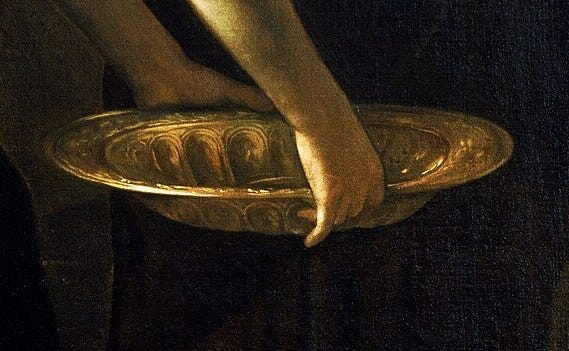
Now look at the dish the maid holds. Hammered gold, wide, round edge. An empty circle.
When John’s head falls into the dish later, the platter will frame it entirely. The shape that will appear is not a kitchen object. It is a halo. And it is at that precise second, at the moment of impact on the gold, that John becomes a saint.
The Lambskin
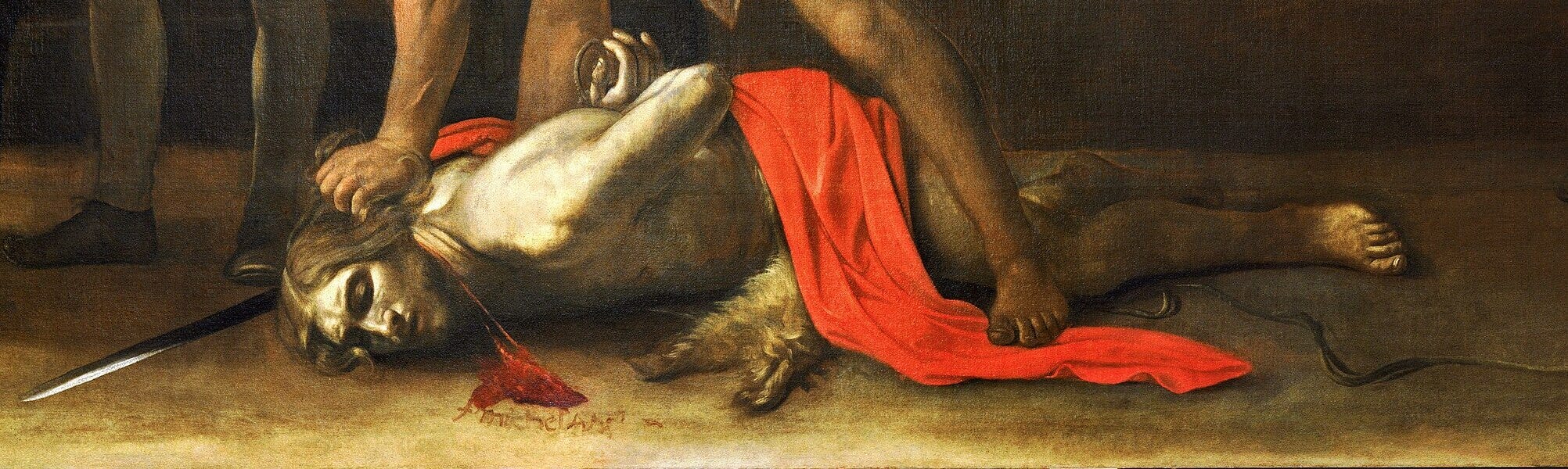
Look back at the saint’s body. Under the scarlet cloak that slips off his shoulder and spreads in the foreground, you can make out the texture of an animal skin tunic, camel or sheep. It is the classic attribute of John in the desert, who preached wearing skins and lived on locusts and wild honey.
Caravaggio goes further.
He lays the saint on the fleece, the way you lay an animal on a slab. The torn-off paws of the animal hang on the stone, in a geometry that mirrors the position of the prophet’s lifeless legs.
In the Christian tradition, John the Baptist had pointed at Christ in front of the crowd, crying: “Behold the Lamb of God.” Ecce Agnus Dei. The lamb was Christ, the one who would let himself be sacrificed to redeem the sins of men, like the lamb of Jewish sacrifice.
Caravaggio takes the image literally. The preacher who pointed at the lamb takes the lamb’s place, on the slab, emptied onto the stone.
The Rope


Look at the saint’s wrists. A thick hemp rope binds his wrists behind his back. It extends along the ground to his feet.
In classical Christian painting, John the Baptist holds a paper scroll on which are written, in Gothic letters, the three words he spoke at the Jordan: Ecce Agnus Dei.
Caravaggio removes the scroll. The rope that binds the saint draws the same curve on the ground as the unrolled scroll would.
The Ears, Not the Eyes
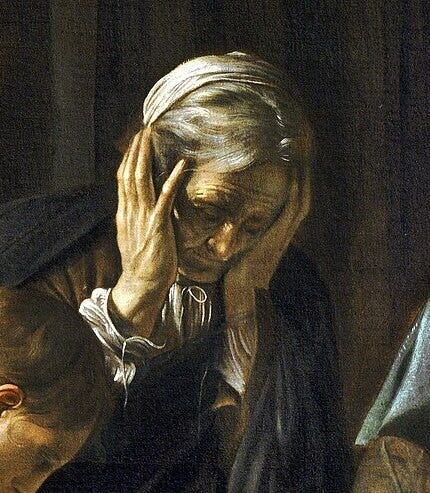
Look behind the young woman with the platter. An old woman, wrinkled face. Her hands rise to her face, but they do not cover her eyes: they press against her ears.
She is the only figure in the painting who reacts to what is happening. All the others are busy or indifferent. The executioner executes, the warden orders, the maid waits, the saint dies.
She is the one who suffers. An ordinary old woman, wrinkled, without grace. And it is the sound she cannot bear, not the sight: the scrape of the knife on bone, the cartilage giving way one piece at a time.
The Warden in Turkish Dress
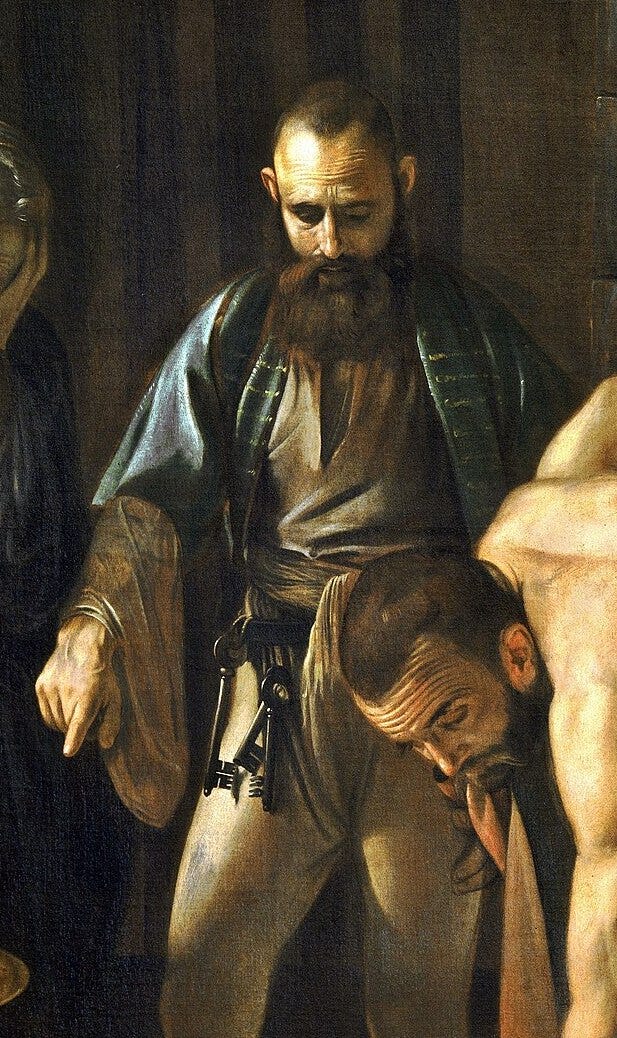
In the middle of the scene, standing, an old bearded man dominates the composition. He extends his index finger to show the executioner where to place the head. From his belt hangs a heavy ring of keys.
These keys have a precise function in the story. John the Baptist was not killed in the street, he was imprisoned for months. The old man with the keys is the one who opened the door of his cell to bring him out to the stone.
His clothing is not that of a Roman official or a servant of Herod. It is Turkish.
For the Knights of Malta praying in the chapel, the meaning is immediate.
Forty-three years before Caravaggio painted this work, in June 1565, the Ottomans had taken Fort Saint Elmo at the entrance of Marsamxett harbor.
They had beheaded the fallen knights, then Pasha Mustafa had their bodies nailed to wooden crosses and set them drifting across the bay to terrify the Grand Master Jean de Valette, the founder of the city.
When a knight looks at Caravaggio’s painting, the executioner of the Baptist is not Herod’s man. He is the image of the enemy who beheaded their brothers.
Keep learning art the fun way


The Two Faces at the Bars
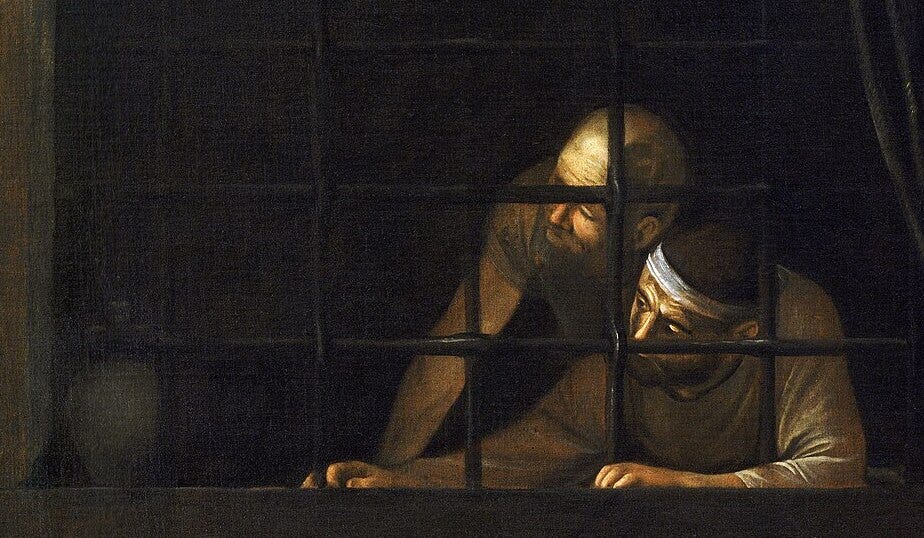
Look to the far right. In the wall of the archway in the background, two men’s faces pressed against the iron grate of a cell, in the brown tunics of the poor. They stretch their necks to miss nothing of the execution.
At first glance, they are ordinary prisoners watching the execution by chance in the courtyard where they are held. They are not. They are a quotation.
The rule book of the Order of Saint John contains an engraving illustrating the two possible fates for a knight. On the right, those who remain virtuous and free. On the left, behind prison bars, those who have broken the rules.
Caravaggio transposed this engraving into his painting. The prisoners in the oratory are not anonymous criminals. They are knights who have broken the rules.
Remember these two faces.
At 36, by delivering this painting to the Knights of Malta, Caravaggio thought his life was saved. Five months later, in this same room, in front of this same painting, it collapsed…