
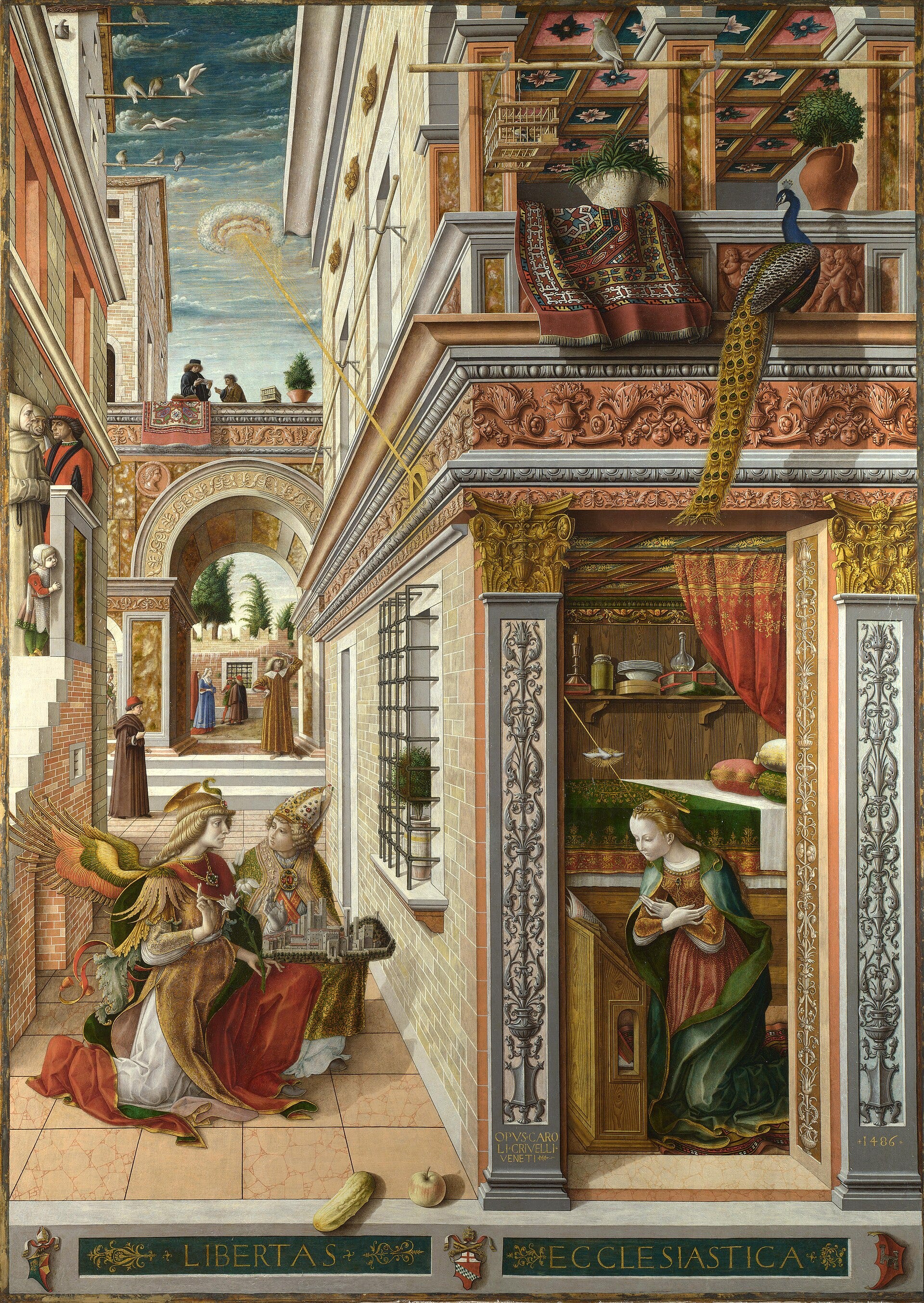
Carlo Crivelli was a Venetian painter, born around 1430, who spent most of his career in the Marche and died around 1495, probably in Ascoli Piceno. He painted only sacred scenes, in egg tempera and raised gold, with sharp outlines, brocades and fruit. He is remembered for the 1486 Annunciation in London, where a cucumber and an apple sit on the front ledge, and for a signature that kept claiming Venice.
In 1457 Venice sentenced him to six months in prison for abducting a sailor's wife. He left the city, and the signature he used in later years often read Carolus Crivellus Venetus, Carlo Crivelli of Venice.
Cool Stories About Art is a newsletter to learn art the fun way.
Join 200,000+ readers and get:
10 new art stories / month
The entire archive of content (1,000+ articles)
Comment, ask questions, and chat with other readers
The picture people look up shows an angel arriving in a small Italian town. A ray of light breaks through the clouds and enters the house where Mary kneels, a carpet hangs over the loggia, a peacock stands on a ledge and a goldfinch sits in a cage. In the foreground, on the step, lie an apple and a cucumber.
The altarpiece was made for the church of the Santissima Annunziata in Ascoli Piceno, to celebrate the self-government that Pope Sixtus IV had granted the town in 1482. The pope's coat of arms is painted at the base. Saint Emidius, the town's patron, kneels beside Gabriel and shows him a model of Ascoli.
So the most discussed vegetable in Renaissance painting sits inside a civic thank-you note. If Crivelli ever explained the cucumber, the explanation has not survived.
What You'll Discover
Why he left Venice behind.
Who paid for the gold.
How gold rises off a panel.
What the cucumber is doing there.
What he added to his name.
Who left him out of the story.