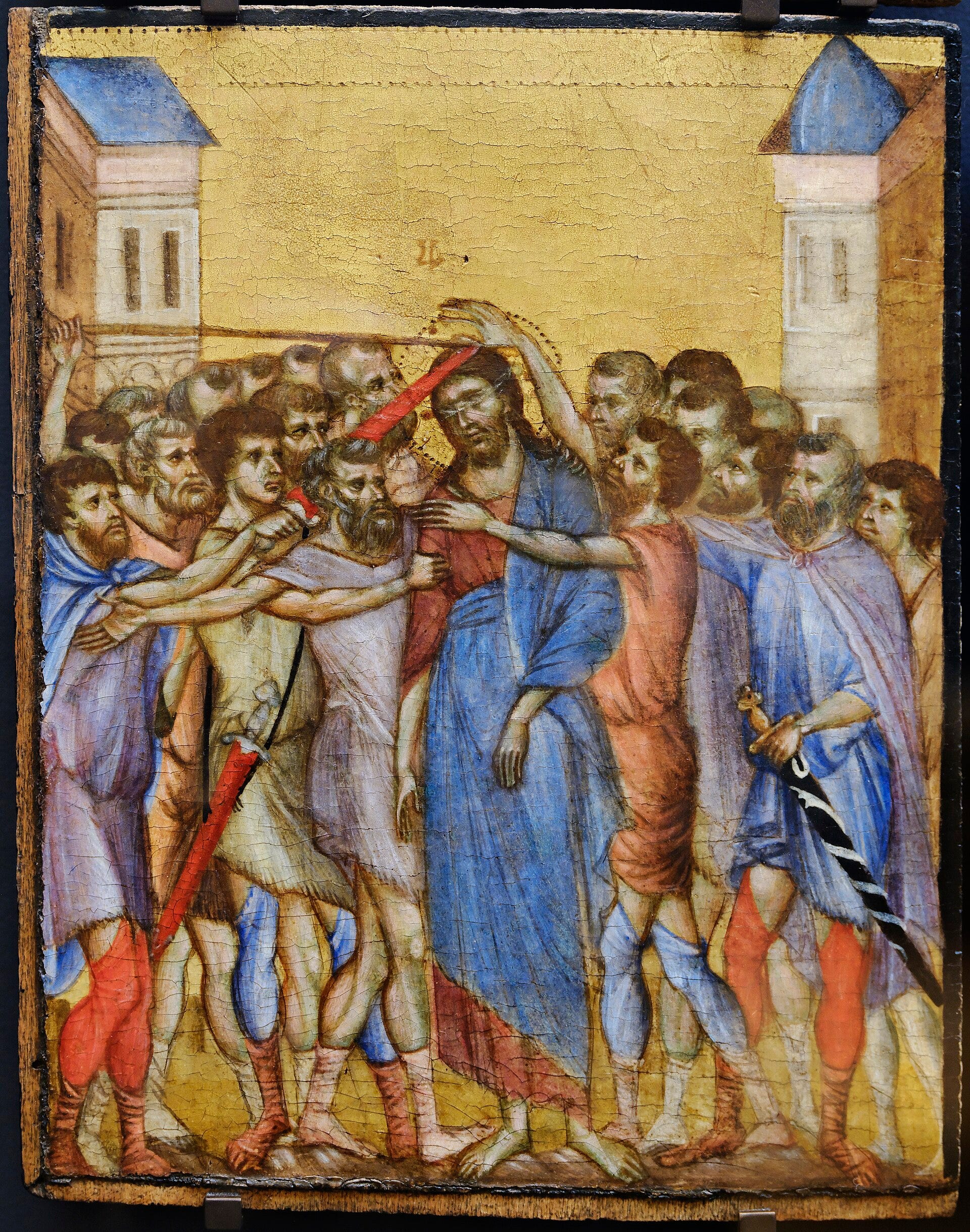
Cimabue: The Complete Story

According to legend, an established master was riding through the Tuscan countryside when he came upon a shepherd boy scratching a drawing of his sheep onto a flat rock. The master was Cimabue, the boy was Giotto, and Cimabue took him on as a pupil. Whether or not it is true, it captures his real place in history: the last great master of the old way, who opened the door to the new.

Santa Trinita Maesta, c 1290 by Cimabue
Cimabue, Santa Trinita Maesta, c 1290

Cimabue stood at the very hinge of Western painting, the final giant of the Italo Byzantine style and the man who began, just barely, to loosen it toward real human feeling.


The roots of Western art, free in your inbox.


The bridge out of Byzantium

For centuries Italian painting followed the Byzantine model: flat, golden, solemn images with little depth or emotion. Cimabue worked in that tradition but began to soften it, giving his Madonnas a touch of weight and tenderness.

He worked in tempera painting on panel and in fresco, the standard tools of his age, while quietly bending the old iconography toward life.

The boy on the rock

fresco at Assisi by Cimabue
Cimabue, fresco at Assisi

The most famous story about Cimabue is Vasari tale of finding the young Giotto drawing a sheep on a flat stone, and being so struck that he took the boy as his pupil.

Whether or not it happened, Giotto did surpass his master and push painting toward full naturalism, so Cimabue is remembered partly for the genius he discovered.

The line in Dante

Madonna and Child by Cimabue
Cimabue, Madonna and Child

Cimabue holds a strange honor: he is named in Dante Divine Comedy. In Purgatorio, Dante writes that Cimabue thought he held the field in painting, but now the cry is for Giotto, and his fame is dimmed.

It is one of the earliest written comments on artistic fame and how quickly it passes, a medieval reminder that even the greatest get overtaken.

The crucifix and the flood

the Louvre Maesta
Cimabue, the Louvre Maesta

One of his masterpieces, the painted Crucifix in Santa Croce in Florence, met disaster in the great flood of 1966, when filthy water tore away much of its paint, making it a symbol of the fragility of old art.

His frescoes at Assisi suffered another slow fate: the white lead pigments darkened over the centuries, so the lights now read as darks, like a photographic negative of what he painted.

Cimabue, your questions answered

What is he known for?

His grand Byzantine style altarpieces and for being the teacher of Giotto.

Did he really discover Giotto?

Vasari tells the story of him finding the shepherd boy drawing, though it may be legend.

Why is he in Dante?

Dante uses him as an example of fame passing quickly, overtaken by Giotto.

When did he die?

Around 1302, in Pisa.

Why the old master still matters

Cimabue stands right on the hinge of art history, the last of the old world and the man who opened the door to the new. He was overtaken almost at once, by his own pupil, which is perhaps the most generous thing a great artist can do.


Join 110,000 readers who learn art the fun way. Free.


We are not even sure Cimabue was his real name. It may have been a nickname meaning something like ox head or bull headed, a hint that the founder of Florentine painting was remembered as stubborn. He also worked on the great mosaics of Pisa Cathedral late in life, and Vasari, writing two centuries later, opened his famous Lives of the Artists with Cimabue, treating him as the man who began the rebirth of painting.


One good art story at a time. Join free, no catch.