
Dante Gabriel Rossetti was the poet painter at the heart of the Pre Raphaelites, who filled his canvases with sensual, dreaming women framed by flowers and symbols.
He was also a romantic disaster: a tangle of muses, obsession, drugs and one of the strangest stories in art, the night he buried his poems in his wife's coffin, then dug them back up.
Half his power is the painting, half is the myth he lived. With Rossetti the two are impossible to separate.
Born: London, 1828, into an Italian family
Known for: Pre Raphaelite founder, sensual symbolic women, poetry
Died: Birchington on Sea, England, 1882
More incredible painter stories
If Dante Gabriel Rossetti pulled you in, you will love these too:


Dante Gabriel Rossetti at a glance
1828. Born in London to an Italian exile who taught and studied Dante.
1848. Founded the Pre-Raphaelite Brotherhood, signing pictures with the secret monogram PRB.
1860. Married Elizabeth Siddal, who died less than two years later.
1869. Had the notebook of poems he had buried with her exhumed from Highgate by lamplight.
1882. Died at Birchington-on-Sea at 53, buried there rather than at Highgate.
The exiles of Charlotte Street
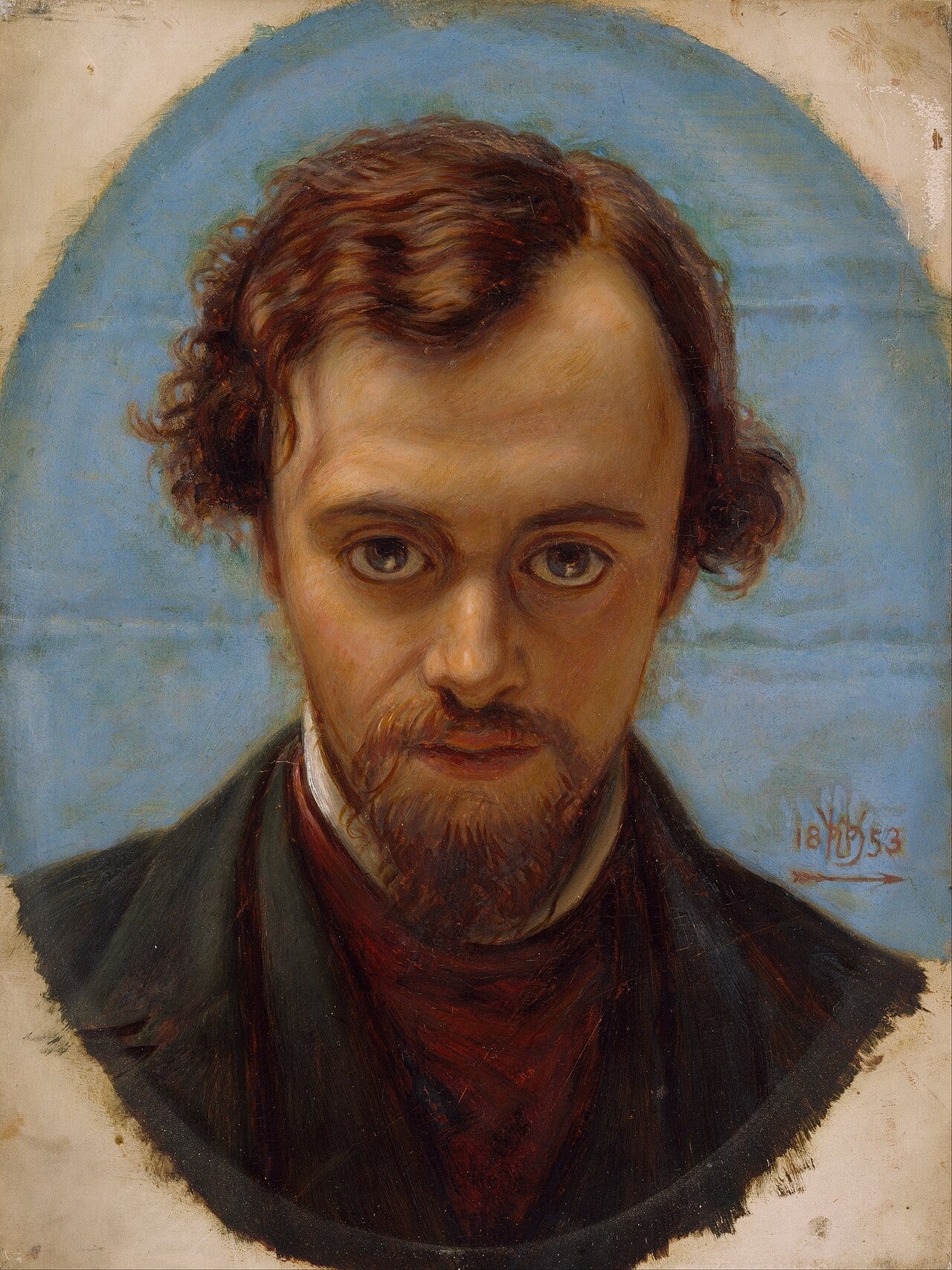
Rossetti was born on 12 May 1828 at 38 Charlotte Street in London, into a household of Italian political refugees. His father, Gabriele Rossetti, was a Dante scholar who had fled Naples after backing the failed Neapolitan constitution of 1820 and reached England in 1824.
The four children came fast: Maria in 1827, Gabriel in 1828, William Michael in 1829, and Christina in 1830. They were taught at home by their mother, Frances Polidori, in rooms that filled with Italian scholars and exiles.
The talent ran sideways as well as down. Christina Rossetti wrote Goblin Market in 1862, and their brother William Michael became the careful diarist and secretary who left much of what we know about the Brotherhood.
Seven young men and a secret monogram
In 1848 Rossetti helped launch the Pre Raphaelite Brotherhood with John Everett Millais and William Holman Hunt. There were seven members in all, every one a Royal Academy student except William Michael Rossetti, who could not draw but kept the minutes.
They signed their canvases with the initials PRB and told no one what the letters meant. When the code leaked around 1850, critics treated the secrecy as arrogance.
The group even had a magazine. The Germ appeared in 1850, ran only four issues, and carried Rossetti's early poem The Blessed Damozel before it folded.
From the river at Blackfriars to Chelsea
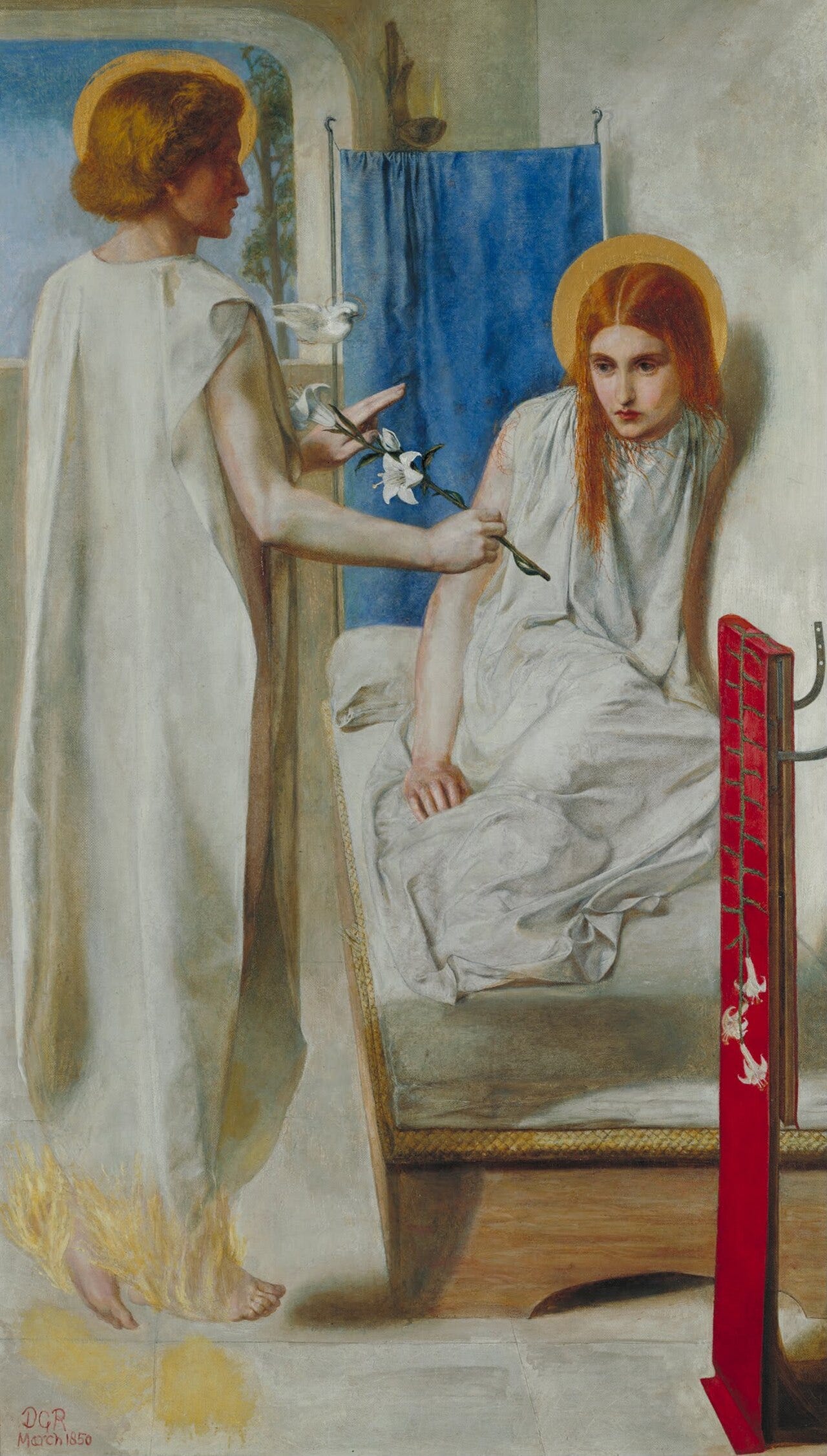
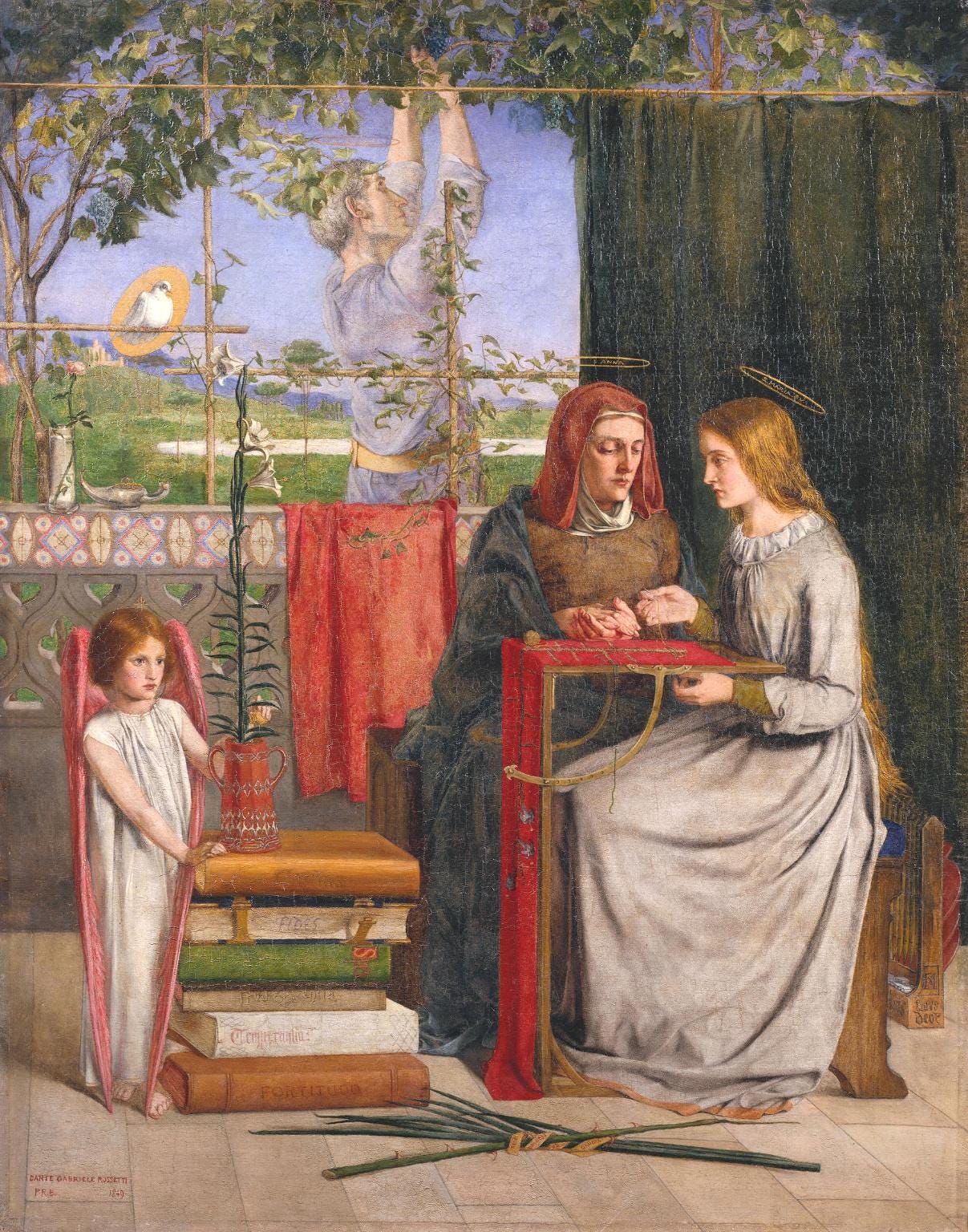
After a spell at Sass's drawing school and the Royal Academy schools from 1845, Rossetti briefly studied under Ford Madox Brown. His first oils, The Girlhood of Mary Virgin in 1849 and Ecce Ancilla Domini in 1850, met harsh reviews that pushed him toward watercolour and private buyers.
For years he worked at Chatham Place, on the river by Blackfriars Bridge, where he set up home with Elizabeth Siddal.
In 1862 he moved to Tudor House at 16 Cheyne Walk in Chelsea, a large house with nearly an acre of garden that would hold the rest of his life.
Elizabeth Siddal, model, pupil and wife
Siddal entered the Pre Raphaelite circle around 1850 as a model for the whole group, then sat for Rossetti alone. He taught her to draw and paint, and she became an artist in her own right before they married in 1860.
Her health was poor and she leaned on laudanum, an opium tincture sold freely at the time. She died of an overdose in February 1862, a death treated at the inquest as accidental.
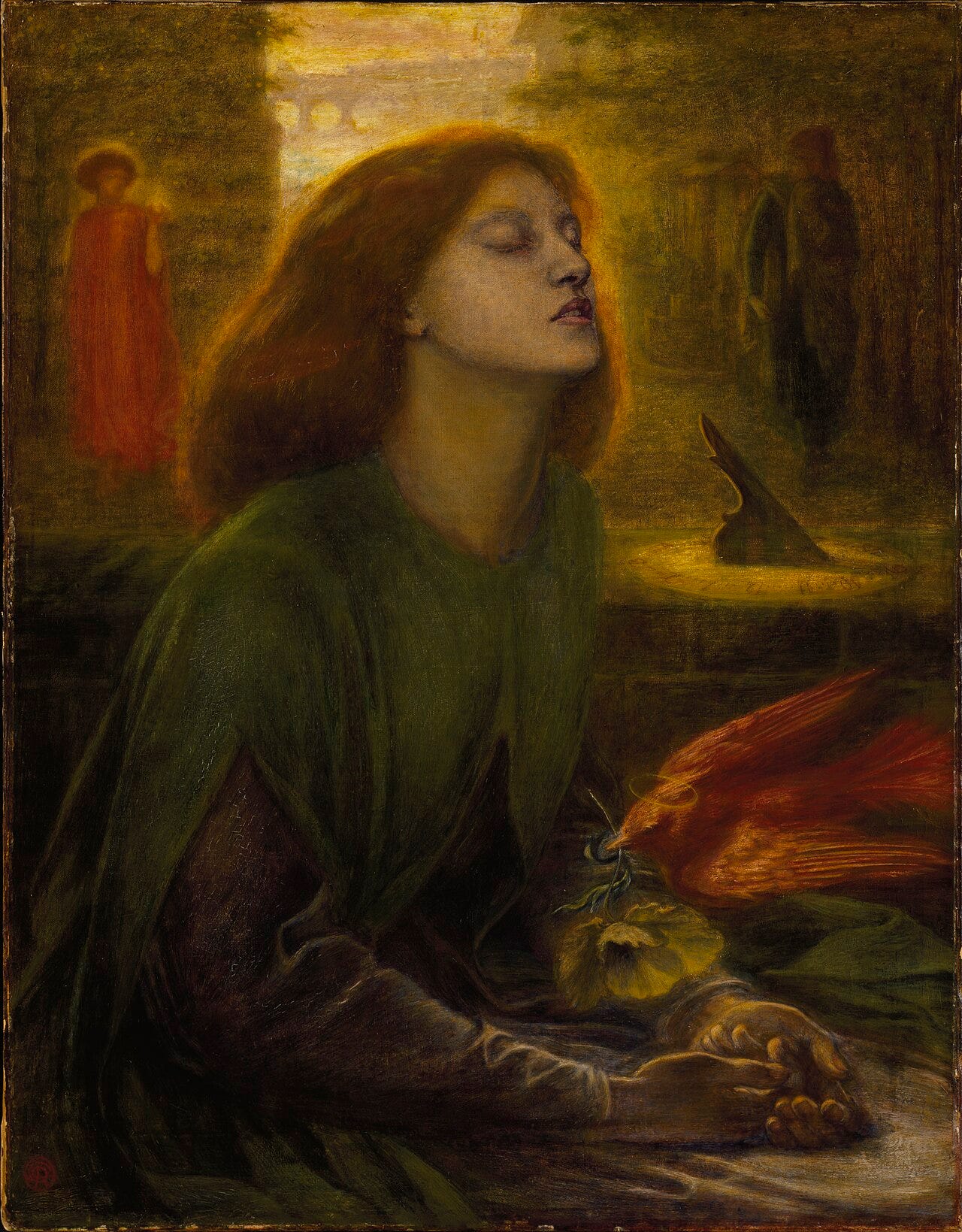
Rossetti turned his grief into Beata Beatrix, casting Siddal as Dante's dead Beatrice. He worked at it through the 1860s, and the finished oil hangs today at Tate.
The grave opened by lamplight
At the funeral Rossetti slid the only complete manuscript of his poems into Siddal's coffin, laid against her cheek. Seven years later he wanted them back to publish, and could not face the grave himself.
The job fell to Charles Augustus Howell, his unconventional man of business, who obtained an exhumation licence quietly, without telling the rest of the family.
One night in October 1869 the coffin was raised at Highgate Cemetery by the light of a bonfire.
Rossetti stayed away. The retrieved book was fouled and worm eaten, and had to be soaked in disinfectant before he could transcribe it. The poems came out as Poems in 1870, and the story shadowed him for the rest of his life.
The menagerie at Tudor House
The Chelsea garden let Rossetti indulge a long appetite for exotic animals. Owls, armadillos, kangaroos, a raccoon that hibernated in a chest of drawers, a Japanese salamander and a small Brahmin bull all passed through, along with the peacocks whose screaming carried down the street.
In November 1867 he tried to buy a young African elephant from the dealer Charles Jamrach, and balked only at the price of 400 pounds.
The most famous resident was a wombat, bought in September 1869. It died on 6 November that year, and Rossetti had it stuffed and set in the front hall.
A Chelsea story still claims his birds are why the estate later barred tenants from keeping peacocks.
Fanny, Annie and Jane
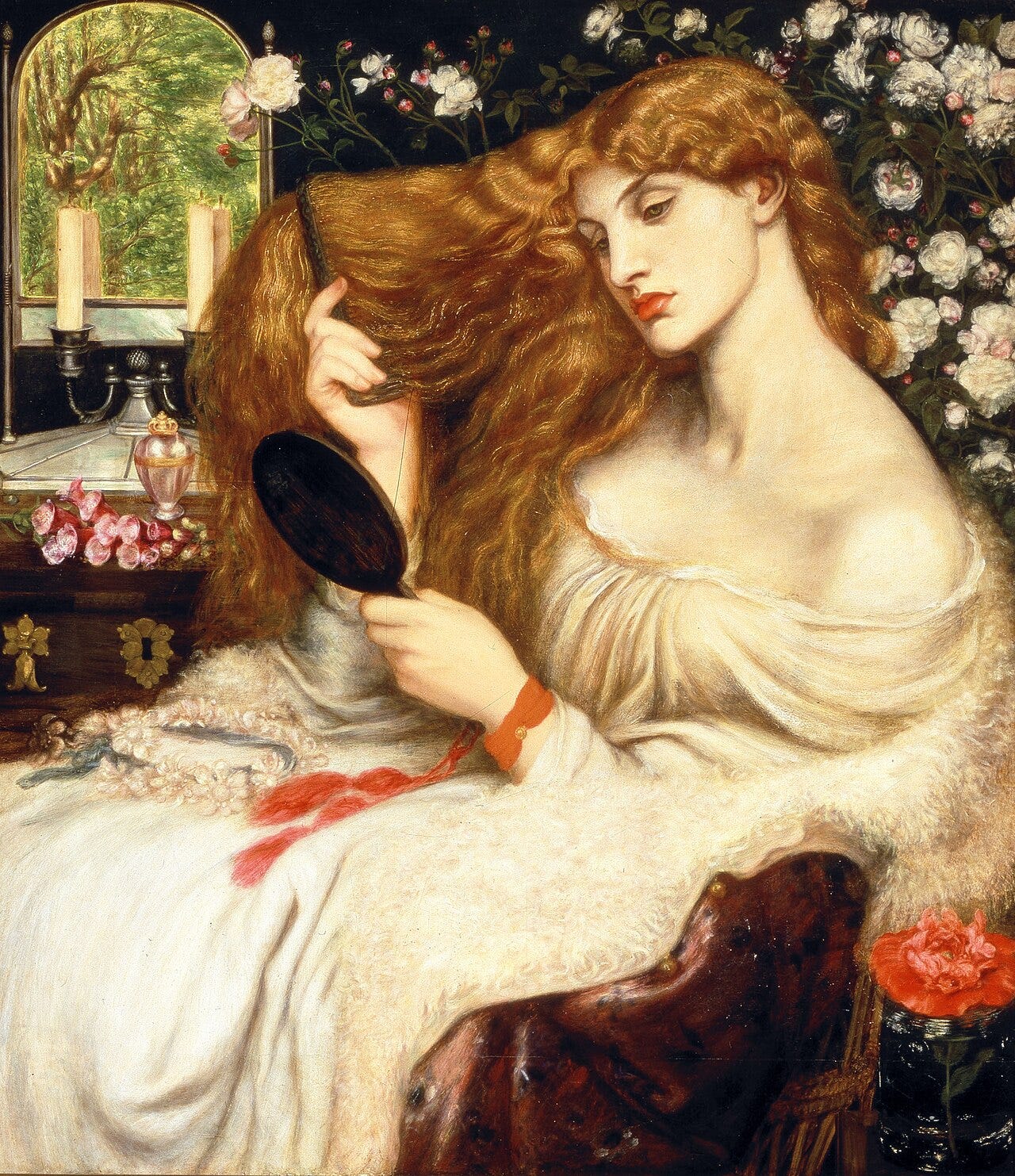
After Siddal, the same few faces filled his work. Fanny Cornforth, born Sarah Cox in 1835, became his housekeeper, mistress and model, the fuller and more earthbound type in pictures like Bocca Baciata.
Annie Miller, a Chelsea barmaid whom Holman Hunt had hoped to marry and remake as a lady, sat for Rossetti while Hunt was abroad, straining the old friendship.
The lasting obsession was Jane Morris, wife of his friend William Morris. She is the model for Proserpine, a subject he reworked across eight versions, painted during the years he shared the tenancy of Kelmscott Manor with her husband from 1871.
The Fleshly School and the collapse of 1872

In October 1871 the critic Robert Buchanan attacked Rossetti's Poems in the Contemporary Review, under the false name Thomas Maitland, in an essay called The Fleshly School of Poetry. He expanded it into a pamphlet in 1872.
Rossetti answered in the Athenaeum that December with The Stealthy School of Criticism, but the wound did not close.
By June 1872 he had broken down, with hallucinations and voices accusing him. Taken to Scotland to recover, he attempted suicide, and returned to a life run on chloral and whisky taken against insomnia.
The last decade, from Kelmscott to Birchington
Rossetti spent much of his time until 1874 at Kelmscott Manor near Oxford, then withdrew into Cheyne Walk as a semi invalid and near recluse. The lawyer Theodore Watts Dunton took his tangled finances in hand.
He kept working. Ballads and Sonnets, published in 1881, held the completed sonnet sequence The House of Life.
A visit to Keswick in 1881 left him worse. He died at Birchington on Sea in Kent on 9 April 1882, aged 53, and was buried in the churchyard there rather than beside Siddal at Highgate.
From medieval watercolours to the great heads
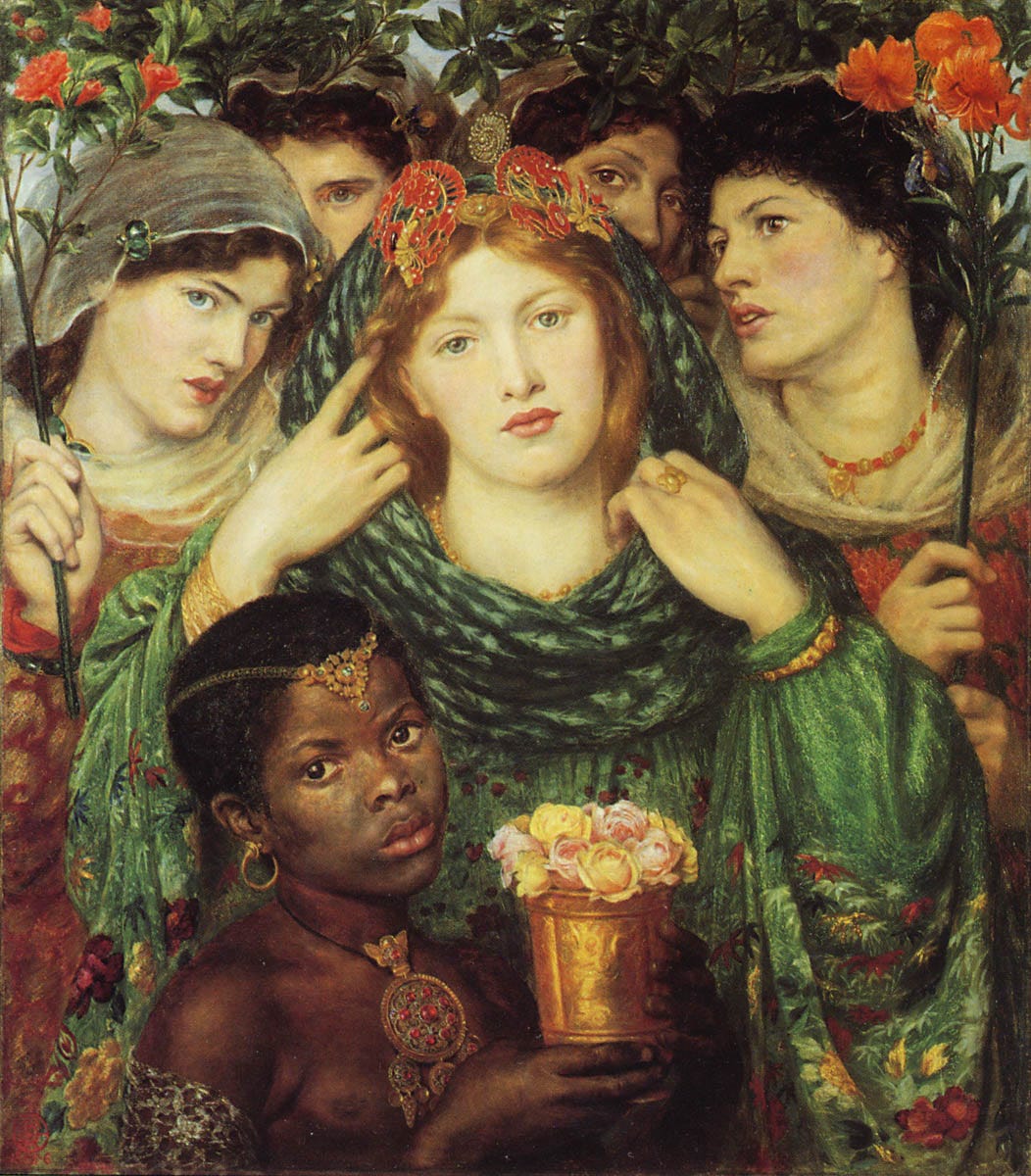
The early Rossetti painted small, jewel coloured scenes from Dante, Shakespeare and Arthurian legend, dense with detail and symbol. After 1856 he pulled two young Oxford men, Edward Burne Jones and William Morris, into a second wave of the movement.
From the 1860s his pictures changed shape. He pushed the figure close up to the surface, filled the frame with one woman, and loaded her hands with fruit, flowers and mirrors that carry meaning.
That format, the beautiful head heavy with symbol, fed straight into Burne Jones, into Symbolism, and into the flowing line of Art Nouveau that followed.
The poet as much as the painter
Rossetti was a serious poet as well as a painter, and for much of his life the two arts fed each other. He wrote The Blessed Damozel as a young man and returned to it in paint decades later.
His finest verse is gathered in the sonnet sequence The House of Life, dense, sensual poems about love, memory and loss. Many of his pictures carry a sonnet on the frame, so that image and words arrive together.
His full name pointed the way. He was christened Gabriel Charles Dante Rossetti, in honor of the Italian poet Dante, whose Vita Nuova he translated and whose doomed love for Beatrice shaped his whole imagination.
The mentor of Morris and Burne Jones
In 1857 Rossetti gathered a group of young men to paint Arthurian murals on the walls of the Oxford Union debating hall. The paint was laid on badly prepared plaster and faded almost at once, but the meeting mattered more than the murals.
Two of those helpers were William Morris and Edward Burne Jones, then students. Rossetti drew them into art, and through them into a second wave of the movement he had helped begin.
Morris went on to remake design and decoration across Britain, and Burne Jones became a leading painter of the age. Rossetti stood behind both, the older figure who had shown them a richer, more medieval way of seeing.
Ranking Rossetti Against the Brotherhood
Millais trained for years at the Royal Academy schools and painted with an anatomical control that still holds up today. Holman Hunt matched him for precision, layering detail with an obsessive, almost scientific patience. Rossetti's own spell at the Academy in 1845 was brief, and his figures show it: stiff hands, long necks, drapery that repeats from one canvas to the next.
Of his own major works, Beata Beatrix ranks first. Rossetti built it from real grief, casting Siddal as Dante's dead Beatrice, and the emotion carries the picture more than the technique does. It hangs at Tate.
Proserpine sits below it. He painted the same pose, the same fruit and the same coil of hair across eight versions, and the repetition reads like a formula for paying clients more than a subject he was still exploring.
The Blessed Damozel ranks third as a painting, and works better as the poem he wrote first. Burne Jones took the same format, the single female figure loaded with symbol, and painted it with a finish Rossetti rarely reached. Rossetti returned to the subject decades later in oil, and the finished canvas now hangs at the Fogg Museum at Harvard.
The Dante Gabriel Rossetti questions that keep coming up
What is Dante Gabriel Rossetti famous for? Co founding the Pre Raphaelites and painting sensual, symbolic women like Proserpine and Lady Lilith.
Was he also a writer? Yes, a notable poet as well as a painter.
Did he really exhume his poems? Yes, from his wife Elizabeth Siddal's grave, years after burying them with her.
How did Dante Gabriel Rossetti die? He died on 9 April 1882 at Birchington on Sea in Kent, aged 53, his health worn down by years of chloral and alcohol taken for insomnia.
Was Rossetti related to the poet Christina Rossetti? Yes. Christina Rossetti, who wrote Goblin Market in 1862, was his younger sister, and their brother William Michael kept the diary of the Pre Raphaelite Brotherhood.
More secrets to unlock


Why Rossetti still fascinates
Rossetti made the muse the whole subject of art, and lived a life as feverish as his pictures. His dreaming women shaped everything from Symbolism to modern fantasy illustration, and his story still reads like a gothic novel.