
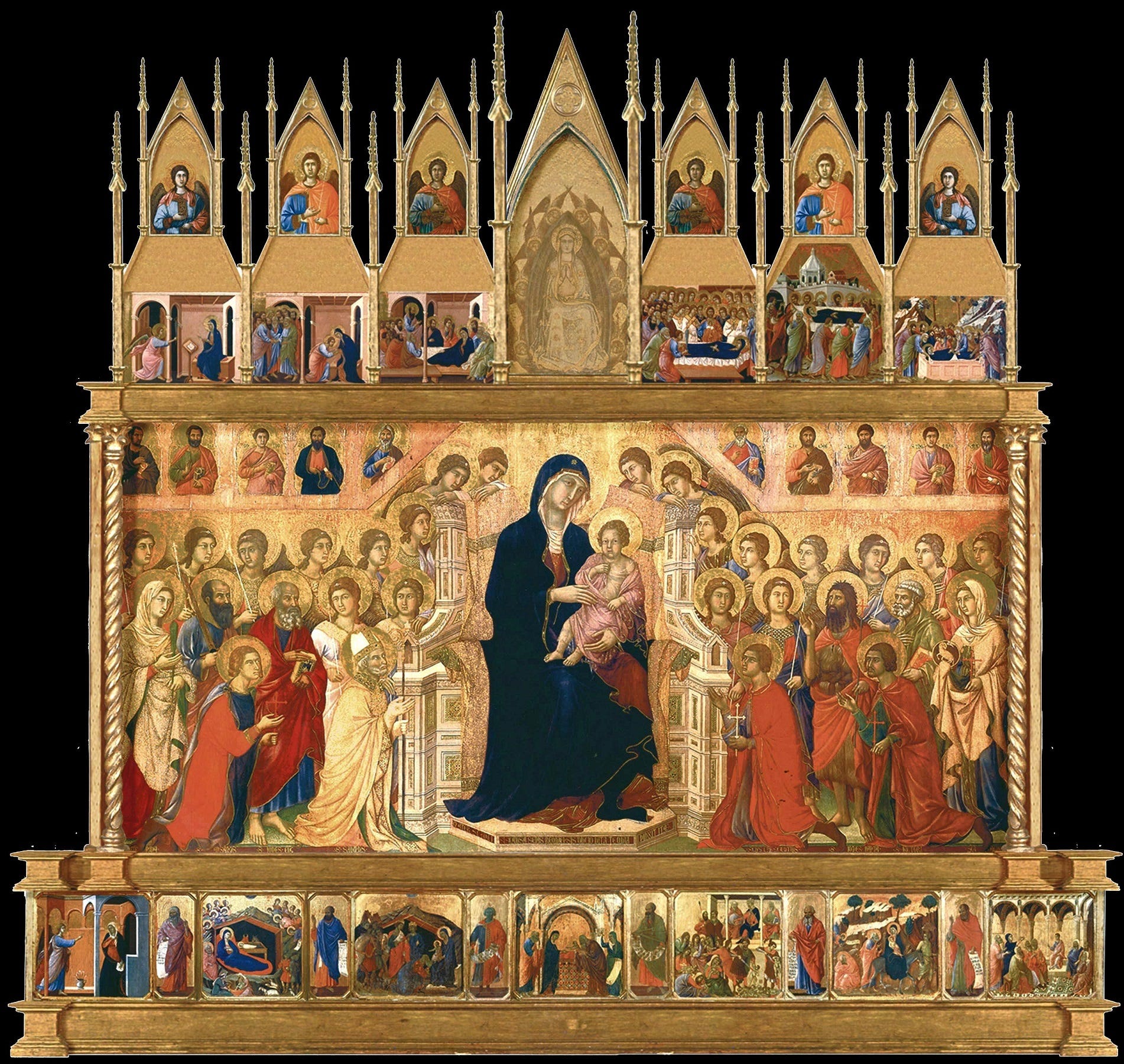
Duccio di Buoninsegna was the painter who founded the Sienese school. Born in Siena around 1255 and dead by 1319, he is remembered for the Maestà, a double-sided altarpiece that the whole city carried to its cathedral in 1311. He gave Siena a Madonna that kept the gold of Byzantine icons and added a tender, flowing line. Most of the Maestà was later sawn apart, and its pieces now hang on three continents.
On 9 June 1311 Siena closed its shops. Clergy, city officials and crowds with candles walked the finished altarpiece from Duccio's workshop to the cathedral, and every bell in the city rang.
Cool Stories About Art is a newsletter to learn art the fun way.
Join 200,000+ readers and get:
10 new art stories / month
The entire archive of content (1,000+ articles)
Comment, ask questions, and chat with other readers
The painter behind that procession did not stand so high in his own city's files. The Siena archives hold fines, summonses and debts with his name on them, and one charge that sounds like witchcraft.
The altarpiece fared no better than its maker. Siena kept it in the cathedral for generations, and then in 1771 the cathedral sawed it in pieces to share them between two altars. Some pieces were sold and some were lost. The panels that reached London, Washington and New York are the reason Duccio's name now hangs on museum walls far from Siena.
What the city did to its greatest painting is only half of the story, and the other half starts with the paperwork he left.
What You'll Discover
What exactly Siena had on him.
Who really painted the Rucellai Madonna.
What the city made him promise.
What was done to the Maestà in 1771.
What he painted on the back.