
Byzantine painting is the religious art of the Eastern Roman Empire, centered on Constantinople from 330 to 1453.
The most famous Byzantine paintings come in two forms. Icons are small wooden panels painted on a gold ground. Mosaics are built into church walls from cubes of glass and stone.
The figures face you straight on, with gold where a sky would be. Believers bowed and lit candles before them. Almost none carries a maker's name.
Cool Stories About Art is a newsletter to learn art the fun way.
Join 200,000+ readers and get:
10 new art stories / month
The entire archive of content (1,000+ articles)
Comment, ask questions, and chat with other readers
How These Were Chosen
Eight works made it, and each answers at least one of these tests.
It still faces believers in the church it was made for. It puts a ruler among holy figures. Or it set the model for its type, as the oldest survivor or the one painters copied for centuries.
8. Christ Pantocrator Dome Mosaic, Daphni Monastery (around 1100)
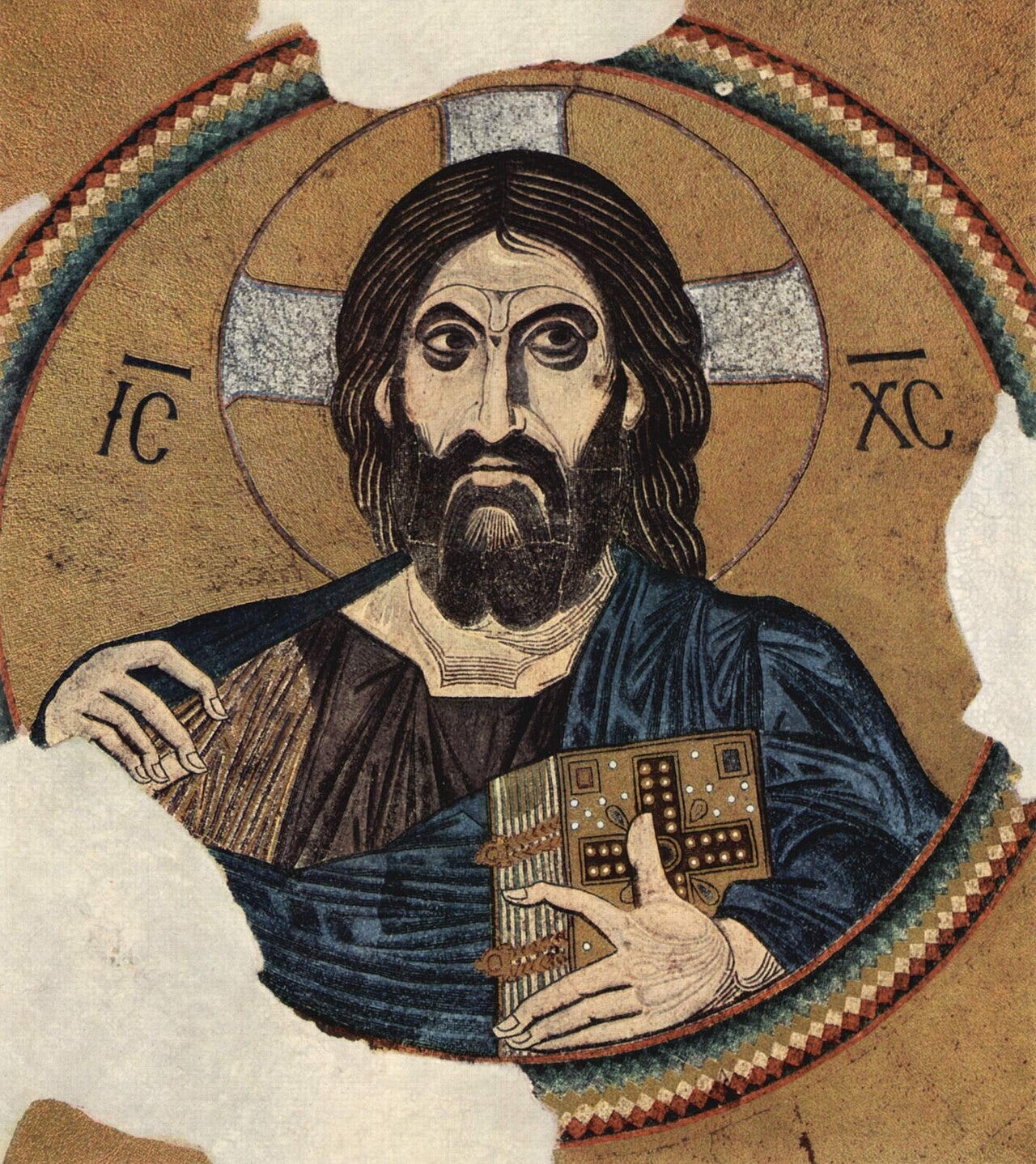
A huge bust of Christ looks down from the center of a dome, set in a round medallion on a gold ground. His right hand blesses, and his left holds a Gospel book. Unnamed Byzantine mosaicists set it around 1100 in the katholikon of Daphni Monastery, west of Athens. The katholikon is the main church of a Greek monastery.
The church at Daphni is dedicated to the Dormition of the Virgin. The monastery stands on the Sacred Way, the ancient road from Athens to Eleusis. A sanctuary of Apollo occupied the site until the end of the fourth century. Daphni takes its name from daphne, the Greek word for laurel. The laurel was Apollo's sacred tree.
Pantocrator is a Greek word meaning "ruler of all." In a Byzantine church the dome stood for heaven. Its highest point belonged to Christ as ruler of all. Sixteen prophets stand around the base of the dome, below him.
When the mosaic went up, the emperor was Alexios I Komnenos, who had seized the throne in 1081. His family held power until 1185, and its century of rule is known as the Komnenian period. The Daphni mosaics date from the early years of that period.
Visitors standing under the dome have to tip their heads back to see this Christ. Byzantine images of Christ were made to be faced, and most look straight out at the viewer.
What unsettles me most here is where the eyes go. The face turns toward you, but the pupils slide sideways under a furrowed brow. His tunic is purple, the color of the Byzantine emperors. He wears a blue mantle over it.
In 1205, Frankish crusaders sacked Daphni. The new Frankish lord of Athens was Othon de la Roche, a knight from Burgundy. He gave Daphni to Bellevaux, a Cistercian abbey in his home region.
The Cistercian monks added a cloister and pointed Gothic arches to the facade. They left in 1458, the year Sultan Mehmed II came to Athens.
Earthquakes in 1886 and 1889 badly damaged the church. On March 1, 1889, Carlo Novelli, a mosaic restorer from Ravenna, inspected it. He described the mosaics as being in deplorable condition. His report notes that the Pantocrator had lost the lower part of its right hand, the hand raised in blessing.
Half of the medallion around the figure was gone. From 1892 to 1897, the Venetian mosaicist Francesco Novo took the damaged mosaics off the walls. He backed them with plaster and set them back on new beds once the building had been repaired.
At a Glance
Made by: Unnamed Byzantine mosaicists
Date: Around 1100
Medium: Glass and stone mosaic on a gold ground
Where to see it: Dome of the katholikon, Daphni Monastery, Chaidari, west of Athens, Greece
About This Mosaic
Can you visit Daphni Monastery today?
Yes. Daphni has been partly open to the public since 2008, and entrance is free. The 1999 Athens earthquake had damaged the church and set off a long restoration.
Is Daphni a World Heritage site?
Yes. UNESCO listed Daphni in 1990, together with the monasteries of Hosios Loukas and Nea Moni on Chios.
What else was Daphni Monastery used for?
Daphni served as a military headquarters during the Greek War of Independence. In the 1830s it was a Bavarian barracks. In the 1880s it housed a psychiatric hospital.
7. Empress Zoe Mosaic, Hagia Sophia, Istanbul (1028 to 1034, reworked after 1042)
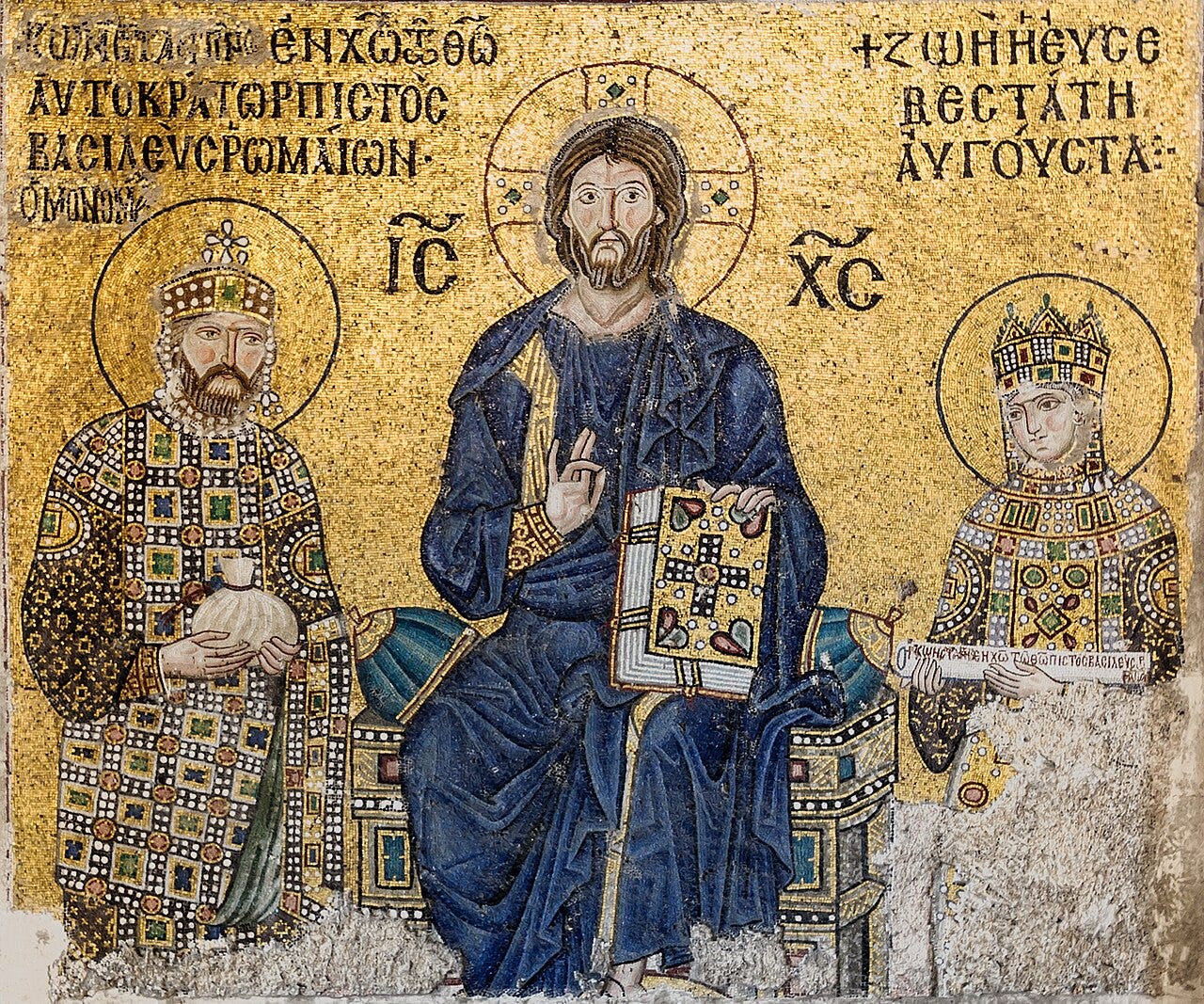
Christ sits enthroned at the center of a gold ground. He blesses with his right hand. An emperor on the left holds out a purse. An empress on the right holds a rolled document. The panel is in the south gallery of Hagia Sophia, in Istanbul.
Unnamed mosaicists set it between 1028 and 1034, and it was reworked after 1042. The words above the empress read "Zoe, the most pious Augusta." Augusta was the title of a crowned empress. Zoe, born around 978, was the daughter of Emperor Constantine VIII and the heir of the Macedonian dynasty.