
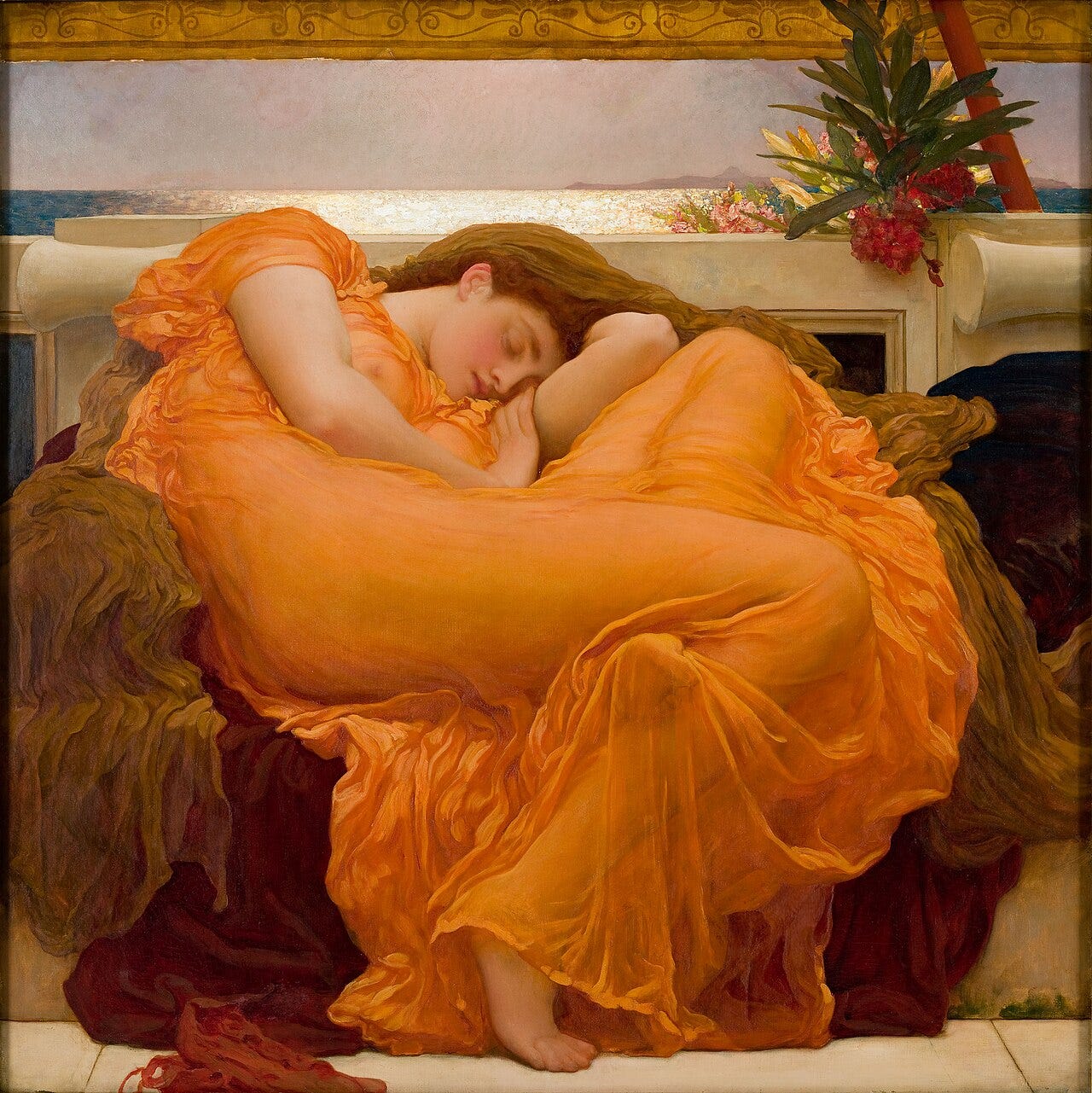
Frederic Leighton was an English painter and sculptor, born in Scarborough in 1830, who was president of the Royal Academy from 1878 until his death in 1896. He is remembered for Flaming June, the sleeping woman in an orange gown he painted in 1895, for the Holland Park house that is now Leighton House Museum, and for a peerage that lasted a single day.
Flaming June is the painting people come for, and its story is stranger than its subject. Leighton died within a year of finishing it. Then, for about thirty years, nobody could say where it was.
Cool Stories About Art is a newsletter to learn art the fun way.
Join 200,000+ readers and get:
10 new art stories / month
The entire archive of content (1,000+ articles)
Comment, ask questions, and chat with other readers
Leighton largely finished it over a few weeks in the winter of 1894, while he was ill. He showed it in his studio on 7 April 1895, and it went on to the Royal Academy. William Luson Thomas, the owner of the magazine The Graphic, saw it there and bought it for just over £1,000.
After that the trail thins out. A widow owned it by 1906. It was lent to the Ashmolean Museum in 1915 and shown at Leighton House in 1930. Then it vanished. In 1962, the story goes, a builder pulled it out of a house being demolished in south London, and an art shop paid £60 for it, because the frame was worth more than the canvas.
Within a year it hung in a gallery in Mayfair, and Luis A. Ferré, who was buying art for the museum he had founded in Ponce, Puerto Rico, paid £2,000 for it. He fell, one account says, "in love with her at first sight." She has stayed in the Caribbean ever since. The man who painted her had spent eighteen years as the most official artist in England.
What You'll Discover
What his father demanded first.
What he made of the Academy.
Why London got an Arab hall.
What a bronze did to sculpture.
Who the sleeping woman was.
How a title lasted one day.