
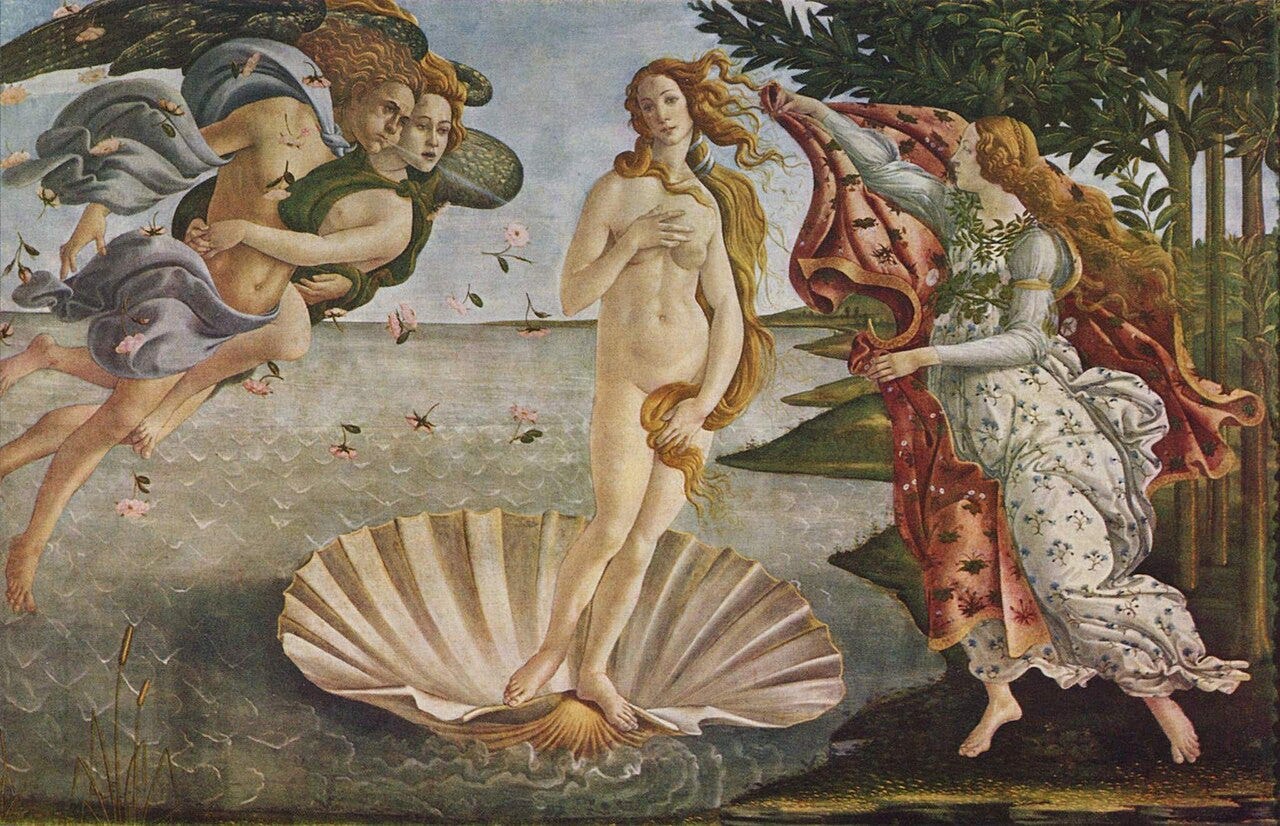
The nude is the unclothed human body treated as a serious artistic subject, a study of ideal form rather than mere nakedness. For centuries it was considered one of the highest tests a painter or sculptor could face.
Botticelli’s Venus rises naked from the sea. Michelangelo’s David stands naked in Florence. The unclothed body sits at the very center of Western art.
The Greeks carved heroic male nudes for centuries before Praxiteles shocked them, around 360 BC, with one of the first life sized naked goddesses.
The nude in brief
What it is: the unclothed body treated as an ideal artistic form.
The roots: ancient Greek and Roman sculpture.
The distinction: naked is exposed, nude is composed and idealized.
The home: mythology, religion and history painting.
The tension: between high art and the simple fact of the body.
The stories behind the pictures


Naked versus nude
Art historians draw a line here that I find genuinely useful.
To be naked is to be deprived of clothes, caught off guard, vulnerable.
The nude, by contrast, is a balanced, confident, idealized form, the body reworked into harmony and proportion.
The art historian Kenneth Clark built a whole book on it: the nude is less a subject than a form, the body translated into the language of ideal beauty.
The naked body is a fact. The nude is a composition.
Born in ancient marble
The nude began as a way of picturing the divine and the heroic.
Greek and Roman sculptors perfected the idealized body, balanced, athletic, serene, often standing in the relaxed pose called contrapposto.
When the Renaissance rediscovered these statues, the nude returned as the supreme test of skill, demanding command of anatomy, proportion and grace.
To carve or paint a convincing nude was to prove you understood the human machine.
The unclothed body became the yardstick of artistic excellence.
Not everything Rome painted aimed that high. Ordinary house walls in Pompeii carried a much more explicit, everyday version of the body, traced in erotic art through history: from Pompeii to the present.
A respectable disguise
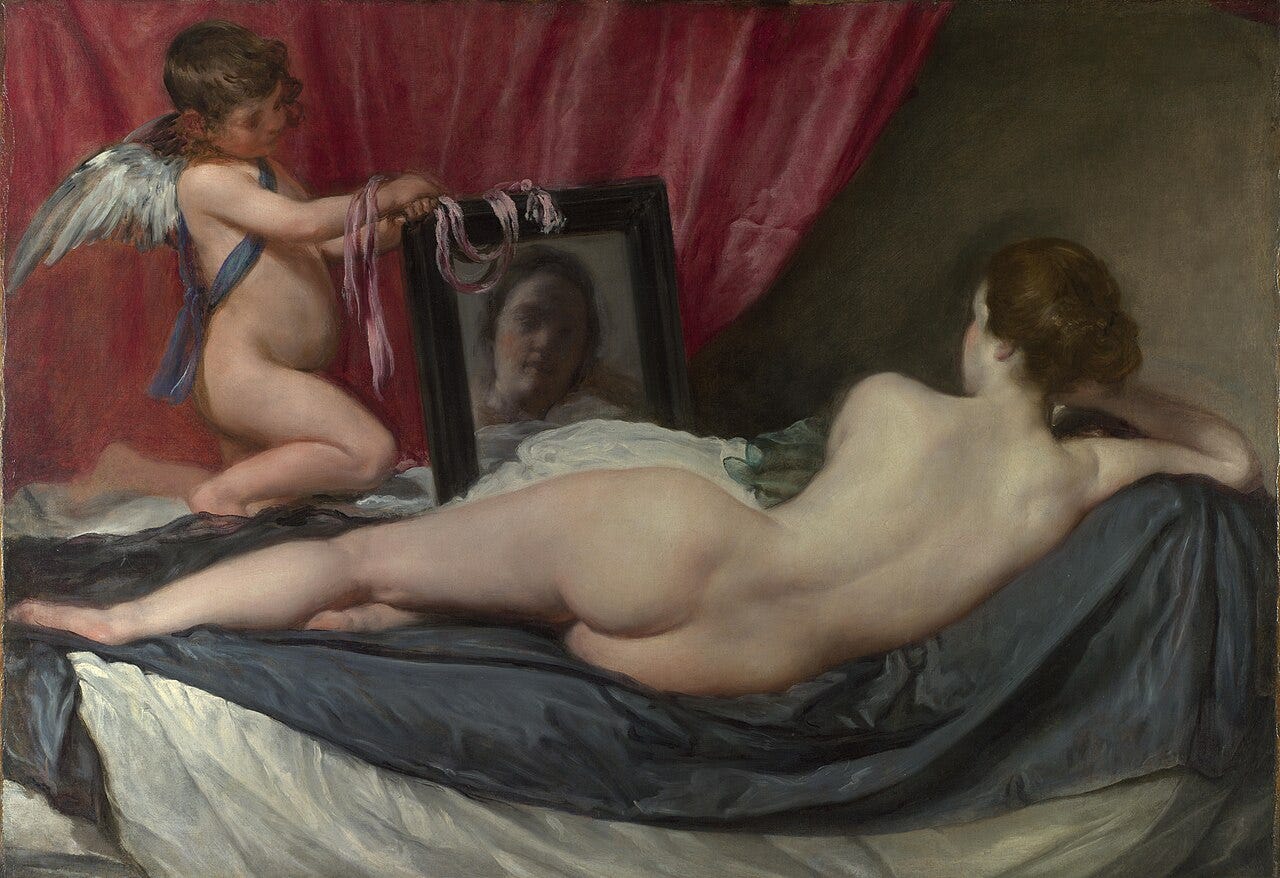
For centuries, the nude needed a story to be acceptable.
A bare body was permitted, even celebrated, as long as it belonged to a goddess, a saint, a hero or a myth. Venus could be nude. So could Adam, Eve and the damned.
This is why so many nudes hide inside history painting and mythology, and why the reclining odalisque was framed as an exotic fantasy. The subject gave the body its alibi.
The myth was often just the permission slip for the nude.
When the alibi dropped
Modern painters began stripping away the mythological cover, showing real, contemporary people with no goddess to excuse them.
Nudity itself was old news; the museums were already full of it. What shocked was the loss of the ideal.
A painted person had replaced the timeless nude, and that collision, between the body as ideal and the body as plain fact, has driven the argument about the nude ever since.
Take away the goddess, and a nude becomes a naked human, and suddenly everyone is uncomfortable.
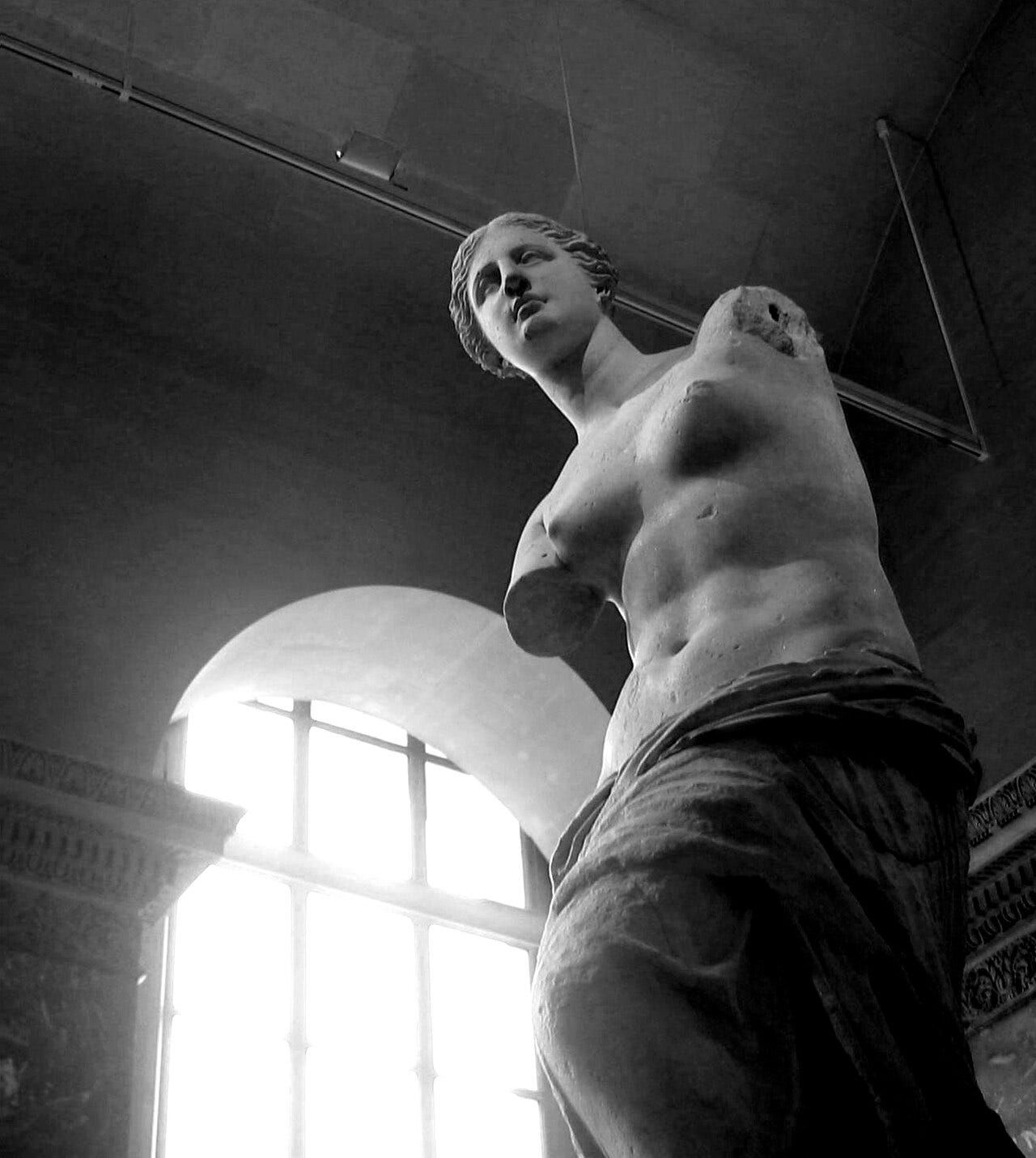
Two ideals of the nude survive in Europe. Botticelli’s Birth of Venus is in the Uffizi, and the ancient Venus de Milo in the Louvre.
Botticelli’s Venus has a back story worth reading in the impossible love that haunted him.
The measure of a training
For centuries, learning to draw the nude was the core of an artist’s education. Academies were built around the life class, where students drew from a posed model for years before they were allowed to paint much else.
The practice study of a single posed nude even got its own name, the academie. To handle the body, its foreshortening, its weight, its balance, was treated as proof you could draw anything. For the academies, the nude was the exam.
The bodies that broke the rules
The history of the nude is also a history of scandals, each one redrawing the line of the acceptable. Goya’s Nude Maja, around 1800, alarmed the authorities because she was a real, knowing woman rather than a goddess.
Manet's Olympia, in 1865, caused an uproar for the same reason, a modern Parisian looking back at the viewer with cool confidence.
Each scandal proved the same point: audiences could accept almost any amount of nudity as long as it stayed an ideal, and recoiled the instant it became a specific, living person.
The scandals never stopped. In 1917 the police shut Modigliani's only solo show for its frank nudes, and a century later one of those reclining nudes sold for around 170 million dollars.
Who gets to look
There is a harder question under all this: who is the nude for? In 1972 the critic John Berger argued that the European nude was built for a male viewer, that in art men act and women appear. I have never quite unseen it since.
The Guerrilla Girls put a number on it in 1989. Counting the modern wing of the Met, they found that under 5 percent of the artists were women, while about 85 percent of the nudes were female.
My own view is that Berger's argument holds up better for the Venus de Milo than for Manet's Olympia. The classical Venus really was built to be admired without resistance. Olympia stares back so hard that Berger's own frame barely survives the encounter.
Of the four nudes below, Goya's Nude Maja interests me the least and Modigliani's the most. Goya still painted an idealized body, only stripped of its myth. Modigliani distorted the anatomy on purpose, and that refusal to idealize feels like the harder, more modern move.
Four nudes that moved the line
Aphrodite of Knidos, Praxiteles, around 360 BC: the first great female nude.
The Nude Maja, Goya, around 1800: a real woman, no goddess to excuse her.
Olympia, Manet, 1865: a modern Parisian staring straight back.
Reclining nudes, Modigliani, 1917: the show the police closed on opening day.
What readers ask about the nude
What is the nude in art? The unclothed human body depicted as an ideal artistic form.
What is the difference between naked and nude? Naked means simply unclothed. Nude means the body composed into ideal beauty.
Where did it come from? From ancient Greek and Roman sculpture of the idealized body.
Why are so many nudes mythological? A bare body was acceptable when it belonged to a goddess, hero or biblical figure.
Why was Manet's nude shocking? It showed a real, modern woman with no mythological excuse, breaking the ideal.
What is the most valuable nude? Modigliani's Nu couche, which sold for around 170 million dollars in 2015.
Another layer under the paint


The body as the measure of art
For most of Western history the unclothed body was the highest challenge an artist could attempt, proof you understood proportion, anatomy and grace at once.
Praxiteles carved his goddess around 360 BC; a Modigliani nude sold for 170 million dollars in 2015. Across 2,300 years the unclothed body has stayed the one subject art keeps fighting over.
