
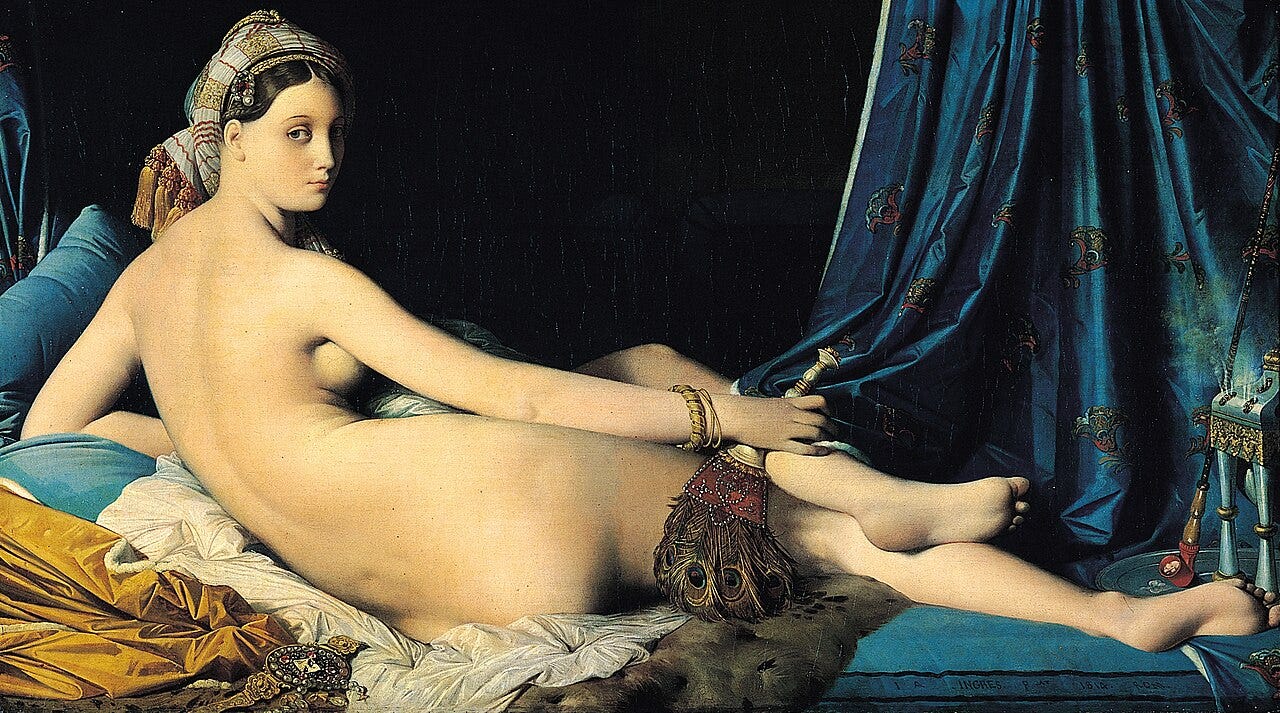
An odalisque is a painting of a reclining woman, usually nude, set in an imagined Eastern harem. The word is Turkish for a chambermaid, but in European art it became a fantasy of the exotic Orient, painted for collectors who would never see one.
A woman reclines, undressed, among rich fabrics in an imagined Eastern harem.
An odalisque takes a Turkish word for a household maid and turns it into a European daydream of the Orient.
Odalisque, the basics
What it is: a reclining nude set in a fantasy Eastern harem.
The word: Turkish, for a maid in the household, not a sultan's lover.
The truth: a European invention, painted from imagination.
The star: Ingres and his Grande Odalisque.
The famous flaw: an impossibly long back.
Keep learning art the fun way


A fantasy with a French address
The odalisque belongs to a craze called Orientalism.
In the 1800s, European artists turned the Ottoman and Arab world into a stage set of harems, slaves, silks and incense, a place of forbidden luxury safely far away.
The odalisque was its central figure: a beautiful woman, undressed, reclining among rich fabrics.
Almost none of these painters had ever entered a real harem. They built the scene from travel books, props and pure desire.
It is a portrait of a place that existed mostly in the European mind.
Ingres and the perfect, impossible body
The most famous odalisque hides a deliberate mistake.
In 1814, Jean Auguste Dominique Ingres painted La Grande Odalisque, a cool, smooth nude turning to look over her shoulder.
Critics were furious, and not only at the subject. Her back is too long. Studies suggest she was given several extra vertebrae, her spine impossibly stretched.
Ingres did not get the anatomy wrong. He bent it on purpose, trading correctness for a long, sinuous, elegant line.
He chose beauty over biology, and for what it is worth, I think he was right: the elongated back is the whole reason the picture is unforgettable.
Cool line versus hot color
Two great painters took the theme in opposite directions.
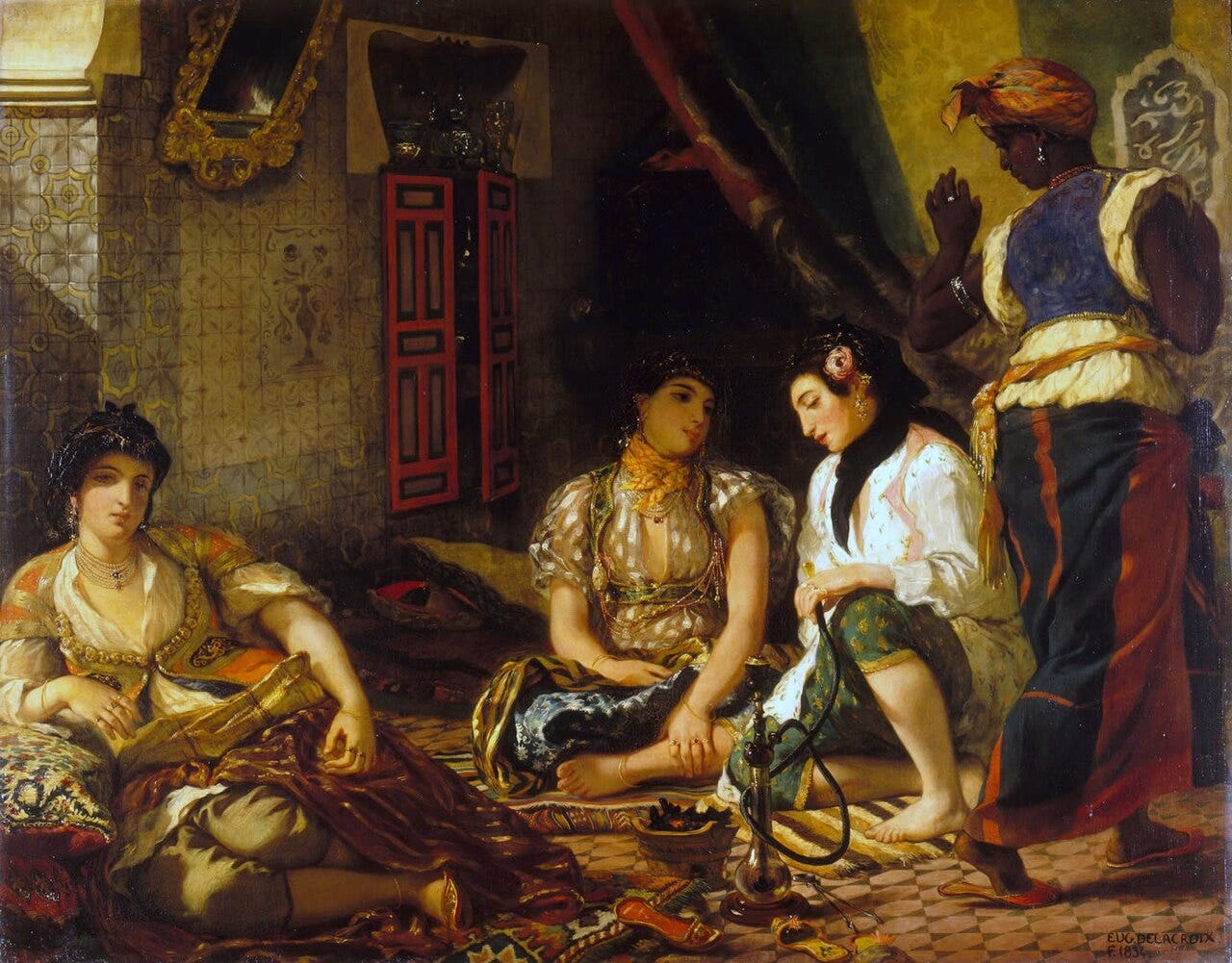
Ingres made it cool: clean contour, porcelain skin, the discipline of neoclassicism applied to a sensual subject. Delacroix made it warm, plunging into rich color and shadow with his Women of Algiers, a scene he claimed to have glimpsed in North Africa.
One worships the line. The other worships the light.
Same fantasy, two temperatures, and I keep returning to Delacroix's heat over Ingres's chill.
The theme did not stop with the 1800s. In the 1920s Henri Matisse painted his own long series of odalisques from a studio in Nice, among them Odalisque with Red Trousers from 1921, now in the Centre Pompidou in Paris, drawing on his own travels to Morocco and Algeria.
More than a nude
An odalisque is not quite a portrait and not quite a history painting.
She is rarely a real person. She has no name, no story, only a role: to recline and be looked at. That is exactly why modern viewers find these pictures so loaded.
They are gorgeous, and they are about power, about who gets to look and who is there to be seen. You can admire the paint and still feel the unease.
The beauty and the discomfort are not separable. They are the subject.
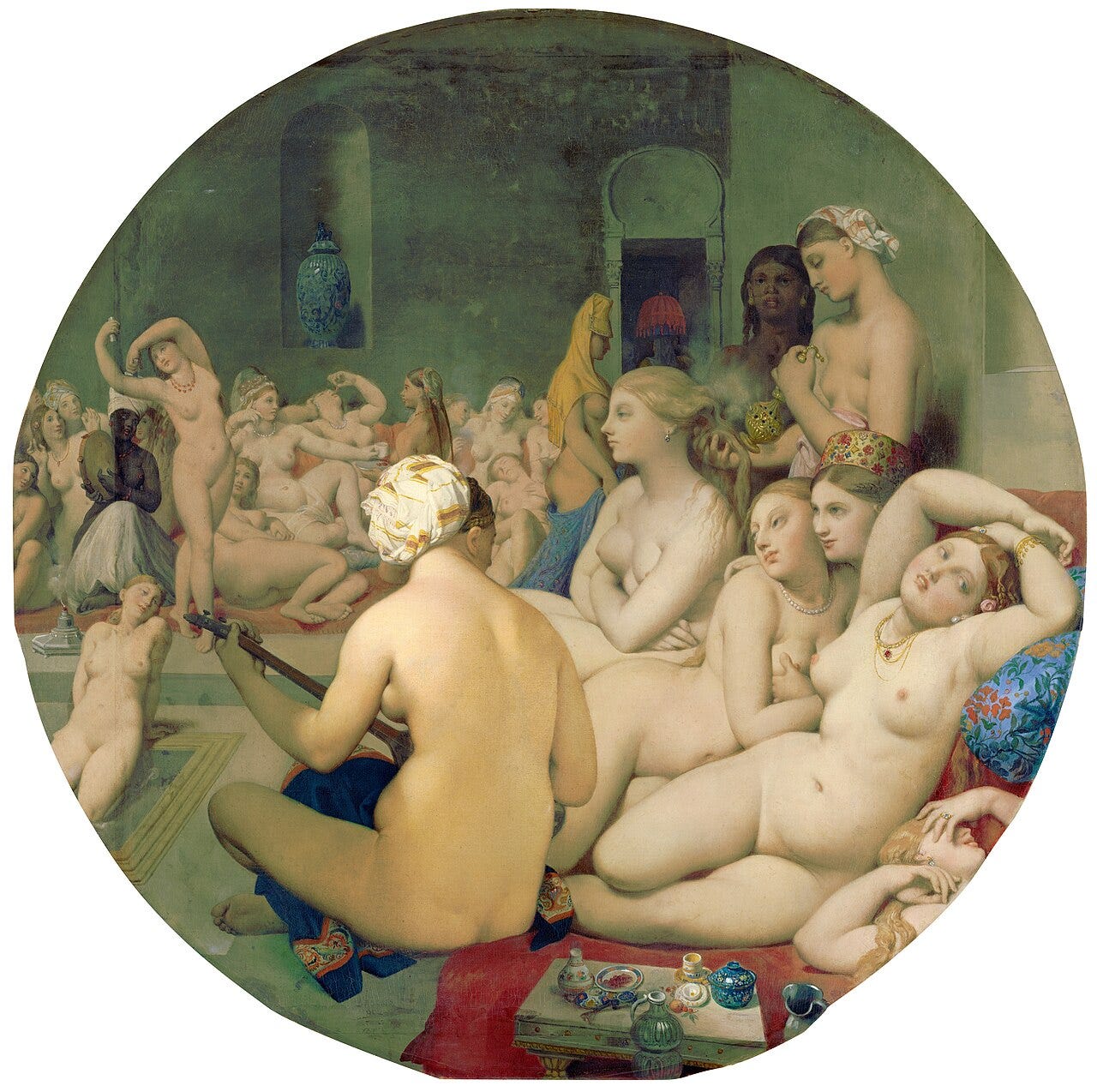
Both hang in the Louvre. You can stand before Ingres’ Grande Odalisque and Delacroix’s Women of Algiers.
Odalisque, questions about the genre
What is an odalisque? A painting of a reclining nude woman shown as part of an imagined Eastern harem.
What does the word mean? It comes from the Turkish for a chambermaid in a household, not a concubine.
Was it based on reality? Mostly no. It was a European fantasy of the Orient, painted from imagination.
What is wrong with Ingres' Grande Odalisque? Her back is anatomically impossible, given extra vertebrae for a longer, more elegant line.
Why is the genre controversial today? It turns a whole culture into a fantasy and a woman into an object to be looked at.
More secrets to unlock


A beautiful picture of a place that never was
To me the odalisque is really a self portrait of the people who bought it. It set out to show the exotic East and ended up showing the Western imagination instead, its desires and its blind spots, in flawless paint.
Ingres stretched a human spine by several vertebrae to get the line he wanted. Few genres reveal so much about the people who made them while pretending to be about someone else.
